







Best vegan multivitamins for active lifestyles in 2026
Best overall starting point: KAGED Multivitamin. Best for avoiding unnecessary iron: a verified vegan iron-free formula. Best for clinician-identified iron needs: a verified vegan iron-containing formula. This 2026 guide compares those options and a chewable alternative, with label checks that matter more than workout-focused packaging.
TL;DR
- KAGED Multivitamin is the best vegan multivitamin starting point here because its description explicitly identifies it as vegan.
- Choose an iron-free vegan multivitamin when additional iron is unnecessary; confirm your needs before choosing iron.
- Check vitamin B12, vitamin D, iodine, capsule ingredients, and overlapping supplements before buying.
- A vegan chewable suits adults who struggle with capsules, but its nutrient coverage still needs checking.
Why this matters
Training does not turn a multivitamin into workout fuel. Vitamins and minerals support normal body functions, but they do not replace the calories, protein, carbohydrates, or fluids your sessions require.
For vegan athletes, the useful question is whether your food and supplements reliably cover your needs. Start with tracking your vitamin and mineral intake, then choose a formula that fills a specific gap rather than adding another overlapping supplement.
Tigerfitness is best for fitness enthusiasts shopping for a vegan multivitamin alongside workout supplements. Keep those purchases separate in your decision-making: a protein powder solves a different problem from a vitamin supplement.
What makes the best vegan multivitamin?
A useful 2026 shortlist starts with these checks, not the longest ingredient list:
- Verified vegan ingredients: Check the complete formula, capsule shell, coatings, and vitamin sources. Plant imagery alone does not establish vegan suitability.
- Relevant nutrient coverage: Inspect vitamin B12, vitamin D, iodine, zinc, and any nutrients your diet review identifies. Do not assume every multivitamin contains them.
- Appropriate iron: Choose iron according to your needs, not because you train hard or follow a vegan diet.
- Transparent serving information: Read amounts per full daily serving, not just per capsule. Compare that serving with your other supplements.
- Usable format: Capsules, tablets, and chewables only work as a routine if you can take them consistently as directed.
- Sport-specific testing: If you compete under anti-doping rules, check a recognized sport-testing program for the exact product. Vegan labeling does not establish banned-substance testing.
These criteria separate dietary suitability from nutrient suitability. A formula can be vegan and still be the wrong match for your intake, medications, or life stage.
Vegan multivitamin options at a glance
This comparison includes one named product and three formulation choices. The formulation choices are not claims that a particular unnamed product has passed testing.
| Option | Best for | Standout feature | Key limitation |
|---|---|---|---|
| KAGED Multivitamin | Starting with an explicitly vegan product | Described as a plant-based vegan multivitamin in capsule form | Vegan suitability does not establish the right nutrient amounts for you |
| Verified vegan iron-free formula | Adults who do not need supplemental iron | Avoids adding iron through the multivitamin | Does not address an identified iron need |
| Verified vegan iron-containing formula | Adults with clinician-identified iron needs | Includes iron within the daily formula | Requires attention to dose, tolerance, and overlapping iron |
| Verified vegan adult chewable | Adults who struggle with swallowing capsules | A chewable delivery format | Format does not guarantee broad mineral coverage |
Choose by nutrient need first and delivery format second. An iron-free chewable, for example, belongs in both categories; these slots describe different buying priorities rather than mutually exclusive products.
1. KAGED Multivitamin: best vegan multivitamin starting point
KAGED Multivitamin is described as a plant-based vegan multivitamin in capsule form, with whole foods, organic fruits, and vegetables referenced in its product description. That explicit vegan designation makes it the clearest named starting point in this comparison. It does not establish that every nutrient amount matches your diet.
Before choosing KAGED Multivitamin, inspect its current Supplement Facts panel and full ingredient list. Confirm the daily serving, iron inclusion, vitamin sources, and any overlap with fortified foods or separate supplements.
KAGED Multivitamin pros:
- Explicitly described as vegan rather than merely plant-focused.
- Identified as a multivitamin, not a protein powder or greens substitute.
- Capsule format gives you a clear delivery-format choice to evaluate.
KAGED Multivitamin cons:
- Capsule format is not the right delivery choice if swallowing capsules is difficult.
- Whole-food ingredients do not replace vegetables, fiber, or balanced meals.
- The vegan designation alone does not establish sport certification or personalized nutrient suitability.
Best for: Active adults who want a named vegan multivitamin to evaluate against their nutrition needs.
For your 2026 shortlist, treat the vegan claim as the entry requirement, not the finish line. Tigerfitness lists KAGED Multivitamin as a vegan option; your final decision still depends on the full label.
Verdict: Hold until you confirm the current formula fits your intake.
2. Verified vegan iron-free formula: best for avoiding extra iron
A verified vegan iron-free multivitamin provides its listed nutrients without adding iron. This is a useful formulation choice when your nutrition review does not identify a need for supplemental iron. Vegan eating alone is not a reason to choose an iron-containing supplement.
Check more than the front label. An iron-free formula still needs appropriate vitamin B12 coverage, clear vitamin D sourcing, and nutrient amounts that fit your existing routine.
Verified vegan iron-free formula pros:
- Avoids adding iron when it is not part of your supplement plan.
- Separates routine multivitamin use from decisions about iron supplementation.
- Lets you evaluate other nutrients without treating iron as a mandatory feature.
Verified vegan iron-free formula cons:
- Does not supply iron for someone whose clinician identifies a need.
- Iron-free does not mean low-dose across the rest of the formula.
- Requires separate confirmation of vegan capsule ingredients and vitamin sources.
Best for: Adults who do not need additional iron and want to avoid including it by default.
If you already use a separate iron supplement, do not automatically add iron through a multivitamin too. Have a clinician or pharmacist review the combined routine.
Verdict: Buy only after confirming vegan suitability and that additional iron is unnecessary.
3. Verified vegan iron-containing formula: best for identified iron needs
A verified vegan iron-containing multivitamin combines iron with its other listed vitamins and minerals. Consider this category when a clinician has identified a reason for supplemental iron. It is not a substitute for a prescribed iron plan.
Fatigue during training is not a diagnosis. Low energy also warrants a review of food intake, sleep, training load, and health rather than an automatic switch to a higher-iron supplement.
Verified vegan iron-containing formula pros:
- Includes iron within a daily multivitamin routine.
- Makes the iron amount visible alongside other nutrient amounts on the label.
- Offers a formulation category to discuss when iron intake needs attention.
Verified vegan iron-containing formula cons:
- Adds iron that is unnecessary for adults without an identified need.
- Iron can cause gastrointestinal side effects.
- The amount in a multivitamin is not automatically appropriate for treating deficiency.
Best for: Adults whose clinician recommends iron and approves the specific formula and amount.
In 2026, the decision remains personal: review the product alongside your food intake, other supplements, and any relevant laboratory results. Menstruation, dietary restriction, and endurance training belong in that conversation, but none establishes a diagnosis by itself.
Verdict: Hold until a clinician confirms the iron amount and overall formula.
4. Verified vegan adult chewable: best for capsule difficulty
A verified vegan adult chewable delivers its listed nutrients without requiring you to swallow a capsule. Choose this format when swallowing is the obstacle to following your supplement routine. Confirm that the product is formulated for adults rather than assuming a children's chewable is interchangeable.
For gummies, inspect gelatin and other animal-derived ingredients. For every chewable format, check the full daily serving and actual nutrient amounts.
Verified vegan adult chewable pros:
- Avoids swallowing intact capsules.
- Offers a delivery option for adults who dislike tablets.
- Lets you match the supplement format to a routine you can follow.
Verified vegan adult chewable cons:
- Chewable format does not guarantee adequate calcium, magnesium, or other mineral coverage.
- Gummies require careful checks for gelatin and vegan suitability.
- An adult serving can involve multiple pieces; follow the label rather than treating them as candy.
Best for: Adults who need a chewable format and can verify its vegan ingredients and nutrient coverage.
Keep chewables out of children's reach. A pleasant flavor does not change the need to follow serving directions.
Verdict: Buy for a genuine format need, not because the product resembles a snack.
Read the label in this order
Use the same sequence for every vegan multivitamin you consider. It prevents a convenient format or appealing ingredient story from distracting you from the formula.
- Vegan status: Confirm the full product's vegan designation and inspect capsule shells, coatings, and vitamin sources.
- Nutrient amounts: Read the full daily serving and identify which nutrients address your intake gaps.
- Iron decision: Establish whether supplemental iron belongs in your routine before comparing formulas.
- Stack overlap: Add contributions from fortified foods, multivitamins, and separate vitamin or mineral supplements.
- Sport testing: If required for your competition, verify the exact product in the relevant certification directory.
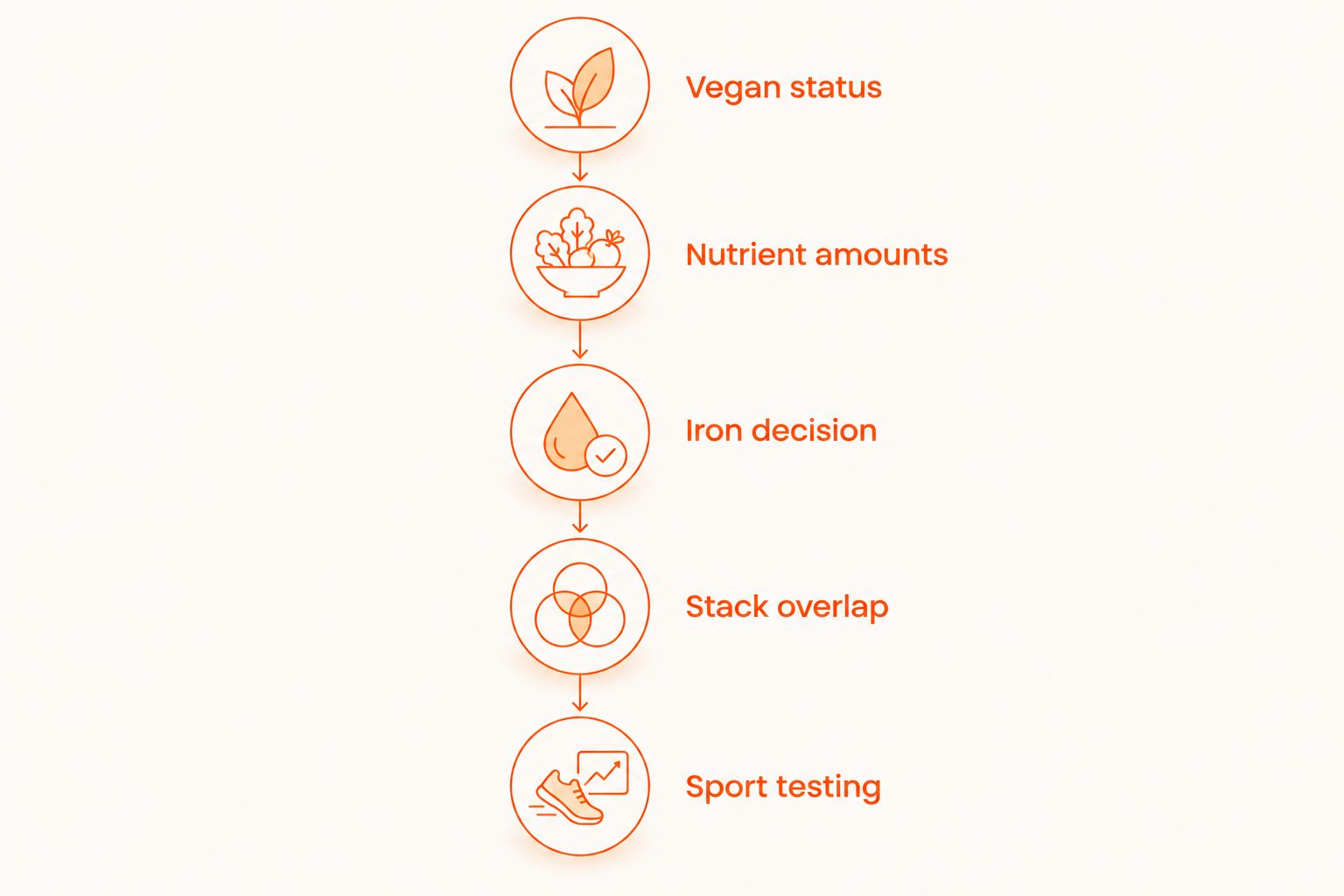
Your 2026 label check should use the product you are actually purchasing, not an old label screenshot. Keep a copy of the serving directions so you can compare it when your supplement routine changes.
Nutrient reference points for active vegan adults
For this 2026 guide, the following reference values come from the National Institutes of Health Office of Dietary Supplements fact sheets. They describe recommended daily intake for generally healthy adults within the stated scope, not personalized supplement doses.
- Vitamin B12: The adult recommended dietary allowance is 2.4 micrograms per day. Vegan diets need a reliable B12 source, such as appropriately fortified foods or supplements.
- Vitamin D: The recommended dietary allowance is 15 micrograms, or 600 IU, per day for adults aged 19–70. Confirm vegan sourcing rather than assuming every D3 ingredient is vegan.
- Iodine: The adult recommended dietary allowance is 150 micrograms per day. Check your food sources and label instead of assuming every multivitamin supplies iodine.
- Calcium: The recommended dietary allowance is 1,000 milligrams per day for adults aged 19–50. Evaluate calcium-rich foods as well as the supplement label.
These amounts describe total intake from relevant sources. They are not instructions to purchase a multivitamin with exactly those quantities, and they do not replace individualized advice during pregnancy, breastfeeding, or medical care.
A multivitamin also does not automatically cover your full calcium or magnesium needs. Read the actual amounts; the word multivitamin is not a promise of complete mineral coverage.
How these options were ranked
The ranking prioritizes explicit vegan suitability, then nutrient fit, iron needs, delivery format, and sport-testing requirements. KAGED Multivitamin leads as the named product explicitly described as vegan; the remaining slots help you choose the right formulation category.
This is a label-based buying framework, not a head-to-head performance trial. No capsule count, nutrient dose, certification, or workout result is assumed for a named product.
Which vegan multivitamin should you choose?
Start with KAGED Multivitamin, then verify the label against your needs. If its formula does not fit, choose a verified vegan alternative using the same checks rather than settling for an unsuitable dose or format.
Choose an iron-free formula when additional iron is unnecessary, an iron-containing formula only with an established reason, and a chewable when swallowing is the barrier. Tigerfitness shoppers should make the multivitamin decision separately from protein, creatine, and pre-workout purchases.
FAQ
What's the best vegan multivitamin for an active lifestyle?
KAGED Multivitamin is the named starting point in this guide because its product description explicitly identifies it as vegan. Confirm its current nutrient amounts, iron content, and serving directions before deciding whether it fits your diet.
Do vegan athletes need a multivitamin every day?
Vegan athletes do not automatically need a daily multivitamin. Review your food intake and ensure reliable vitamin B12 coverage, then choose supplements for identified gaps rather than training intensity alone.
Should my vegan multivitamin contain iron?
Your vegan multivitamin should contain iron only when additional iron fits your needs. Discuss suspected deficiency or an existing iron prescription with a clinician before adding an iron-containing formula.
Is vitamin D3 vegan?
Vitamin D3 is not always vegan. Some D3 comes from lanolin, while vegan sources include lichen; confirm the source and the full product's vegan suitability.
Are vegan gummies better than capsules?
Vegan gummies are a better format when swallowing capsules prevents you from following serving directions. They are not automatically better nutritionally, so compare nutrient amounts, serving size, and ingredients.
Can I take a vegan multivitamin with protein powder and creatine?
A vegan multivitamin, protein powder, and creatine serve different nutritional purposes. Review the complete labels for added vitamins and minerals, and ask a clinician or pharmacist about suitability if you take medications or have a medical condition.
Will a vegan multivitamin improve my workouts?
A vegan multivitamin does not guarantee better workout performance. Its role is to supplement nutrient intake; training, adequate food, hydration, and sleep remain separate requirements.
How do I know whether a multivitamin is vegan?
Look for an explicit vegan designation and check the complete ingredient list. Verify capsule shells, coatings, and vitamin sources, and ask the manufacturer to clarify anything ambiguous.
One last thing
A bigger percentage on the label is not a better workout plan. Percent Daily Value helps you interpret a serving; it is not a score for athletic performance.
Before adding a multivitamin, put your fortified foods and existing supplements on the same list. That simple check can reveal that you already cover a nutrient you were about to add again.
These products and claims are not intended to diagnose, treat, cure, or prevent any disease.
Leave a comment