







Can Creatine Cause Kidney Damage? The 2026 Answer
Creatine monohydrate does not damage healthy kidneys at the standard 3-5g daily maintenance dose, and that conclusion holds up across more than three decades of published research, including a study that tracked college athletes for 21 months. The catch nobody mentions: creatine raises serum creatinine, the exact marker doctors use to screen for kidney trouble, so a routine blood panel can look alarming even when nothing is actually wrong — and megadosing without enough water, or lifting with an existing kidney condition, is a genuinely different situation.
TL;DR
- Creatine monohydrate does not damage healthy kidneys at the standard 3-5g daily dose, based on decades of published research.
- Creatine raises serum creatinine readings without causing real kidney damage — a common false alarm on lab panels.
- People with existing kidney disease, or anyone megadosing without enough water, should check with a doctor before starting creatine.
- MTS Nutrition Creapure Creatine and similar monohydrate products use the same well-studied form tested in the clinical trials cited for safety.
The numbers behind the answer
3-5g
Daily maintenance dose
20g
Loading phase dose
split across 5-7 days
21 months
Longest tracked safety study
Why this matters
Search interest in "can creatine cause kidney damage" spikes every time a gym forum thread or a doctor's short-form video claims otherwise, and the confusion costs lifters real training time. Skipping one of the most studied supplements in sports nutrition over a misread blood test is the kind of mistake that stalls strength gains for no real reason heading into 2026.
Tiger Fitness gets this exact question from new customers on a weekly basis, right alongside "is creatine safe to take every day." The short answer to both is yes, for the overwhelming majority of healthy adults. If you already manage a kidney condition, the calculus changes — the guidance on whey protein for people with kidney concerns covers how protein and supplement dosing typically gets adjusted in that situation.
Does creatine cause kidney damage?
No, not in people with normal kidney function taking a standard dose. The research base includes short-term trials, multi-month tracked studies on athletes, and reviews published in sports nutrition journals — none of them show a measurable decline in kidney function tied to creatine monohydrate at 3-5g per day. The confusion almost always traces back to one lab value: serum creatinine, which creatine supplementation naturally elevates as a normal metabolic byproduct, not as evidence of organ damage.
| Kidney status | Effect of creatine monohydrate | Verdict |
|---|---|---|
| Healthy kidneys, normal hydration | No measurable decline in kidney function across long-term tracked studies | Safe at standard doses |
| Pre-existing kidney disease | Not enough dedicated research to rule out added strain on impaired kidneys | Talk to a doctor first |
| Megadosing (20g+/day for weeks) without adequate water | Raises the fluid and waste-clearance workload on the kidneys | Limit high doses to short loading phases |
The practical takeaway: a normal maintenance dose of creatine monohydrate is not a kidney risk for someone with healthy kidneys, and that's true whether you're using a plain monohydrate powder or a German Creapure-sourced version like MTS Nutrition Creapure Creatine. The form of creatine matters far less to kidney safety than dose, hydration, and pre-existing health status.
Why the kidney damage myth sticks
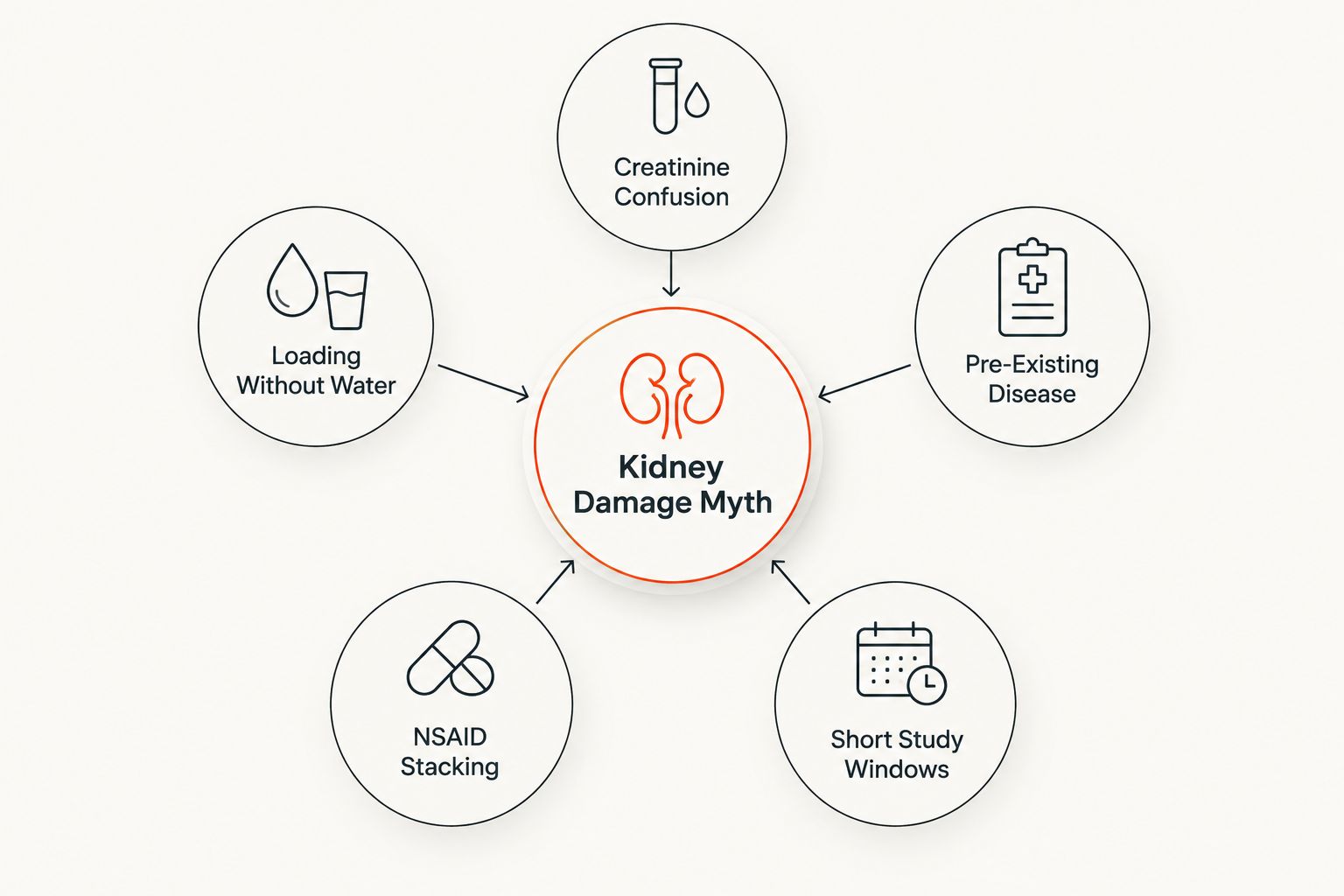
A handful of specific factors keep this myth alive year after year, and none of them prove creatine itself is the problem:
- Creatinine confusion. Creatine supplementation raises serum creatinine on a standard blood panel, and a doctor unfamiliar with sports nutrition can misread that as declining kidney function.
- Loading without water. A 20g/day loading phase run for 5-7 days puts extra fluid-processing demand on the kidneys if water intake doesn't increase to match.
- Pre-existing kidney disease. Impaired kidneys clear creatine and its byproducts differently than healthy ones, and this population is largely left out of the mainstream safety data.
- Stacking with nephrotoxic substances. Combining creatine with high-dose NSAIDs or other kidney-taxing substances adds risk that has nothing to do with creatine alone.
- Short study windows. Most controlled trials run under two years — nobody has published a 20-year dataset, so framing long-term risk as fully "proven safe" overstates the evidence.
Does creatine cause kidney stones?
There's no established link between standard creatine monohydrate dosing and kidney stone formation in healthy adults. Kidney stones form from mineral buildup, not from the creatine metabolism pathway, and the studies cited for general kidney safety don't report elevated stone rates in supplement users.
Is creatine safe if I already have kidney disease?
If you have diagnosed kidney disease, talk to a doctor before starting creatine rather than assuming the general safety data applies to you. The bulk of the long-term research was done on healthy populations, so people with reduced kidney function fall outside the group these studies actually cover.
How much water should I drink while taking creatine?
There's no single published number for exact water intake on creatine, but increasing fluid intake alongside a 20g/day loading phase is the standard practical guidance, since creatine draws water into muscle cells. Cutting hydration while running a high dose is the scenario most likely to strain the kidneys, not the creatine itself.
FAQ
Does creatine monohydrate affect creatinine blood test results?
Yes, creatine supplementation raises serum creatinine as a normal metabolic byproduct, which can look like reduced kidney function on a standard panel even though it isn't. Tell your doctor you're supplementing before a routine kidney function test.
How much creatine per day is considered safe long-term?
A 3-5g daily maintenance dose is the standard long-term amount used across the research base, including studies tracking athletes for 21 months. Higher doses are typically limited to short loading phases of 5-7 days.
Should people with kidney disease avoid creatine?
People with diagnosed kidney disease should check with a doctor before starting creatine rather than relying on general safety data. Most long-term studies were done on healthy adults, not people with impaired kidney function.
Is creatine hydrochloride safer for kidneys than monohydrate?
There's no published evidence that creatine HCl is safer for kidneys than monohydrate — both deliver creatine to muscle tissue and neither form has a kidney-damage record in healthy adults at standard doses. The difference between them is mainly solubility and dosing size, not kidney risk.
Do I need to drink more water when taking creatine?
Increasing water intake alongside creatine, especially during a loading phase, is standard practical advice since creatine pulls water into muscle cells. Skipping extra hydration during a high-dose loading phase is a bigger risk factor than the creatine itself.
Can creatine cause kidney stones?
There's no established link between standard creatine dosing and kidney stone formation in healthy adults. Stones form from mineral buildup, a different mechanism than creatine's metabolic pathway.
Is it safe to take creatine every day in 2026?
Yes, daily use at the standard 3-5g maintenance dose is the way creatine has been studied and used for decades, and 2026 research hasn't changed that picture for healthy adults. The exceptions remain pre-existing kidney disease and megadosing without adequate water.
What's the best creatine to take if I'm concerned about kidney safety?
Any well-sourced creatine monohydrate taken at the standard 3-5g dose carries the same safety profile in the research, so the choice comes down to purity and testing rather than the kidney question. A Creapure-sourced monohydrate like MTS Nutrition Creapure Creatine uses the same form studied in the clinical literature.
One last thing
Here's the detail that gets lost in every kidney-damage debate: your liver, kidneys, and pancreas already produce roughly 1g of creatine per day on their own, and you store more of it in muscle tissue than you'll ever add through a scoop of powder. Supplementing at 3-5g daily just tops off a system your body runs constantly — it's not introducing a foreign substance your kidneys have never processed before. That's the context most headlines about creatine and kidney damage leave out going into 2026.
Leave a comment