



How much should you budget for Pre-Workout? Per-use, 2026
For 2026, budget for pre-workout by what you will use per training session, not by the container or package alone. The useful number is your cost per workout: divide the current package price by the number of label directed servings it provides, then account for how often you train. That calculation excludes extras such as a separate drink or other supplements you choose to use alongside it.
TL;DR
- How much should you budget for pre workout? In 2026, calculate cost per label directed serving, then match it to your training schedule.
- Tiger Fitness is best for lifters who want to compare pre-workout powders, chews and ready to drink options.
- A lower package price does not establish a lower cost per workout; check serving count and directions.
- If you train late or limit caffeine, compare stimulant-free options before deciding what fits your routine.
Why This Matters
A Pre-Workout you use before every session affects your budget differently from one you reserve for demanding workouts. Package size alone does not settle the comparison: you need the serving count, the label directions and a realistic training schedule.
Your schedule also determines whether a formula fits. If caffeine affects your sleep or you train in the evening, a stimulant-free option deserves a separate look. Tiger Fitness’s guide to pre-workout without caffeine covers that choice; this page focuses on what each choice means for your budget.
How much should you budget for Pre-Workout in 2026?
Set a per-workout limit first, then check whether a product fits it. No single amount applies to every lifter in 2026: a powder, chew and ready-to-drink option cannot be compared fairly until you know how much of each the label directs you to use. Use this breakdown rather than choosing the package with the lowest displayed price.
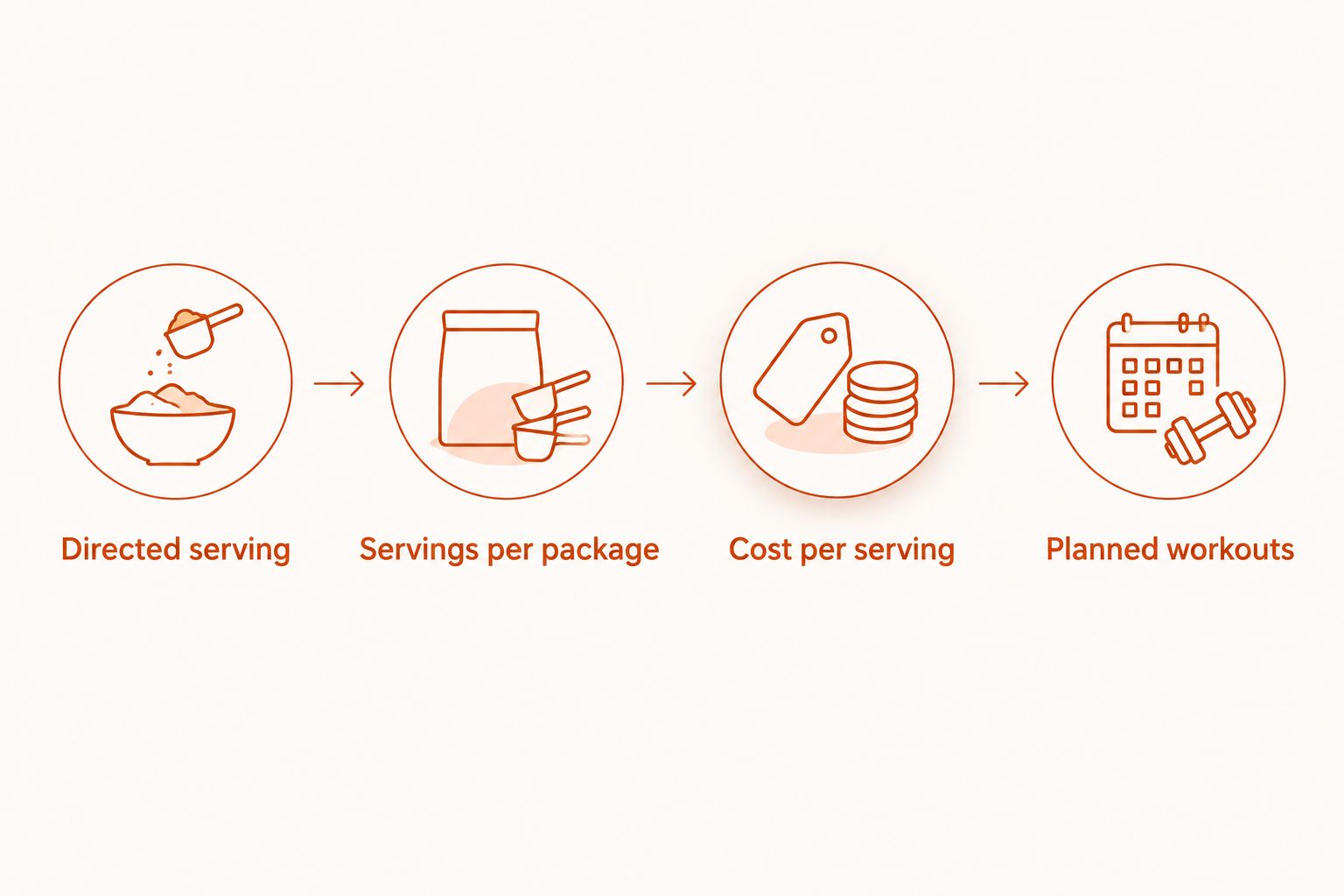
- Count the workouts you plan to use it for. Include only sessions when you expect to take pre-workout, not every day on your calendar.
- Read the label-directed serving size and servings per package. Do not assume that one scoop, one chew or one container equals one workout’s serving.
- Calculate cost per directed serving. Divide the current package price by the number of servings on the label. For a ready-to-drink product, check whether the container represents the serving you intend to use.
- Calculate your training-period total. Multiply cost per workout by the number of workouts in that period. Use the same period for every option you compare.
- Check the formula before committing. A product that does not suit your caffeine preference or training time is a poor use of your supplement budget, whatever the serving calculation says.
| Budget question | What to check | What it tells you |
|---|---|---|
| What will one workout use? | Label directed serving size | Whether your planned use matches the stated serving |
| How many workouts will a package cover? | Servings per package and your planned use | When you would need another package |
| What is the comparable cost? | Current package price divided by directed servings | Cost per serving across different formats |
| What fits your routine? | Format, ingredients and training time | Whether you are likely to use what you buy |
Keep the calculation tied to the actual product label. In 2026, a serving count or direction on one product tells you nothing reliable about another product’s cost per workout.
The calculation is simple, but the input needs care. If the label offers different serving directions, calculate the cost for the amount you actually intend to take. Do not increase a serving just to make a workout feel more intense; follow the product directions and consider your total caffeine intake from other sources.
Which Pre-Workout format fits your budget?
Powder, chews and ready-to-drink products solve different practical problems. Compare them by directed servings and likelihood of use, not by package appearance. The examples below show the trade-offs; they do not establish a cost ranking because their serving details are not provided here.
| Option | Best for | Advantage | Trade-off to check |
|---|---|---|---|
| RedCon1 Total War Pre-Workout powder | Lifters who prefer mixing a pre-workout drink | Powder format for a planned gym routine | Check the label’s serving size and caffeine information |
| Bucked Up Non-Stimulant Pre-Workout | Lifters avoiding caffeine | Described as stimulant-free | Check the serving count and full ingredient label |
| GAT Sport Nitraflex® Pre-Workout Chews | Lifters who do not want a shaker | Chew format does not require mixing a drink | Check how many chews make one directed serving |
| RAW Nutrition CBUM Thavage Pre RTD | Lifters who want a ready-to-drink option | No mixing step | Check the container’s serving information |
Tiger Fitness is best for lifters who want to compare pre-workout powders, chews and ready-to-drink options in one retailer’s catalog. That range is useful when format determines whether you will actually use the product. It does not replace reading each label, and it does not make every format equally suitable for your schedule.
A powder is a straightforward choice if mixing a drink is already part of your pre-gym routine. Its drawback is the preparation step. A chew removes that step, but you still need to verify the directed serving rather than treating a single chew as a full workout serving.
A ready-to-drink option removes mixing as well. Its practical advantage matters most when preparation is the reason you skip a product you already own; its drawback is that you must compare the container’s serving information against the powder or chews you would otherwise use. For caffeine-sensitive training, the stated stimulant-free formula gives you a distinct option, but check its complete label rather than assuming it fits every ingredient preference.
Build a budget around the workouts you actually do
A useful 2026 budget reflects how you train, not how you hope to train. If you intend to use pre-workout only for selected lifting sessions, calculate for those sessions. Buying as though you will take it before every workout can leave you with more product than your routine calls for.
Start with your training calendar. Mark the sessions when you genuinely want a pre-workout, then check whether those sessions occur near bedtime or alongside another source of caffeine. That separates a buying decision from a habit decision: the first asks which format to buy; the second asks when you will use it.
For a regular routine, repeat the same cost-per-serving calculation whenever you consider a different product. For occasional use, pay attention to whether you would finish the package while it remains within the manufacturer’s stated date and storage directions. Neither routine makes a particular format automatically cheaper.
This matters when you compare a tub with an individual drink or chew package. The tub can look like a bigger commitment, while the individual format can feel easier to fit into a single gym trip. Those impressions are not a budget calculation. Divide by directed servings and compare against the sessions you have actually planned.
Why your Pre-Workout budget varies
The drivers of your 2026 budget are specific. Check these before deciding that one format is better value than another:
- Training frequency. More planned uses mean more directed servings to account for. Count the sessions when you expect to take the product.
- Serving directions. The amount directed on the label determines the denominator in your cost-per-serving calculation. Different products require their own calculation.
- Product format. Powder requires mixing; chews and ready-to-drink options remove that step. Choose the format you will use consistently.
- Caffeine preference. A stimulant-free product is a distinct choice when you avoid caffeine, while other formulas require a label check before you decide.
- Training time. Evening sessions can change whether a caffeinated option fits your routine. Do not buy around a morning schedule if you usually train late.
- Other workout purchases. If you also plan to use a separate drink or supplement, track that purchase separately so the pre-workout calculation stays clear.
The best budget decision is not necessarily the fewest products or the largest package. It is the option whose directed serving, format and intended use make sense together. Recheck those details when you change your training schedule or consider a different formula.
A quick way to compare labels
Set two candidate products side by side and read the serving panels before looking at the package totals. Write down the directed serving, servings per package and any caffeine information you need for your training time. Then perform the same cost per directed serving calculation for each.
Do not treat cost per serving as a verdict on ingredients. Two products can meet the same spending limit yet differ in format or stimulant content. Read the full label and follow its directions; if you have a health concern, ask a qualified healthcare professional before using a pre-workout.
Once you have a comparable cost per serving, make the final choice based on your real routine. Tiger Fitness carries pre-workout options across the formats discussed here, but the right choice is the one you can use as directed at the workouts you have planned.
Is powder cheaper than ready-to-drink Pre-Workout?
Powder is not automatically cheaper per workout. Compare the current price divided by label-directed servings for each product; a ready-to-drink container also needs its serving information checked before you treat it as one use.
Convenience has a place in this decision. If a ready-to-drink product suits a session when you cannot mix powder, compare the cost of that actual use rather than judging both products by package size. For a routine built around mixing a drink before every selected workout, calculate the powder against that same routine.
Should you budget for Pre-Workout at every workout?
Budget only for the workouts when you plan to take it. If you do not want pre-workout before a particular session, including that session inflates your expected use and distorts the package comparison.
Revisit the count when your training changes. A new schedule can make a previously suitable purchase less useful, especially if more workouts move to a different time of day. In 2026, the practical budget starts with your calendar, not the front of the container.
Does Stimulant-free Pre-Workout change the calculation?
No: stimulant-free pre-workout uses the same cost-per-directed-serving calculation. It changes which formulas you consider, not how you compare their use across planned workouts.
Check the complete label even when the product is described as stimulant-free. Your ingredient preferences and any health considerations still matter. A format that fits your caffeine preference but not your intended use is not a budget win.
FAQ
How much should you budget for Pre-Workout in 2026?
Set a cost-per-workout limit based on the current price, label directed servings and workouts when you plan to use Pre-Workout. There is no single amount that fits every training schedule or format.
How do I calculate Pre-Workout cost per workout?
Divide the current package price by its label-directed servings when you intend to use one directed serving per workout. If your intended use differs, calculate from the label directions and the amount you actually plan to use.
Is a larger Pre-Workout tub better value?
A larger tub is better value only if its cost per directed serving suits your budget and you will use it as planned. Compare serving information rather than container size alone.
Is Stimulant-free Pre-Workout cheaper?
Stimulant-free status does not determine cost per workout. Compare the current price and directed serving count for the specific products you are considering.
Should I buy Pre-Workout powder or chews?
Choose powder if mixing a drink fits your routine; choose chews if you want to avoid that step. Check each product’s directed serving before comparing what a workout will use.
Does a ready-to-drink Pre-Workout count as one serving?
Check the container label rather than assuming it represents one serving. Use its stated serving information when comparing it with powder or chews.
Should I take Pre-Workout before every training session?
Your budget should cover only the sessions when you intend to use pre-workout. Follow the product label and consider your training time and other caffeine sources when making that plan.
One Last Thing
The easiest budget mistake is buying for the format you wish you used. If a shaker stays in your bag untouched, a powder’s package size will not fix that habit; if mixing is already routine, convenience alone need not decide the purchase. In 2026, match the serving calculation to your actual workouts before you choose.
Related Guides
- Pre-Workouts ranked by caffeine content
- How to take Pre-Workout supplement safely
- Can you take Pre-Workout on an empty stomach?
Leave a comment