
NEW NULLA BAR FLAVORS
In-Stock Now!

Here's the reality: most people guessing at their protein intake are leaving gains on the table. They either eat too little and wonder why muscle growth stalls, or they overdo it thinking more protein automatically equals more muscle. Neither approach works.
The difference between a calculated approach and random eating comes down to one thing: knowing exactly what your body needs based on your specific situation. Your age, activity level, training intensity, and goals all shift the number. Getting this right isn't complicated, but it requires understanding the formula.
According to the 2025-2030 Dietary Guidelines for Americans updated in January 2026, protein recommendations have shifted meaningfully. The outdated baseline of 0.8 grams per kilogram of body weight has been replaced with a range of 1.2-1.6 grams per kilogram for optimal health. For athletes and people serious about muscle building, the numbers climb significantly higher.
This guide from Tiger Fitness breaks down exactly how to calculate daily protein intake for your goals, walks you through the math step-by-step, and shows you how to implement it without overthinking. By the end, you'll know your target number and how to hit it consistently.
The Recommended Dietary Allowance (RDA) exists to prevent deficiency, not to optimize performance. That's an important distinction.
For decades, 0.8 grams per kilogram of body weight was the standard. That number kept people from getting sick. It didn't build muscle, support recovery, or improve body composition. It was a survival baseline, not a performance target.
Research from MaxWell Nutrition's 2026 protein intake audit shows that the true minimum protein requirement for younger adults with normal kidney function is at least 1.0 grams per kilogram per day, roughly 25% higher than the old RDA. This revised floor represents the amount below which most healthy adults start losing muscle and function over time.
For active individuals and athletes, the picture changes entirely. The 2026 guidelines acknowledge what sports nutrition science has been saying for years: sedentary people need the RDA, but active people need significantly more.
Here's the breakdown by activity level:
The evidence is clear: protein intake beyond 2.0 grams per kilogram per day stops producing additional gains in lean muscle mass. You hit a ceiling. More protein after that point doesn't build more muscle, it just becomes calories.
The calculation is straightforward once you know your target. Here's the exact process.
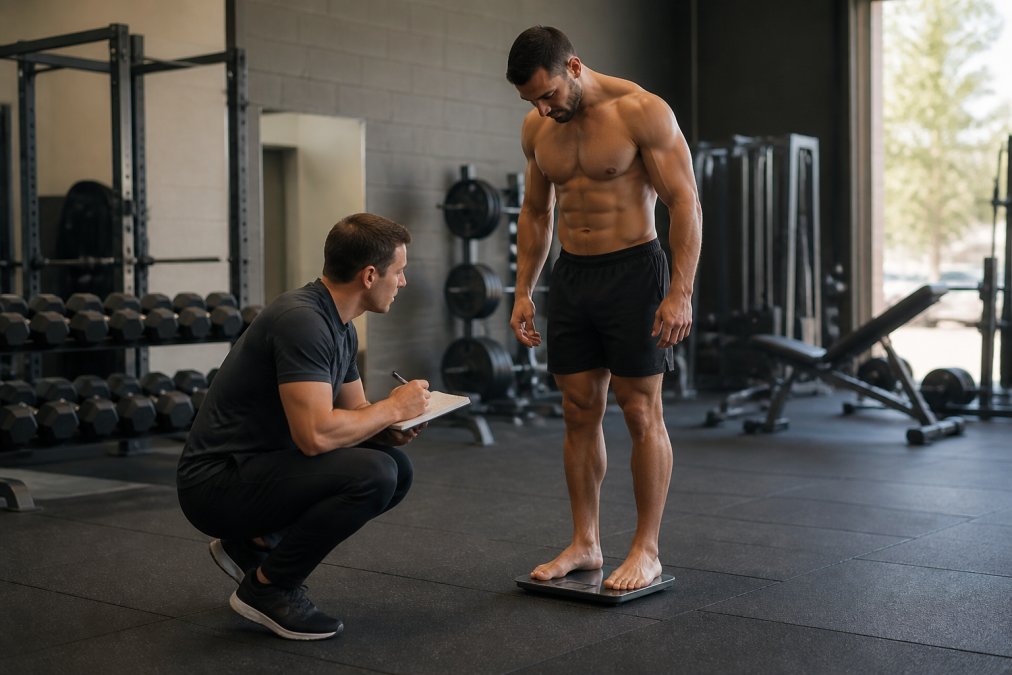
Start with your current body weight. If you're tracking macros for beginners, this is your foundation number.
Convert pounds to kilograms by dividing by 2.2. If you weigh 180 pounds, that's 82 kilograms (180 ÷ 2.2).
Write this number down. You'll use it for every calculation moving forward.
This is where your specific situation matters. Your activity level determines how much protein your body actually needs.
If you're doing resistance training 4-6 days per week and serious about muscle gain, use 1.8 grams per kilogram as your multiplier. This sits in the high end of the evidence-based range and accounts for the increased protein synthesis demands of heavy training.
The math: 82 kg × 1.8 = 147 grams of protein per day
If you're training 3-4 days per week with moderate intensity, drop to 1.6 grams per kilogram: 82 kg × 1.6 = 131 grams of protein per day
If you're doing mostly cardio or light activity, use 1.2 grams per kilogram: 82 kg × 1.2 = 98 grams of protein per day
The multiplier reflects reality: harder training creates more muscle damage and requires more protein for repair and growth.
Age changes how your muscles respond to protein. After 50, your muscles become less responsive to the same amount of protein, a phenomenon called anabolic resistance.
Research from MaxWell Nutrition's 2026 protein audit on aging shows that adults 50 and older should target 1.2-1.6 grams per kilogram per day to preserve muscle mass and function. This is higher than younger adults at the same activity level because the muscle isn't responding as efficiently to the stimulus.
If you're over 50 and training hard, add 0.2 grams per kilogram to your calculated number.
Also consider injury or recovery from illness. If you're coming back from an injury or recovering from surgery, increase your protein by 1.3-1.8 grams/kilogram/day for non-athletes, and 1.5-2 grams/kilogram/day for athletes. Healing tissue requires extra amino acids.
For the 82 kg athlete over 50 doing resistance training: (82 kg × 1.8) + (82 × 0.2) = 147 + 16 = 163 grams per day
This accounts for both the training stimulus and the age-related reduction in muscle responsiveness.
The "one gram per pound" rule is popular and easy to remember. It's also often too high.
One gram per pound equals 2.2 grams per kilogram. The research shows that anything above 2.0 grams per kilogram stops producing additional muscle growth. So the "one gram per pound" approach overshoots the evidence-based ceiling.
For practical purposes, here's what actually works:
| Body Weight | Training Level | Daily Protein Target | Grams Per Pound |
|---|---|---|---|
| 150 lbs (68 kg) | Moderate (3-4x/week) | 109 grams | 0.73 |
| 150 lbs (68 kg) | Heavy (5-6x/week) | 122 grams | 0.81 |
| 180 lbs (82 kg) | Moderate (3-4x/week) | 131 grams | 0.73 |
| 180 lbs (82 kg) | Heavy (5-6x/week) | 147 grams | 0.82 |
| 200 lbs (91 kg) | Moderate (3-4x/week) | 145 grams | 0.73 |
| 200 lbs (91 kg) | Heavy (5-6x/week) | 164 grams | 0.82 |
The grams-per-pound approach ranges from 0.73 to 0.82 for most athletes. The "one gram per pound" rule overshoots this by about 20%.
If you want a simple shortcut: multiply your body weight in pounds by 0.8. For a 180-pound person, that's 144 grams per day. It's close enough to the calculated number and easy to remember.
Once you know your protein target, the next step is actually hitting it. Most people underestimate how much protein they're eating.
A 3-ounce serving of grilled chicken has about 26 grams of protein. A whole egg has 6 grams. A cup of Greek yogurt has 15-20 grams depending on the brand. These numbers add up slower than most people think.
The easiest way to track is using a free app like MyFitnessPal or Cronometer. Enter your foods, and the app calculates your macros automatically. Spend one week tracking everything you eat. You'll quickly see where you stand.
Most people discover they're eating 40-60% of their target protein. The gap is usually filled with carbs and fats, which are easier to overconsume.
Here's the practical approach for beginners:
Pick 3-4 protein sources you actually like. Chicken, beef, fish, eggs, Greek yogurt, cottage cheese, or protein powder. Don't force yourself to eat things you hate.
Aim for 25-40 grams of protein per meal. This is the range that maximizes muscle protein synthesis. Spreading protein across the day matters more than piling it all into one meal.
Track for one week. Write down everything. You'll see patterns and identify where you're falling short.
Make one change at a time. If you're 30 grams short, add one extra serving of your preferred protein source. Don't overhaul your diet overnight.
Tiger Fitness offers FREE TOOLS & FITNESS CALCULATORS to help you dial in your exact macro targets based on your body weight, activity level, and goals. Combined with quality protein sources like ON Gold Standard 100% Whey Protein at 24 grams per serving, you have a straightforward way to fill protein gaps without cooking extra food.
Here's what matters: how you distribute protein across the day affects how much muscle your body actually builds.
Eating 150 grams of protein all at one meal is less effective than spreading 150 grams across four meals of 37-40 grams each. Your muscles can only use so much protein per meal for building new tissue. The rest becomes excess calories.
Research shows that 20-40 grams per meal is the optimal range for muscle protein synthesis. Below 20 grams, you're not triggering maximum growth. Above 40 grams, you're wasting the excess.
For a 180-pound person targeting 147 grams per day, the breakdown looks like this:
This distribution hits 175 grams, slightly above target, which is fine. The key is consistency, not perfection.
Timing around training matters more than most people realize. Consuming protein within 2 hours after resistance training supports muscle protein synthesis. This doesn't mean you need an immediate post-workout shake, but eating protein in that window is smart.
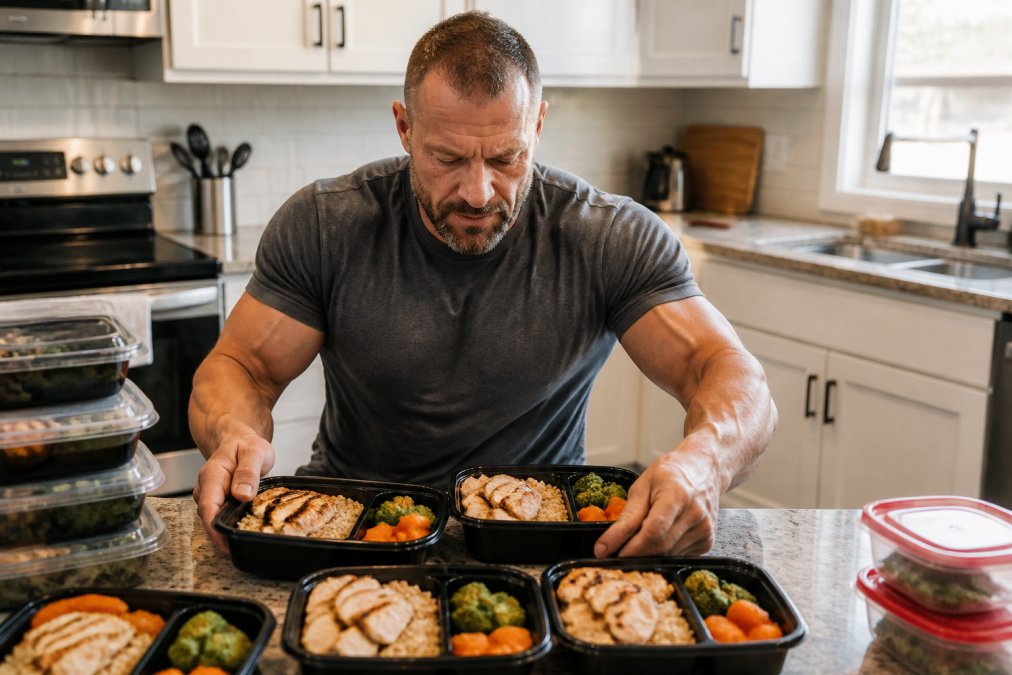
For older adults (50+), distributing protein evenly becomes even more important. Because anabolic resistance means muscles are less responsive to protein, spreading intake across the day maximizes the opportunity for muscle protein synthesis at each meal.
Mistake 1: Using the old RDA as your target. The 0.8 grams per kilogram number is a survival baseline, not a performance target. If you're training hard, you need more. Don't shortchange yourself based on outdated guidelines.
Mistake 2: Overestimating how much protein you're eating. Most people think they're hitting their target when they're actually 30-50% short. Track for one week. You'll be surprised.
Mistake 3: Eating all your protein at one meal. Your muscles can only use so much protein at once. Spreading it across the day is more effective for building muscle.
Mistake 4: Confusing protein quantity with protein quality. A gram of protein from chicken is not identical to a gram of protein from a plant source. Animal proteins contain all essential amino acids in optimal ratios. Plant proteins often lack one or more essential amino acids. If you're using plant sources, combine them strategically or supplement with a complete protein source.
Mistake 5: Ignoring age-related changes. If you're over 50, your muscles need more protein to respond the same way. Sticking to younger-person targets will result in slower progress.
Mistake 6: Dropping protein during a cut. When losing fat, people often reduce protein along with calories. This is backwards. Protein becomes more important during a cut because it preserves muscle while you're in a caloric deficit. Maintain your protein target even when eating fewer total calories.
Calculating your daily protein intake isn't complicated once you know the formula. Multiply your body weight in kilograms by 1.6 to 2.0 depending on your training intensity, adjust for age if you're over 50, and hit that number consistently. Spread it across four to five meals, track for one week to build awareness, and adjust based on results.
The difference between guessing and calculating shows up in your mirror within 4-6 weeks. More muscle, better recovery, and a body that actually responds to your training.
Get started today with a clear target and the tools to hit it.
The most practical formula is: body weight in pounds × 0.7 to 1.0 grams for active individuals, or multiply body weight in kilograms by 1.6 to 2.2 grams for muscle building. The 2025-2030 Dietary Guidelines recommend 1.2-1.6 g/kg for general health. For resistance training, aim for the higher end: 1.6-2.2 g/kg per day. This accounts for muscle protein synthesis and recovery demands.
Sedentary individuals need the RDA baseline of 0.8 g/kg body weight. Endurance athletes require 1.2-1.4 g/kg, while strength and resistance athletes need 1.6-2.2 g/kg daily. The more intense your training stimulus, the higher your protein needs to support muscle repair and adaptation. Training without adequate protein limits your muscle-building results.
Yes. Adults over 50 experience anabolic resistance, meaning aging muscle responds less efficiently to protein. Older adults need 1.2-1.6 g/kg daily to preserve lean body mass and function, compared to younger adults at 1.0-1.2 g/kg. This higher intake counters sarcopenia and maintains metabolic rate. A 30-author consensus review in 2026 confirmed that higher protein in older adults significantly preserves muscle and function.
Aim for 20-40 grams of protein per meal, distributed evenly throughout the day. This range optimizes muscle protein synthesis, especially around training and in older adults. Consuming more than 40 grams at once doesn't produce additional muscle-building benefits. Spacing protein intake across meals ensures consistent amino acid availability for muscle repair and growth.
{"one"=>"Select 2 or 3 items to compare", "other"=>"{{ count }} of 3 items selected"}



Leave a comment