







Testosterone Booster Safe for Men Under 30? 2026 Guide
A testosterone booster is safe for most healthy men under 30 in 2026 when you follow the label dose, but the part most sites skip is that few men this age actually need one natural testosterone typically peaks in the late teens through the mid-20s and doesn't start its steady decline until your 30s. The bigger risk isn't ingredients like zinc or D-Aspartic Acid; it's stimulant-loaded or proprietary blend formulas that hide dosages and stack poorly with a pre-workout you're already taking.
TL;DR
- A Testosterone booster is safe for men under 30 in 2026 when dosed as directed on the label.
- Natural Testosterone peaks in the late teens to mid-20s, so most men under 30 have little room for a booster to improve.
- Testosterone boosters differ from prohormones like Hi-Tech Pharma 1-Testosterone, which convert directly into active hormones.
- Tiger Fitness sells Testosterone booster options built on studied ingredients, like Hi-Tech Pharma Testosterone 21.
- Stimulant stacked or proprietary blend boosters carry more risk than transparent, single purpose formulas.
Key numbers
Late teens-mid 20s
Natural testosterone peak
1-2% per year
T decline after age 30
Widely cited clinical average
Why This Matters
Search interest in testosterone boosters skews young, and the reason is mostly marketing: gym content online treats "boosting T" as a shortcut to faster size and strength gains, and most guys under 30 have never had bloodwork done to know their actual baseline. The category itself is broad some products are simple mineral and herb blends, others get marketed right alongside prohormones and SARMs that work nothing like a label compliant booster, and that mix is exactly why the safety question keeps coming up in 2026.
Tiger Fitness sells testosterone booster products across that whole range, which is exactly why it matters to know what you're buying before you buy it. A testosterone booster for natural lifters is built around ingredients with published human trials at transparent doses, not a proprietary blend hiding the amounts that distinction matters more for safety than your age does.
Is a Testosterone booster safe for men under 30 in 2026?
For most healthy men in this age range, yes a testosterone booster built on studied ingredients at label doses carries low risk, similar to taking a daily multivitamin with a few added herbs mixed in. The phrase "testosterone booster" on a front label covers a wide range of products though, from a simple zinc magnesium combo to aggressive stacks built around untested extracts, so the ingredient panel matters far more than the marketing claim on the front of the bottle.
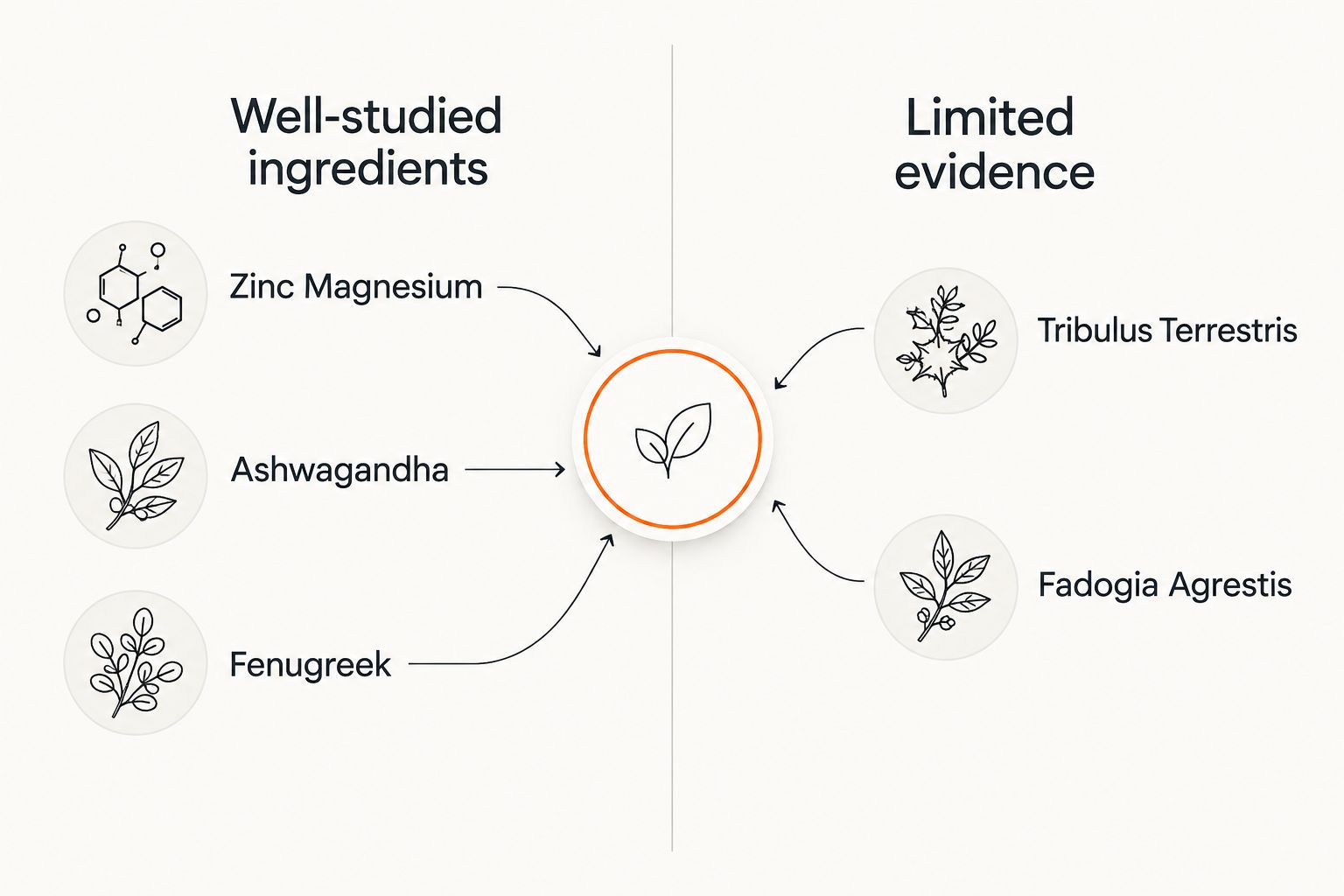
Here's how the common ingredient categories stack up on safety and evidence:
| Ingredient type | Common examples | Under-30 safety consideration | Verdict |
|---|---|---|---|
| Minerals | Zinc, magnesium | Well tolerated at label doses; most useful if you're actually deficient | Buy |
| Amino acid | D-Aspartic Acid | Short-term T bump shown in some trials, effect fades after a few weeks | Hold |
| Adaptogen | Ashwagandha | Widely studied for stress and recovery, low side-effect profile | Buy |
| Herb | Fenugreek | Marketed for libido and strength; watch blood sugar at high doses | Buy |
| Herb | Tribulus terrestris | Popular ingredient, but human trials show little testosterone change | Skip |
| Newer extract | Fadogia agrestis | Trending on social media; long-term safety data is still thin | Wait |
The verdict: a mineral and adaptogen based testosterone booster is safe for a man under 30 to try; a stimulant stacked formula built around a trending extract like fadogia agrestis is the one worth waiting on until more data exists.
“A mineral and adaptogen based testosterone booster is safe for a man under 30 to try; a stimulant stacked formula built around a trending extract is the one worth waiting on.”
The split above holds whether you're 22 or 29 being under 30 doesn't change how an ingredient behaves in the body, it changes how much room you have for a booster to move a hormone that's already sitting near its lifetime high.
How Testosterone booster ingredients are regulated
Testosterone boosters sold in the U.S. are regulated as dietary supplements, not drugs, which means they don't go through the same FDA approval process as prescription testosterone therapy. That distinction matters for safety: manufacturers are responsible for the truthfulness of their own claims, and legitimate brands state clearly that their products are not intended to diagnose, treat, cure, or prevent any disease. Reading the supplement facts panel not the marketing copy on the front of the bottle is the fastest way to judge whether a specific testosterone booster is safe for you to add to your routine in 2026.
Why Testosterone booster safety varies for men under 30
Age is only one input in this equation. These factors decide whether a given testosterone booster is a low-risk add or a waste of money for a man under 30:
- Baseline hormone status — a 24-year-old training hard, sleeping short, and under-eating protein has more room to benefit than one already sitting in a normal range.
- Sleep quality — poor sleep suppresses testosterone more than most supplements can compensate for, so fix that before adding a booster to the stack.
- Body fat percentage — higher body fat correlates with lower free testosterone, which changes how much room a booster realistically has to work with.
- Formulation transparency — a label showing exact milligram doses is far easier to evaluate for safety than a "proprietary blend" hiding the amounts, which is covered in detail in how testosterone boosters rank by ingredient dosage.
- Existing medications or conditions — blood pressure medication, blood thinners, and diabetes management can all interact with common booster ingredients like fenugreek.
- Stacking with stimulants — combining a stim-heavy booster with a stim-heavy pre-workout is where most reported side effects, like a racing heart or jitters, actually come from.
None of these factors are unique to men under 30, but they explain why two 26-year-olds can take the exact same testosterone booster and get completely different results or completely different side effects.
Signs a Testosterone booster is worth trying
- You've had bloodwork showing a low-normal or borderline testosterone reading.
- Your diet is consistently short on zinc, magnesium, or vitamin D.
- You want a transparent, single-purpose formula rather than a proprietary stack.
Signs to skip it for now
- You haven't dialed in sleep, calories, or training volume yet.
- Your last bloodwork came back in a normal or high-normal range.
- The product you're looking at hides doses behind a "proprietary blend" label.
Where a Testosterone booster actually fits your stack
If you've read the checklist above and still want ingredient-based support, look for a formula with a transparent label instead of a proprietary blend. Tiger Fitness carries testosterone booster options built around that kind of transparency, alongside broad multivitamins that cover the mineral bases most booster ingredients depend on in the first place.
Testosterone and multivitamin support

Formula built to support healthy testosterone levels in active men.
$49.95

Related Questions users ask
Can a 20-year-old safely take a testosterone booster?
Yes, a 20-year-old can safely take a testosterone booster built around studied ingredients at label doses, since natural testosterone is typically at or near its lifetime peak in the late teens and early 20s. The more useful question for a 20-year-old isn't safety it's whether training, sleep, and food intake are dialed in enough for a booster to have anything left to improve, and most young lifters see more from those basics than from any bottle.
Is a testosterone booster the same as a prohormone or steroid alternative?
No, a testosterone booster and a prohormone are not the same category, even though both often get marketed near each other. A booster works with ingredients like zinc, ashwagandha, or D-Aspartic Acid to support the body's own hormone production, while a product like Hi-Tech Pharma 1-Testosterone is a prohormone designed to convert directly into an active hormone, which carries a different risk profile and typically calls for a post-cycle recovery plan afterward.
Do men over 30 need a different testosterone booster than men under 30?
The formulation itself doesn't necessarily need to change, but the reason for taking one does men over 30 are managing an actual measured decline, roughly 1-2% per year after 30, while men under 30 are usually optimizing an already adequate baseline. The testosterone booster guide for men over 50 covers what changes once natural decline becomes the primary driver instead of lifestyle factors.
FAQ
Is it safe for a 20-year-old to take a testosterone booster in 2026?
Yes, it is safe for a 20-year-old to take a testosterone booster in 2026 when the ingredients are studied and the label dose is followed. Natural testosterone is typically near its peak at this age, so the main consideration is whether the product adds real value rather than whether it's dangerous.
Do testosterone boosters actually raise testosterone in men under 30?
Most testosterone boosters produce a small or negligible increase in men under 30 who already have normal levels, because there's less room to move a hormone that's already near its lifetime peak. Ingredients like D-Aspartic Acid show a short-term bump in some trials that fades within a few weeks.
Can testosterone boosters affect fertility or sperm count?
Standard testosterone boosters built on zinc, ashwagandha, or fenugreek are not associated with fertility problems at label doses. Products that actually alter hormone production directly, like prohormones, are a different category and carry a different fertility risk profile.
What's the difference between a testosterone booster and a prohormone?
A testosterone booster supports the body's own hormone production using ingredients like minerals and herbs, while a prohormone converts into an active hormone once ingested. Prohormones typically require a post-cycle support plan; standard boosters do not.
Should a beginner lifter take a testosterone booster before fixing diet and training?
No, a beginner lifter should fix sleep, protein intake, and training consistency before adding a testosterone booster, since those factors move hormone levels and performance more than any supplement. A booster added on top of a weak foundation rarely shows a noticeable difference.
Can you take a testosterone booster with a multivitamin?
Yes, you can take a testosterone booster alongside a multivitamin, but check both labels for overlapping zinc or magnesium doses first. Stacking two products with the same mineral can push you well past what's useful without added benefit.
Are testosterone boosters regulated the same way as anabolic steroids?
No, testosterone boosters sold as dietary supplements are not regulated the same way as anabolic steroids, which are controlled substances. Booster ingredients fall under standard supplement regulation, and none are intended to diagnose, treat, cure, or prevent any disease.
One Last Thing
The combination with the most consistent research behind it for men under 30 isn't a flashy newcomer ingredient it's plain zinc and magnesium, the backbone of most ZMA-style formulas, and it only does real work if your diet or sleep is actually short on those minerals. If you're already eating varied whole foods and sleeping 7 or more hours a night in 2026, a broad multivitamin like ON Opti-Men covers much of the same territory a dedicated testosterone booster claims to own, often without chasing trendier extracts like fadogia agrestis.
Related Guides
- Best PCT supplement for natural testosterone recovery
- Best testosterone booster for hardgainers struggling to build muscle
Leave a comment