
NEW NULLA BAR FLAVORS
In-Stock Now!

You should not assume a testosterone booster is safe to take long term; safety depends on the exact ingredients, daily doses, other supplements, medications, and your health history. Feeling fine during an initial bottle does not establish that continued use is safe, and persistent symptoms of low testosterone need a medical evaluation rather than indefinite supplementation.
A training plateau is frustrating. But adding a daily hormone-support supplement without checking the formula creates a different problem: you are making a long-term decision based on a category name rather than an ingredient assessment.
For your 2026 supplement review, start with everything you already take. Tigerfitness carries sports nutrition supplements, but a retailer's product selection cannot determine whether a formula fits your medical history. Use the guide to tracking vitamin and mineral intake to organize your intake before discussing it with a clinician or pharmacist.
A familiar ingredient is not a blanket safety clearance. Its dose, preparation, interactions, and reason for use still matter.
There is no category-wide safety guarantee for long-term testosterone booster use. Products sold under that label contain different combinations of nutrients, botanicals, and other compounds, so evidence about an individual ingredient cannot establish the safety of every finished formula.
Separate the product types before deciding what to do:
| Product type | Best for | Potential benefit | Limitation or concern |
|---|---|---|---|
| Vitamin or mineral supplementation | People with an identified dietary gap or deficiency | Addresses a specific nutrient need | Excess intake creates risks; correcting a deficiency does not justify unlimited dosing |
| Botanical or multi-ingredient booster | People seeking a clinician's assessment of a specific formula | Individual ingredients can be evaluated against relevant research | Ingredient research does not automatically establish long-term safety of the blend |
| Prohormone or hormone-active bodybuilding product | Medical review before use | Classification helps distinguish it from ordinary nutrient support | Hormone-active products have different risks and should not be treated as interchangeable with vitamins |
| Prescription testosterone | Patients with a diagnosis and a prescriber's treatment plan | Provides medically supervised treatment when indicated | Requires monitoring and is not equivalent to an over-the-counter booster |
Do not borrow a safety conclusion from a different product type. Prescription testosterone research does not validate a botanical blend, and nutrient intake limits do not establish a safe dose for a hormone-active compound.
A useful evidence review asks whether research studied the same ingredient preparation, dose, population, and duration. A short study without reported serious adverse events does not establish safety for ongoing use.
Bring the actual container or clear photographs of the complete label to your appointment. A product name alone leaves out information your clinician needs.
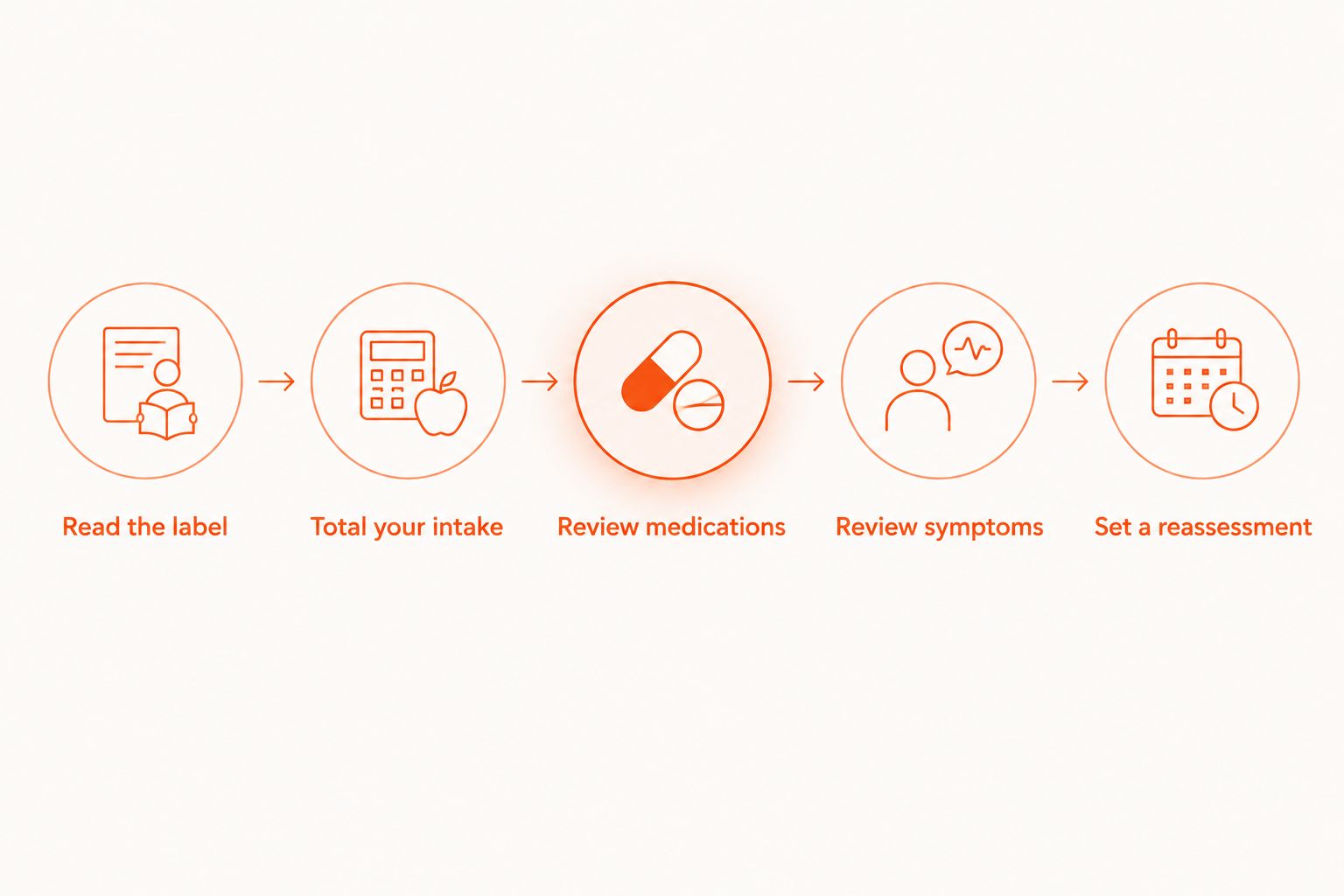
For a 2026 review, check the current bottle rather than relying on an old screenshot or a previous purchase. A reassessment plan is more useful than an automatic reorder.
These factors change the assessment, even when products share similar marketing language:
These are reasons to review the actual product, not reasons to assume every booster causes harm. The correct conclusion is narrower: safety belongs to a specific formula and person, not to the word booster.
Nutrient totals are a concrete place to start. The NIH Office of Dietary Supplements fact sheets for zinc, vitamin D, and magnesium describe the following adult tolerable upper intake levels; these are safety boundaries, not testosterone-support targets.
The adult upper intake level for zinc is 40 mg per day, including food and supplements. Excess zinc intake over time can interfere with copper absorption and cause other adverse effects.
If your booster and multivitamin both contain zinc, count both. A formula does not become safer because the same nutrient appears under different product names.
The adult upper intake level for vitamin D is 100 mcg per day, equivalent to 4,000 IU per day. Excessive supplementation can cause toxicity, including elevated blood calcium and kidney problems.
Clinicians sometimes prescribe different amounts for specific medical needs. That is supervised treatment, not permission to copy the dose into your own stack.
The adult upper intake level for magnesium from supplements and medications is 350 mg per day; it does not include magnesium naturally present in food. Supplemental magnesium can cause diarrhea, nausea, and abdominal cramping, and impaired kidney function increases concern about excess accumulation.
For your 2026 label check, distinguish elemental magnesium from the weight of the magnesium compound. Ask a pharmacist if the label is unclear.
Staying below a nutrient upper limit does not prove that an entire booster is safe. These limits also do not cover botanical extracts or hormone-active ingredients.
Natural describes an ingredient's origin, not its risk level. Botanical extracts can interact with medicines, differ in composition, and cause adverse effects that are unrelated to vitamin or mineral intake.
For example, the National Center for Complementary and Integrative Health's ashwagandha safety guidance describes concerns involving thyroid conditions, medication interactions, and reported liver injury. That guidance applies to ashwagandha, not automatically to every botanical or every testosterone booster.
When a formula contains an extract, ask whether the evidence concerns the same plant part and preparation. Do not treat a study of an individual extract as proof that a multi-ingredient product is safe indefinitely.
Start with the label rather than the promised outcome. At Tigerfitness, Blackstone Labs Apex Male is described as a non-hormonal testosterone booster containing D-aspartic acid; that description alone does not establish long-term safety or suitability for you.
The practical advantage of examining a named product is specificity: your clinician can review its actual formula. The limitation is equally important: a product description is not a long-term clinical safety study.
Tigerfitness is best for fitness enthusiasts shopping for supplements, not for diagnosing low testosterone. For a 2026 purchase decision, keep those roles separate and avoid choosing a booster solely because a product name sounds familiar.
Symptoms alone do not diagnose testosterone deficiency. Fatigue, poor recovery, reduced libido, and mood changes overlap with sleep problems, inadequate energy intake, medication effects, and other health conditions.
A clinician combines symptoms with appropriately collected testosterone measurements and further evaluation when indicated. The American Urological Association's Testosterone Deficiency Guideline calls for separate early-morning total testosterone measurements as part of diagnosis rather than relying on an isolated result.
Tell the clinician about every supplement before testing. Do not add products to chase a laboratory number, and do not assume better workouts prove that your testosterone changed.
Cycling does not establish long-term safety. A break cannot prove that a product lacks interactions, that previous exposure caused no harm, or that restarting is appropriate.
Follow label directions, but do not confuse directions with a personalized medical assessment. Avoid copying a cycle or post-cycle protocol from a forum, particularly when a product contains hormone-active ingredients.
Combining supplements requires a review of the complete stack, not just the booster. The main questions are overlapping ingredients, total exposure, medication interactions, and whether any product contains stimulants or hormone-active compounds.
Keep labels together and record when symptoms occur. Adding several products at once makes it harder to identify which ingredient is responsible for a problem.
Chest pain, difficulty breathing, fainting, or signs of a severe allergic reaction need emergency care. Tell emergency staff what you took and bring the container if practical.
Yellowing skin or eyes, dark urine, severe abdominal pain, or persistent vomiting need urgent medical assessment. Stop the suspected nonprescription supplement and seek care rather than adding a liver-support product to cover the symptoms.
If a product contains hormone-active compounds, explain that explicitly to the clinician. Do not improvise a withdrawal or post-cycle treatment plan, and never stop prescribed medication without medical advice.
Can I take a testosterone booster every day indefinitely?
Do not assume indefinite daily use is safe. Review the exact ingredients, doses, medication interactions, and reason for use with a clinician before continuing long term.
How long can I safely take a testosterone booster?
There is no universal safe duration for every testosterone booster. The answer depends on the formula, your health history, and the duration and quality of relevant safety research.
Is a natural testosterone booster safer than testosterone therapy?
A natural label does not establish that a booster is safer than prescribed testosterone. These are different products with different evidence, risks, and monitoring requirements.
Does taking a break prevent testosterone booster side effects?
Taking a break does not guarantee that side effects or interactions will be prevented. Cycling is not a substitute for reviewing the ingredients and your individual risk factors.
Can a testosterone booster damage my liver?
Some supplement ingredients and adulterated bodybuilding products can cause liver injury, but risk is product-specific. Seek urgent medical care for jaundice, dark urine, or severe abdominal pain during use.
Should I get blood tests before taking a testosterone booster?
Ask a clinician about testing if you have symptoms suggesting testosterone deficiency or a health condition that affects supplement safety. An isolated result or training plateau does not establish a diagnosis.
Is zinc safe to combine with a testosterone booster?
The adult zinc upper intake level is 40 mg per day from all sources. Count zinc in the booster, multivitamins, separate supplements, and food rather than assessing each bottle alone.
Can a testosterone booster replace treatment for low testosterone?
A testosterone booster does not replace evaluation or prescribed treatment for diagnosed testosterone deficiency. Discuss persistent symptoms and fertility goals with a qualified clinician.
Before you reorder in 2026, write down the problem you wanted the booster to solve and whether that problem has changed. If you cannot identify a meaningful benefit, continuing by habit adds exposure without a clear reason.
Do not confuse tolerating a product with proving that you need it. Bring that distinction, your labels, and your symptom history to the next medical discussion.
This article provides general education, not individualized medical advice. Dietary supplements and their claims are not intended to diagnose, treat, cure, or prevent any disease.
{"one"=>"Select 2 or 3 items to compare", "other"=>"{{ count }} of 3 items selected"}






Leave a comment