





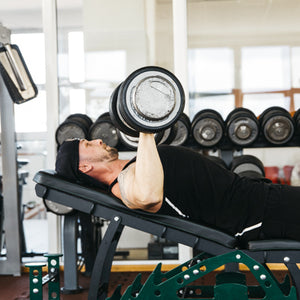

Rebuild Muscle After Injury: A Proven 4-Phase Plan
Table of Contents
- Understanding Your Injury and Recovery Timeline
- Phase 1: Restore Range of Motion and Mobility
- Phase 2: Build Isometric Strength Without Movement
- Exercises to Rebuild Muscle After Injury
- Nutrition for Muscle Repair After Injury
- Supplements for Muscle Recovery After Injury
- Progressive Overload After Injury: Tracking What Matters
- Psychological Barriers and Sleep Positioning for Recovery
Rebuild Muscle After Injury: A Proven 4-Phase Plan
Last Updated: July 27, 2026
Understanding Your Injury and Recovery Timeline
How to rebuild muscle after injury starts with one non-negotiable truth: you cannot rush the process. The ones who succeed aren't necessarily the strongest, they're the ones who respect the timeline their body actually needs.
Most people fail because they confuse "feeling better" with "being healed." Your pain might subside in two weeks. Your tissue might take eight. Ignoring that gap is how you end up injured again, starting from zero instead of building from where you left off.
According to research from the American Physical Therapy Association, athletes who follow a structured, phase-based approach return to sport 40% faster than those who self-program their comeback. Trying to do heavy strength training in Phase 1 when you should be restoring range of motion is like trying to run before you can walk.
Why Rushing Back Kills Progress
When you rush, inflammation returns, swelling increases, and you lose progress. Your body learns to avoid the injured area, and other muscles take over. Now you've got imbalances that create secondary injuries.
Pain-free doesn't mean ready to train. Strength, stability, and range of motion must all develop together. Athletes who follow a 12-16 week structured progression have significantly lower re-injury rates than those who return to heavy training in 4-6 weeks.
The Role of Physical Therapy and Professional Guidance
Physical therapy is the foundation for rebuilding muscle after injury properly. A licensed physical therapist assesses your specific injury, identifies movement restrictions, and builds a progression tailored to your tissue healing timeline, not your ego.
A PT identifies compensatory patterns you cannot see yourself. Before starting any strength work, get clearance from your orthopedic provider or PT. The few hundred dollars spent on professional assessment saves you months of setback. To help you track your progress objectively, use FREE TOOLS & FITNESS CALCULATORS to monitor your metrics, range of motion, strength gains, and recovery benchmarks, so you have data-driven evidence of your advancement through each phase.
Phase 1: Restore Range of Motion and Mobility
The first phase is about mobility, not strength. Your goal is to restore the range of motion you lost due to injury, inflammation, and immobilization. Without this foundation, every phase that follows will be compromised.
This phase typically lasts 2-4 weeks depending on injury severity. If you had surgery, add another 2-4 weeks.
Pendulum Exercises and Passive Mobility Work
Pendulum swings are one of the most underrated tools in shoulder injury recovery. Bend forward at the waist, let your injured arm hang, and make small circles. The movement is generated by your core and legs, not your shoulder. Start with circles the size of a dinner plate. After a week, increase to hula hoop size. Do this 2-3 times daily, 10-15 circles in each direction.
Pendulum exercises reduce pain through gentle joint distraction and activate proprioceptors, the sensory receptors that tell your brain where your arm is in space. Early proprioceptive work is critical because injury disrupts these signals.
Passive mobility work means someone else moves your arm, or you use your other arm to move it. Lie on your back, use your good arm to gently pull the injured arm across your chest. Hold for 20-30 seconds. Do this 3-4 times daily.
Pro TipPerform pendulum exercises and passive stretching in the morning and evening when inflammation is lowest. Combine these with ice for acute inflammation or heat for stiffness in chronic injuries.
Wall Crawls and Overhead Mobility Drills
Wall crawls are a progression from passive work. Stand facing a wall, place your fingers on the wall at shoulder height, and slowly walk your fingers up. Go as high as pain allows. Walk them back down. Do this 10-15 times, 2-3 times daily.
This exercise restores overhead mobility and teaches your rotator cuff to activate without heavy load. It builds scapular control, the shoulder blade's ability to move properly as your arm moves.
Once you can reach near full height without pain, progress to active range of motion: stand tall, arms at your sides, and slowly raise your arms overhead. Go as high as comfortable. Lower slowly. Do 10-15 reps twice daily.
Phase 2: Build Isometric Strength Without Movement
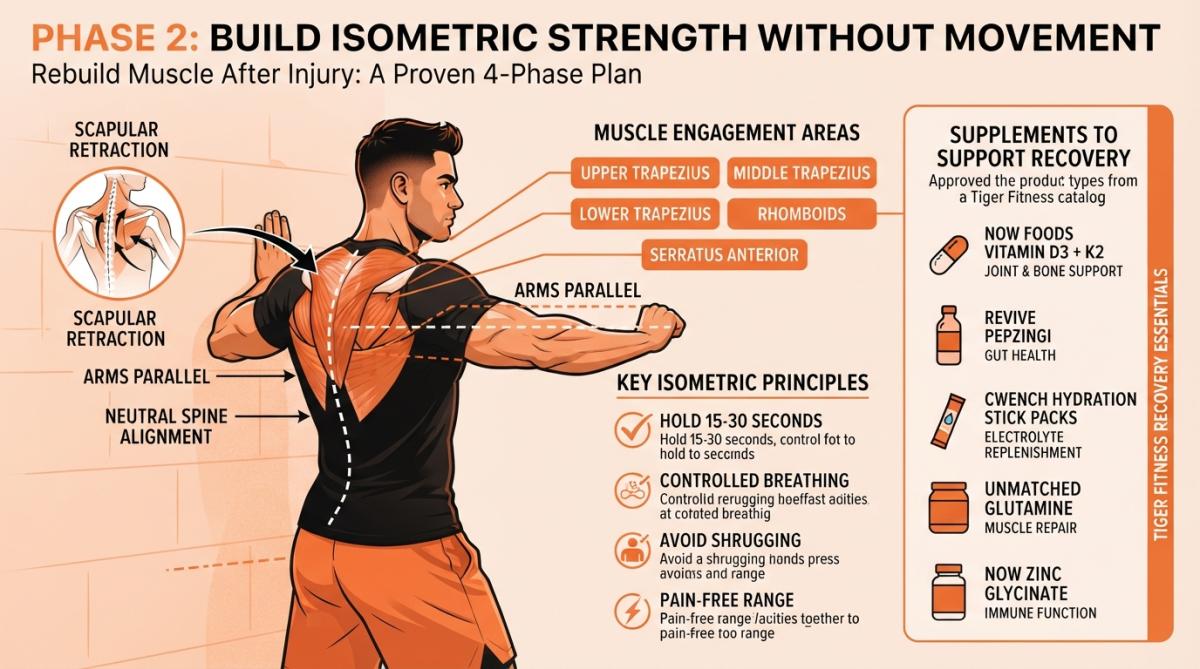
Professional illustration showing rebuilding muscle after injury
Phase 2 begins when you have pain-free range of motion. This phase typically spans 3-5 weeks. Your goal is to rebuild strength without moving the joint. Isometric contractions, where you contract a muscle without changing its length, are perfect for this because there's no joint motion and minimal stress on remodeling tissue.
Scapular Stabilization Techniques
Scapular stabilization is non-negotiable for shoulder injury recovery. The scapula is the foundation of shoulder stability. If it doesn't move properly, your rotator cuff has to work twice as hard to stabilize the joint.
Wall holds teach proper scapular activation: stand facing a wall, place your hands on the wall at shoulder height, and lean forward slightly. Your arms are straight but not locked. Hold for 20-30 seconds. Feel your scapula pulled down and back, not shrugged up toward your ears. Do 3-4 sets, 2-3 times weekly.
Progress to quadruped holds: get on your hands and knees, hands directly under shoulders. Hold for 20-30 seconds. You're now supporting more body weight, forcing your scapula to work harder. Do 3-4 sets, 2-3 times weekly.
Isometric external rotation holds target the rotator cuff directly. Lie on your side with your injured arm bent 90 degrees at the elbow, elbow tucked to your ribs. Hold a light dumbbell or resistance band. Push your forearm toward the ceiling against resistance without moving. Hold for 10-15 seconds. Do 3 sets of 5-8 reps, 3 times weekly.
Key TakeawayScapular stability determines rotator cuff health. If your shoulder blade doesn't move correctly, your rotator cuff compensates. This compensation is how most chronic shoulder problems develop.
Exercises to Rebuild Muscle After Injury
Phase 3: Progressive Resistance Training
Phase 3 begins when you have full pain-free range of motion and can maintain scapular control through isometric work. This phase typically lasts 4-6 weeks. Your goal is to rebuild strength through progressive resistance.
Progressive resistance means you start light and gradually increase load. Start with bodyweight or extremely light resistance. Do 2-3 sets of 12-15 reps. Your goal is to reinforce the movement pattern and build work capacity, not to fatigue the muscle.
Scapular push-ups are foundational for shoulder recovery. Get in a push-up position but keep your elbows locked. Move only by retracting and protracting your scapula, pulling your shoulder blades together and apart. Do 2-3 sets of 10-12 reps, 2-3 times weekly.
Light dumbbell rows rebuild back strength and reinforce scapular retraction under load. Use a weight you can control for 12-15 reps. Focus on pulling the dumbbell toward your hip. Do 3 sets of 12-15 reps, 2-3 times weekly.
Lateral raises with light weight rebuild deltoid strength. Use a weight that allows 12-15 reps without compensation. Raise your arms to shoulder height, pause briefly, lower slowly. Do 3 sets of 12-15 reps, 2-3 times weekly.
The progression protocol: every 2 weeks, increase either the weight or the reps. If you're doing 3 sets of 12 reps with 10 pounds, move to 12 pounds the following week. Once you reach 3 sets of 15 reps, increase the weight and drop back to 12 reps.
Watch OutPain is a stop signal. Discomfort or a mild burn is normal. Sharp pain or pain that lingers after training means you've done too much. Back off immediately.
Phase 4: Return to Heavy Compound Movements
Phase 4 begins when you can perform Phase 3 exercises with progressive load without pain or compensation. This phase typically lasts 4-8 weeks and bridges rehabilitation to full training.
Start with empty bar or light weight. Your goal is to prove to your nervous system that the movement is safe. Do 3 sets of 8-10 reps with a weight you could do for 15. This gives you a massive safety margin.
Every session, add a small amount of weight. You're not jumping to your old maxes. You're building back systematically.
Bench press progression: start with empty bar or dumbbells you can press for 12 reps. Do 3 sets of 8-10 reps. Week 2, increase weight slightly. After 4 weeks, you should be pressing roughly 50-60% of your pre-injury max. This is normal. You've lost strength. You'll rebuild it.
Barbell rows follow the same protocol. Start light, progress gradually, focus on movement quality. Your scapula should retract fully. Every rep should look identical.
Overhead press requires the most shoulder stability. Don't rush this movement. You should be 6-8 weeks into Phase 3 before attempting loaded overhead pressing. Start with dumbbells lighter than you think you need. Progress slowly.
Nutrition for Muscle Repair After Injury
Your nutrition during recovery determines how quickly you rebuild muscle. Training creates the stimulus. Nutrition provides the raw materials for adaptation.
Protein Requirements During Recovery
Protein is non-negotiable. Your body uses amino acids to repair damaged tissue and build new muscle. During injury recovery, your protein needs increase because your body is in a catabolic state.
Aim for 1 gram of protein per pound of bodyweight daily. If you weigh 200 pounds, that's 200 grams of protein daily. Distribute this across 4-5 meals. Your body can use roughly 30-40 grams of protein per meal. Whole food sources like chicken breast, ground beef, eggs, fish, and Greek yogurt are your foundation. Whey protein powder supports recovery during periods of reduced training.
Supporting Joint Health and Connective Tissue
Joint health is as important as muscle during recovery. Your ligaments, tendons, and cartilage are under stress during rehabilitation.
Collagen and gelatin provide amino acids specific to connective tissue. Include bone broth, collagen peptides, or gelatin in your daily nutrition. Research shows that collagen supplementation combined with resistance training improves joint integrity and reduces pain.
Vitamin C is essential for collagen synthesis. Your body cannot build collagen without adequate vitamin C. Include citrus fruits, berries, and leafy greens daily. If you're not getting enough from food, supplement 500-1000mg daily.
Omega-3 fatty acids reduce inflammation and support joint health. Include fatty fish like salmon 2-3 times weekly, or supplement with fish oil. Aim for 2-3 grams of combined EPA and DHA daily.
Supplements for Muscle Recovery After Injury
Supplements are tools, not magic. They support nutrition and training but cannot replace either. The hierarchy is: training > nutrition > supplementation.
Glutamine supports gut health and immune function during recovery. Include 5-10 grams daily.
Magnesium supports muscle relaxation and sleep quality. Include 300-400mg daily, taken in the evening.
Creatine monohydrate supports muscle strength and cellular energy production. Include 5 grams daily. It takes 3-4 weeks to build up in your system, so start early in your recovery.
Joint support supplements combine glucosamine, chondroitin, and other compounds that support cartilage health and reduce joint pain. Include these throughout your recovery, especially during Phase 3 and 4 when you're returning to heavier training.
Multivitamin fills micronutrient gaps. During recovery, your body has increased demands for vitamins and minerals.
Progressive Overload After Injury: Tracking What Matters
Progressive overload is the engine of muscle growth. You must gradually increase the demands placed on your muscles. Without progressive overload, you plateau.
Measuring Progress Without the Scale
The scale is useless during injury recovery. You've lost muscle and possibly gained fat due to reduced training.
Track these metrics instead:
Metric |
Frequency |
Target |
|---|---|---|
Range of motion (degrees) |
Weekly |
Increasing toward pre-injury baseline |
Strength (weight x reps) |
Every session |
Increasing 2.5-5% every 2 weeks |
Pain level (0-10 scale) |
Daily |
Decreasing trend over weeks |
Reps at fixed weight |
Weekly |
Increasing reps before increasing weight |
Body composition (mirror/photos) |
Every 2 weeks |
Muscle definition increasing |
Movement quality (video analysis) |
Every 2 weeks |
Form improving, compensation decreasing |
Range of motion is your primary metric in Phase 1 and 2. If your range is increasing and pain is decreasing, you're winning.
Strength is your primary metric in Phase 3 and 4. Track the weight and reps for each exercise. Document this in a training log. The log is your proof of progress.
Equipment-Specific Modifications for Safe Training
Resistance bands allow you to train with accommodating resistance. The band is easier at the beginning of the movement and harder at the end. This is safer than dumbbells or barbells because you're not fighting heavy weight at the weakest part of the movement.
Machines fix your movement path. You cannot cheat or deviate from the intended range of motion. This is safer than free weights during early recovery because your stabilizer muscles don't have to work as hard.
Partial range of motion movements allow you to train heavy without full range. As your range improves, increase the range of motion.
Tempo training slows down the eccentric (lowering) portion of the lift. Lower the weight over 3-4 seconds instead of 1 second. This creates more stimulus with less load, which is perfect for recovery phases.
Psychological Barriers and Sleep Positioning for Recovery
Recovery is 50% physical and 50% mental. Your mindset determines whether you stick to the process or sabotage yourself.
Overcoming Fear and Rebuilding Confidence
Fear is the biggest barrier to returning to training after injury. You're terrified of re-injury. But fear-driven training decisions keep you weak.
The antidote is evidence-based progression. You're not guessing. You're following a structured plan. Every phase has specific criteria for progression. Track your progress obsessively. Every week, you should see evidence that you're improving: range of motion increasing, strength increasing, pain decreasing. This evidence builds confidence. Confidence kills fear.
Train with a partner or coach when possible. Having someone external validate your form and progress provides psychological safety.
Accept that you will be weaker than before for several months. This is normal. This is temporary. Your strength will return if you're patient.
Sleep Positioning and Recovery Optimization
Sleep is where adaptation happens. Your body rebuilds tissue during sleep. Poor sleep destroys recovery.
Sleep position matters for shoulder injuries. Avoid sleeping on your injured side. Sleep on your back or on your good side. If you sleep on your back, place a pillow under your arm to keep it supported.
Keep your bedroom between 60-67°F. A cool room improves sleep quality and reduces inflammation.
Aim for 7-9 hours nightly. During injury recovery, you may need more. Your body is under stress. It needs sleep to adapt.
Go to bed and wake up at the same time daily, even on weekends. This regulates your circadian rhythm and improves sleep quality.
Avoid screens 1 hour before bed. Blue light suppresses melatonin, which impairs sleep quality. Read, stretch, or meditate instead.
Key TakeawaySleep is where your body rebuilds muscle and heals tissue. Prioritize sleep like you prioritize training. A perfect training program with poor sleep will fail. A mediocre training program with excellent sleep will succeed.
Frequently Asked Questions
How long does it take to rebuild muscle after an injury?
Recovery timelines vary by injury type and severity. Most athletes see initial strength gains within 2-4 weeks of structured rehabilitation. Full return to pre-injury strength typically takes 8-16 weeks for moderate injuries, longer for severe cases. The key is following a progressive protocol—rushing this timeline increases re-injury risk. Work with a physical therapist to establish realistic milestones for your specific injury.
What supplements help with muscle recovery after injury?
Protein is non-negotiable—aim for 0.8-1g per pound of body weight daily. Glutamine supports gut health and immune function during recovery; consider Unmatched Glutamine to optimize protein synthesis. Collagen supports connective tissue repair; MTS Collagen+ provides comprehensive tissue support. Magnesium aids muscle relaxation and sleep quality—NOW Foods Magnesium Citrate is highly bioavailable. Joint support formulas like Beverly Joint Care target inflammation and mobility. These work best when paired with adequate protein and whole-food nutrition.
Can you regain muscle after atrophy from injury?
Yes. Muscle has memory—your neuromuscular system retains adaptations even after detraining. This means you'll rebuild faster than you built initially. However, the rebuilding process requires progressive resistance training, adequate protein intake, and patience. Atrophied muscle typically returns within 4-8 weeks of consistent training, depending on how long you were immobilized. The psychological barrier often matters more than the physical one—trust the process and progress gradually.
What's the difference between isometric and progressive resistance training for injury recovery?
Isometric contractions (holding tension without movement) rebuild strength early in recovery without stressing healing tissues. They're safer when range of motion is limited. Progressive resistance training (adding weight or reps gradually) comes later, once mobility and basic strength return. Isometric work typically happens in Phase 2; progressive resistance begins in Phase 3. Both are essential—isometric builds the foundation, progressive overload builds the muscle back to hypertrophy.
Leave a comment