







BEST SHOULDER OPENERS FOR BENCH PRESS
Yoga Stretches for Shoulder Mobility Improvement
Table of Contents
- Why Shoulder Mobility Matters for Lifters
- How Long to Hold Yoga Stretches for Flexibility
- The Best Shoulder Openers for Bench Press
- Yoga Blocks for Shoulder Mobility
- Dynamic vs. Static Stretching for Shoulder Mobility
- Breathing Techniques to Enhance Shoulder Mobility
- Desk-Worker Shoulder Mobility Routine
- Safety and Contraindications for Shoulder Mobility Work
- Frequently Asked Questions
Last Updated: October 3, 2026
Why Shoulder Mobility Matters for Lifters
If you can't get your shoulders into position, you can't press heavy. Simple as that. A 2025 randomized controlled trial published through the National Center for Biotechnology Information found that a 12-week yoga intervention significantly improved shoulder range of motion compared to a usual-care control group, with shoulder rotation flexibility scores hitting p = 0.004. That's real, measurable change.
But here's what most articles won't tell you: mobility isn't one thing. It's four joints working in sequence, and if one link is locked, the others pay the price.
The Four Joints You're Actually Training
The shoulder complex is not a ball-and-socket in isolation. It's four articulations stacked together:
- Glenohumeral joint, the ball-and-socket where the humeral head sits in the shallow glenoid. This is where most people feel tightness, but it's rarely the root cause.
- Acromioclavicular (AC) joint, where the clavicle meets the acromion. Restricted here kills your overhead lockout.
- Sternoclavicular (SC) joint, the only true bony attachment between the arm and the axial skeleton. If it doesn't rotate, nothing above it moves well.
- Scapulothoracic articulation, not a true joint, but the scapula gliding on the rib cage. This is where desk posture wrecks you.
Scapulohumeral Rhythm: The Mechanism Nobody Explains
For every 2 degrees you raise your arm, the scapula should upwardly rotate about 1 degree. That's a 2:1 ratio, the classic scapulohumeral rhythm described in orthopedic literature. Break that ratio and the humeral head starts jamming into the acromion. That's impingement. That's the pinch you feel at the bottom of a heavy press.
Yoga stretches for shoulder mobility improvement restore that rhythm by training the scapula to move with the arm instead of lagging behind it. Puppy pose and thread the needle don't just stretch muscle, they reteach the scapula to glide.
The Thoracic Spine Is the Hidden Variable
Your shoulder can only move as far as your thoracic spine lets it. A stiff T-spine forces the shoulder to overcompensate, and that's where impingement and labrum stress come from. This is why thread the needle, which combines thoracic extension with scapular retraction, outperforms pure shoulder stretches for most lifters.
Fix the T-spine, and the shoulder gets range for free.
What That Buys You Under the Bar
- Better pressing positions mean more weight moved safely
- Less shoulder impingement risk during overhead work
- Improved scapular retraction for a stronger bench setup
- Healthier joint capsule function over years of training
Most guys skip this work. They'd rather add another set of bench than spend six minutes opening up their shoulders. Then they wonder why their rotator cuff is screaming.
Mobility isn't soft. It's what keeps you in the gym.
How Long to Hold Yoga Stretches for Flexibility
Hold static stretches for 30 to 60 seconds per position. That's the sweet spot for improving flexibility without overstretching connective tissue. Anything shorter than 20 seconds barely moves the needle.
For shoulder-specific work, aim for 2 to 3 rounds per stretch. Total time per session: 6 to 10 minutes.
Some coaches push longer holds, up to 2 minutes. That works for some people, but it's not required. Consistency beats duration every time.
A short daily session outperforms one long weekly session. That's why programs like the 14-day shoulder mobility challenge push just 6-minute daily sessions to build movement freedom. Six minutes. Every day. That's the deal.
| Hold Time | Best For | Rounds | Total Time |
|---|---|---|---|
| 20-30 sec | Warm-up, pre-lift | 1-2 | 3-5 min |
| 30-60 sec | General flexibility | 2-3 | 6-10 min |
| 60-120 sec | Deep tissue release | 1-2 | 8-12 min |
The Best Shoulder Openers for Bench Press
Puppy pose with blocks and thread the needle are the two best shoulder openers for bench press. Both target the chest, lats, and posterior shoulder in ways that directly improve your pressing setup.
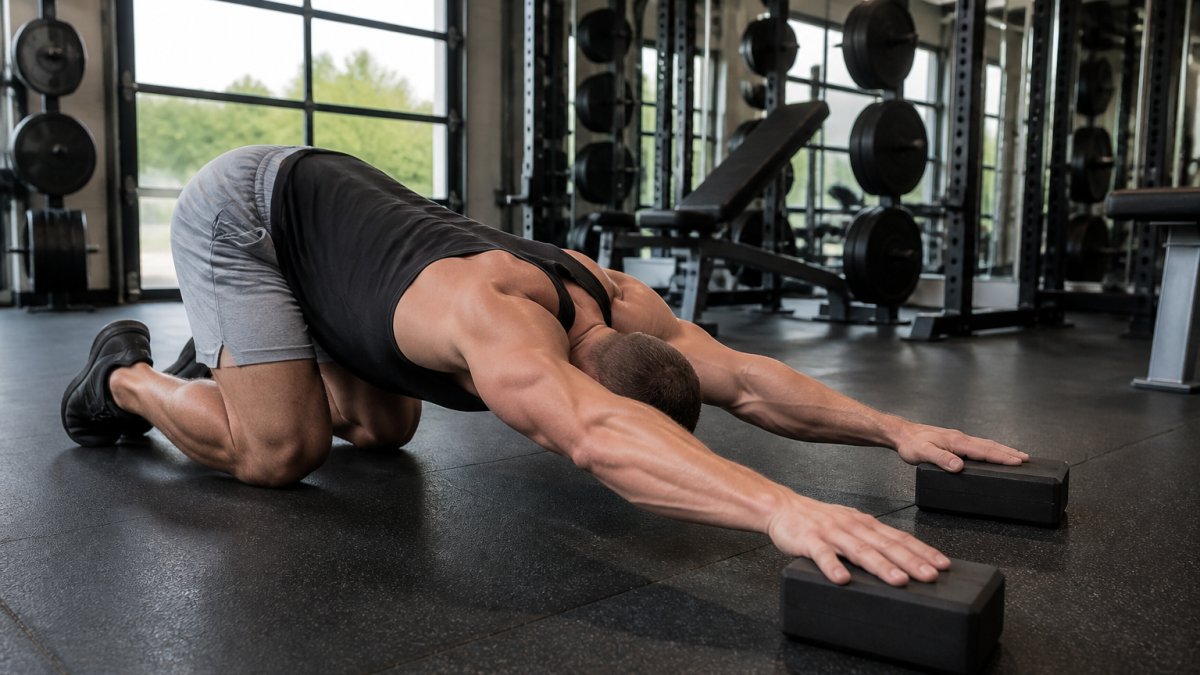
Do these before you bench. Every session. Your setup will feel different within two weeks.
Puppy Pose with Blocks
Kneel on the floor. Place two yoga blocks under your hands. Walk your hands forward until your chest drops toward the ground.
Keep your hips high. Let your armpits release. Breathe into the stretch for 45 seconds.
The blocks raise your hands, which increases the angle of shoulder flexion. That extra height opens the joint capsule and stretches the lats harder than the floor version.
Thread the Needle
Start on all fours. Slide your right arm under your left arm, palm up. Let your right shoulder and ear rest on the floor.
Hold for 45 seconds. Switch sides.
This one hits thoracic extension and scapular retraction at the same time. It's the single best drill for the desk-worker crowd.
Yoga Blocks for Shoulder Mobility
Yoga blocks are the cheapest tool you'll ever buy for shoulder mobility. They let you control the depth of every stretch, which matters when your shoulders are tight.
Multiple instructional resources now emphasize blocks for poses like puppy pose to target chest and shoulder muscles. The reason is simple: blocks raise the floor.
- Under the hands for puppy pose and downward dog
- Between the knees to keep hips square in thread the needle
- Under the sacrum for supported bridge and chest openers
- Under the head for gentle cervical alignment work
Start with one block. Add a second when the stretch feels easy. Don't rush it.
Pro Tip Stack two blocks under each hand for puppy pose if your chest can't reach the floor. Most lifters with tight pecs need the extra height for the first month. Drop to one block once your sternum touches down without strain.
Dynamic vs. Static Stretching for Shoulder Mobility
Dynamic stretching before training. Static stretching after. That's the rule.
Dynamic work moves the joint through its range under control. Arm circles, band pull-aparts, wall slides. These raise tissue temperature and wake up the stabilizers.
Static holds, like puppy pose and thread the needle, are for after your session. That's when you're chasing length in the connective tissue and fascia.
Get this backwards and you'll feel weaker on the bench. Static stretching before heavy pressing can temporarily reduce force output. Save it for your cool-down.
- Pre-lift: 5 minutes dynamic, arm circles, band dislocates, wall slides
- Post-lift: 5-10 minutes static, puppy pose, thread the needle, doorway stretch
- Off days: full static session, 10 minutes
Breathing Techniques to Enhance Shoulder Mobility
Your breath controls how deep a stretch goes. Exhale into the tension. Never hold your breath.
The nervous system guards tight tissue. Slow exhales tell it that you're safe, which lets the muscle release. Inhale for 4 seconds. Exhale for 6 to 8 seconds.
Match the breath to the stretch:
- Inhale as you set up the position
- Exhale as you sink deeper
- Hold the exhale at the bottom for 2 seconds
- Repeat for the full hold time
This is the piece most lifters skip. They muscle through a stretch with clenched teeth and wonder why nothing changes. Breathe, and the tissue lets go.
Desk-Worker Shoulder Mobility Routine
Sitting all day rounds your shoulders forward and locks your thoracic spine. This 6-minute routine undoes it.
Do it once in the morning and once after work.
- Wall slides - 10 reps, slow
- Thread the needle - 45 seconds per side
- Doorway chest stretch - 45 seconds per side
- Band pull-aparts - 15 reps
- Puppy pose with blocks - 60 seconds
- Neck circles - 30 seconds each direction
That's it. Six minutes. No equipment beyond a band and a block.
Watch Out Don't stretch into sharp pain. A dull pull is fine. A pinch, stab, or numbness down the arm means stop immediately. That's a nerve issue, not tight muscle, and pushing through it makes it worse.
Safety and Contraindications for Shoulder Mobility Work
Yoga improves flexibility, but it isn't enough on its own. Experts note that shoulder health needs strength work too, like rows and resistance band training, to build joint stability. Flexibility without stability is a loose joint waiting to get hurt.
Here's where most articles stop. They hand you a list of red flags and walk away. That's useless if you're actually coming back from a shoulder issue. So let's talk about a phased return, the protocol nobody else is giving you.
When to Skip Stretching Entirely
Do not stretch into these situations. Get evaluated first:
- A current acute shoulder injury or post-surgical repair
- Diagnosed shoulder impingement in an active flare
- Numbness, tingling, or radiating pain down the arm
- A history of shoulder dislocation or instability
- Any sharp pinch at end-range that doesn't resolve with position change
A dull pull is fine. A pinch, stab, or numbness down the arm means stop immediately. That's a nerve or structural issue, not tight muscle, and pushing through it makes it worse.
The Phased Return Protocol for Minor Impingement
If you've been cleared by a professional and you're working back from a minor impingement or a layoff, don't jump straight into deep puppy pose. Work the phases.
Phase 1, Pain-Free Range Only (Weeks 1-2)
Goal: restore motion without provoking the joint.
- Wall slides, 2 sets of 10, stop before the pinch point
- Band pull-aparts, 2 sets of 15, light band
- Thread the needle, 30 seconds per side, no pressing into end-range
- No overhead work. No loaded pressing.
Phase 2, Add Load and Time (Weeks 3-4)
Goal: build tolerance at the new range.
- Puppy pose with blocks, 45 seconds, 2 rounds
- Doorway chest stretch, 45 seconds per side
- Band dislocates, 2 sets of 12, slow tempo
- Reintroduce light overhead pressing with dumbbells, 2 sets of 8 at 50% of your normal working weight
Phase 3, Return to Full Training (Weeks 5-6)
Goal: load the shoulder through full range under control.
- Full static session, 10 minutes, post-lift
- Barbell overhead press at 70-80% working weight, 3 sets of 5
- Keep dynamic warm-up before every session
- If pain returns, drop back one phase. No ego.
The Rule That Matters
If a phase hurts, you're not ready for it. Back up. There's no prize for rushing a rehab and re-tearing what you just fixed.
Talk to a qualified professional before starting any mobility program if you're recovering from an injury. General advice doesn't replace a real evaluation.
For healthy lifters, pair your mobility work with joint support. Our Yoga Medicine shoulder drills approach and a solid recovery stack keep you training for decades. Tiger Fitness carries joint formulas built for this exact purpose, including options with glucosamine, chondroitin, and MSM. And if you want to track how your pressing strength and mobility are progressing over time, our FREE TOOLS & FITNESS CALCULATORS make it easy to log the numbers instead of guessing.

Key Takeaway Mobility gets you the range. Strength keeps it. Do both or you'll be back to square one in three months.
Frequently Asked Questions
How often should I do yoga stretches for shoulder mobility improvement?
Aim for 3-5 sessions per week. Research shows a 12-week yoga intervention significantly improved shoulder range of motion compared to usual care (PMC, 2025). Short daily sessions work too: 6-minute mobility challenges like the 14-day shoulder mobility challenge from Blissology (2026) promote consistency. Pair this with strength work like rows or resistance bands for joint stability.
Can yoga really relieve shoulder pain?
Yoga can help with flexibility and tension relief, but it is not a cure for chronic pain. A randomized controlled trial found significant improvements in shoulder rotation flexibility after 12 weeks of yoga (PMC, 2025). However, experts note that yoga must be balanced with strength training for joint stability (GoodRx/Healthline, 2026). If you have sharp pain or a diagnosed injury, see a qualified professional before starting.
What are the best shoulder openers for bench press?
Focus on poses that target thoracic extension and scapular retraction. Puppy pose with blocks, thread the needle, and armpit release drills are top choices. Do them before pressing to open the chest and shoulders, not after when you're already fatigued.
How do I know if I have poor shoulder mobility?
Try the back scratch test: reach one hand over your shoulder and the other behind your back. If your hands can't get close, mobility is limited. A 2025 PMC study used this exact test and found significant improvement (p = 0.001) after yoga intervention. Other signs include difficulty with overhead presses, shoulder impingement during bench press, and constant stiffness after training.
Leave a comment