





Affordable Sports Nutrition for Students: 7 Real Strategies
Table of Contents
- The Reality: What College Students Actually Spend on Sports Nutrition
- Build Your Foundation with Macronutrients on a Budget
- High-Protein Budget Meal Prep for Students
- Essential Supplements for Student Athletes
- Cheapest Place to Buy Fitness Supplements Online
- Pre-Workout and Post-Workout Fueling on a Student Budget
- Hydration and Micronutrient Strategy Without Overspending
- Conclusion
Last Updated: August 24, 2026
The Reality: What College Students Actually Spend on Sports Nutrition
66% of college students use dietary supplements at least once a week (peer-reviewed research). The mean monthly expenditure on supplements by college student users is $17, with 19.5% spending $30 or more per month. That's $204-$360 per year on top of already tight food budgets. College students spend an average of $547 each month on food, including groceries, restaurants and meal delivery services.
Most college athletes have no idea how to build affordable sports nutrition without starving themselves or going broke. You're juggling classes, training, work, and trying to recover like a pro on a part-time job's salary. This guide covers 7 real strategies for affordable sports nutrition that work in dorm rooms, don't require a full kitchen, and won't drain your bank account.
Key Takeaway 66% of college students use supplements weekly. The average student spends $17-$30 monthly. Smart budgeting cuts that in half while improving results.
Build Your Foundation with Macronutrients on a Budget
Forget the supplement industry's marketing. Your foundation is macronutrients: protein, carbs, and healthy fats. These three categories account for 95% of what matters for muscle recovery and athletic performance. The cheapest foods on the grocery store shelf are often your best macronutrient sources.
The global sports nutrition market size was valued at USD 71.6 billion in 2025 and is projected to grow to USD 138.5 billion by 2033 (grandviewresearch.com). The U.S. sports nutrition market was valued at USD 18.34 billion in 2025, is estimated to reach USD 19.68 billion in 2026, and is projected to reach USD 34.53 billion by 2034. That growth is driven by rising demand for protein powders and recovery supplements. But here's what the industry doesn't want you to know: whole foods deliver the same macronutrients for 40-60% less money.
Your macronutrient targets as a student athlete:
- Protein: 0.7-1.0 grams per pound of body weight daily
- Carbohydrates: 3-5 grams per pound of body weight on training days
- Fats: 0.3-0.4 grams per pound of body weight
Hit those numbers from cheap whole foods first. Supplements fill the gaps when whole foods aren't practical.
Protein Without Breaking the Bank
A 5-ounce chicken breast delivers 35 grams of protein. A scoop of whey protein powder delivers 25 grams. The cost-per-gram is nearly identical, but whole food sources are often cheaper overall.
Your best protein sources ranked by cost-per-gram:
Tier 1 (under $0.03/gram):
- Eggs: $0.019 per gram when buying a dozen
- Canned tuna: $0.033 per gram
- Chicken thighs (bone-in, skin-on): $0.018 per gram
- Greek yogurt (plain, nonfat): $0.054 per gram
Tier 2 ($0.03-$0.05/gram):
- Ground beef (80/20): $0.058 per gram
- Cottage cheese (2%): $0.065 per gram
- Protein powder: $0.03-$0.05 per gram depending on brand
Tier 3 (over $0.05/gram):
- Ready-to-drink protein shakes
- Protein bars
- Premium lean meats
Buy 90% of your protein from Tier 1 sources. Use Tier 2 (protein powder) for convenience post-workout or when short on time. Skip Tier 3 unless necessary.
Pro Tip Buy eggs in bulk at warehouse clubs, 18 eggs for $3 beats grocery store pricing. One egg has 6 grams of protein and costs $0.17. That's your cheapest complete protein source.
Carbohydrate Loading on Grocery Store Staples
Carbs are your training fuel and dirt cheap. A pound of white rice costs $0.50-$0.80 and delivers 1,600 calories and 130 grams of carbs. Your body doesn't care if those carbs came from a $60 sports drink or a $0.50 bag of rice.
Best budget carb sources:
- White rice: $0.50-$0.80/lb (200 cal, 45g carbs per cooked cup)
- Oats: $0.60-$1.00/lb (150 cal, 27g carbs per cooked cup)
- Potatoes: $0.40-$0.60/lb (100 cal, 23g carbs per medium baked)
- Pasta: $0.50-$1.00/lb (220 cal, 43g carbs per cooked cup)
- Beans (canned): $0.60-$1.00/can (210 cal, 20g carbs, 7g protein per can)
- Bananas: $0.40-$0.60/lb (105 cal, 27g carbs per banana)
Make rice and beans your base meal. One cup of cooked rice plus one can of beans delivers 65 grams of carbs, 12 grams of protein, and costs about $1.50 total.
Healthy Fats from Affordable Sources
Healthy fats support hormone production and nutrient absorption. Regular butter, peanut butter, and cooking oil work identically to expensive alternatives.
Best budget fat sources:
- Peanut butter: $0.15-$0.25/tbsp (95 cal, 8g fat)
- Cooking oil: $0.10-$0.15/tbsp (120 cal, 14g fat)
- Whole eggs: $0.17-$0.25/egg (5g fat per egg)
- Canned fatty fish: $1.00-$1.50/can (10g fat per can)
- Nuts (bulk): $0.30-$0.50/oz (160 cal, 14g fat per oz)
Two tablespoons of peanut butter mixed into oatmeal costs $0.30-$0.50 and delivers 16 grams of fat plus 8 grams of extra protein.
High Protein Budget Meal Prep for Students
Meal prep separates students who build muscle from students who spin their wheels. When your meals are ready, you eat them. When they're not, you hit the drive-through. High school athletes demonstrate low overall nutrition knowledge, with many underestimating carbohydrate and calorie needs (peer-reviewed research). College students face the same gap. The fix is a system, not willpower.
Dorm-Room Meal Prep Without a Full Kitchen
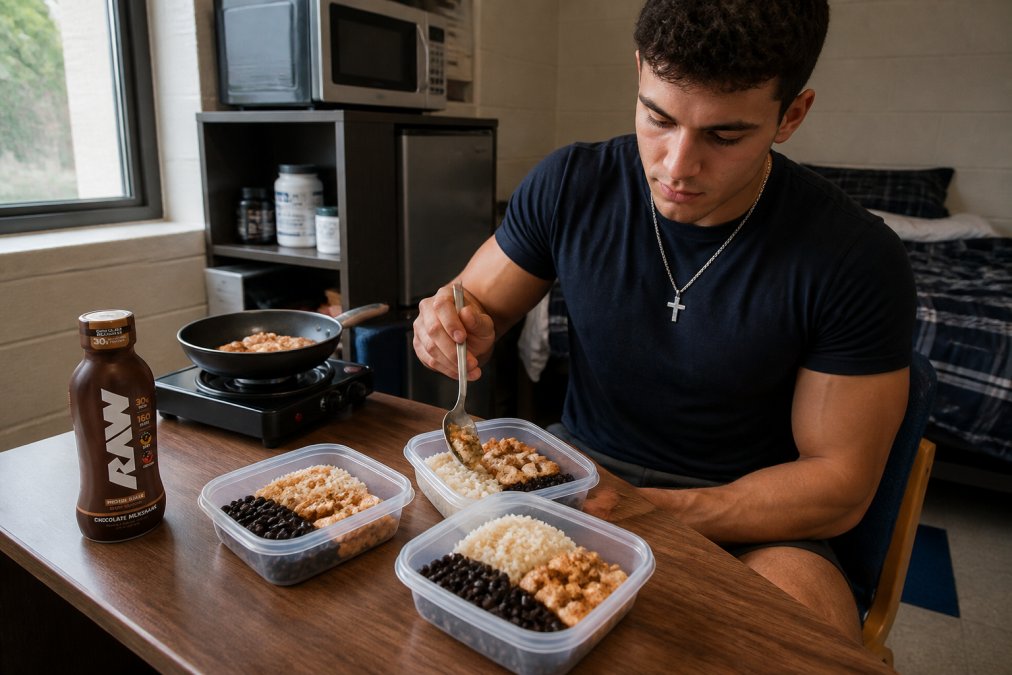
You don't need a full kitchen. A hot plate, microwave, or mini-fridge is enough.
Sunday Prep (2 hours total):
- Cook 3 pounds of chicken thighs in the oven or slow cooker. Cost: $4-$5. Yield: 12 servings of 30g protein each.
- Cook 5 cups dry white rice. Cost: $2-$3. Yield: 15 servings of 45g carbs each.
- Cook 3 cans of black beans. Cost: $2. Yield: 9 servings of 20g carbs and 7g protein each.
- Prep frozen vegetables. Cost: $3-$4. Microwave when ready.
Total cost: $11-$14 for 12 meals. That's $0.92-$1.17 per meal.
Daily assembly (2 minutes):
- Grab one container of chicken
- Add one serving of rice
- Add one serving of beans
- Microwave for 90 seconds
This system requires minimal equipment: a slow cooker (one-time investment), microwave-safe containers, and a mini-fridge. Most dorms have all three.
Batch Cooking Strategy for the Week
If you have shared dorm kitchen or apartment access, scale up:
Sunday batch cooking (3 hours):
- Cook 8 pounds of ground beef (80/20): $12-$14. Yield: 32 servings of 25g protein each.
- Cook 2 large batches of rice: $4. Yield: 30 servings.
- Cook 2 large batches of sweet potatoes: $4. Yield: 20 servings.
- Roast 5 pounds of mixed vegetables: $5. Yield: 20 servings.
Total cost: $25-$27 for 30 meals. That's $0.83-$0.90 per meal.
Store everything in glass containers with airtight seals. Grab a container, microwave, eat. This system works for 5 days. Batch cooking costs 30-40% less per meal than buying prepared foods or eating out.
Watch Out Use glass containers with airtight seals, refrigerate immediately, and consume cooked meals within 4 days. Improper food storage leads to foodborne illness.
Essential Supplements for Student Athletes
Now that your whole-food foundation is locked in, we can talk supplements. The sports nutrition market in the U.S. accounted for 92.1% of the North America sports nutrition industry in 2025. That massive market is built on convincing you that supplements are essential. They're not. But certain supplements deliver real value when your whole-food nutrition is dialed in. budget-friendly kitchen appliances.
When Whole Foods Aren't Enough
Three scenarios justify supplementation:
1. Post-workout timing window (0-2 hours after training) Your muscles need protein and carbs immediately after training. Whole food takes 1-2 hours to digest. A protein shake takes 30-45 minutes. If you're training at 6 AM before class, whole food isn't practical.
2. Total daily protein targets If you weigh 180 pounds and train hard, you need 126-180 grams of protein daily. Hitting that from whole food alone requires eating 6+ chicken breasts or 18+ eggs. One post-workout protein shake bridges the gap.
3. Micronutrient gaps If your budget forces you to eat mostly rice, beans, and chicken, you're missing micronutrients like calcium, iron, and vitamin D. A basic multivitamin fills those gaps.
Everything else is optional.
Supplement Safety and Quality Without Premium Pricing
Supplement quality varies wildly. Some products are exactly what the label claims. Others contain undisclosed ingredients, contaminants, or nothing at all. Buy supplements that are NSF Certified for Sport or Informed Choice certified. These certifications mean the product was independently tested and contains what the label claims.
Your essential supplement stack for a student athlete:
| Supplement | Purpose | Frequency |
|---|---|---|
| Whey Protein Powder | Post-workout protein | Daily post-workout |
| Creatine Monohydrate | Strength & power | Daily (5g) |
| Multivitamin | Micronutrient insurance | Daily |
| Caffeine | Pre-workout focus | Pre-training |
Everything else is marketing.
Cheapest Place to Buy Fitness Supplements Online
Price matters when you're on a student budget. But the cheapest price isn't always the best deal. A protein powder that tastes like cardboard and causes bloating costs more in wasted money and misery than one you'll actually drink.
Tiger Fitness positions itself as the destination for lowest prices on sports nutrition, backed by fast shipping and personalized customer service. When comparing supplement retailers, focus on three factors: price per serving, third-party testing, and return policy. Use FREE TOOLS & FITNESS CALCULATORS to dial in your exact macronutrient targets and supplement needs based on your body weight, training frequency, and goals, this removes guesswork from your purchasing decisions.
Ready-to-Drink Protein: Convenience vs. Cost
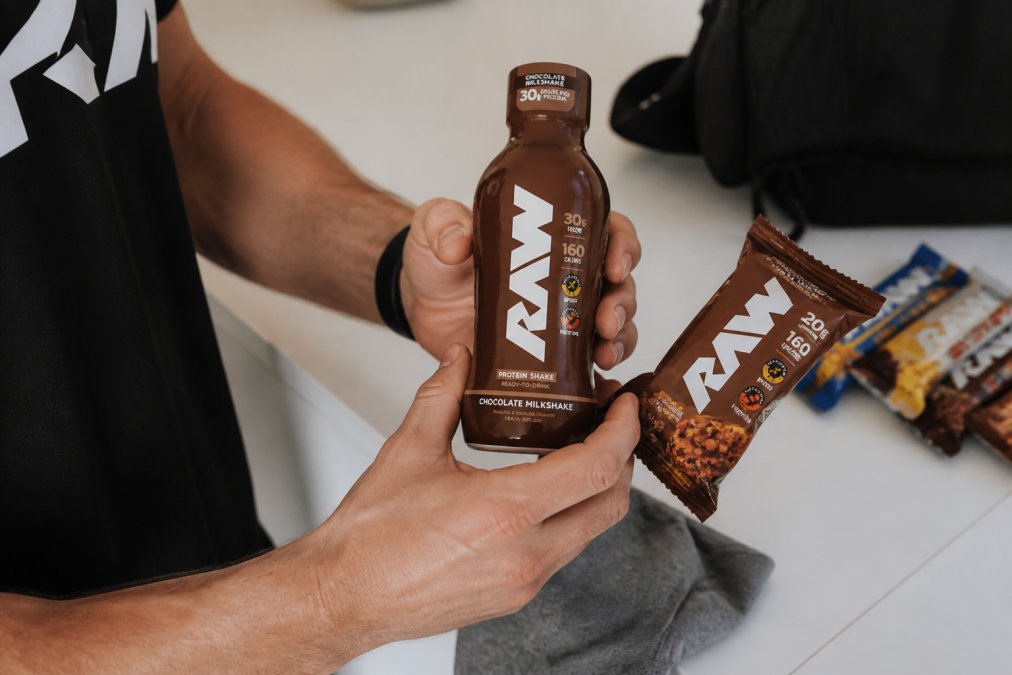
Ready-to-drink (RTD) protein shakes offer maximum convenience. Grab, shake, drink. No blender, no cleanup, no measuring. The cost is the tradeoff.
RTD Protein Cost Analysis:
| Product | Serving Size | Protein/Dollar |
|---|---|---|
| RAW Nutrition Protein RTD | 1 bottle (30g protein) | 7.6g |
| Bucked Up Protein RTD | 1 bottle (varies) | 6-8g |
| GHOST Protein Drink | 1 bottle (25g protein) | 6.3g |
| Powder (Nutrex ISOFIT) | 1 scoop (25g protein) | 10.4g |
Powder costs 40% less per gram of protein. But RTD shakes solve a real problem: you can't always prepare a shake. You're between classes, at the gym, or traveling. Strategy: buy powder as your base (90% of servings). Buy RTD shakes for situations where mixing isn't practical (10% of servings).

Protein Bars and Snacks That Fit Your Budget
Protein bars are expensive per gram of protein but solve a real problem: they're portable, shelf-stable, and require zero preparation.
Budget protein bar options:
- Mammoth Protein Bars: Quality baseline with bulk pricing available.
- Bucked Up Protein Popcorn: Sweet-salty kettle corn flavor, 10-15g protein per serving.
- Lenny & Larry's Protein Candy Bar: High-protein candy alternative, satisfies sweet cravings without derailing nutrition.
- David Protein Bar: Premium option with clean ingredients.
Protein bars are 3-5x more expensive per gram of protein than powder. Use them for convenience when traveling or between classes, not as your primary protein source. One bar per day as a snack is reasonable.
Pro Tip Buy protein snacks in bulk packs from Tiger Fitness or warehouse clubs. A 12-pack of protein bars costs 20-30% less per bar than buying singles.
Pre-Workout and Post-Workout Fueling on a Student Budget
Pre-workout and post-workout nutrition is where most students waste money. The industry sells premium supplements. The reality is simpler.
Pre-workout (30-60 minutes before training):
- Carbs: 30-50 grams (banana, rice cakes, oatmeal)
- Protein: 10-20 grams (optional; mainly for convenience)
- Fat: minimal (slows digestion)
- Caffeine: 150-300mg (coffee, tea, or budget pre-workout)
A banana plus rice cakes plus coffee totals minimal cost.
Post-workout (within 2 hours of training):
- Protein: 25-40 grams (whey powder, chicken, eggs)
- Carbs: 40-80 grams (rice, pasta, fruit, oats)
- Electrolytes: optional (water is usually sufficient)
Use whole foods for 90% of pre/post-workout nutrition. Use supplements only when whole foods aren't practical. This approach costs $1-$3 per day instead of $10-$15 if you're buying premium pre/post-workout supplements.
Hydration and Micronutrient Strategy Without Overspending
Hydration is free. Water costs nothing. Electrolyte drinks cost more. For training under 60 minutes, water is sufficient. For training over 90 minutes or in hot environments, electrolytes matter.
Your micronutrient priorities as a student athlete:
Calcium: 1,000-1,200mg daily. Sources: milk, yogurt, canned fish with bones.
Iron: 8-18mg daily (depending on sex). Sources: red meat, beans, fortified cereals.
Vitamin D: 600-800 IU daily. Sources: fatty fish, fortified milk, sunlight (free).
If your diet is lacking in any of these, a basic multivitamin covers all three. That's your insurance policy.
Drink water during training. Drink electrolyte drinks only for workouts over 90 minutes. This costs minimal compared to specialty sports drinks.
The core strategy is straightforward: build your nutrition foundation from cheap whole foods (rice, beans, eggs, chicken). Use supplements to fill specific gaps when whole foods aren't practical. Avoid premium pricing for convenience. A student athlete spending $3-$5 per day on nutrition builds muscle just as effectively as one spending $15-$20 per day. The difference is strategy, not supplements.
Tiger Fitness provides the tools to execute this strategy: lowest prices on quality supplements and a rewards program that compounds your savings over time. Start with whole foods, add supplements strategically, and track your results. That's how you build affordable sports nutrition for students that actually works.
=== FAQ ANSWERS (audit these too, same rules) ===
[1] Q: What are the most cost-effective protein sources for student athletes? A: Eggs, Greek yogurt, canned tuna, and bulk chicken are your best bets for protein density per dollar. A 2017 study of college students found that 66% used supplements at least weekly, but whole foods deliver better value. Eggs run about $0.019 per gram of protein, while protein powder starts around $0.03-$0.05 per gram. Ready-to-drink options like RAW Nutrition Protein RTD at $3.95 per bottle deliver 30 grams of protein for convenience, but cost more per serving than powder. Focus on whole foods first, then fill gaps with affordable supplements.
[2] Q: How can students balance affordable sports nutrition with a limited budget? A: The mean monthly expenditure on supplements by college students is $17, with 19.5% spending $30 or more per month. Start by buying staple carbs (rice, oats, potatoes), cheap proteins (eggs, beans, canned fish), and frozen vegetables in bulk. Meal prep on weekends eliminates expensive last-minute food purchases. Skip premium-branded supplements and focus on basic creatine monohydrate (like Bucked Up Creatine Candy at $23.96) and whey protein isolate (Nutrex ISOFIT at $59.99 for larger containers). The real savings come from planning, not from chasing the cheapest individual products.

[3] Q: Are budget-friendly supplements as effective as premium brands? A: Yes, if they're third-party tested and contain the right active ingredients. Creatine monohydrate is creatine monohydrate, the research on it is identical whether it costs $15 or $40 per serving. Whey protein isolate delivers the same amino acid profile regardless of brand. What changes with price is convenience (ready-to-drink vs. powder), taste, and branding. A 2017 study showed college students often lack education on what supplements actually do, leading to overspending on unnecessary products. Focus on proven ingredients at any price point, not on brand names.
[4] Q: What should a student athlete prioritize in their diet for performance? A: Macronutrient balance comes first: adequate protein for muscle repair, carbohydrates for energy and glycogen replenishment, and healthy fats for hormone production. A 2025 study found high school athletes averaged only 45% nutrition knowledge, often overestimating protein needs while underestimating carbohydrate requirements. Prioritize whole foods that deliver all three macros, then add micronutrients like calcium, iron, and vitamin D through food or affordable supplements. Hydration status matters as much as nutrition, water costs nothing and beats expensive sports drinks for most training sessions under 90 minutes.
[5] Q: Is it possible to meet nutritional needs through whole foods alone as a student athlete? A: Yes, but it requires planning and access to basic cooking facilities. Whole foods provide superior nutrient density and cost less per calorie than most supplements. However, time constraints, limited dorm kitchens, and athletic schedules make whole foods alone impractical for many students. That's where affordable ready-to-drink options and protein bars fill gaps. The goal is 80% whole foods, 20% convenient supplements to fit your actual life as a student. This approach beats trying to be perfect with limited resources.
Frequently Asked Questions
What are the most cost effective protein sources for student athletes?
Eggs, Greek yogurt, canned tuna, and bulk chicken are your best bets for protein density per dollar. A 2017 study of college students found that 66% used supplements at least weekly, but whole foods deliver better value. Eggs run about $0.019 per gram of protein, while protein powder starts around $0.03-$0.05 per gram. Ready-to-drink options like RAW Nutrition Protein RTD at $3.95 per bottle deliver 30 grams of protein for convenience, but cost more per serving than powder. Focus on whole foods first, then fill gaps with affordable supplements.
How can students balance affordable sports nutrition with a limited budget?
The mean monthly expenditure on supplements by college students is $17, with 19.5% spending $30 or more per month. Start by buying staple carbs (rice, oats, potatoes), cheap proteins (eggs, beans, canned fish), and frozen vegetables in bulk. Meal prep on weekends eliminates expensive last-minute food purchases. Skip premium-branded supplements and focus on basic creatine monohydrate (like Bucked Up Creatine Candy at $23.96) and whey protein isolate (Nutrex ISOFIT at $59.99 for larger containers). The real savings come from planning, not from chasing the cheapest individual products.
Are budget-friendly supplements as effective as premium brands?
Yes, if they're third-party tested and contain the right active ingredients. Creatine monohydrate is creatine monohydrate, the research on it is identical whether it costs $15 or $40 per serving. Whey protein isolate delivers the same amino acid profile regardless of brand. What changes with price is convenience (ready-to-drink vs. powder), taste, and branding. A 2017 study showed college students often lack education on what supplements actually do, leading to overspending on unnecessary products. Focus on proven ingredients at any price point, not on brand names.
What should a student athlete prioritize in their diet for performance?
Macronutrient balance comes first: adequate protein for muscle repair, carbohydrates for energy and glycogen replenishment, and healthy fats for hormone production. A 2025 study found high school athletes averaged only 45% nutrition knowledge, often overestimating protein needs while underestimating carbohydrate requirements. Prioritize whole foods that deliver all three macros, then add micronutrients like calcium, iron, and vitamin D through food or affordable supplements. Hydration status matters as much as nutrition, water costs nothing and beats expensive sports drinks for most training sessions under 90 minutes.
Is it possible to meet nutritional needs through whole foods alone as a student athlete?
Yes, but it requires planning and access to basic cooking facilities. Whole foods provide superior nutrient density and cost less per calorie than most supplements. However, time constraints, limited dorm kitchens, and athletic schedules make whole foods alone impractical for many students. That's where affordable ready-to-drink options and protein bars fill gaps. The goal is 80% whole foods, 20% convenient supplements to fit your actual life as a student. This approach beats trying to be perfect with limited resources.
Leave a comment