
Pick This Year's Olympia T-Shirt

Last Updated: August 27, 2026
Whey protein is a complete, fast absorbing protein source derived from milk containing all nine essential amino acids your body cannot produce. If you're serious about building muscle, the best whey protein for beginners isn't optional, it's foundational. Your muscles don't grow in the gym. They grow during recovery, and recovery demands protein.
According to International Food Information Council (IFIC) 2025 report, 70% of Americans in 2025 aimed to consume adequate protein. The problem is most people don't hit targets through food alone. Whey protein solves this: a single scoop delivers 20-30g of protein in seconds, triggering muscle protein synthesis faster than whole foods. Research from the Nutrients journal peer-reviewed study on whey supplementation (2017) found that consuming an additional 25g of whey protein post-workout contributed to greater whole body protein balance over 24 hours compared to carbohydrate supplementation alone.
The most common beginner mistake? Overthinking it. Beginners buy overpriced isolates when concentrates work just fine. They chase exotic flavors instead of consistent taste. They ignore price per-serving and end up with supplements they can't afford to use consistently.
Whey protein concentrate (WPC) contains 70-80% protein, with the remainder being natural fats and carbohydrates (lactose). Whey protein isolate (WPI) is processed further, removing most fat and lactose, yielding 90%+ protein content.

For beginners, concentrate is the move. You get 80% of the results at 60% of the cost. Isolate makes sense if you're lactose intolerant, tracking macros aggressively, or running a strict cut where every carb matters. Otherwise, you're paying extra for a problem you don't have.
According to Mordor Intelligence United States Whey Protein Ingredients Market (2026), whey protein concentrates dominated 51.31% of the U.S. whey protein ingredients market share in 2025. That's not accident, it's because concentrates work, taste better, and don't drain your wallet.
Hydrolyzed whey (hydrolysate) sits between them: pre-broken down protein that absorbs fastest but costs the most. For beginners, skip it. The speed difference is negligible in real life.
The real differentiator? Lactose tolerance. If dairy causes bloating, gas, or digestive issues, isolate or a hydrolysate blend is non-negotiable. Otherwise, concentrate delivers the leucine, branched-chain amino acids (BCAAs), and essential amino acid profile you need without the premium price tag.
Building muscle with whey protein requires three things: adequate total protein intake, consistent training stimulus, and caloric surplus. Protein powder handles the first part, but only if you use it strategically.

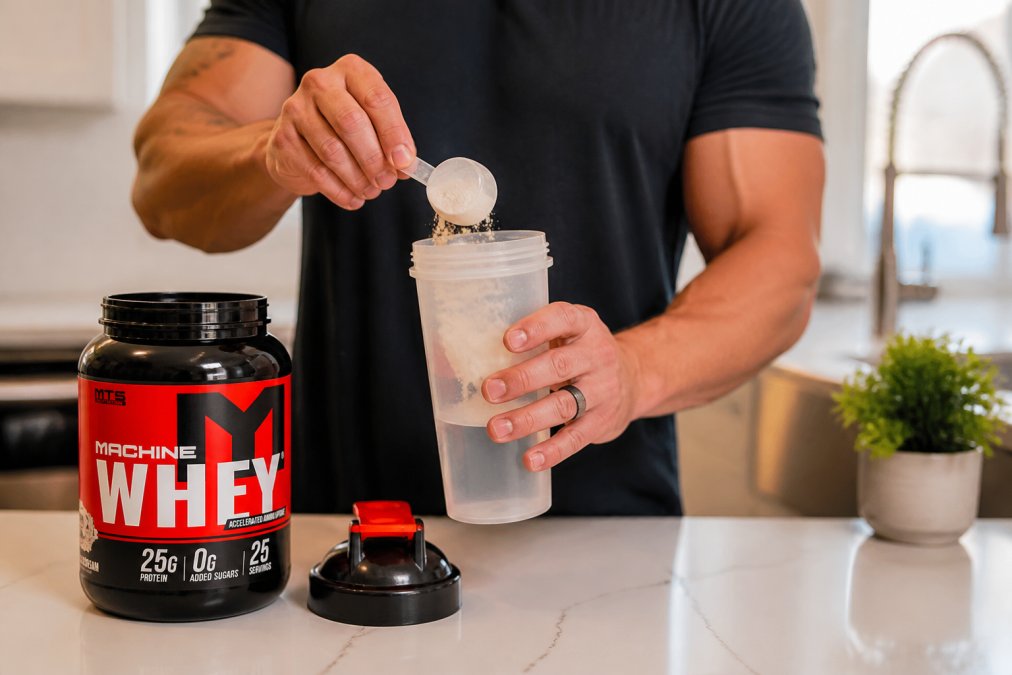
Calculate your daily protein target: 0.7-1g per pound of bodyweight. A 180-pound beginner needs 126-180g daily. Distribute that across 4-5 meals, using whey protein to fill gaps where whole food is impractical, post-workout, between meals, or first thing in the morning.
Most beginners consume 25-30g per serving, which aligns with research on optimal muscle protein synthesis stimulation. According to Council for Responsible Nutrition survey (2026), 43% of U.S. adults regularly consume protein supplements, predominantly whey-based.
Consistency beats timing. Yes, post-workout protein is ideal. But if you miss your daily target by 20g, that matters more than whether you drank it at 3 p.m. or 4 p.m.
Beginner framework in action: 180-pound trainee targeting 150g protein daily. Breakfast: 30g (eggs and toast). Post-workout shake: 30g (whey). Lunch: 35g (chicken and rice). Snack: 25g (Greek yogurt). Dinner: 30g (fish and vegetables). Total: 150g. Two servings of whey powder made this achievable without eating chicken six times a day.
Your muscles don't stop accepting protein 30 minutes after your last rep. That's a myth that's cost supplement companies billions in unnecessary urgency marketing.
The real science: consuming protein within 2 hours post-workout is optimal. Beyond that? Still effective, just slightly less so. The difference between immediate and 2-hour post-workout is roughly 5-10% in muscle protein synthesis, meaningful in a controlled study, negligible in real life if you're hitting your daily total.
For beginners, the priority ranking is:
Morning protein is underrated. A 30g shake with oats first thing jumpstarts muscle protein synthesis after an 8-hour fast. Pre-workout protein is unnecessary; save it for post. Between-meal shakes prevent energy crashes and keep you satiated.
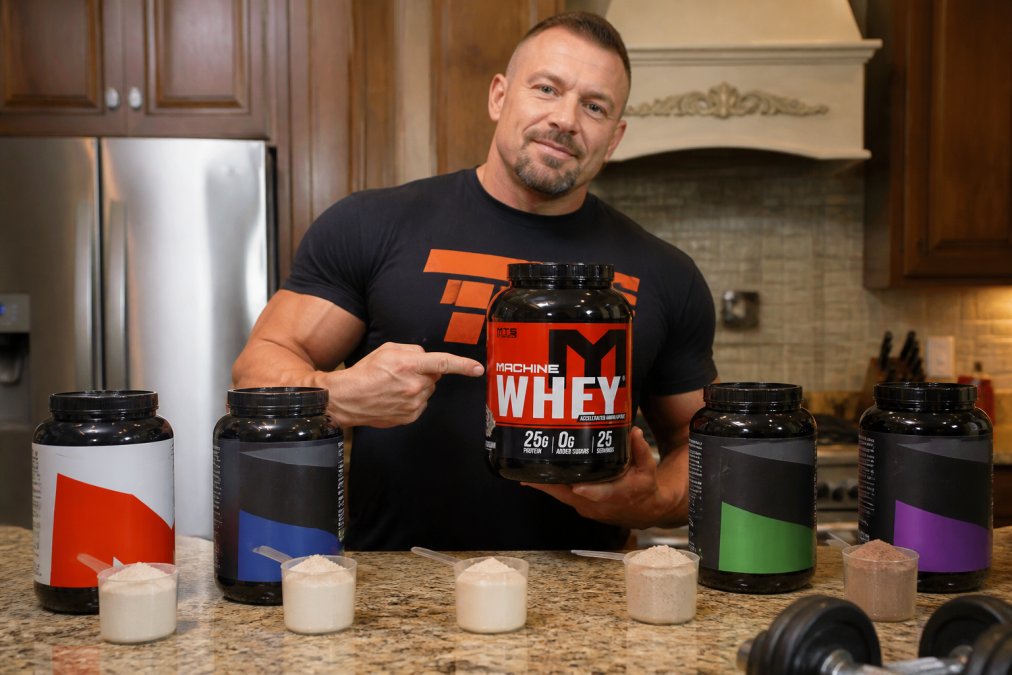
These recommendations are ranked by value, taste, mixability, and whether beginners will actually use them consistently.
Machine Whey is the no-nonsense choice. It's a blend of 80% whey protein concentrate and whey isolate, delivering 25g protein per scoop with 5.5g BCAAs and 2.7g leucine. The formula hits the sweet spot: high protein content, genuine taste, and pricing that won't break your budget.
The real advantage is mixability and flavor consistency. Most budget proteins taste like chalk. Machine Whey tastes like an actual shake. Flavors like Cookies and Cream, Peanut Butter Cookies and Cream, and Ice Cream Sandwich are genuinely good enough that you'll look forward to drinking them.
Marc Lobliner, CEO of MTS Nutrition, designed this specifically for athletes who need protein that works without unnecessary complexity. No proprietary blends hiding weak ingredients. Just effective protein at a price that makes sense for beginners.
Best for: Budget-conscious beginners who prioritize consistency and taste over isolate purity. Perfect for daily use post-workout or between meals.
Dymatize Elite delivers 25g of 100% whey protein (isolate and concentrate blend) with 5.5g BCAAs, 4g glutamine, and 2.7g leucine per serving. The glutamine addition supports immune function during heavy training, a detail most budget brands skip.
This is the middle-ground option. Better ingredient quality than concentrate-only powders, better value than pure isolate. It mixes clean, tastes legitimate, and delivers consistent results. Dymatize has been trusted by competitive athletes for years for good reason.
Best for: Beginners stepping up from basic concentrates who want proven brand reliability without isolate pricing.
ON Gold Standard combines whey isolate, concentrate, and hydrolyzed whey peptides, delivering 24g protein with 5.5g BCAAs per serving. This is the benchmark. If you've ever tried a protein shake at a supplement store or gym, it was probably Gold Standard. The taste is refined, mixability is flawless, and the ingredient profile is transparent. Forbes' research team rated it 5 stars, and Labdoor gave it a perfect score for label accuracy and purity.

The downside? Cost. For beginners on a tight budget, this is overkill. But if budget isn't the constraint, Gold Standard is the safe choice.
Best for: Beginners who want the most trusted option and don't mind paying for proven quality and brand reputation.
ISO 100 is pure whey protein isolate, 25g per serving with virtually zero sugar and less than 1g fat. This is for beginners with lactose sensitivity or those tracking macros obsessively for competition prep.
If regular whey causes bloating or digestive issues, ISO 100 eliminates that problem. The hydrolyzed isolate format absorbs faster than concentrate, which matters if you're training twice daily or competing. For most beginners though, this is unnecessary.
Best for: Lactose-intolerant beginners or those running aggressive cuts where every carb and fat gram matters.
KAGED delivers 25g pure whey isolate per serving with Informed Sport certification and banned substance testing. If you compete in sports with strict supplement policies, this removes doubt. No artificial flavors or colors, just clean ingredients.
The third-party testing is the differentiator. If you're nervous about contamination or banned substances, KAGED's transparency is worth the investment.
Best for: Competitive athletes or beginners in tested sports who need verified purity and transparency.
| Product | Type | Protein/Serving | Best For | Key Feature |
|---|---|---|---|---|
| Machine Whey | Concentrate/Isolate Blend | 25g | Budget beginners | Best taste at lowest price |
| Dymatize Elite 100% | Concentrate/Isolate Blend | 25g | Value seekers | Includes glutamine for recovery |
| ON Gold Standard | Isolate/Concentrate/Hydrolysate | 24g | Quality-first | #1 trusted brand globally |
| Dymatize ISO 100 | Isolate | 25g | Lactose sensitive | Ultra-low carb/fat |
| KAGED Isolate | Isolate | 25g | Tested athletes | Third-party certified |
The International Society of Sports Nutrition recommends 1.4-2.0g per kilogram of bodyweight for muscle building, which is roughly 0.64-0.91g per pound.
For a 180-pound beginner, that's 126-180g daily. Beginners often underestimate this. They eat 80-100g and wonder why they're not growing. The problem isn't the training, it's protein.
Framework:
Don't obsess over hitting exactly 180g. Hit 150-180g consistently, and you're in the muscle-building zone. Missing by 10-20g occasionally doesn't matter. Missing by 50g regularly does.
Whey protein makes this achievable. Two 25g shakes cover 50g, roughly one-third of your daily target. The rest comes from real food.
Use these criteria in order:
1. Protein per serving (20-30g minimum). Below 20g, you're wasting money on filler. Above 30g per scoop, the powder gets chalky and doesn't mix well. Target 25g as the sweet spot.
2. Taste you'll actually drink. This is non-negotiable. A perfect protein that tastes like cardboard gets abandoned after two weeks. Buy the flavor that excites you. Vanilla, chocolate, and cookies-and-cream are safest bets for beginners.
3. Price per serving. Calculate cost divided by servings per container. Both budget and premium options work. One fits your budget better.
4. Ingredient transparency. Avoid proprietary blends hiding weak ingredients. Look for WPC-80 or WPI-90 specifically listed. Avoid artificial sweeteners if they bother your digestion. Stevia is gentler on most stomachs.
5. Third-party testing (optional but smart). NSF, Informed Sport, or Labdoor certification means independent verification of label accuracy and contamination screening.
6. Mixability. Read reviews specifically about clumping and texture. Some powders mix perfectly with water. Others need a blender. For beginners, easy mixing removes friction from consistency.
Beginner checklist:
Start with Machine Whey or Dymatize Elite. Both hit every checkbox. Use it consistently for 4 weeks. If you hate the taste, switch. If it works, buy in bulk and save money.
Building muscle as a beginner doesn't require expensive supplements or complex protocols. It requires consistent training, adequate protein, and caloric surplus. Whey protein makes the protein part achievable. Use FREE TOOLS & FITNESS CALCULATORS to dial in your exact daily protein targets and caloric needs based on your bodyweight and training frequency, no guessing required. Tiger Fitness carries the full range of products covered here, from budget concentrates to premium isolates, backed by fast shipping and a rewards program that actually saves money on repeat purchases. Start with Machine Whey or ON Gold Standard, hit your daily protein target, and train hard. Results follow.
=== FAQ ANSWERS (audit these too, same rules) ===
[1] Q: What protein powder is best for beginners? A: Machine Whey Protein is the best starting point for most beginners. It blends whey concentrate (80% WPC) with isolate to deliver 20-25g of protein per scoop at an affordable price point. It mixes well, tastes good, and provides all essential amino acids including the branched-chain amino acids (BCAAs) that drive muscle protein synthesis. For those with lactose sensitivity, Dymatize ISO 100 or KAGED Whey Isolate are stronger choices because they remove most lactose through additional processing.
[2] Q: Should I buy whey protein as a beginner? A: Yes. Whey protein accelerates recovery and muscle growth when combined with resistance training. Research shows consuming 25g of whey protein post-workout enhances whole body protein balance over 24 hours compared to carbohydrate supplementation alone. While you can technically build muscle without supplements, whey protein is the most efficient and cost-effective way to hit your daily protein target, especially if you're training hard. Beginners benefit most from consistency, and a good whey powder removes the friction of meal prep.
[3] Q: How much protein do I need per day as a beginner? A: Aim for 0.7-1.0g of protein per pound of body weight daily if you're training with weights. For a 180-pound beginner, that's 126-180g per day. Whey protein should fill the gap between whole food sources and your total target. One scoop (20-25g) post-workout plus one serving between meals covers roughly 40-50g. The rest comes from chicken, eggs, Greek yogurt, and other whole foods. Start tracking your intake using a fitness calculator to dial in your exact needs.
[4] Q: When should I take my protein shake for best results? A: Post-workout (within 2 hours after training) is the priority window because your muscles are primed to absorb amino acids and rebuild. Take 20-30g of whey protein within this window to maximize muscle protein synthesis. Outside of training, drink protein shakes between meals or first thing in the morning to boost daily intake without adding significant calories. Timing matters less than total daily protein intake, so consistency across the day matters more than hitting a magic 30-minute window.
[5] Q: What's the difference between whey isolate and whey concentrate? A: Whey concentrate (WPC-80) contains 70-80% protein with more natural fats and carbohydrates (including lactose). It's cheaper, tastes creamier, and works great for most beginners. Whey isolate (WPI) is processed further to remove 90%+ of fats and lactose, making it leaner and faster-digesting, ideal if you have lactose sensitivity or are on a strict diet. Both deliver full amino acid profiles and drive muscle growth equally well. Choose concentrate first; switch to isolate only if you experience bloating or digestive issues.
Machine Whey Protein is the best starting point for most beginners. It blends whey concentrate (80% WPC) with isolate to deliver 20-25g of protein per scoop at an affordable price point. It mixes well, tastes good, and provides all essential amino acids including the branched-chain amino acids (BCAAs) that drive muscle protein synthesis. For those with lactose sensitivity, Dymatize ISO 100 or KAGED Whey Isolate are stronger choices because they remove most lactose through additional processing.
Yes. Whey protein accelerates recovery and muscle growth when combined with resistance training. Research shows consuming 25g of whey protein post-workout enhances whole body protein balance over 24 hours compared to carbohydrate supplementation alone. While you can technically build muscle without supplements, whey protein is the most efficient and cost-effective way to hit your daily protein target, especially if you're training hard. Beginners benefit most from consistency, and a good whey powder removes the friction of meal prep.
Aim for 0.7-1.0g of protein per pound of body weight daily if you're training with weights. For a 180-pound beginner, that's 126-180g per day. Whey protein should fill the gap between whole food sources and your total target. One scoop (20-25g) post-workout plus one serving between meals covers roughly 40-50g. The rest comes from chicken, eggs, Greek yogurt, and other whole foods. Start tracking your intake using a fitness calculator to dial in your exact needs.
Post-workout (within 2 hours after training) is the priority window because your muscles are primed to absorb amino acids and rebuild. Take 20-30g of whey protein within this window to maximize muscle protein synthesis. Outside of training, drink protein shakes between meals or first thing in the morning to boost daily intake without adding significant calories. Timing matters less than total daily protein intake, so consistency across the day matters more than hitting a magic 30-minute window.
Whey concentrate (WPC-80) contains 70-80% protein with more natural fats and carbohydrates (including lactose). It's cheaper, tastes creamier, and works great for most beginners. Whey isolate (WPI) is processed further to remove 90%+ of fats and lactose, making it leaner and faster digesting, ideal if you have lactose sensitivity or are on a strict diet. Both deliver full amino acid profiles and drive muscle growth equally well. Choose concentrate first; switch to isolate only if you experience bloating or digestive issues.
{"one"=>"Select 2 or 3 items to compare", "other"=>"{{ count }} of 3 items selected"}




Leave a comment