
NEW NULLA BAR FLAVORS
In-Stock Now!

Last Updated: October 31, 2026
Quick Summary
Third party supplement certifications are independent evaluations of a product's purity, potency, and composition by an organization with no financial stake in the manufacturer's sales. They are not government approval and not a guarantee the product works, and evidence suggests only a minority of products are certified at all.
Third party supplement certifications are independent evaluations of a product's purity, potency, and composition, performed by an organization with no financial stake in the manufacturer's sales. They are not a government approval, and they are not a guarantee that the product works.
Here's the uncomfortable truth: a 2018 review by researchers R. L. Bailey and colleagues found that how widely manufacturers actually use third-party certification was largely unknown, with evidence pointing to use in only a minority of cases (review of dietary supplement certification guidelines). Read that again.
So what does a seal actually buy you? A testing protocol run by someone other than the company selling the tub.
A certification program evaluates a defined scope: ingredient identity, label claim accuracy, purity, potency, and the presence of contaminants like heavy metals or microbes. Researchers S. R. Akabas and colleagues described three U.S. certification programs that independently assess dietary supplement quality across purity, potency, and composition (Quality Certification Programs for Dietary Supplements).
What most guides miss is the word scope. Each program draws its own boundaries. One may test finished products batch by batch; another audits the facility and samples periodically. Same seal family, different depth. Ask what's covered before you trust the mark.
Third-party testing and certification are not the same thing, and treating them as synonyms is the mistake I see constantly.
Third-party testing is a single event: a lab screens a sample and reports results. Certification is an ongoing program that combines testing with facility audits, manufacturing practice review, and surveillance over time. One is a snapshot.
That gap is where marketing gets slippery. A brand can run one lab test, publish a clean result, and call itself "third-party tested" forever. Certification requires the independent organization to keep checking, keep sampling, and keep the mark valid.
Here's how the two stack up:
| Factor | Third-Party Testing | Certification |
|---|---|---|
| What it covers | Single sample, single moment | Testing plus facility audit |
| Ongoing surveillance | None | Periodic retesting |
| Who pays | Manufacturer | Manufacturer |
| Public accountability | Limited | Mark can be pulled |
| Best for | Spot-checking a claim | Long-term product trust |
The takeaway: testing answers "was this batch clean?" Certification answers "does this company keep it clean?"
Here's the part most guides skip. Not every seal tests the same things, and a side-by-side matrix is the fastest way to see it. The three programs you'll actually run into on a U.S. shelf are NSF, USP, and Informed Choice/Informed Sport.
| What gets checked | NSF Certified for Sport | USP Verified | Informed Choice / Informed Sport |
|---|---|---|---|
| Ingredient identity | Yes | Yes | Yes |
| Label claim / potency | Yes | Yes | Yes |
| Heavy metals | Yes | Yes | Yes |
| Microbes | Yes | Yes | Yes |
| Facility GMP audit | Yes | Yes | Yes |
| Banned-substance screen | Yes | No | Yes |
| Finished-product batch testing | Yes | Yes | Yes |
| Public product directory | Yes | Yes | Yes |
Match the program to your actual need. If you compete, confirm that the program you rely on includes a banned-substance screen.
This is the honest boundary nobody prints on the label:
That last point is the one that bites people. A clean result today doesn't promise a clean batch next year. Use the mark as one filter among several, not as a substitute for reading the label and knowing your own goals.
Athletes face banned-substance risk that recreational lifters don't, so screening for substances prohibited in sport matters.
If you compete, this is the seal to hunt for. A tainted product can end a season, and no label claim protects you from that.
One caution: the mark confirms the screening happened, not that the product builds muscle. For a sport-specific pre-workout option, look at Gat Sport Nitraflex Sport. Certification is a safety and accuracy tool, not a results guarantee.
A supplement certificate of analysis is a document from a testing lab that reports what was found in a specific batch: identity, potency, and contaminant results. It's the paper trail behind the claim.
Ask for it. A real COA ties to a batch number, lists the tests run, and shows actual values, not just a pass/fail stamp. If a brand can't produce one tied to the product in your hand, the "tested" claim is decoration.
Learning to read these documents takes practice, and comparing a COA against the label is the fastest way to build that skill. Now Sports Kre Alkalyn® Creatine Capsules gives you a concrete product to evaluate.
Verifying supplement certification takes about two minutes if you know where to look. Don't take the seal's word for it.
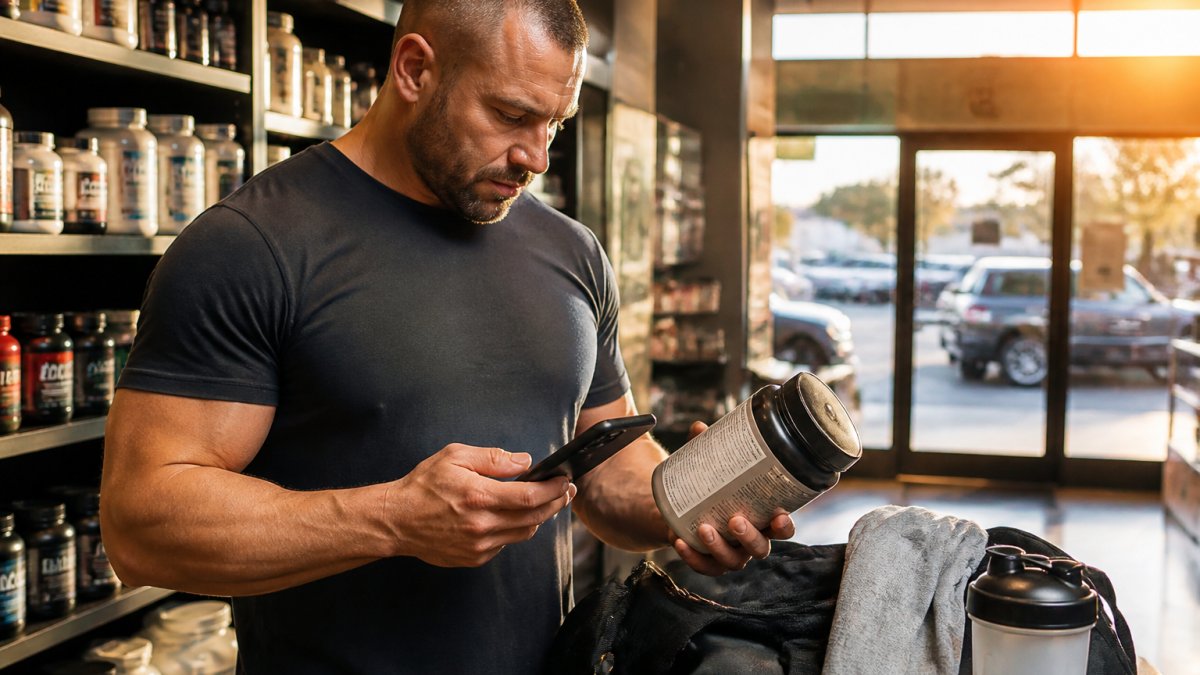
Here's the checklist we'd run:
Watch out: a logo can be copied onto a label without any testing behind it. The directory search is the step people skip, and it's the only one that proves the mark is real.
Every major program runs a public product directory. Go to the source, not the brand's website:
Search the certifying organization's official product directory for the exact product name and formulation.
If the product isn't in the directory, the seal on the tub is decoration. That's the whole test.
This is where people get fooled. A brand can have one certified SKU and twenty uncertified ones. The directory listing has to match the exact product and formulation you're holding. A certified pre-workout in one flavor does not certify the whole line.
Once you find the listing, read what it covers. Does the certification include a banned-substance screen, or only identity and contaminants? Does it cover the finished product or just the facility? Then check the batch number on the container against the listing or COA. If the batch doesn't match, the paperwork doesn't apply to what's in your hand.
A pass result means the tested batch met that program's criteria at the time of testing. It does not mean the product is effective, safe for every person, or FDA-approved. It's a quality and accuracy filter, not a results guarantee. Read it that way and you'll never be surprised.
Certification cannot tell you a supplement is effective or risk-free. The Office of Dietary Supplements describes certification as independent evaluation or testing, and supplies no evidence that it establishes clinical effectiveness or guarantees safety (why third-party certification matters for supplements).
That's the honest boundary. A certified product passed specific screens. It did not prove it will add muscle, burn fat, or fix your recovery. Those outcomes depend on training, diet, and consistency, and no seal changes that.
Certification frequency and sampling also vary by program, so a clean result today doesn't promise a clean batch next year. Use the mark as one filter among several, not as a substitute for reading the label and knowing your own goals.
Building a stack around certified products is the smart play, and it starts with knowing what you're actually buying. Start with the products that carry the strongest verification for your use case, then fill in the rest.
If you're new to this, start with the products that carry the strongest verification for your use case, then fill in the rest. The Ultimate Beginner Stack is a curated starter stack of certified products.
Certification won't lift the weight for you. It just means you're not guessing about what's in the tub.
Third-party tested supplements are products sent to an independent lab, not the manufacturer's own facility, to check ingredient identity, potency, purity, and contaminant levels. The testing lab has no financial stake in the result. How widely manufacturers use third-party certification is largely unknown. That means the seal on the bottle is doing real work: it tells you someone outside the brand checked the batch.
Testing is a single lab analysis of a batch. Certification is an ongoing program: an independent organization tests products, audits the manufacturing facility, and lets the brand use a seal only while it keeps meeting the standard. Testing is a snapshot; certification is surveillance over time. A brand can test one batch and never repeat it. A certification program like NSF or USP requires continued compliance, which is why certification carries more weight than a one-off lab report.
No. Certification verifies that a product was independently evaluated for quality factors such as purity, potency, and composition. Certification does not establish clinical effectiveness or guarantee safety. It confirms the label matches the contents and that contaminants were screened, not that the product will deliver results. Treat the seal as one filter in your buying decision, not a free pass.
Go to the certifying body's own product directory, not the brand's website. Match the exact product name, form, and batch where listed. If a bottle shows a seal but the product does not appear in the certifier's directory, treat the claim as unverified. A supplement certificate of analysis from the manufacturer is useful, but it is self-reported unless an independent lab produced it.
No. NSF Certified for Sport is a stricter program built for athletes. It is designed for athletes and is the sport-specific option to look for when drug-testing rules apply. If you compete under drug-testing rules, the sport-specific seal is the one that matters.
Look for a recognized seal from an independent organization, then confirm it in that organization's product directory. Check that the label lists exact ingredient amounts, not a vague proprietary blend. Request or review the certificate of analysis if the brand publishes one. A verified seal plus a full ingredient panel is your strongest combination.
The supplement aisle is full of logos that mean less than they appear to. At Tiger Fitness, we stock products with transparent testing and give you the tools to check them yourself, from free fitness calculators to workout plans that put your stack to work. Get started with Tiger Fitness and build a stack you can actually verify.
{"one"=>"Select 2 or 3 items to compare", "other"=>"{{ count }} of 3 items selected"}







Leave a comment