




Rebuild Muscle After Shoulder Injury: Science-Backed Steps
Table of Contents
- Understanding Your Shoulder Anatomy and Injury Types
- Physical Therapy for Shoulder Injury: Foundation Before Lifting
- Phase 1: Restore Range of Motion and Mobility
- Phase 2: Isometric Strengthening and Scapular Stabilization
- Shoulder Injury Rehabilitation Exercises: Progressive Resistance Training
- Strengthening Exercises After Shoulder Surgery: Return-to-Lifting Protocol
- How to Rebuild Muscle After Shoulder Injury Without Re-Injury
- Shoulder Injury Recovery Timeline: What to Expect
Rebuild Muscle After Shoulder Injury: Science-Backed Steps
Last Updated: July 27, 2026
You can't jump back into heavy pressing after a shoulder injury. Most lifters try it anyway and end up sidelined for another six months. Rebuilding muscle after shoulder injury requires a structured, progressive approach that respects healing timelines while maintaining muscle mass elsewhere. The difference between successful recovery and re-injury comes down to following a phase-based protocol, not guessing.
Your shoulder didn't fail because you were too careful. It failed because something in your training, recovery, or mechanics broke down. Before you touch a barbell again, understand what happened, get professional clearance, and rebuild from the ground up.
Pro TipThe biggest mistake is starting resistance training too early. Most people get 50% range of motion back, feel "good enough," and start benching. That's how you turn a 6-week injury into a 6-month setback. Patience now saves months later.
Understanding Your Shoulder Anatomy and Injury Types
Your shoulder is the most mobile joint in your body, incredibly strong when healthy, incredibly vulnerable when damaged. The shoulder complex includes the rotator cuff (supraspinatus, infraspinatus, teres minor, subscapularis), the deltoid, the labrum, and scapular stabilizers. When any structure fails, your entire pressing pattern collapses.
Common Shoulder Injuries That Affect Muscle Rebuilding
Rotator cuff strains and tears are most common, ranging from minor inflammation to full-thickness tears requiring surgery. Labral tears (SLAP or Bankart lesions) damage the cartilage ring stabilizing the joint. Impingement syndrome occurs when soft tissue gets compressed between bones. Tendonitis involves inflammation from overuse or poor mechanics. Post-surgical cases require the most conservative approach.
The injury type determines your starting point. A minor strain might allow Phase 1 exercises within two weeks. A surgical repair requires four to six weeks of complete rest before any active movement. Professional assessment matters, you can't guess your way through this.
Why Standard Training Won't Work Right Now
Standard strength training assumes full range of motion, proper scapular control, and pain-free movement. None of that exists right now. What you need is progression that rebuilds these capacities in order: range of motion, isometric strength in safe positions, controlled resistance with proper mechanics, then return to sport-specific movements. Rushing this progression costs you months.
Watch OutContinuing to train around a shoulder injury by "just doing legs" doesn't work. Compensation patterns you develop will delay recovery and create new injuries. Complete rest from aggravating movements for 2-4 weeks is usually necessary.
Physical Therapy for Shoulder Injury: Foundation Before Lifting
You need professional guidance. A physiotherapist or orthopedic physical therapist can assess your specific injury, identify movement restrictions, and guide you through early-stage rehabilitation safely.
When to Work With a Physiotherapist
Start physical therapy immediately after injury or surgery. Early intervention prevents secondary problems like frozen shoulder, which can develop within weeks of immobilization. A physiotherapist will assess your range of motion, strength, scapular control, and pain patterns to identify which movements are safe.
If you had surgery, follow your surgeon's specific restrictions exactly. Post-surgical protocols protect the repair while it heals. Violating them might feel fine for weeks, then suddenly you're back in the operating room.
Getting Clearance to Progress
Work with your physiotherapist to establish clear benchmarks: pain-free passive range of motion in specific planes, ability to perform scapular stabilization exercises without compensation, isometric strength at 50% of your uninjured side, and pain-free active range of motion through 80% of normal movement. Only when you consistently meet these benchmarks should you progress to the next phase.
Phase 1: Restore Range of Motion and Mobility
This phase typically lasts 2-4 weeks post-injury or post-surgery. Your goal is restoring pain-free range of motion and reducing inflammation. You're rebuilding the foundation.
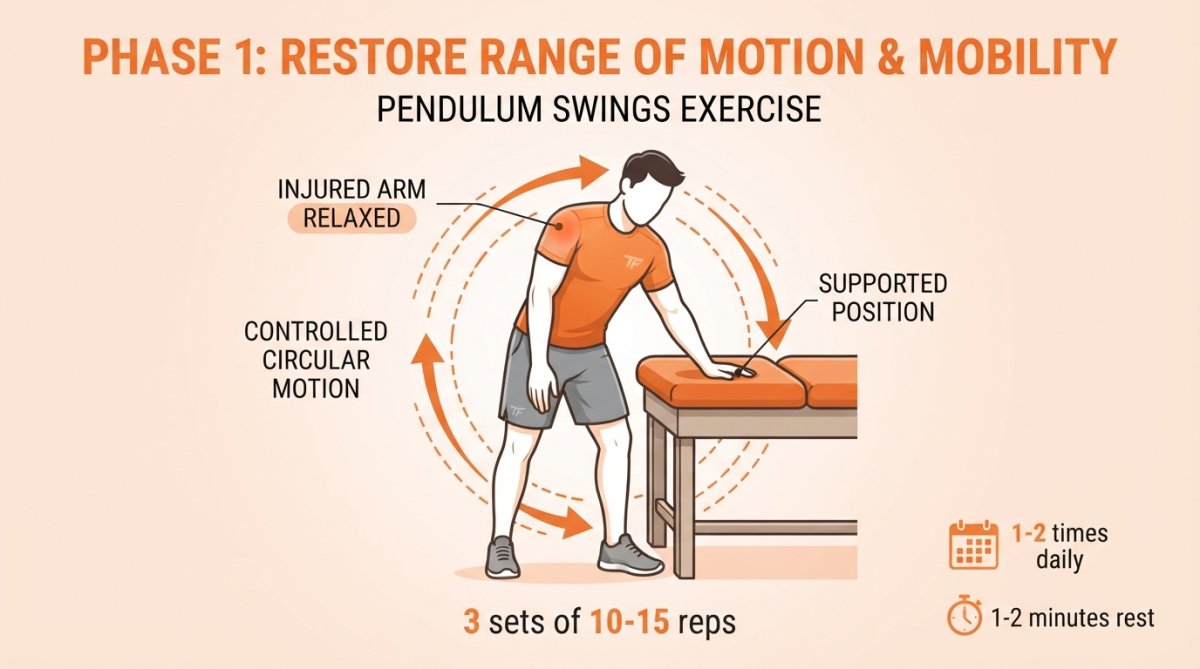
Pendulum Exercises for Pain Relief
Pendulum swings are the starting point for almost every shoulder injury. Stand with feet shoulder-width apart, bend forward at the hips about 90 degrees, and let your injured arm hang naturally. Use your torso to create small circular motions, no more than 12 inches in diameter. Perform 10-15 circles in each direction, three times daily. As pain decreases, gradually increase circle size over 2-3 weeks.
Wall Crawls and Overhead Mobility Work
Wall crawls restore overhead range of motion gradually. Stand facing a wall about 6 inches away. Place your palm on the wall at waist height, then slowly "crawl" your fingers up the wall as high as pain allows. Hold at the top for 2-3 seconds, then crawl back down. Perform 8-10 repetitions, three times daily. As pain decreases and mobility improves, increase the height you reach. After 2-3 weeks, most people can reach overhead without sharp pain. Don't rush this, incomplete range of motion in Phase 1 means compensation patterns in Phase 2, which means re-injury.
Phase 2: Isometric Strengthening and Scapular Stabilization
This phase typically lasts 3-4 weeks. Your range of motion is mostly restored. Now you're building strength without movement, isometric contractions in safe positions. This builds neuromuscular control and prepares the rotator cuff for loaded movement.
Isometric Contractions: Building Strength Without Movement
Stand in a doorway, place your palm against the frame at shoulder height, and push hard for 6 seconds without moving. Rest 10 seconds. Repeat for 10 repetitions. Perform this three times daily in four directions: forward, backward, inward, and outward. Start with light pressure, maybe 30% of maximum effort. As pain decreases, increase to 50%, then 70%, then near-maximum. Research shows isometric training produces strength gains comparable to dynamic training in early rehabilitation, with significantly lower re-injury rates.
Scapular Stabilization Techniques for Joint Stability
The scapula is your foundation. If it doesn't move properly, your rotator cuff can't function. Prone shoulder Y-T-I holds are the gold standard. Lie face-down on a bench with your chest off the edge. Raise your arms overhead in a Y position, hold 3 seconds, lower. Repeat 8 times. Then raise your arms out to the sides in a T position, hold 3 seconds, lower. Repeat 8 times. Finally, raise your arms at your sides with elbows bent (I position), hold 3 seconds, lower. Repeat 8 times. Perform this sequence three times per week. Start with bodyweight only. Don't add resistance until you can complete three sets without compensation.
Band pull-aparts strengthen the rear deltoid and scapular retractors. Hold a resistance band at arm's length in front of you. Pull the band apart by moving your hands outward, squeezing your shoulder blades together. Return to start. Perform 3 sets of 15 repetitions, three times per week. Start with light resistance; this is about control, not load.
Key TakeawayScapular stabilization is the foundation for everything that comes next. Most lifters skip straight to rotator cuff exercises and wonder why their shoulder still feels unstable. The scapula comes first.
Shoulder Injury Rehabilitation Exercises: Progressive Resistance Training
This phase typically lasts 4-6 weeks. Your range of motion is normal, pain is minimal, and isometric strength is solid. Now you're adding light resistance with controlled movement. This is where muscle rebuilding actually begins.
Resistance Bands and Light External Rotation Work
External rotation is the most important rotator cuff exercise. Lie on your side with your injured shoulder on top. Bend your elbow 90 degrees, place a small towel roll between your elbow and ribs. Attach a light resistance band to your hand. Rotate your forearm upward against the band, keeping your elbow stationary. Perform 3 sets of 15 repetitions, three times per week. Start with minimal resistance and progress when you can complete three sets of 15 with perfect form and zero pain.
Internal rotation is equally important. Lie on your side with your uninjured shoulder on top. Bend your elbow 90 degrees. Hold a light dumbbell (start with 2-5 pounds). Rotate your forearm downward across your body. Perform 3 sets of 15 repetitions, three times per week. Start light and progress slowly.
Controlled Hypertrophy: Building Muscle Without Re-Injury
After 6-8 weeks of rehabilitation, you can start actual strength training. Start with light dumbbell work: dumbbell bench press with 50% of your pre-injury working weight, dumbbell rows, dumbbell shoulder press. Perform 3 sets of 12-15 repetitions, twice per week. Focus entirely on form. If form breaks down, stop the set.
Progress weight by 5 pounds per week if you complete all sets with perfect form and zero pain. This slow progression feels light intentionally. You're rebuilding the shoulder's tolerance to load gradually. Machine-based exercises are safer than free weights at this stage. Machines guide movement patterns, reducing compensation.
Strengthening Exercises After Shoulder Surgery: Return-to-Lifting Protocol
Post-surgical recovery follows the same phases but with longer timelines and stricter restrictions. Your surgeon will provide specific guidelines. Follow them exactly.
Timeline and Benchmarks for Post-Surgical Progression
Weeks 1-4: Complete rest from shoulder movement. Your arm is typically in a sling. Perform only passive range of motion exercises prescribed by your physiotherapist.
Weeks 4-8: Begin active-assisted range of motion. Your physiotherapist guides movement; you provide minimal force. Pendulum exercises are appropriate.
Weeks 8-12: Progress to active range of motion without assistance. Isometric exercises begin with light pressure only.
Weeks 12-16: Add light resistance. Resistance bands with minimal tension. Isometric exercises with moderate pressure.
Weeks 16-20: Progress resistance gradually. Bodyweight exercises (wall push-ups, wall dips) become appropriate. Light dumbbells (2-5 pounds) for external and internal rotation.
Weeks 20+: Return to normal strength training, progressing weight conservatively. Many surgeons recommend waiting 6 months before returning to sport-specific movements.
These timelines are minimums. If you're not meeting benchmarks, extend the phase. Healing follows tissue adaptation, not a calendar.
How to Rebuild Muscle After Shoulder Injury Without Re-Injury
The most dangerous period is weeks 6-12 post-injury. Your shoulder feels better. Pain is minimal. You think you're ready for normal training. You're not. This is when most re-injuries occur.
Tracking Progress Metrics That Matter
Don't rely on pain as your only metric. Pain is unreliable. Instead, track these metrics:
Range of motion: Measure your overhead reach against your uninjured side. You should have 95%+ symmetry before progressing to heavy loading.
Strength symmetry: Compare isometric strength on your injured side to your uninjured side. Aim for 80%+ symmetry before adding heavy resistance.
Functional movement: Can you perform a pain-free push-up with perfect form? Can you perform a pain-free overhead press with 50% of your pre-injury weight?
Pain-free range: Can you move through your full range of motion without sharp pain? Mild discomfort is expected. Sharp, shooting pain means you're pushing too hard.
Track these weekly. If metrics aren't improving, you're either progressing too fast or your rehabilitation is incomplete. Slow down. Use FREE TOOLS & FITNESS CALCULATORS to structure your progression and ensure you're hitting the right rep ranges and volume targets for each phase.
Sleep Positioning and Recovery Optimization
Sleep position matters more than most lifters realize. Sleeping on your injured shoulder compresses the rotator cuff and slows healing. Sleep on your uninjured side or on your back with a pillow under your shoulder. This maintains neutral shoulder position and reduces inflammation overnight.
Manage inflammation with ice (15 minutes, 3-4 times daily) during the first 2-4 weeks. After that, heat might be more beneficial. Avoid NSAIDs unless specifically recommended by your doctor; they can slow tissue healing. Focus on protein intake (0.8-1.0 grams per pound of bodyweight) to support tissue repair. Consider collagen supplementation; research shows collagen peptides support connective tissue repair.
Psychological Barriers to Returning to Lifting
After a shoulder injury, many lifters develop fear-avoidance behavior. That fear is rational; re-injury is possible. But it often becomes irrational, preventing normal training long after healing is complete. Acknowledge the fear. Work with your physiotherapist to identify which movements are actually safe versus which ones feel unsafe but are fine. Gradually expose yourself to those movements in controlled doses. This desensitization takes 8-12 weeks.
Phase |
Duration |
Primary Goal |
Key Exercises |
Training Frequency |
|---|---|---|---|---|
Phase 1 |
2-4 weeks |
Restore range of motion |
Pendulum swings, wall crawls |
Daily |
Phase 2 |
3-4 weeks |
Build isometric strength |
Doorway isometrics, Y-T-I holds |
3x/week |
Phase 3 |
4-6 weeks |
Add light resistance |
Band external rotation, light dumbbells |
3x/week |
Phase 4 |
4-8 weeks |
Progressive hypertrophy |
Dumbbell work, machines |
3-4x/week |
Phase 5 |
Ongoing |
Return to normal training |
Barbell work, sport-specific movements |
4-6x/week |
Shoulder Injury Recovery Timeline: What to Expect
Recovery isn't linear. You'll have good weeks and frustrating weeks. Tissue healing is a chaotic process. The timeline below is realistic, but individual variation is significant.
Typical Recovery Windows by Injury Type
Minor rotator cuff strain: 4-8 weeks. You'll return to normal training within 6-8 weeks if you follow the protocol. Most people try to return faster and end up injured again.
Significant rotator cuff strain or partial tear (non-surgical): 8-12 weeks. Full recovery requires patience. Many people return to normal training at 10-12 weeks but experience lingering weakness for another 4-6 weeks.
Rotator cuff repair surgery: 4-6 months minimum. The repair itself takes 6-8 weeks to achieve basic strength. Full functional recovery takes 4-6 months. Returning to heavy pressing before 4 months guarantees re-injury.
Labral repair surgery: 4-6 months. Similar timeline to rotator cuff repair. The labrum is more fragile than the rotator cuff. Respect the timeline.
Impingement syndrome (non-surgical): 4-8 weeks. Usually responds well to conservative treatment.
Frozen shoulder (adhesive capsulitis): 6-18 months. This is the worst-case scenario. Aggressive physical therapy is necessary.
These timelines assume you're following the protocol. If you're training aggressively or progressing too fast, add 4-8 weeks to every timeline.
Red Flags That Signal You're Progressing Too Fast
Sharp, shooting pain in the front of the shoulder during pressing movements means you're loading the shoulder before it's ready. Stop pressing immediately. Return to Phase 2 exercises for another 2-4 weeks.
Night pain that wakes you from sleep means inflammation is increasing. Reduce training volume by 30-50%. Increase ice application.
Weakness that develops suddenly suggests re-injury or new damage. Stop all shoulder training. See your physiotherapist immediately.
Loss of range of motion (your overhead reach decreases instead of improves) means adhesions are forming. Increase mobility work. Don't increase resistance work.
Pain that doesn't improve after 2 weeks of consistent training at a given phase means you're progressing too fast. Spend another 2-4 weeks in the current phase before advancing.
Rebuilding muscle after shoulder injury takes time, patience, and respect for the healing process. Most lifters fail because they rush progression or skip early phases. The ones who succeed follow a structured protocol, trust the process, and accept that recovery isn't linear. Work with a physiotherapist, track progress metrics, and progress conservatively. Your shoulder will thank you with years of pain-free training ahead. The extra weeks you spend now rebuilding properly save you months of re-injury and frustration later.
Frequently Asked Questions
How long does it take to rebuild muscle after a shoulder injury?
Timeline varies by injury severity. Minor soft-tissue injuries typically require 6-12 weeks before returning to resistance training; rotator cuff strains may take 12-16 weeks; post-surgical cases (labrum repair, rotator cuff surgery) often require 4-6 months before heavy loading. Recovery isn't linear—expect plateaus. Work with your physiotherapist to assess readiness at each phase before advancing intensity.
What exercises should I avoid when rebuilding shoulder muscle after injury?
Avoid overhead pressing, heavy bench press, wide-grip pull-ups, and explosive plyometrics until cleared by your physiotherapist. Skip internal rotation work if you have impingement. Don't perform ballistic movements or high-velocity exercises during phases 1-2. Avoid stretching into pain—mobility work should be pain-free. Never skip the scapular stabilization foundation just to get back to heavy compound lifts faster.
Can I use resistance bands and light weights during shoulder injury rehabilitation?
Yes. Resistance bands are ideal for phase 2 isometric work and phase 3 progressive overload because they provide variable resistance and allow pain-free range of motion control. Light dumbbells (2-5 lbs) work well for external rotation and controlled hypertrophy once you've cleared phase 1. Start with zero resistance during mobility work, progress to bands, then light weights only after pain-free range of motion is restored.
What role does scapular stabilization play in rebuilding shoulder muscle safely?
Scapular stabilization is foundational—it prevents compensation patterns and impingement during any overhead or pressing movement. Without stable scapulae, your rotator cuff works overtime and re-injury risk spikes. Exercises like prone Y-T-W holds, wall slides, and band pull-aparts build this stability. Master scapular control before progressing to deltoid hypertrophy work. This is non-negotiable for long-term shoulder health and muscle rebuilding success.
Leave a comment