
Pick This Year's Olympia T-Shirt

Last Updated: September 12, 2026
Let me hit you with the reality first: skipping breakfast is the fastest way to wreck your energy, your focus, and your gains. According to Johns Hopkins Medicine's guidance on healthy breakfasts, a solid morning meal should prioritize plant-based foods like fruits, vegetables, whole grains, beans, nuts, and seeds, seasoned with olive oil and herbs. That's not complicated. It's just not what most students actually eat.
Here's the problem. You're juggling a full course load, maybe a job, and you still want to train. Traditional breakfast advice assumes you have a full kitchen and thirty free minutes. You don't. You have a mini-fridge, a microwave, and about five minutes between your alarm and your first class.
This guide from Tiger Fitness breaks down seven easy healthy breakfast ideas for busy college students that actually fit that reality. Below, we'll show you exactly how to build each one and how to hit your macros without losing your mind.
Overnight oats are the single best grab-and-go breakfast for a dorm room. You build them the night before, they sit in your mini-fridge, and they're ready when you wake up. No cooking, no cleanup, no excuses.
Here's the base recipe:
Stir it in a mason jar, seal it, and refrigerate overnight. The oats soften, the chia seeds thicken everything into a pudding like texture, and you get a fiber rich, nutrient dense meal you can eat with a spoon while walking to class.
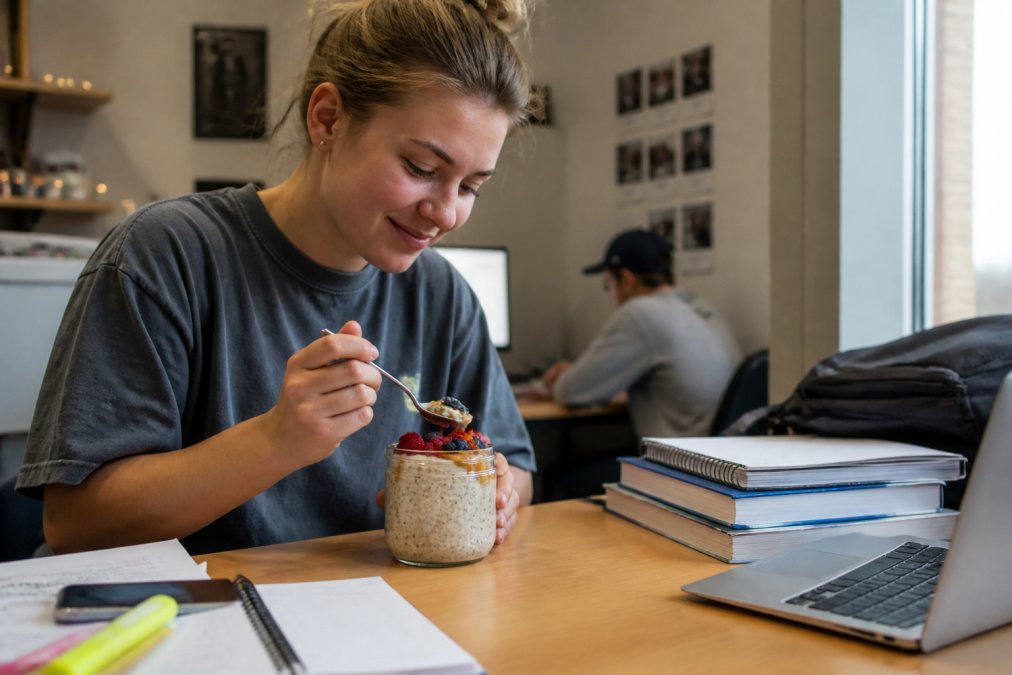
What most guides miss is the protein problem. Plain oats are mostly carbs. Add a scoop of protein powder or a big spoon of Greek yogurt and you turn a carb bomb into a balanced meal that keeps you full through a two-hour lecture.
Greek yogurt bowls are the fastest high protein breakfast for college students who have zero time to cook. You open a container, add toppings, and eat. Total prep time: ninety seconds.
The formula is simple:
That combination delivers protein, healthy fats, and complex carbohydrates in one bowl. Frozen fruit is cheaper than fresh and works just as well. It also thaws overnight in your mini-fridge, so by morning it's ready to eat.
Microwave egg bites are the dorm friendly answer to a hot, protein packed breakfast. Crack two large eggs into a microwave safe mug, add a splash of milk, salt, pepper, and any diced veggies you have, then microwave for 60 to 90 seconds. Two large eggs give you about 12 grams of protein and roughly 140 calories before you add anything else.
Watch it closely the first time. Overcooked eggs in a microwave turn rubbery fast. Stop at 60 seconds, stir, then go in 15-second bursts until just set.
For batch cooking, whisk six eggs with chopped spinach, bell pepper, and a handful of shredded cheese, pour into a greased microwave safe container, and cook in two-minute bursts until set. Cut into portions and store in your mini-fridge. That's roughly 36 grams of protein across the whole batch, so three portions land around 12 grams each.
Hard boiled eggs are another option. Boil a dozen on Sunday, keep them in the fridge, and grab two on your way out the door. That's about 12 grams of protein with zero morning effort. A dozen large eggs typically runs a few dollars depending on where you shop and whether you buy conventional or pasture raised.
The part most articles skip: dorm fridge food safety.
Egg dishes are perishable, and a shared mini-fridge is not the same as a full-size kitchen fridge. Here's what actually matters:
Allergy and diet swaps:
Macro snapshot per two-egg serving (approximate):
Eggs are one of the cheapest complete proteins you can buy, and the microwave makes them a two-minute breakfast. Just don't let a warm dorm fridge turn a smart meal into a sick day.
Healthy eating on a college budget comes down to one strategy: batch cooking. Breakfast burritos are the perfect example. You make ten on Sunday, wrap them individually, freeze them, and microwave one every morning for the rest of the week.
Build them like this:
Learning how to track macros for beginners doesn't require an app subscription or a food scale in your backpack. Start with three numbers: protein, carbs, and fat. That's it.
Here's the simple framework:
That last step matters. Most students quit tracking because they treat it as a permanent chore. Use it as a learning tool, not a life sentence.
Tiger Fitness offers free fitness calculators that handle the math for you, so you can set your targets in a couple of minutes instead of guessing.
Smoothies are the ultimate on-the-go breakfast when you're sprinting to an 8 a.m. exam. Blend everything the night before, pour it into a shaker bottle, and drink it on the walk across campus.
A balanced smoothie needs three things:
Frozen fruit is the secret weapon here. It's cheaper than fresh, lasts for weeks, and gives the smoothie a thick texture without ice.
If you don't even have time to blend, ready-to-drink protein shakes solve the problem entirely. The RAW Nutrition Protein RTD delivers 30 grams of grass-fed protein with zero mixing and no cleanup, which makes it a legitimate breakfast replacement when your morning falls apart.

Protein pancakes and waffles give you a hot breakfast in minutes without wrecking your macros. The RYSE Loaded Protein Pancake & Waffle Mix is built for exactly this: 21 grams of protein, 3 grams of MCTs, 2 grams of fiber, and no added sugar per serving. Mix it with water, pour it on a hot pan or waffle iron, and you're eating in five minutes.

This is where most students go wrong. They eat a stack of regular pancakes, spike their blood sugar, and crash halfway through their first lecture. A protein-based mix keeps your energy steady instead of spiking and dropping.
If you want a warm, carb-focused option for a training day, cream of rice works well. The RAW Nutrition Cream of Rice is a fast-digesting carb source you can microwave in a minute and top with protein powder, nut butter, and fruit. MuscleSport Cream'd Rice Gourmet does the same job with 25 grams of real food carbohydrates per serving and a smoother, more dessert-like flavor.
For mornings when even five minutes is too much, keep shelf-stable options on hand. A protein bar like the RAW Nutrition Protein Bar (20 grams of protein, 1 gram of added sugar) or a My Cookie Dealer Protein Toaster Pastry gives you something you can eat straight from the wrapper in your backpack.
Here's how the seven options stack up:
| Breakfast Idea | Prep Time | Best For | Protein Source |
|---|---|---|---|
| Overnight Oats | 5 min (night before) | Grab-and-go mornings | Protein powder, yogurt |
| Greek Yogurt Bowl | 2 min | Zero-cook mornings | Greek yogurt |
| Microwave Egg Bites | 3 min | Hot protein breakfast | Eggs |
| Breakfast Burritos | 10 min (batch) | Budget batch cooking | Eggs, beans |
| Macro Tracking | 5 min setup | Hitting daily targets | Any |
| Smoothies | 3 min | On-the-go mornings | Powder, RTD shake |
| Protein Pancakes | 5 min | Hot weekend breakfast | Protein mix |
That's the whole system. Seven easy healthy breakfast ideas for busy college students, all built around a mini-fridge, a microwave, and five minutes or less. No culinary degree required.
Greek yogurt bowls, microwave egg bites, and protein pancakes are all high-protein breakfast ideas that cost less than $2 per serving. Eggs, canned beans, and plain Greek yogurt are among the cheapest protein sources at any grocery store. Buy store-brand oats and frozen fruit to keep costs down. A 21g-protein serving of RYSE Loaded Protein Pancake & Waffle Mix runs $19.95 for six servings, which works out to about $3.33 per meal and takes two minutes to cook.
Start by logging everything you eat for three days using a free app. You do not need a food scale in a dorm; use measuring cups and the nutrition labels on packaged foods. For homemade meals, estimate portions by comparing them to your hand: a palm of protein, a fist of carbs, a thumb of fats. Focus on hitting your protein target first, then adjust carbs and fats based on your goals.
Overnight oats, Greek yogurt bowls, and ready-to-drink protein shakes need zero cooking. You can also eat hard-boiled eggs (buy them pre-cooked), string cheese, nut butter on whole grain toast, or a protein bar. My Cookie Dealer Protein Toaster Pastries can be eaten straight from the wrapper, and RAW Nutrition Protein RTD delivers 30 grams of protein with no mixing or refrigeration until you open it.
Prioritize protein at every meal and keep total daily intake around 0.7 to 1 gram per pound of body weight. Without a full kitchen, rely on Greek yogurt, pre-cooked eggs, canned tuna, protein bars, and ready-to-drink shakes. A mini-fridge stocked with these staples plus a microwave for eggs and oats covers most of your needs. Track your intake for a week to confirm you are hitting your target, then adjust.
Ready-to-drink protein shakes like RAW Nutrition Protein RTD and Quest Milkshake RTD require zero prep. Protein bars such as RAW Nutrition, Grenade, and Barebells are shelf-stable and fit in a backpack. For a hot option, MuscleSport Cream'd Rice Gourmet and RAW Nutrition Cream of Rice cook in the microwave in about two minutes. These options help you hit your protein and carb targets when you have no time to cook.
The hardest part of eating well in college isn't knowledge. It's having the right food within arm's reach when your morning goes sideways. Tiger Fitness stocks the protein powders, ready-to-drink shakes, pancake mixes, and bars that make these breakfasts possible, backed by fast shipping and a rewards program that stretches a student budget further. Grab your staples, set your macros with our free fitness calculators, and stop letting a bad breakfast cost you your focus in class.
{"one"=>"Select 2 or 3 items to compare", "other"=>"{{ count }} of 3 items selected"}

Leave a comment