
NEW NULLA BAR FLAVORS
In-Stock Now!

Last Updated: October 29, 2026
Quick Summary
Proprietary blends can hide low-quality ingredients because the label discloses only a combined total weight, not individual doses, so a blend can hit its stated total while underdosing every ingredient inside it. You cannot verify ingredient amounts you cannot see, and a product can be fully FDA-compliant and still tell you almost nothing about whether it works.
A proprietary blend is a group of ingredients listed together under one total weight, with the individual amounts of each ingredient kept off the label.
Why does it matter? Because an effective dose is ingredient-specific. Clinical research on any compound establishes a dose range, and a blend can technically hit its stated total while underdosing every ingredient inside it. You cannot verify ingredient amounts you cannot see.
Formula protection is a real business concern.
The problem is that this rationale gets used as cover. As industry commentary in SupplySide Supplement Journal has pointed out, some blends pack in many ingredients with thin supporting science, and intellectual property protection becomes the stated reason.
Secrecy is not automatically guilt, but it shifts the burden of proof onto the brand.
Below are the red flags we would check before spending a dollar on any blend-based product. None of these is proof on its own. Stack two or three together and walk away.
| Sign | What to Check | Why It Matters |
|---|---|---|
| 1. Tiny blend total | Blend weight vs. number of ingredients | Too little total for too many ingredients means trace amounts |
| 2. Buried stimulants | Stimulants listed late in the blend | You cannot gauge stimulant load or jitter risk |
| 3. No third-party testing | COA available on request? | No independent verification of identity or purity |
| 4. Vague serving size | Servings per container vs. scoop size | Underdosing hidden behind a small scoop |
| 5. Ingredient order games | First ingredient vs. blend position | Cheap fillers can outrank actives |
| 6. No dosing rationale | Any clinical citation for the blend? | Unsupported claims instead of evidence-based dosing |
| 7. Resistance to questions | Will the brand disclose on request? | A refusal to verify amounts tells you plenty |
Do the math. If a blend total is modest and ten ingredients sit inside it, several of those ingredients are present in amounts too small to matter. This is the most common form of underdosing, and it is completely legal because the blend total is disclosed.
This one carries real safety concerns. When caffeine and stimulant-like ingredients sit inside a blend, you cannot calculate your total stimulant intake for the day. That is how people end up with jitters, a racing heart, and a ruined night of sleep. If a pre-workout will not disclose its stimulant doses individually, treat that as a hard no.
Ask for the certificate of analysis. A serious manufacturer can produce one covering identity testing, purity testing, and contamination screening. If the answer is a vague assurance that "we test everything," that is not verification. For help judging testing standards and quality claims, read Identifying High Quality Supplement Manufacturers: A No-Nonsense Guide.
Read the panel in a fixed order and the tricks are easier to spot. Start with the serving size, then the servings per container, then the blend total, then the ingredient order. Compare the blend total against the number of ingredients inside it.
That is the routine. Now let me show you what it looks like on a real label.
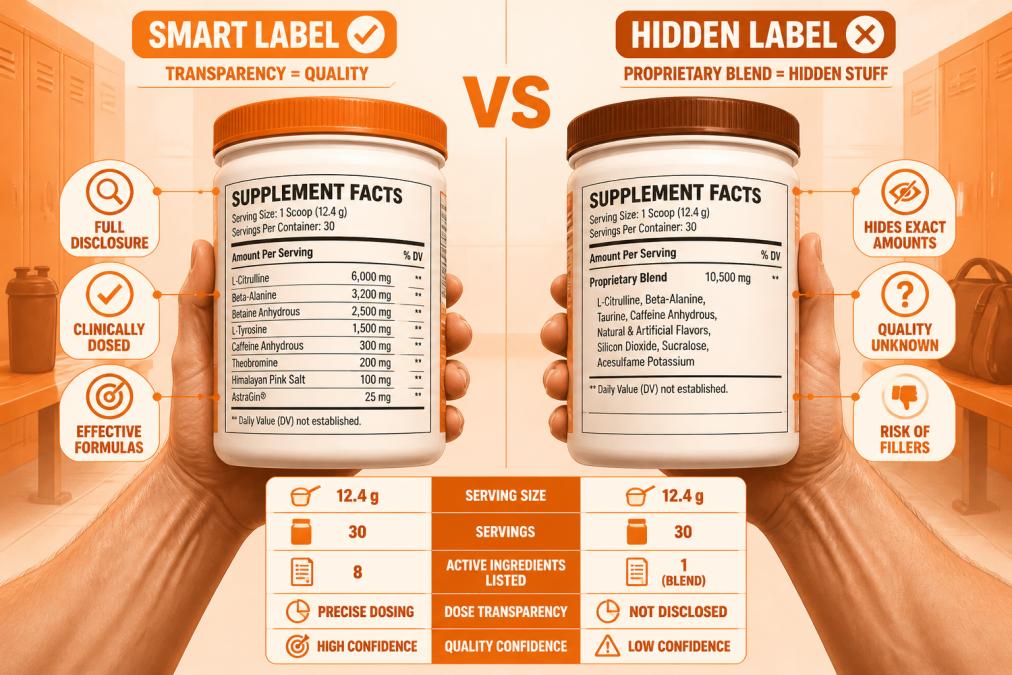
Picture a pre-workout with a Supplement Facts panel that reads:
Run the routine:
Now picture the same category with full disclosure:
Same routine, different result. You can check every dose against the research. You know your stimulant load. You know whether the formula is dosed to work or dosed to fit a price point.
If you only remember three things from this section, remember these:
That five-minute routine catches most label games.
Let me give you the actual rule, not a summary. Under 21 CFR 101.36, a dietary supplement label must carry a Supplement Facts panel.
Read that again. The descending-order rule tells you which ingredient weighs the most. It does not tell you how much more. An ingredient listed first could be 90% of the blend or 30% of it. The label is compliant either way.
Here is the short list of what 21 CFR 101.36 and related FDA labeling rules require for a blend-based product:
What the rules do not require:
That last point is the one people miss. Even the descending-order rule can be gamed. A brand can put 500 mg of a cheap ingredient first and 50 mg of the expensive active second, and the label is fully compliant. The order is accurate. The formula is still underdosed where it counts.
The practical consequence is simple: a product can be 100% FDA-compliant and still tell you almost nothing about whether it works. Compliance means the label follows the formatting and disclosure rules.
This is where the FDA's limits become your problem to solve. The agency does not pre-approve dietary supplements before they hit the market. It does not verify doses. It does not certify that a blend is dosed to match the research.
Since the regulation will not close the gap, you have to. Ask the brand for:
If a brand cannot or will not provide those, you have your answer. The label is legal. The product is unverifiable. Treat the label as a starting point and demand testing documentation to fill the gap.
Full disclosure means every active ingredient gets its own milligram amount. No grouped totals, no mystery. A transparent label lets you verify ingredient amounts against the clinical research for each compound, which is the only way to judge whether the formula is dosed to actually work.
A short, fully dosed formula is generally preferable to a kitchen-sink blend, since three ingredients at effective doses outperform fifteen at trace amounts.
Use this decision tree before you buy:
That is the whole framework. It takes two minutes and it will save you from a lot of bad tubs.
Put two products next to each other and the difference is obvious. One lists every ingredient with a dose you can check. The other hides behind a blend total. If you want creatine with clear dosing instead of a buried blend ingredient, browse Best Creatine Supplements.
And if you want to run your own numbers on intake and timing, Tiger Fitness offers free fitness calculators.
No. The Council for Responsible Nutrition notes that proprietary-blend labeling can protect a trade secret formula and help ensure you get the same blend consistently. A 2023 paper by Saldanha and colleagues examined why brands use blends and what that means for consumers. The blend format itself is not the problem; the problem is when a brand hides doses to cover up underdosed or inferior ingredients. Judge the whole label, not just the word blend.
No. Under FDA dietary supplement labeling requirements, a proprietary blend only has to list the total weight of the blend and its ingredients in descending order by weight. Individual ingredient amounts inside the blend do not have to be disclosed. That is why dose transparency varies so much between products. If exact amounts matter to you, buy products that list every ingredient amount on the Supplement Facts panel.
Compare the blend total to the ingredient list. If a pre-workout blend lists eight ingredients but the blend total is small, each ingredient gets a tiny share. Check whether the key active ingredients have clinical research at an effective dose, then see if the label gives you enough to verify it. If the brand will not disclose amounts and there is no third-party testing, treat the dose as unverified and compare labels before you buy.
Ask for a certificate of analysis or third-party testing results. If the brand will not share either, walk away. Many brands list full amounts per ingredient and publish purity and identity testing. Tiger Fitness's free fitness tools and calculators can help you dial in your training and nutrition.
The supplement industry will keep selling blends because blends are profitable. Your job is to make that harder by asking for the COA, reading the panel in order, and refusing to pay for mystery powder. At Tiger Fitness, we stock products with disclosed formulas, offer free workout plans and diet guides to support your training, and back every order with fast shipping and personalized customer service. Get started with Tiger Fitness and train on supplements you can actually verify.
{"one"=>"Select 2 or 3 items to compare", "other"=>"{{ count }} of 3 items selected"}







Leave a comment