





Best lifting chalk for grip strength in 2026
Best overall for powerlifters: House of Gains Clutch Liquid Chalk. Best for keeping hands dry with less loose powder: Gymreapers Liquid Chalk. Best for traditional block application: Gym Chalk. This 2026 guide compares the best lifting chalk by application, cleanup, and training use—not unsupported promises about heavier lifts.
TL;DR
- House of Gains Clutch Liquid Chalk is the best lifting chalk pick here for powerlifters seeking a liquid format.
- Gymreapers Liquid Chalk suits weightlifters prioritizing dry hands and less loose powder.
- Gym Chalk suits lifters who prefer rubbing a solid chalk block onto their hands.
- Lifting chalk manages moisture; it does not build grip strength or replace grip training.
Why this matters
Your back can have another rep ready while your hands struggle to hold the bar. Chalk addresses moisture at that contact point. It does not make your forearms stronger, and it cannot fix every reason a bar slips.
Choose chalk for sweaty hands; choose grip training for stronger hands. That distinction keeps your next purchase tied to the actual problem instead of a promise about instant gains.
Tigerfitness sells sports nutrition supplements and fitness gear. For lifting chalk, the useful decision is narrower: choose a format your gym allows, apply it correctly, and keep the shared equipment clean.
Before buying lifting chalk in 2026, ask staff whether liquid chalk, block chalk, or neither is permitted. Liquid chalk still leaves residue. A gym's restriction on powder does not automatically mean a liquid bottle gets approval.
What makes the best lifting chalk?
The best lifting chalk fits your training environment without creating another problem. Use these criteria before choosing a bottle or block:
- Gym permission: The approved format wins over any personal preference. Ask specifically about liquid chalk and solid blocks.
- Application control: You should be able to cover the gripping surfaces without dumping excess material onto the floor.
- Moisture management: Chalk belongs on hands that need help staying dry. More coverage is not a substitute for checking why your grip fails.
- Cleanup: Consider residue on the bar, your clothing, and your gym bag—not just airborne powder.
- Skin comfort: Read the ingredients and directions. Do not assume every liquid formula uses the same ingredients.
- Training fit: Powerlifting, bodybuilding, and general weight training involve different exercises, equipment, and grip demands.
None of these criteria requires an invented hold-time score. A useful 2026 comparison tells you how each option fits your workout and where its limitations start.
Best lifting chalk at a glance
| Rank and option | Best for | Standout feature | Key limitation |
|---|---|---|---|
| 1. House of Gains Clutch Liquid Chalk | Powerlifters choosing a liquid format | Explicitly described for powerlifters, bodybuilders, and athletes | Liquid application requires drying before gripping |
| 2. Gymreapers Liquid Chalk | Weightlifters prioritizing dry hands and less loose powder | Described as a liquid alternative to traditional lifting chalk | Less loose powder does not mean no equipment residue |
| 3. Gym Chalk | Lifters who prefer traditional block application | Solid chalk-block format | Handling and rubbing a block creates loose chalk |
These are use-case recommendations, not measured rankings of friction or endurance. No option here earns a claim about adding weight to your deadlift, lasting through an entire session, or outperforming every competing formula.
1. House of Gains Clutch Liquid Chalk: best for powerlifters
House of Gains Clutch Liquid Chalk is a liquid chalk option described for powerlifters, bodybuilders, and athletes. Its stated audience makes it the default recommendation here for a powerlifter who wants a liquid format. Apply it according to the label and let your hands dry before taking your grip.
Best for: Powerlifters who want liquid chalk rather than a loose-powder setup.
The reason to choose House of Gains Clutch Liquid Chalk is its fit with that buyer and format. This is not a claim that its formula produces more friction than Gymreapers Liquid Chalk. Match the choice to your gym's rules and your preference for application.
House of Gains Clutch Liquid Chalk pros:
- Its description explicitly includes powerlifters.
- Its stated audience also includes bodybuilders and athletes.
- The liquid format avoids handling a loose chalk block during application.
House of Gains Clutch Liquid Chalk cons:
- Liquid chalk needs to dry before you grip equipment.
- A liquid format does not remove the need to clean shared bars and handles.
- Chalk does not address grip fatigue caused by insufficient holding strength.
For your 2026 training bag, choose this option if the liquid format matches your routine. Do not treat the powerlifting positioning as a guarantee of new PRs.
Verdict: Buy House of Gains Clutch Liquid Chalk if you are a powerlifter seeking gym-approved liquid chalk.
2. Gymreapers Liquid Chalk: best for dry-hand convenience
Gymreapers Liquid Chalk is described as keeping hands dry and providing a liquid alternative to traditional lifting chalk. That makes it the recommendation for weightlifters who prioritize moisture management without handling loose powder. Use the label's application instructions rather than guessing how much you need.
Best for: Weightlifters who want a liquid format centered on keeping hands dry.
Liquid chalk changes how you apply the material, not whether you leave chalk behind. Expect to inspect your equipment after a set and clean residue as your gym requires. A bottle also needs a secure closure before it goes back into your bag.
Gymreapers Liquid Chalk pros:
- Its description explicitly identifies keeping hands dry as a purpose.
- It provides a liquid alternative to traditional chalk.
- Its stated audience includes weightlifters.
Gymreapers Liquid Chalk cons:
- You need to wait until the application dries before lifting.
- Liquid chalk can still transfer residue onto equipment.
- The format is unsuitable wherever the gym prohibits liquid chalk.
Choose Gymreapers Liquid Chalk for its stated dry-hand purpose, not an assumed formula advantage. There is no supported reason here to promise that it needs fewer applications than House of Gains Clutch Liquid Chalk.
Verdict: Buy Gymreapers Liquid Chalk if dry-hand convenience is your priority and your gym permits it.
3. Gym Chalk: best for traditional block application
Gym Chalk is described as a Gymreapers chalk block for grip support. The solid format lets you rub chalk onto the areas of your hands that contact the bar. Keep the block in a suitable container and apply it over that container to limit stray powder.
Best for: Lifters who prefer direct application from a solid chalk block.
Choose Gym Chalk when the handling experience matters to you. A block gives you a physical piece to work across your palms and fingers, but it does not eliminate dust. Broken pieces and residue need somewhere to stay between workouts.
Gym Chalk pros:
- The solid-block format supports direct application to gripping surfaces.
- Dry chalk does not require a liquid layer to evaporate.
- A block can stay at a designated chalk station where the facility permits one.
Gym Chalk cons:
- Rubbing and breaking a block releases loose chalk.
- Storage needs to contain both the block and any broken pieces.
- Powder restrictions can rule it out even where liquid chalk is permitted.
Gym Chalk is a format choice, not a budget winner or a proven performance winner. For a home gym in 2026, decide whether you are willing to contain and clean the powder before choosing it.
Verdict: Buy Gym Chalk if you prefer block application and train somewhere that permits loose chalk.
Choose your format before choosing your chalk
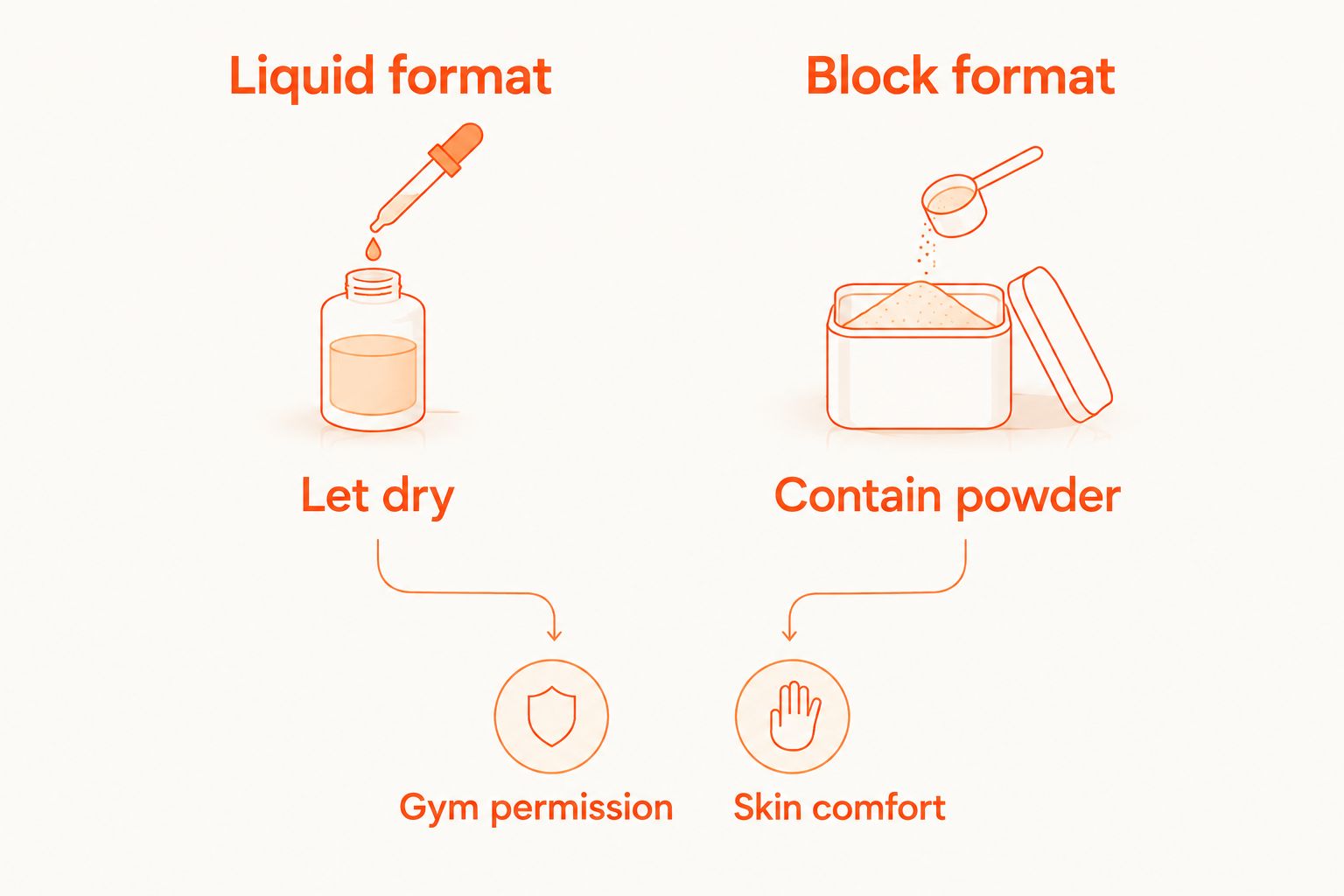
The difference you can judge most directly is application. Liquid chalk starts wet and must dry; block chalk goes onto your hands dry and creates loose powder during handling. Both leave material on your skin and can transfer it to the equipment.
Use this checklist to make the choice:
- Liquid format: Choose it if you prefer bottle application and can wait for it to dry.
- Block format: Choose it if you prefer rubbing chalk directly onto your hands and can contain the powder.
- Gym permission: Confirm the exact format is allowed before putting it in your training bag.
- Skin comfort: Check the label and stop using the product if it causes irritation.
Tigerfitness's lifting chalk recommendations serve different application preferences. Choose the product that fits your approved format; do not infer differences in ingredients, drying speed, or application frequency from the product name.
Compare the chalk options

Liquid chalk described for powerlifters, bodybuilders, and athletes.
$18.99


How to use lifting chalk without overdoing it
Start with clean, dry hands. Chalk is not a replacement for removing lotion, sweat, or grime before you grip a bar. Inspect the contact surfaces too, and follow the facility's cleaning instructions.
Prepare your hands
Dry both hands with a towel and check the areas that contact the equipment. Cover your fingers and palms as needed rather than coating your wrists and clothing. Avoid applying chalk over broken or irritated skin.
Apply a thin layer
Start with 1 thin layer rather than a heavy coating. For liquid chalk, follow the label and let it dry before touching the equipment. For a block, rub it onto the contact areas over a container instead of crushing it into an open pile.
Check your grip under a manageable load
Use 1 warm-up set to assess application before a demanding working set. Check whether the bar still moves in your hands and whether moisture is the problem. Do not turn an application check into an unplanned maximum attempt.
Reassess and clean up
Check 2 hands between sets: moisture, coverage, and skin comfort all matter. Reapply when needed rather than adding another layer automatically after every exercise. Clean chalk residue from shared equipment and secure the container before leaving.
The goal is adequate coverage, not visibly white hands. If chalk piles up on the bar or falls onto the floor, reduce the excess and follow the gym's cleanup rules.
Chalk, straps, and gloves solve different problems
A slipping bar does not always mean you need more chalk. Identify whether moisture, grip fatigue, or hand-contact comfort is limiting the set. Then choose the aid that addresses that specific issue.
| Option | Best for | Main benefit | Main limitation |
|---|---|---|---|
| Lifting chalk | Moisture at the hand-equipment contact point | Helps keep the gripping surface dry | Does not build holding strength |
| Lifting straps | Grip fatigue during appropriate pulling exercises | Connect the hand and wrist to the implement | Reduce the demand placed on an unaided grip |
| Lifting gloves | Lifters seeking a barrier or padding | Add material between skin and equipment | Change the thickness and feel of the grip |
Chalk supports your contact with the bar; straps change how you hold it. If your hands are dry but open before your target muscles finish the set, adding chalk does not address the underlying fatigue.
Gloves are a separate preference. Padding changes the contact surface, so evaluate the fit and feel rather than assuming gloves automatically improve every lift. Competition and facility rules also matter when you choose any training aid.
How these chalk recommendations are ranked
This 2026 ranking uses the products' stated audiences, their application formats, and the practical criteria above. House of Gains Clutch Liquid Chalk takes the default powerlifting slot because its description explicitly names powerlifters. Gymreapers Liquid Chalk takes the dry-hand slot, while Gym Chalk takes the traditional-block slot.
Tigerfitness's best lifting chalk guide does not assign unsupported friction scores or promise additional reps. The ranking helps you choose a suitable format; your gym rules, skin response, and workout determine whether that choice fits.
Which lifting chalk should you choose?
Start with House of Gains Clutch Liquid Chalk if you are a powerlifter seeking a liquid option. Choose Gymreapers Liquid Chalk if its stated dry-hand purpose matches your priority. Choose Gym Chalk if you prefer a solid block and can manage the loose powder.
Do not buy multiple formats just to cover every possibility. Confirm permission, choose the application you prefer, and assess it during normal training. If your hands stay dry but your grip still fails, focus on the cause rather than switching chalk repeatedly.
FAQ
What's the best lifting chalk for powerlifting in 2026?
House of Gains Clutch Liquid Chalk is the default powerlifting recommendation in this guide because its description explicitly includes powerlifters. Choose it if you want liquid chalk and your gym permits that format; this is not a measured claim of better friction than competing products.
Is liquid chalk better than block chalk?
Liquid chalk is better for lifters who prefer bottle application, while block chalk is better for those who prefer direct dry application. Liquid chalk needs to dry before use, and block handling creates loose powder. Neither format automatically wins for every lifter.
Does lifting chalk actually make my grip stronger?
Lifting chalk does not build grip strength. It manages moisture at the contact surface, which can help you maintain contact when sweaty hands are the problem. Stronger holding capacity requires training rather than additional chalk.
Can I use liquid chalk in a gym that bans powder chalk?
You need the gym's explicit permission to use liquid chalk. A restriction on loose powder is not automatic approval for a liquid product. Ask staff about the exact format before applying it.
How much lifting chalk should I put on my hands?
Start with a thin layer on the surfaces that contact the equipment and follow the product's directions. Let liquid chalk dry before gripping. Add more only when you need coverage rather than coating your hands heavily by default.
Should I use lifting chalk or straps for deadlifts?
Use chalk when hand moisture is the problem, and consider straps for appropriate training sets when grip fatigue limits the target muscles. Straps change the assistance provided to your grip. Check competition rules if you are preparing for an event.
Can lifting chalk irritate my skin?
Lifting chalk can dry the skin, and individual ingredients can cause irritation. Read the label, avoid broken skin, and stop using a product that irritates your hands. Persistent symptoms warrant advice from a healthcare professional.
How often should I reapply liquid chalk during a workout?
Reapply liquid chalk according to its label and the condition of your hands, not a fixed set count. Check for moisture and lost coverage between sets. There is no universal application schedule for every formula and workout.
One last thing
Dry hands and a slipping bar point to a different problem than sweaty hands and a slipping bar. That simple check saves you from treating every missed hold as a chalk problem.
For your next workout, note when the slip starts: immediately on contact or after your hands fatigue. Check technique, equipment condition, and training demands before changing products. Tigerfitness's lifting chalk picks support that process; they do not replace it.
Products and claims are not intended to diagnose, treat, cure, or prevent any disease.
Leave a comment