





Best resistance bands for strength training in 2026
Best overall: long loop bands for full-body strength training. Best for handle-based workouts: resistance tubes; best for lower-body accessory work: fabric mini bands; best for compact warm-ups: rubber mini bands; best for adjustable-grip exercises: flat therapy bands.
TL;DR
- The best resistance bands for strength training in 2026 are long loops when full-body versatility matters most.
- Tigerfitness ranks band formats by exercise fit, usable resistance, grip, setup, and progression.
- Resistance tubes suit handle-based home workouts; fabric mini bands suit lower-body accessories.
- Choose resistance you can control through the complete movement, not the largest printed load.
Why this matters
Buy a band for the exercises you intend to perform, not for the resistance number on its packaging. A short hip loop and a long pull-up band solve different problems. Neither replaces the other simply because both feel heavy.
This 2026 guide compares band formats rather than specific commercial sets. Tigerfitness sells sports nutrition supplements and fitness products; the recommendations here focus on matching resistance bands to your workouts, not on claiming a particular band is part of its catalog.
Bands create tension as they stretch. Your starting position, grip, anchor location, and range of motion all affect how an exercise feels, so repeatable setup matters as much as the band itself.
What makes the best resistance bands for strength training?
Use these criteria before comparing sets. Accessories are useful only when they support the movements you actually train.
- Exercise fit: The band must accommodate your intended squat, hinge, press, pull, or accessory movement without forcing an awkward position.
- Usable resistance: You need controlled movement from start to finish. A band that prevents you from completing the exercise is the wrong resistance.
- Grip and contact: Handles, a flat strip, and a continuous loop feel different in your hands and against your legs.
- Setup safety: Anchors, connections, and the band itself need inspection. Follow the manufacturer's attachment and stretch instructions.
- Progression: Look for a way to increase difficulty while keeping your movement and setup consistent.
- Material suitability: Check the stated material, especially with latex sensitivity. Fabric covering does not establish that a band is latex-free.
Resistance bands at a glance
The 2026 ranking below gives each format a distinct job. Start with the row that matches your main training goal, then read its limitations before choosing.
| Rank and band format | Best for | Standout feature | Key limitation |
|---|---|---|---|
| 1. Long loop bands | Full-body strength and pull-up assistance | Continuous loop supports varied grips and setups | Grip pressure and changing tension require adjustment |
| 2. Resistance tubes with handles | Handle-based home workouts | Dedicated handles for presses, rows, and curls | Connections and anchors add inspection points |
| 3. Fabric mini bands | Lower-body accessory exercises | Broad contact surface around the legs | Short loop limits upper-body exercise options |
| 4. Rubber mini bands | Compact warm-up routines | Small loop for lateral steps and activation drills | Narrow bands can roll or pinch |
| 5. Flat therapy bands | Light exercises with adjustable grips | Open strip allows different hand positions | No built-in handles or closed loop |
1. Long loop bands: best resistance bands for full-body strength
Long loop bands are continuous elastic loops. You can stand on them for certain exercises or attach them to a suitable anchor according to the manufacturer's instructions. They also work for assisted pull-ups when the band and attachment setup are designed for that purpose.
Long loop bands are the strongest default choice when you want one format for several movement patterns. Squats, hinges, rows, and presses need different setups, but a long loop offers more positioning options than a short hip band.
Long loop band pros:
- Support both upper-body and lower-body exercises.
- Allow different grips without separate handles.
- Suit assisted bodyweight work with an appropriate setup.
- Pack without a rigid frame or machine.
Long loop band cons:
- Direct gripping can press into your hands.
- Resistance changes through the movement rather than staying constant.
- Anchored exercises require a secure attachment point.
Best for: Lifters building a versatile home or travel strength kit in 2026.
Select a loop that lets you finish the intended range without twisting, shortening the movement, or losing balance. Do not choose a heavier loop merely because it makes the first few inches harder.
Verdict: Buy long loop bands as your default full-body format.
2. Resistance tubes: best resistance bands for handle-based workouts
Resistance tubes use elastic tubing, commonly paired with handles. Some systems include detachable connections and anchoring accessories; check the individual set rather than assuming those parts are included.
Handles give you a defined gripping point for movements such as curls, standing presses, and anchored rows. That makes tubes a useful choice when holding a bare loop distracts you from the exercise.
Resistance tube pros:
- Dedicated handles separate your grip from the elastic tubing.
- Fit familiar handle-based push and pull movements.
- Offer different pulling directions with a suitable anchor.
Resistance tube cons:
- Handles, clips, and attachments need inspection alongside the tubing.
- Anchored exercises depend on the attachment location.
- Tube setups do not serve the same role as a continuous pull-up loop.
Best for: Home exercisers who prefer handles for upper-body workouts.
Check how the handles connect and whether the manufacturer permits combining tubes. An attachment that fits physically is not automatically approved for that use.
Verdict: Buy resistance tubes when handle comfort is your deciding factor.
3. Fabric mini bands: best resistance bands for lower-body accessories
Fabric mini bands are short loops with a textile exterior. They fit exercises that push the legs outward against resistance, including lateral steps and selected hip-abduction movements.
These bands complement lower-body training rather than replacing a full-body strength kit. Their short loop is useful around the legs but restricts the positions needed for many presses and rows.
Fabric mini band pros:
- Broad contact surface distributes pressure around the legs.
- Fit lateral stepping and other lower-body accessory movements.
- Avoid handles and separate attachment hardware for those exercises.
Fabric mini band cons:
- Limited reach makes many upper-body movements impractical.
- A tight loop can restrict your intended movement.
- Textile construction does not guarantee latex-free materials.
Best for: Lifters adding hip-focused accessories to an existing routine.
Use the placement specified for the exercise and band. If you compensate by rotating your feet or leaning your torso, reduce resistance and restore control.
Verdict: Buy fabric mini bands for lower-body accessories, not as your only strength equipment.
4. Rubber mini bands: best resistance bands for compact warm-ups
Rubber mini bands are small elastic loops used for short-range drills and accessory movements. They suit a compact warm-up kit when you want lateral steps or similar exercises without an anchored setup.
Keep their role specific. A mini band that works well around your legs does not have the reach of a long loop for a standing press or row.
Rubber mini band pros:
- Take up little space in a gym bag.
- Require no handles for common leg-loop drills.
- Provide a simple format for brief warm-up movements.
Rubber mini band cons:
- Narrow material can roll, bunch, or pinch against skin.
- Short length restricts exercise selection.
- Material suitability needs checking with latex sensitivity.
Best for: Gym-goers carrying a dedicated warm-up band in 2026.
A warm-up should prepare you for the session, not exhaust you before your main lifts. Use deliberate steps and keep your intended leg position instead of chasing the strongest band.
Verdict: Buy rubber mini bands for a compact warm-up kit; skip them as a full-body solution.
5. Flat therapy bands: best resistance bands for adjustable-grip exercises
Flat therapy bands are open elastic strips rather than closed loops. You can change hand spacing for suitable exercises, provided you stay within the manufacturer's use instructions.
The adjustable grip suits light accessory movements and exercises where a fixed handle position is inconvenient. The word therapy does not make every strip appropriate for an injury or rehabilitation plan.
Flat therapy band pros:
- Allow different hand positions along the strip.
- Suit light, controlled accessory movements.
- Fold without handles or attachment hardware.
Flat therapy band cons:
- Lack dedicated handles for grip comfort.
- Require a secure grip throughout the exercise.
- Do not provide a ready-made closed loop for assisted pull-ups.
Best for: Exercisers who prioritize adjustable hand placement and lighter movement practice.
If your goal involves rehabilitation, use the resistance and exercises prescribed by a qualified clinician. Do not turn a general buying guide into an injury-treatment plan.
Verdict: Buy flat therapy bands for adjustable-grip exercises; skip them as your main heavy-training format.
How to choose resistance and track progress
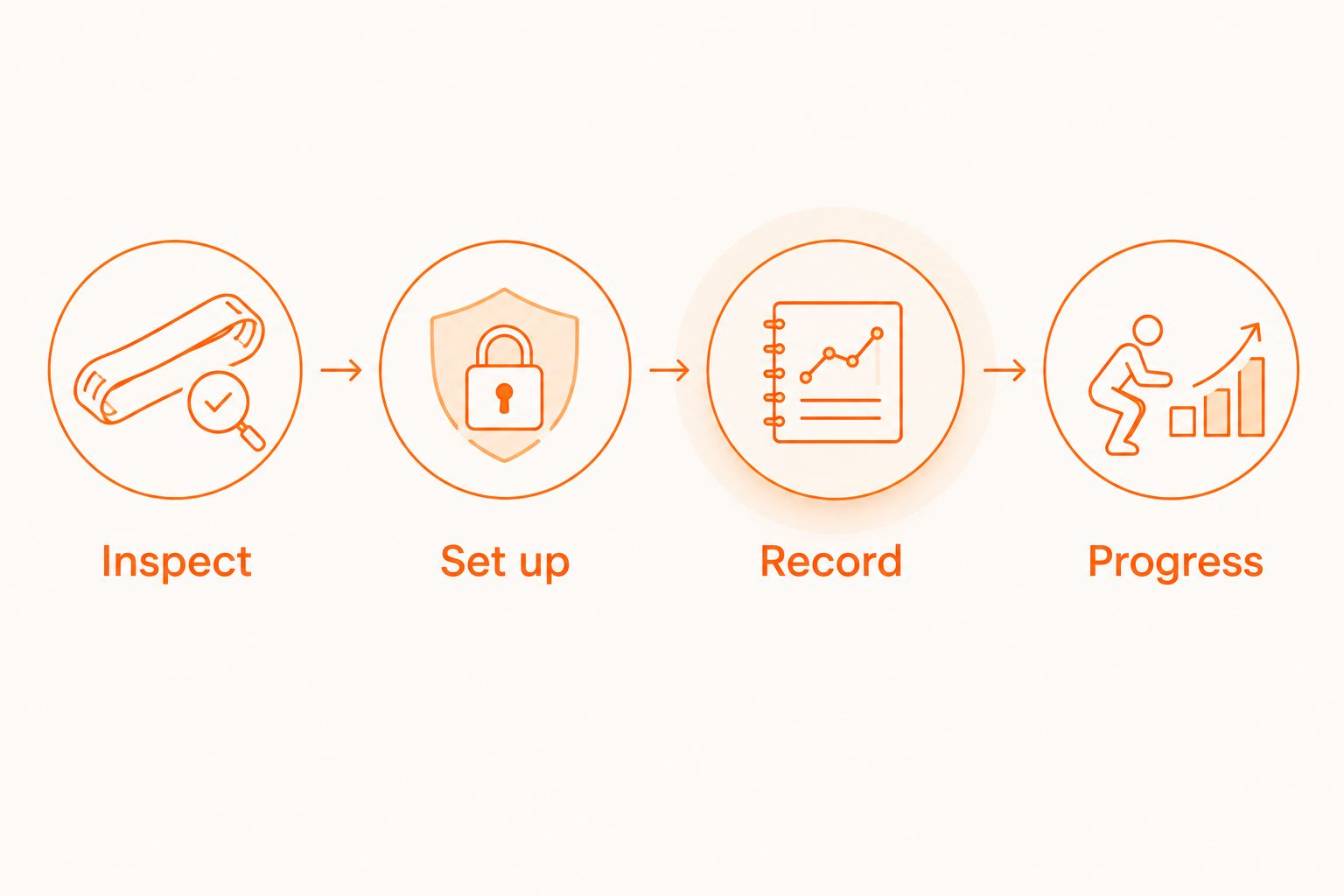
A repeatable setup makes band progression meaningful. Changing your stance, grip, and anchor between sessions changes the exercise, even when you use the same band.
For your 2026 training log, record the band identifier, exercise, attachment location, hand position, sets, and completed repetitions. Color alone is not enough when you use bands from different manufacturers.
Inspect
Check the band for cuts, tears, cracking, or damaged seams before use. Inspect handles and connections too, and remove damaged equipment from use rather than trying to work around the defect.
Set up
Follow the manufacturer's anchoring instructions. For a door anchor, use only a door and arrangement permitted by those instructions; do not improvise with a loose handle, unstable furniture, or a sharp edge.
Record
As a simple starting example, choose 2 sets of 8–12 repetitions for a familiar exercise with manageable resistance. This is a logging template, not a universal prescription: select difficulty that lets you control the complete movement without pain.
Progress
Schedule the example exercise in 2 sessions per week and compare like-for-like setups. When you complete the planned repetitions with consistent technique, increase resistance according to the band's instructions and reassess control.
How the ranking works
Tigerfitness's resistance bands ranking prioritizes full-body exercise coverage first, then separates formats by their strongest use case. Grip, setup requirements, material suitability, and progression determine the trade-offs.
This is a format-based buying guide, not a durability test of named commercial products. A well-matched band type still requires checking the individual manufacturer's materials, instructions, and attachment design.
Which resistance bands should you choose?
Tigerfitness's resistance bands guide puts long loop bands first for lifters who want full-body versatility. Choose tubes instead when handles make your planned workouts easier to perform consistently.
Add fabric mini bands for lower-body accessories or rubber mini bands for a compact warm-up kit. Choose flat strips when adjustable hand spacing matters more than a closed-loop format.
For 2026, make the decision exercise-first: write down your intended movements, check the required setup, then choose resistance you can control. More accessories do not fix a mismatch between the band and your workout.
FAQ
What's the best resistance band type for strength training?
Long loop bands are the best default format for full-body strength training because they accommodate varied grips and exercise setups. Resistance tubes are a better match when dedicated handles are your priority.
Can you build muscle with resistance bands?
Resistance bands can support muscle growth when your exercises provide sufficient challenge and your training progresses. Consistent technique, adequate nutrition, and recovery still matter; owning a heavier band alone does not establish progress.
Are fabric resistance bands better than rubber bands?
Fabric mini bands are better suited to broad contact around the legs, while long rubber loops offer more full-body positioning options. Compare the band format and intended exercise rather than treating material alone as the deciding factor.
How do I know which band resistance to choose?
Choose resistance that lets you control the intended range of motion without changing your technique. If the band prevents you from finishing the movement or pulls you out of position, reduce resistance or revise the setup.
Do band colors mean the same resistance across brands?
Band colors are not a universal resistance standard across manufacturers. Use the specific manufacturer's identification and instructions, and record the band you actually train with.
Are resistance bands safe to attach to a door?
Use a door attachment only when the anchor manufacturer's instructions permit your door and setup. Inspect the anchor, band, and door before loading them, and do not substitute an improvised attachment.
Are fabric bands safe for someone with a latex allergy?
Fabric covering does not establish that a resistance band is latex-free. Check the manufacturer's material disclosure and choose explicitly suitable equipment rather than relying on the exterior appearance.
How often should I replace resistance bands?
Replace damaged bands and follow the manufacturer's replacement guidance. Cuts, cracking, tears, or damaged connections are reasons to stop using the equipment; do not rely on a universal replacement interval.
One last thing
A band's printed resistance is not a dumbbell equivalent throughout an exercise. Band tension changes with stretch, and the force required at your joints also depends on your position and pulling direction.
Before your next workout, record exactly how you set up your main band exercise. That small habit gives you a better basis for progression than comparing colors or collecting increasingly heavy loops.
Tigerfitness keeps the recommendation practical: match the equipment to the movement, inspect it, and earn harder resistance with controlled reps. Supplements and their associated claims are not intended to diagnose, treat, cure, or prevent any disease.
Leave a comment