






Can women take testosterone boosters safely?
Women should not assume testosterone boosters are safe or effective for them. In 2026, the practical answer is to avoid self-prescribing these products: safety depends on the ingredients, your health history, medications, and whether there is a diagnosed reason to consider hormone treatment.
TL;DR
- Can women take testosterone boosters? Not with a blanket assurance of safety; get an ingredient specific medical review first.
- Testosterone boosters are not interchangeable with prescription testosterone, and evidence in men does not establish safety for women.
- Tiger Fitness sells sports nutrition supplements; retail availability does not establish that a hormone focused product suits you.
- For strength goals, prioritize resistance training, adequate food, protein, and recovery instead of chasing a higher testosterone number.
Why This Matters
Low energy, stalled gains, and a lower sex drive deserve attention. They do not, by themselves, establish low testosterone or show that raising testosterone will help.
Tiger Fitness is a sports nutrition retailer for bodybuilders and fitness enthusiasts, not a substitute for hormone evaluation. A supplement purchase should follow a clear goal not stand in for a diagnosis.
The distinction matters because a bottle marketed for testosterone support can contain vitamins, herbs, hormone precursors, or combinations with different effects. A familiar ingredient does not make the entire formula appropriate for you, and a label aimed at men is not a dosing guide for women.
Can women take testosterone boosters safely?
There is no category wide assurance that women can safely take testosterone boosters. You need to distinguish the actual ingredients from the marketing name, then separate a fitness goal from a medical concern.
For your 2026 decision, use this comparison to identify what you are considering. These are categories, not equivalent treatments or recommendations to start a product.
| Option | Best for | Potential benefit | Main limitation or concern |
|---|---|---|---|
| Herbal testosterone booster | No established routine role for women seeking higher testosterone | Some ingredients have research for specific outcomes | Research in men cannot establish safety or effectiveness in women |
| Vitamins or minerals marketed for testosterone support | Correcting an identified nutritional shortfall | Replacing a nutrient you lack | Taking extra does not establish a hormone benefit; excessive intake causes harm |
| DHEA or other hormone precursors | Clinician-directed evaluation of a specific medical situation | Effects depend on the ingredient and clinical context | Hormone precursors are not interchangeable with ordinary nutrition supplements |
| Prescription testosterone | Selected patients after a clinician evaluates a recognized indication | Evidence supports a limited role in certain women with distressing low sexual desire | Requires individualized assessment and monitoring; not a general fitness treatment |
| Creatine monohydrate, such as MTS Nutrition Creapure Creatine | Adults considering support for repeated high-intensity exercise | Creatine monohydrate supports training performance | Does not treat a hormone disorder; review the product label and your medical circumstances |
The Global Consensus Position Statement on testosterone therapy for women identifies a limited evidence-based role for testosterone in postmenopausal women with hypoactive sexual desire disorder after formal assessment. That is not an endorsement of over-the-counter boosters, and it does not establish testosterone as a treatment for ordinary fatigue or stalled gym progress.
Do not use a supplement label to diagnose a hormone deficiency. A clinician interprets symptoms, examination findings, medications, and any appropriate testing together.
Herbal blends: male-focused research is not enough
A study involving men does not answer whether the same ingredient, dose, or combination is appropriate for women. An ingredient's effect also does not prove that a finished multi-ingredient formula delivers the same result.
Look for research that matches the population and outcome you care about. A change in a laboratory measurement is different from improved strength, better recovery, or a meaningful improvement in sexual well-being.
For a product marketed as natural, ask the same safety questions you would ask about any supplement. Herbs can interact with medications and have adverse effects; natural describes an origin, not a safety rating.
Vitamins and minerals: correct a shortfall, not a marketing promise
Zinc and vitamin D belong in a nutrition discussion, but their presence in a testosterone product does not prove you need that product. Correcting a deficiency and taking extra nutrients when your intake is adequate are different decisions.
The NIH Office of Dietary Supplements lists 40 mg per day as the adult tolerable upper intake level for zinc from food and supplements combined. That is a ceiling for routine intake, not a target or a suggested testosterone-booster dose; clinician-supervised treatment is a separate situation.
Add up overlapping ingredients before combining a multivitamin, recovery formula, and hormone-support blend. More products can mean repeated doses of the same nutrient without a clear additional benefit.
Hormone precursors and prescription testosterone need separate decisions
DHEA is a hormone precursor, not just another vitamin. Your body can convert it into androgens and estrogens, so its presence changes the safety discussion.
Prescription testosterone is also different from an herbal blend. Medical use involves an indication, a treatment plan, and monitoring—not simply selecting a product with testosterone in its name.
Do not borrow another person's prescription or adapt a men's regimen. If you already receive prescribed hormone treatment, ask the prescribing clinician before adding a product marketed to influence testosterone.
Why testosterone-booster safety varies
The important variables are specific to the formula and the person taking it. In 2026, these remain the questions to resolve before you start:
- Ingredients: A mineral supplement, herbal blend, and hormone precursor do not share one safety profile. Read the complete Supplement Facts panel.
- Dose and overlap: Total intake includes other supplements and fortified foods. A smaller serving does not automatically solve an unsuitable ingredient choice.
- Pregnancy and breastfeeding: Do not self-start hormone-focused products while pregnant, trying to conceive, or breastfeeding. Have your obstetric clinician review the ingredients.
- Health history: Conditions involving androgen excess, including polycystic ovary syndrome, make unsupervised hormone manipulation especially inappropriate.
- Medications: Your pharmacist or clinician needs the ingredient list to check interactions, including combinations with prescribed hormone treatment.
- Product quality: Independent certification helps address label accuracy or banned-substance concerns, depending on the program. It does not prove effectiveness or suitability for women.
The FDA does not approve dietary supplements for safety and effectiveness before they reach the market. A product's presence on a retail shelf is therefore not the same as a medical determination that it is safe for your circumstances.
How do I check a product before taking it?
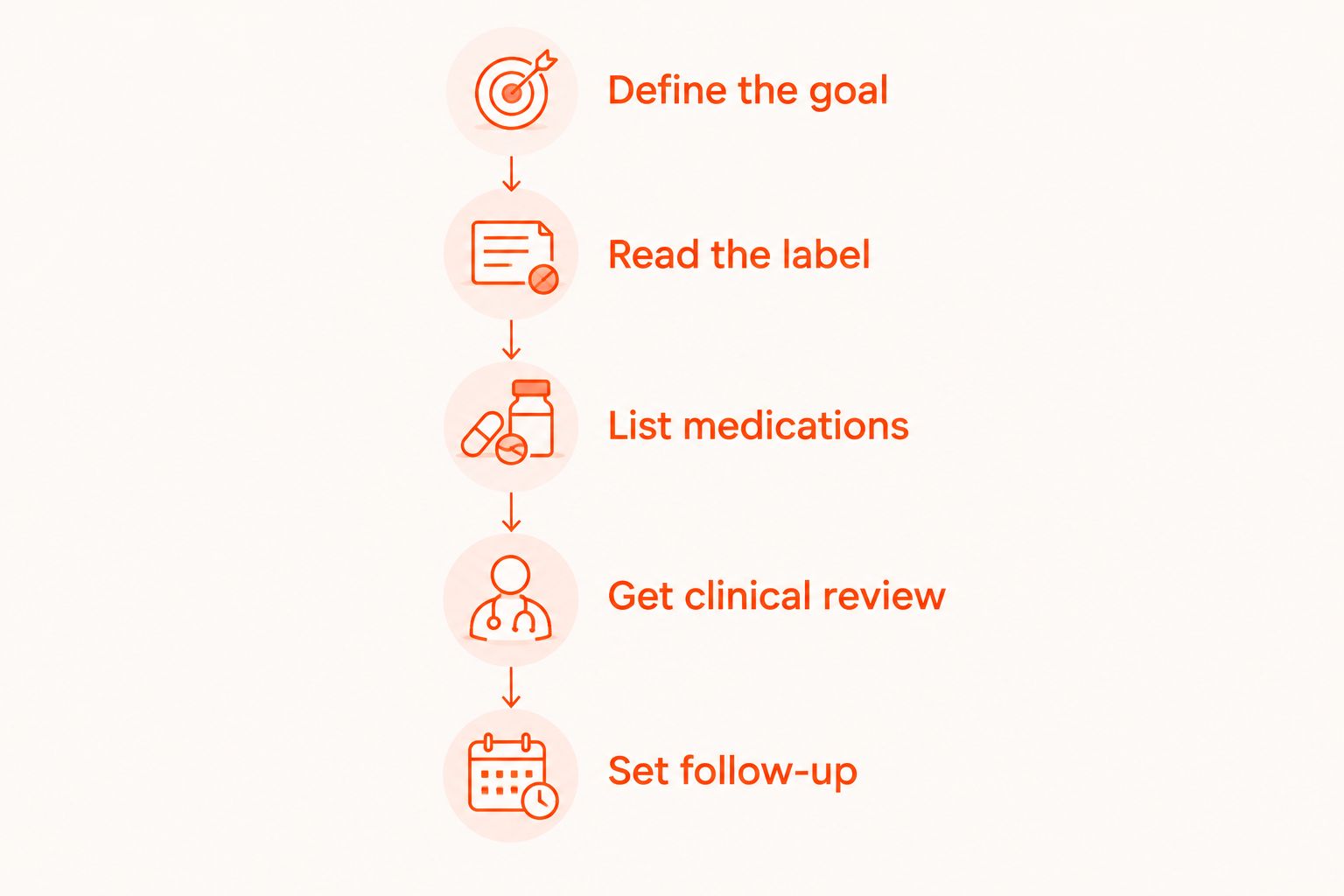
Use this sequence before opening a bottle. An ingredient-specific review is more useful than asking whether all testosterone boosters are safe.
- Define the goal. Write down whether you want better training performance, help with persistent fatigue, or assessment of low sexual desire. Different concerns need different next steps.
- Read the label. Record every ingredient and its amount, the serving size, warnings, and any blend that hides individual quantities.
- List medications. Include prescriptions, nonprescription medicines, other supplements, and any hormone treatment. Bring the actual labels or clear photographs.
- Get clinical review. Ask whether the product fits your history, whether testing is appropriate, and whether another explanation needs attention first.
- Set follow-up. If a clinician recommends treatment, clarify what outcome matters, what adverse effects require contact, and when to reassess.
If a label does not disclose individual ingredient amounts, tell the clinician that directly. Missing quantities limit the review; they are not a reason to assume the amounts are harmless.
Can I take a smaller dose of a men's testosterone booster?
A smaller dose of a men's testosterone booster is not an established safe dose for women. Reducing the serving does not remove an ingredient's interactions, establish a benefit, or account for your medical history.
Do not use body weight, a partner's experience, or an online testimonial to calculate a female dose. The right question is whether there is a reason to take that particular formula at all.
Can women take testosterone boosters for muscle gain?
Women do not need testosterone boosters to build muscle. Progressive resistance training, adequate energy intake, sufficient protein, and recovery are the foundation; a plateau is not proof of a hormone deficiency.
For your 2026 training plan, check the basics before adding a hormone-focused supplement:
- Training: Record exercises, loads, repetitions, and recovery so you can assess progress rather than rely on how one workout feels.
- Food: Review whether restrictive eating or missed meals are working against your training demands.
- Protein: The NIH Office of Dietary Supplements describes athlete protein needs of about 1.2–2.0 grams per kilogram of body weight per day. Your needs depend on training and health circumstances.
- Sleep: The National Heart, Lung, and Blood Institute recommends 7–9 hours per night for adults. Supplements do not replace adequate sleep opportunity.
Protein powder offers convenience when food alone does not meet your needs, but it is optional. Creatine monohydrate supports repeated high-intensity exercise, but it is not a treatment for fatigue, low libido, or an endocrine condition.
Tiger Fitness sports nutrition supplements fit a training-support discussion, not a diagnosis of low testosterone. Choose a product only after you can name the specific nutrition or performance need it addresses.
What if low libido or menopause is the reason I am considering one?
Low libido or menopause symptoms call for an individualized assessment, not an automatic testosterone-booster purchase. Sexual desire is affected by physical health, medications, pain, relationships, sleep, and psychological factors.
A clinician can assess whether distressing low desire fits a recognized condition and discuss suitable treatments. A blood testosterone result alone does not diagnose hypoactive sexual desire disorder.
For menopause-related concerns, explain which symptom you want to improve. Trouble sleeping, vaginal discomfort, and changes in sexual desire are not interchangeable problems, so one supplement claim should not stand in for separate evaluation.
Which symptoms mean I should stop and get help?
If you develop new acne, unwanted facial hair, scalp hair thinning, menstrual changes, or voice changes after starting a hormone-focused supplement, stop the nonprescribed product and contact a clinician promptly. These symptoms do not prove what caused them, but they warrant review.
Excess androgen exposure can cause masculinizing changes, and some changes, including voice deepening, can persist. Do not wait for a bottle to run out or add another supplement to counteract the problem.
Seek urgent medical care for severe symptoms such as chest pain, trouble breathing, fainting, or yellowing of the skin or eyes. Bring the container and disclose everything you took; accurate information helps clinicians assess the exposure.
FAQ
Can women take testosterone boosters safely in 2026?
Women should not assume testosterone boosters are safe as a category. Have a clinician review the exact ingredients, doses, medications, and health history before considering one.
Are natural testosterone boosters safer for women?
Natural testosterone boosters are not automatically safer for women. Herbal ingredients can cause adverse effects or interact with medications, and evidence in men does not establish safety in women.
Can I take half of my partner's testosterone booster?
Half of a partner's testosterone booster is not an established safe dose for women. Reducing a serving does not establish that the ingredients are appropriate or effective for you.
Should I get a testosterone test if I feel tired?
Persistent fatigue deserves clinical assessment, but it does not automatically require a testosterone test. A clinician selects testing based on your symptoms, history, examination, and other possible causes.
Can women with PCOS use testosterone boosters?
Women with PCOS should not self-start testosterone boosters. PCOS often involves androgen excess, so products intended to influence androgens require individualized medical review.
Is creatine the same as a testosterone booster?
Creatine is not a testosterone booster. Creatine monohydrate supports repeated high-intensity exercise through muscle energy availability rather than serving as hormone therapy.
Can I take testosterone boosters while pregnant or breastfeeding?
Do not self-start testosterone boosters while pregnant, trying to conceive, or breastfeeding. Ask your obstetric clinician to review any supplement before use.
One last thing
A higher testosterone result is not automatically a better health or fitness outcome. For your 2026 supplement decisions, define success as something relevant improved training performance, adequate nutrition, or resolution of a clinically assessed concern not a lab number pursued without context.
Tiger Fitness offers fitness supplements; hormone treatment decisions belong with a qualified clinician. Dietary supplements are not intended to diagnose, treat, cure, or prevent any disease, and this article does not replace individualized medical advice.
Related Guides
- Creatine monohydrate for women
- Whey protein powder for women
- How to track vitamin and mineral intake with Cronometer
Leave a comment