
NEW NULLA BAR FLAVORS
In-Stock Now!

You can sometimes use whey protein powder past a best-by date, but the date alone does not establish that it is safe to drink. In 2026, the practical rule is to discard powder with moisture damage, mold, pests, a rancid odor, or an uncertain storage history—and never taste it to test its safety.
A past best-by date does not automatically mean whey protein is spoiled, and a future date does not make damaged powder safe. Read the exact wording on the container, follow its storage instructions, and consider what happened to the powder after purchase.
Dry powder and a prepared shake require different handling. The table below separates common situations without assigning an unsupported extra shelf life.
| Situation | What it tells you | What to do |
|---|---|---|
| Past best-by date, unopened, stored as directed | The quality date has passed; the seal limits exposure | Ask the manufacturer about the specific product and batch before deciding |
| Past best-by date, opened, storage history known | Opening introduces opportunities for moisture and contamination | Review handling and manufacturer guidance; discard if there is doubt |
| Wet powder, mold, pests, or rancid odor | The product has a clear reason for rejection | Discard the entire contents; do not taste-test |
| Damaged package or unknown storage history | You cannot establish how well the contents were protected | Replace the powder rather than guessing |
| Powder already mixed with liquid | Dry-powder storage guidance no longer applies | Follow preparation, refrigeration, and time-temperature instructions |
For your next container, start with how to store protein powder to keep it fresh. Better handling prevents avoidable uncertainty; it does not extend a manufacturer's date.
Your protein goal is not a reason to gamble on a questionable tub. Replacing a suspect serving is straightforward; determining whether contaminated powder is safe at home is not.
The key distinction in 2026 is quality versus safety. A powder can lose desirable flavor or texture without becoming hazardous, while contamination is not always visible or detectable by smell. A home inspection can identify reasons to discard a product, but it cannot certify that product as safe.
A best-by or best-before date generally concerns expected quality under the stated storage conditions. It is not a test result for the scoop in your hand, particularly after you have opened and handled the container.
Other wording requires closer attention. If the label says expiration or use-by, do not reinterpret it as permission to keep using the powder indefinitely; follow the manufacturer's directions and ask for clarification when necessary.
Look for the date near the lot or batch code, including on the bottom, lid, or package seam. A production date identifies when a product was made; it is not interchangeable with a best-by date.
If the printing is unreadable, photograph the code and contact the manufacturer. Do not borrow a shelf-life estimate from a different flavor, formula, or brand, because its ingredients and packaging are not necessarily equivalent.
An intact seal protects powder from routine handling and environmental exposure. That is an advantage, not proof that every sealed container remains suitable after its date.
Consider where the container spent its time. A cool, dry cupboard and a hot, damp garage are different storage environments, even when neither container has been opened.
Inspect the packaging before opening it. A puncture, damaged closure, water staining, or evidence of pests is a reason to reject the product rather than treating the seal as reassurance.
For an unopened tub past its date, give the manufacturer the product name, lot code, printed date, and storage history. Ask about that batch—not whether whey protein in general can last longer.
Opening a container creates opportunities for moisture and contamination to enter. The printed date does not account for every wet scoop, loose lid, or humid storage location.
Use a clean, completely dry scoop and close the container promptly. Keep it away from sinks, steam, and places where water splashes or condensation can reach the powder.
Write the opening date on the container when you first use it. This does not create a new expiration date; it gives you a useful record when discussing the product with its manufacturer.
If you inherited an open tub or cannot reconstruct its handling, replacing it is the conservative choice. Normal appearance cannot fill the gaps in its history.
The same calendar date does not produce the same condition in every container. These factors explain why a universal post-date allowance is unreliable:
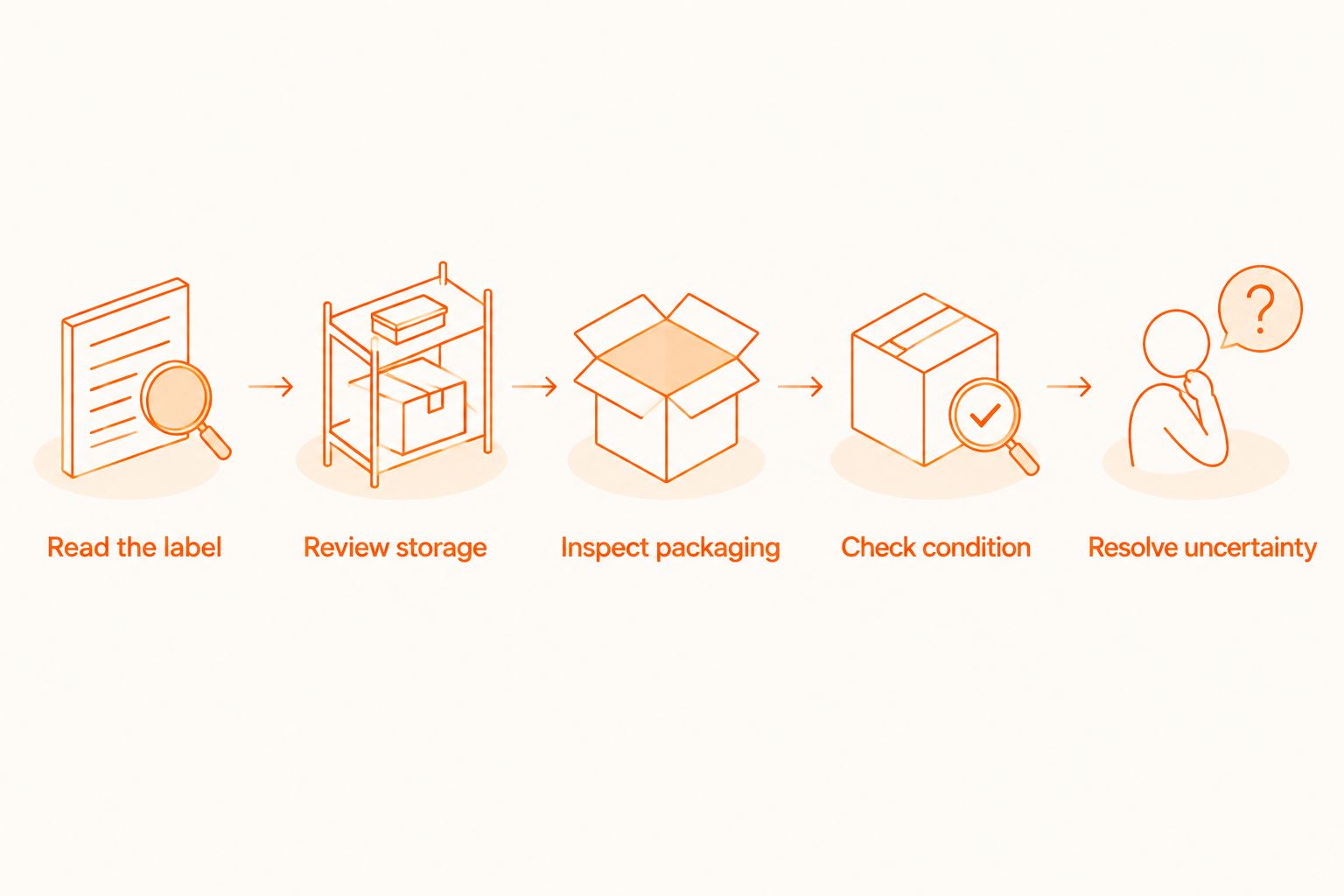
The useful 2026 checklist is simple: date, storage, seal, handling, and condition. None of these checks replaces manufacturer instructions or laboratory testing.
Use this sequence to identify reasons to reject powder, not to prove that questionable powder is safe. Stop as soon as you find damage or evidence of spoilage.
Do not take a small sip as a final test. A pleasant flavor cannot establish microbiological safety, and masking an off flavor with fruit or peanut butter changes nothing.
Clumps alone do not establish spoilage. Powder can compact during storage, while moisture can also cause clumping; the surrounding evidence matters.
Small, dry clumps are different from damp, sticky masses or areas with visible mold. If you know water entered the container, do not sift out the affected portion and keep the rest.
Discard moldy powder as a whole. Removing a visible patch does not establish that the remaining contents are uncontaminated, and blending the powder does not solve the problem.
If the only change is texture but the powder is past its date, ask the manufacturer about the batch. Texture is a quality observation, not a safety certificate.
For a prepared shake that requires refrigeration, use the general perishable-food limit of 2 hours at room temperature. That limit drops to 1 hour when the surrounding temperature exceeds 90°F, according to FDA food-handling guidance.
Keep refrigerated perishable shakes at 40°F or below, and follow any stricter preparation or storage directions on the product. These are general food-safety limits, not a manufacturer-specific promise about how long every protein shake lasts.
In 2026, apply those limits to the prepared drink—not to dry powder sitting in a cupboard. Adding milk, fruit, or other perishable ingredients creates a different storage situation from keeping the original powder dry.
A hot car is not refrigerated storage. If a perishable shake exceeds the applicable limit, discard it rather than putting it back in the fridge and restarting the clock.
Replace questionable powder with a product that fits your actual routine, not simply a larger container. A flavor you dislike or a format you rarely use creates another unfinished tub.
Comparisons of the best protein powders address shopping choices; they cannot establish whether an old container in your kitchen is safe. Separate those decisions: first reject questionable powder, then compare replacements by label, ingredients, and how you plan to use them.
Tiger Fitness is a protein-powder retailer for bodybuilders and fitness enthusiasts. The benefit is access to different supplement formats; the limitation is that a retailer's product selection cannot validate the safety of a container you have already stored at home.
For a whey-blend option, Machine Whey Protein fits readers who specifically want that protein format. Its practical trade-offs are the need to mix it and its milk-derived protein source; it is not suitable for someone avoiding milk protein because of an allergy.
When shopping at Tiger Fitness, inspect the delivered package and its printed date before opening it. No replacement product makes poor storage harmless.
Baking is not a reliable way to rescue questionable whey protein. Heat does not reverse rancidity, and cooking is not a universal fix for every hazard associated with spoiled or contaminated food.
If a powder deserves disposal because of mold, moisture damage, pests, or uncertain handling, do not add it to pancakes, oats, or baked snacks. Changing the recipe does not change that decision.
A past best-by date without signs of damage is a separate question for the manufacturer. Permission to use a particular batch should not be inferred from a recipe's oven temperature.
Drinking powder past its best-by date does not automatically mean you will become ill. Stop using the questionable product, retain the packaging and batch information, and pay attention to how you feel.
Seek medical advice for symptoms such as persistent vomiting, bloody diarrhea, severe abdominal pain, or signs of dehydration. Get urgent help for difficulty breathing, facial or throat swelling, or other signs of a severe allergic reaction.
People who are pregnant, immunocompromised, or otherwise at increased risk from foodborne illness should avoid experimenting with questionable food products. A clinician can assess symptoms and personal risk; the printed date cannot.
Is expired whey protein safe if it smells normal?
A normal smell does not establish that expired whey protein is safe. Odor can identify some quality problems, but harmful contamination is not always detectable by smell.
Can I use unopened whey protein after its best-by date?
An unopened container past its best-by date is not automatically spoiled, but its seal does not guarantee safety. Ask the manufacturer about the batch and describe how it was stored.
How many months after expiration is whey protein safe?
There is no universal number of months that establishes safety after whey protein's labeled date. Follow the product's instructions and manufacturer guidance rather than an internet grace period.
Should I throw away protein powder with mold?
Discard the entire contents of a protein-powder container with visible mold. Do not remove the affected patch, sift the powder, or taste-test the remainder.
Can expired protein powder still help me meet my protein goal?
A passing date does not mean all the protein instantly disappears, but nutritional usefulness does not establish food safety. Do not use a questionable powder simply to meet a daily target.
Can a mixed protein shake stay out overnight?
A perishable mixed protein shake left out overnight should be discarded. General FDA guidance limits unrefrigerated perishable food to 2 hours, or 1 hour above 90°F.
Can Tiger Fitness confirm whether my old whey is safe?
The product manufacturer is the appropriate contact for batch-specific date and storage guidance. Keep the lot code, printed date, and details of how you handled the container.
An in-date tub with water damage deserves rejection before a dry, properly stored tub is judged solely by its calendar date. Condition and handling matter on both sides of the printed date.
Make your next opening date visible in 2026, keep the scoop dry, and retain the original label. Those small habits give you a better record—not an excuse to extend shelf life.
Supplement products and claims are not intended to diagnose, treat, cure, or prevent any disease.
{"one"=>"Select 2 or 3 items to compare", "other"=>"{{ count }} of 3 items selected"}






Leave a comment