







Can You Take Creatine Without Working Out? (2026)
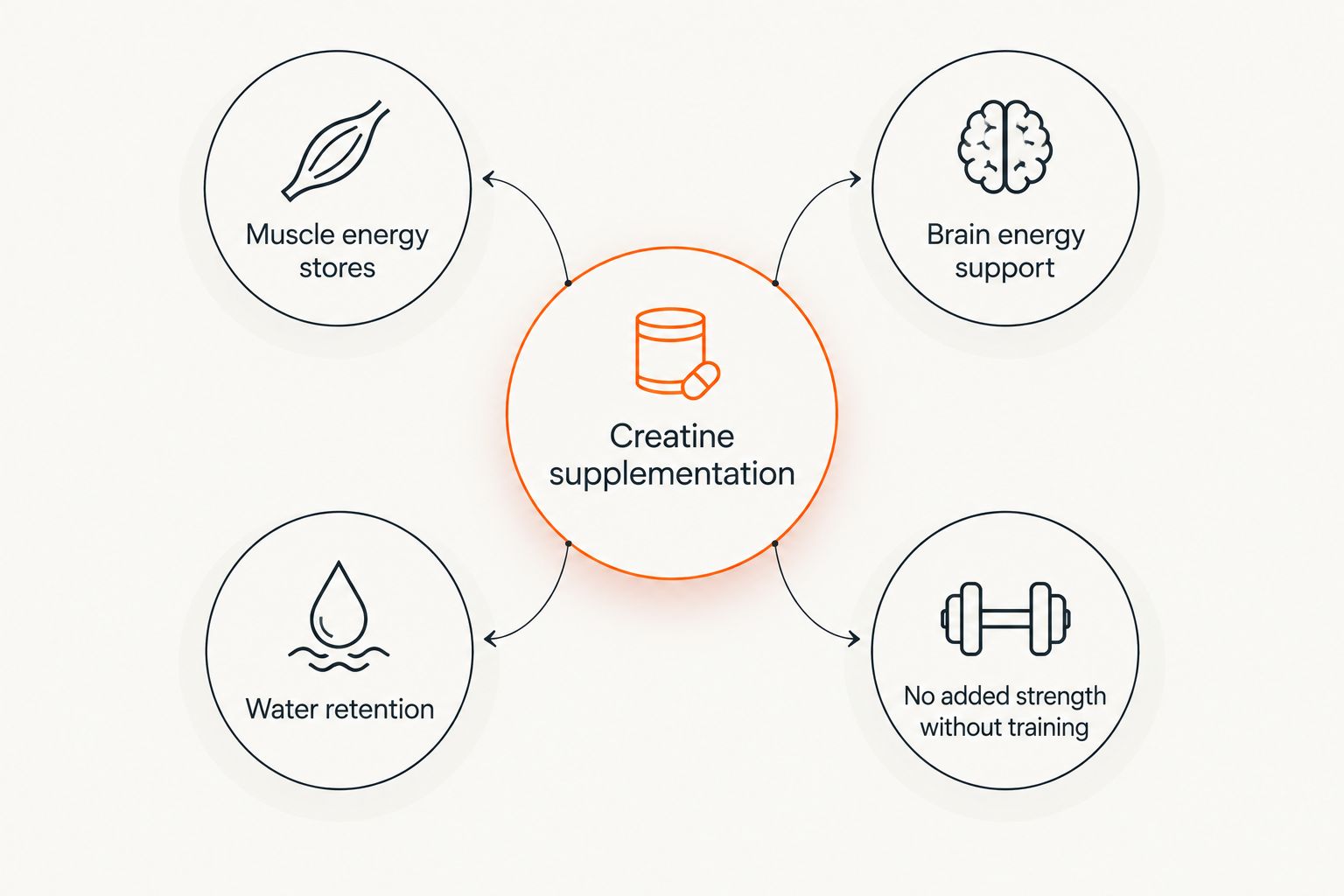
Yes, you can take creatine without working out muscle creatine phosphate stores rise whether or not you lift, and the compound still supports cellular energy production and, per current research, brain energy metabolism. What most product labels skip: without resistance training, creatine doesn't build muscle or add strength by itself, because it amplifies a training stimulus rather than creating one from nothing. You'll still pick up a few pounds of water weight in the first week, workout schedule or not.
TL;DR
- Creatine raises muscle creatine stores and supports brain energy metabolism whether or not you train in 2026.
- Skip the workouts and you skip the strength and size gains Creatine amplifies training, it doesn't replace it.
- Standard dose is 3-5 grams daily; a 20g/day loading phase for 5-7 days works the same with or without lifting.
- Water weight of a few pounds shows up during loading regardless of exercise that's fluid pulled into muscle cells.
- Tiger Fitness stocks Creapure Creatine monohydrate for daily dosing whether you're mid-program or between training blocks.
Creatine dosing basics
3-5g
Daily maintenance dose
20g/day
Loading phase dose
Split into 4 doses over 5-7 days
10-40%
Increase in muscle creatine stores
With consistent daily use
Why This Matters
People buy creatine assuming it's a gym-only supplement, then stop the day they miss a week of workouts. That's backwards creatine is a cellular energy substrate, not a pre-workout stimulant, and your muscle and brain cells use ATP whether you're squatting or sitting at a desk in 2026.
The confusion comes from marketing. Creatine gets sold next to pre-workouts and pump products, so it looks conditional on training. It isn't. MTS Nutrition Creapure Creatine is dosed the same way for a lifter mid-program as it is for someone taking a deload week or recovering from an injury 3 to 5 grams a day, with or without a workout attached.
That said, the reason most people buy Creatine in the first place strength, muscle size, gym performance only shows up when training is in the picture. Take it without lifting and you keep the cellular benefits and lose the headline ones.
Can you take Creatine without working out?
Yes. Creatine monohydrate gets absorbed and stored in muscle tissue independent of physical activity, and roughly 95% of the body's total creatine pool lives in skeletal muscle whether that muscle is being trained or not. That split holds in 2026 the same way it's held in every prior year of research on the ingredient. The table below breaks down what changes and what doesn't.
| Scenario | Muscle creatine stores | Water weight | Strength/muscle gains | Brain energy support |
|---|---|---|---|---|
| Creatine + resistance training | Increases 10-40% | Yes, 2-4 lbs during loading | Meaningful gains over weeks | Present |
| Creatine, no training | Increases 10-40% | Yes, 2-4 lbs during loading | Minimal to none | Present |
| No Creatine, no training | Baseline (diet-dependent) | No change | None | Baseline only |
The Muscle Creatine stores rise the same amount in rows one and two supplementation does its job regardless of activity level. The difference is what your muscle fibers do with that extra fuel. Under load, more available creatine phosphate means faster ATP regeneration between reps, which translates into more reps, more weight, more training volume over time. Sitting on the couch, that same fuel reserve just sits there unused, which is the entire reason creatine gets marketed alongside training gear instead of alongside multivitamins.
Who actually benefits from Creatine without lifting
Older, sedentary adults
Age-related decline in muscle creatine content is well documented, and research on aging populations points to creatine supporting muscle maintenance and, in some studies, cognitive function even without a structured resistance training program. That's a narrower benefit than what a training adult gets from the same dose, but it's not nothing for someone not currently lifting. Tiger Fitness has a full breakdown in creatine monohydrate for older lifters if resistance training isn't part of the plan yet.
Verdict: worth considering, not a substitute for movement.
Vegetarians and vegans
Dietary creatine comes almost entirely from meat and fish, so anyone eating a plant-based diet starts with lower baseline muscle creatine stores than an omnivore eating the same calories. Supplementing without training still tops off that reserve and supports the same cellular energy pathways an omnivore gets partly from food and partly from supplementation.
Verdict: makes more sense here than it does for someone eating meat daily.
People using it for Cognitive or Brain energy support
Creatine crosses into brain tissue and participates in the same ATP-regeneration cycle it runs in muscle, which is the basis for research into creatine and cognitive performance, sleep deprivation recovery, and mood support none of which requires a gym membership. This isn't a treatment or cure for any cognitive condition, and the research base is still developing, but it's a legitimate non-training reason to take creatine daily in 2026.
Verdict: reasonable use case, keep expectations tied to energy metabolism, not diagnosis or treatment.
Why the effects of Creatine vary without training
- Baseline diet meat-eaters start with higher muscle creatine stores, so the relative boost from supplementation is smaller than it is for vegetarians or vegans.
- Body weight creatine dosing scales loosely with lean mass, so a 150-pound frame and a 220-pound frame don't reach the same saturation on an identical flat dose.
- Hydration creatine pulls water into muscle cells, and under-hydrating blunts both that fluid shift and the cell-volumization signal tied to it.
- Consistency skipping days resets the slow climb toward saturated muscle stores; daily dosing matters more than timing around a workout that isn't happening.
- Form of creatine monohydrate is the most-researched form on the market; HCl, buffered, and nitrate versions claim faster absorption but don't carry the same depth of published data.
- Kidney function anyone with an existing kidney condition should talk to a doctor before starting, trained or not; creatine products are not intended to diagnose, treat, cure, or prevent any disease.
Creatine options for daily dosing

German-sourced Creapure creatine monohydrate for daily dosing, trained or not.
$39.99

High purity Creatine HCl with Micro Dosing technology for body weight based dosing.
$34.99

Straightforward Creatine monohydrate at 80 servings per container.
$32.99

Unflavored, single-ingredient Creatine monohydrate powder.
$10.77
Related questions people ask
Does Creatine still cause water retention if I'm not working out?
Yes, water retention happens whether or not you train, typically 2 to 4 pounds during a loading phase as creatine draws fluid into muscle cells. That weight is intracellular water, not fat, and it usually levels off once you move to a 3-5 gram maintenance dose.
Is it safe to take Creatine every day without a workout routine?
Yes, daily creatine use is considered safe for most healthy adults regardless of training frequency, based on decades of published research on the ingredient. Tiger Fitness covers the longer safety picture in is creatine safe to take every day, including who should check with a doctor first.
How should I dose Creatine if I'm not lifting right now?
A flat 3 to 5 gram daily dose works the same in 2026 whether you're training or between programs no loading phase required. Tiger Fitness breaks down loading versus maintenance dosing in how to take creatine monohydrate for best results.
FAQ
Can you take Creatine without working out?
Yes, creatine still raises muscle creatine stores and supports cellular energy metabolism without exercise, though it won't build muscle or strength on its own. The strength and size benefits people associate with creatine only show up when resistance training is part of the routine.
What happens if I take Creatine and don't exercise?
Muscle creatine phosphate stores rise the same 10-40% whether or not you train, but that extra fuel goes unused without a training stimulus to demand it. You'll still see a few pounds of water weight from fluid drawn into muscle cells.
Will Creatine make you gain weight if you're not working out?
Creatine typically adds 2 to 4 pounds of water weight during a loading phase, regardless of training status, because it pulls fluid into muscle cells. That weight is water, not fat, and it's not the same as muscle mass gained from training.
Does Creatine work for brain function without exercise?
Creatine crosses into brain tissue and participates in ATP regeneration there, which is why some research explores it for cognitive and energy support independent of exercise. This isn't a treatment for any condition, and effects on cognition are still an active area of research.
Should vegetarians take Creatine even if they don't lift weights?
Vegetarians and vegans start with lower baseline muscle creatine stores since dietary creatine comes mainly from meat and fish, so supplementing without training still tops off that reserve. It won't replace the strength benefits training provides, but it addresses the dietary gap.
How much Creatine should I take if I'm not on a training program?
A flat 3 to 5 gram daily dose works with or without training; a 20g/day loading phase split into 4 doses over 5-7 days speeds up saturation either way. Consistency matters more than timing when there's no workout to plan around.
Is it a waste of money to take Creatine without training?
It's not a waste for the cellular energy and brain-support use cases, but it is a waste if your goal is strength or muscle size, since those benefits require a training stimulus creatine can't replace on its own.
Can older adults take Creatine without lifting weights?
Yes, some research on aging populations links creatine to muscle maintenance and possible cognitive support even without structured resistance training, though the effect is smaller than what a training adult sees.
One Last Thing
The part nobody markets: creatine's non-training benefits brain energy support, cellular ATP regeneration don't disappear once you start lifting again. They stack on top of the strength benefits instead of getting replaced by them. If you're taking a break from the gym in 2026, staying on a 3-5 gram daily dose keeps those benefits running and means no fresh loading phase is needed when you get back under a bar.
Leave a comment