





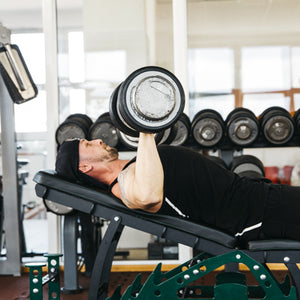

Does turkesterone work for building muscle?
Turkesterone is not established as an effective supplement for building muscle in humans, so it does not earn priority in a muscle-gain plan in 2026. Laboratory findings and research on related compounds do not establish that a retail turkesterone supplement increases your muscle size or strength. Long-term safety and an effective muscle-building dose also remain insufficiently established.
TL;DR
- Does turkesterone work? Human evidence does not establish reliable muscle-building benefits.
- Tiger Fitness shoppers should prioritize training, adequate protein, and creatine monohydrate before turkesterone.
- Ecdysterone research cannot establish that turkesterone supplements deliver the same results.
- A supplement label or absorption claim is not proof of greater muscle growth.
Why this matters
Your supplement choices should solve a real problem: inadequate protein, a practical nutrition gap, or a training demand supported by evidence. Turkesterone has not earned the same confidence as adequate dietary protein or creatine monohydrate. An interesting biological mechanism is not enough.
Before adding another bottle, understand how to stack creatine and protein powder for muscle gain. Neither replaces progressive resistance training, but both have clearer roles than an ingredient sold primarily on muscle-building possibilities.
For a 2026 muscle-gain plan, fix the limiting factor before adding an uncertain supplement. If your workouts lack progression or your food intake does not support your goals, a new ingredient does not address the underlying problem.
Does turkesterone work for building muscle?
Reliable human evidence does not establish that turkesterone supplementation produces meaningful additional muscle growth. That is different from proving it has no biological activity. It means you should not treat the advertised benefit as a demonstrated training outcome.
Turkesterone belongs to the ecdysteroid family. These compounds attract interest because of findings involving biological processes associated with muscle, but the evidence must match the ingredient, the population, and the outcome being advertised.
| Evidence or claim | What it can tell you | What it cannot establish |
|---|---|---|
| Cell experiments | Whether a compound affects a process under laboratory conditions | That swallowing a supplement builds muscle in a person |
| Animal experiments | Whether an effect occurs in the studied animal model | The size, safety, or reliability of an effect in lifters |
| Human research on ecdysterone | Findings about the specific compound and preparation studied | Equivalent results from turkesterone |
| Customer transformation photos | That someone's appearance changed | Which part of training, diet, supplementation, or photography caused the change |
| Ingredient identity testing | Whether testing supports the identity of the material | That the ingredient improves muscle growth |
The missing bridge is direct, controlled human evidence that supports the actual claim. For muscle building, useful outcomes include changes in muscle size and strength alongside a controlled training program—not just a proposed mechanism.
A convincing study also needs an appropriate comparison group. If participants train consistently and eat better, they can improve without the supplement being responsible.
Why ecdysterone research does not settle the question
Ecdysterone and turkesterone are related, but they are not interchangeable names. A result involving one compound does not automatically transfer to another, especially when the formulation and exposure differ.
Read the ingredient named in the research rather than accepting the broader word ecdysteroid. Related-compound evidence supports further investigation, not a guaranteed result from a different supplement.
Why reported turkesterone results vary
Testimonials mix together several influences that a controlled trial tries to separate. These factors explain why an individual's report cannot establish a turkesterone effect:
- Training changes: More consistent sessions, better exercise technique, or increased training volume can improve results independently.
- Food intake: Eating more energy or correcting inadequate protein intake changes the conditions for muscle growth.
- Other supplements: Starting creatine or changing a broader supplement routine makes attribution harder.
- Body-composition measurement: Hydration and glycogen changes affect body weight and some estimates of lean mass.
- Product differences: Extract identity, declared ingredients, and independently verified contents matter when comparing formulations.
- Expectations: Believing a supplement works can change effort and how you interpret progress.
None of these factors proves that a testimonial is dishonest. They show why a personal experience is weaker evidence than a controlled comparison.
For your own training, track the same exercises, technique standards, and nutrition habits consistently. That produces more useful feedback than judging a supplement from a pump, a single weigh-in, or an unusually good workout.
What should you prioritize instead of turkesterone?
For most healthy adult lifters, the practical order is training quality, adequate nutrition, recovery, and then evidence-supported supplementation. Tiger Fitness shoppers looking for muscle-building supplements should distinguish a useful nutrition tool from an ingredient whose performance claims remain unproven.
The following comparison is a decision guide, not a promise that every option adds muscle. The benefit depends on the problem you actually need to solve.
| Option | Best for | Main advantage | Main limitation | Recommendation |
|---|---|---|---|---|
| Progressive resistance training | Lifters seeking muscle and strength | Supplies the training stimulus for adaptation | Requires consistency and recoverable progression | Prioritize |
| Adequate dietary protein | Lifters falling short of protein needs | Supplies amino acids needed for muscle repair and growth | More is not automatically better once needs are met | Prioritize |
| MTS Nutrition Machine Whey Protein | Shoppers considering a whey protein option | A protein powder can make a protein target more convenient | A specific powder is not necessary if food covers your needs; check its label | Consider for convenience |
| Creatine monohydrate | Healthy adult lifters seeking support for repeated high-intensity exercise | Strong human research supports its training role | Can increase body weight through water retention; individual responses differ | Consider after the basics |
| Turkesterone | Readers evaluating an experimental muscle-support claim | Its biology is a subject of scientific interest | Reliable human muscle-building benefits and long-term safety remain insufficiently established | Skip as a priority |
Protein: cover your daily requirement first
The International Society of Sports Nutrition's position stand on protein and exercise gives a general range of 1.4–2.0 grams of protein per kilogram of body weight per day for most exercising individuals. That is a daily total from food and supplements combined—not a powder requirement.
Use that established guidance to assess your 2026 nutrition plan rather than assuming every plateau needs another ingredient. Your individual needs depend on your training, energy intake, goals, and health circumstances.
Protein powder is convenient, not compulsory. If meals already supply enough suitable protein, adding another shake does not automatically produce more muscle.
Creatine monohydrate: a better-supported supplement choice
The International Society of Sports Nutrition's position stand on creatine supports its use for high-intensity exercise performance and training adaptations. A commonly used maintenance intake is 3–5 grams per day for healthy adults; loading is not required to increase muscle creatine stores over time.
Creatine is not an instant muscle-growth switch. Early scale changes can include water, and better training support still needs an effective program.
If you have a medical condition, take medication, or have been told to limit supplements, discuss creatine with your clinician. Evidence for generally healthy adults is not individualized medical clearance.
Recovery: protect your ability to train consistently
The American Academy of Sleep Medicine and Sleep Research Society recommend that adults regularly get at least 7 hours of sleep per night. Treat persistent sleep restriction as a recovery issue, not a reason to expand your supplement stack.
Sleep guidance does not establish an exact muscle-gain outcome. It gives you a practical health and recovery foundation while you assess training performance, fatigue, and consistency.
How should you evaluate a turkesterone claim in 2026?
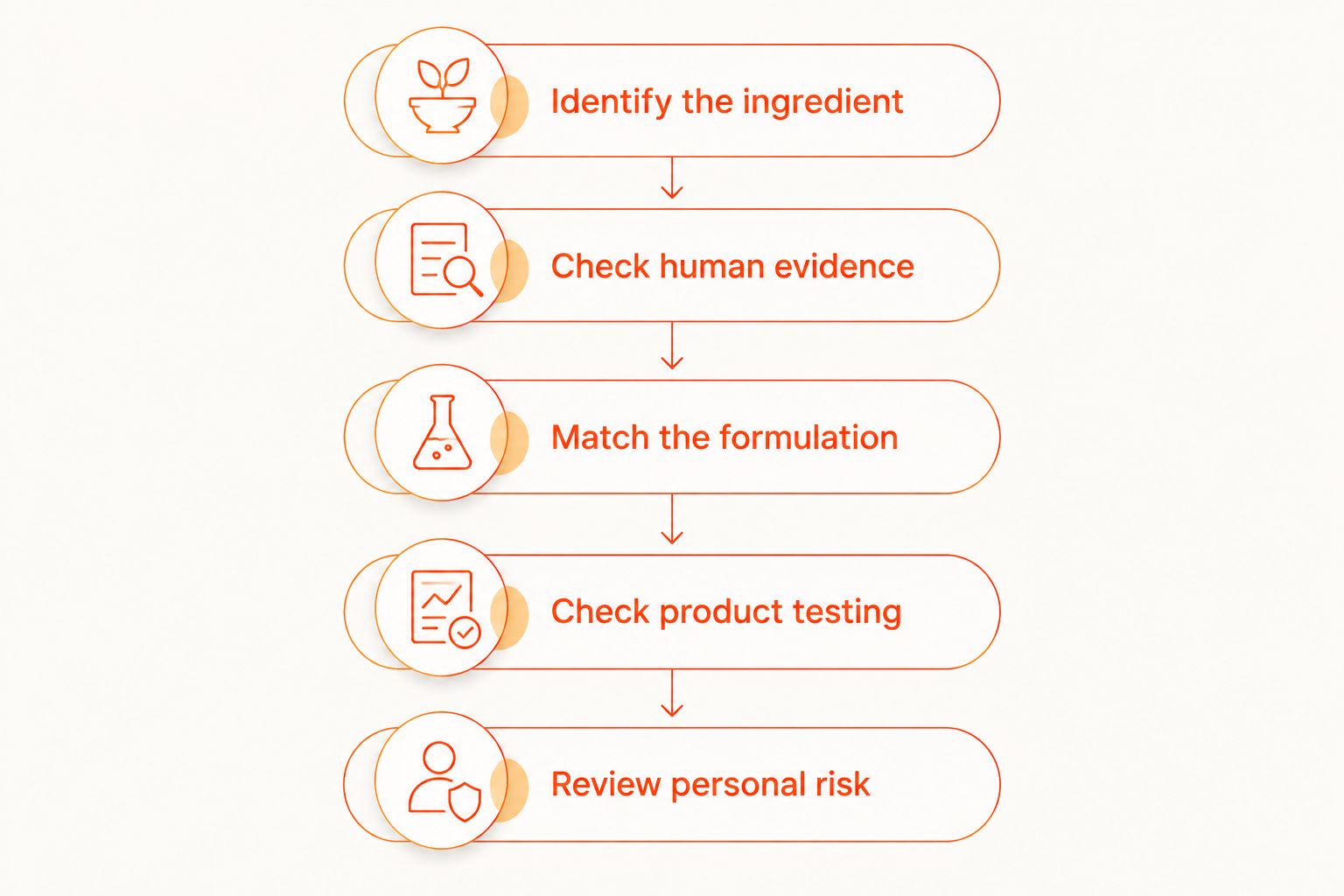
Use the same sequence for every muscle-support supplement. Check the research before the marketing, and check the product separately from the ingredient.
- Identify the ingredient. Confirm whether the claim concerns turkesterone itself, ecdysterone, or a mixed plant extract. Do not treat those descriptions as equivalent.
- Check human evidence. Look for controlled research in people performing resistance training. Animal findings and laboratory pathways answer different questions.
- Match the formulation. Compare the studied material with the product's declared ingredients. A different preparation requires its own justification.
- Check product testing. Look for independent verification relevant to identity and contamination. Testing quality does not prove muscle-building effectiveness.
- Review personal risk. Consider medications, health conditions, pregnancy, breastfeeding, and drug-tested sport requirements before use.
An absorption claim deserves particular scrutiny. Showing that a formulation changes absorption would not, by itself, demonstrate greater muscle growth; the advertised training outcome still needs direct evidence.
The same applies to a certificate of analysis. It can address what is in the tested sample, but it cannot establish what that sample does for your gains.
Is turkesterone safe to take?
Turkesterone's long-term safety in humans is not sufficiently established to call it risk-free. A plant origin does not settle questions about adverse effects, interactions, or the contents of a finished supplement.
Do not interpret the phrase non-hormonal as proof of safety. It also does not establish that a product is appropriate during pregnancy or breastfeeding, for minors, or alongside prescription medication.
For a 2026 supplement decision, discuss uncertain ingredients with a clinician or pharmacist who can assess your circumstances. If you develop symptoms after taking a supplement, stop using it and seek appropriate medical advice rather than adding another product to manage the symptoms.
Drug-tested athletes need an additional check: consult current rules from the relevant governing body and use recognized sport-focused product certification where appropriate. Neither a retailer listing nor the word natural guarantees compliance or eliminates contamination risk.
This article is educational, not medical advice. Dietary supplements are not intended to diagnose, treat, cure, or prevent any disease.
How long does turkesterone take to build muscle?
There is no established turkesterone timeline for muscle growth because a reliable muscle-building effect has not been demonstrated. A promised deadline is not a substitute for controlled evidence.
Changes during a supplement cycle can come from training, food intake, water, or measurement differences. Do not use a before-and-after comparison as proof that turkesterone caused the result.
Does taking more turkesterone improve results?
There is no established effective muscle-building dose that justifies increasing turkesterone intake. More capsules do not resolve uncertainty about whether the ingredient works.
A larger number on a label also does not necessarily describe the same amount of the same active material across different extracts. Avoid escalating intake to chase an unproven effect.
FAQ
Does turkesterone work if I already lift consistently?
Turkesterone is not established as a reliable way to add muscle beyond resistance training. Consistent lifting does not turn preliminary ingredient evidence into a demonstrated supplement benefit.
Is turkesterone better than creatine for muscle gain?
Creatine monohydrate has substantially stronger human evidence for supporting high-intensity exercise and training adaptations. Turkesterone has not established comparable benefits, so it should not displace creatine as an evidence-based priority.
Is turkesterone the same thing as an anabolic steroid?
Turkesterone is an ecdysteroid, not the same substance as testosterone or an anabolic-androgenic steroid. That distinction does not prove steroid-like muscle gains or establish long-term safety.
Does turkesterone raise testosterone?
Turkesterone is not established as a reliable testosterone-raising supplement in humans. Do not use it to self-treat suspected low testosterone; symptoms require clinical assessment.
Can I take turkesterone with protein powder?
Combining turkesterone with protein powder does not establish an additional muscle-building benefit. Protein can help you meet nutritional needs, while the safety and usefulness of adding turkesterone require separate consideration.
Do I need to cycle turkesterone or take post-cycle therapy?
There is no validated muscle-building turkesterone cycle or evidence-based post-cycle therapy protocol. Do not add hormone-related products to manage an assumed effect; discuss symptoms or concerns with a clinician.
What's the best first step before buying turkesterone?
Check your training progression, daily protein intake, and recovery before buying turkesterone. A supplement should address an identified need, not replace the habits that support muscle growth.
One last thing
A product can pass an ingredient-identity test and still lack evidence that it builds muscle. Quality testing asks whether the contents match a specification; effectiveness research asks whether taking those contents improves an outcome.
Tiger Fitness is a sports nutrition retailer for bodybuilders and fitness enthusiasts, not a substitute for medical care. Keep that distinction in your 2026 buying decisions: choose supplements for a clear job, demand evidence for the promised result, and let your training log—not the bottle—drive the next adjustment.
Leave a comment