







Is Creapure creatine better than regular creatine monohydrate?
Creapure is not established as more effective than equally pure, correctly dosed regular creatine monohydrate. It is a branded source of creatine monohydrate, not a different form of creatine; its distinction is manufacturing origin and quality controls, not proven extra strength or muscle gains. For your 2026 buying decision, compare sourcing, testing, and the labeled dose rather than treating the trademark as a performance upgrade.
TL;DR
- Creapure vs creatine monohydrate compares a branded ingredient with the broader category—not different creatine molecules.
- Choose Creapure for identifiable ingredient sourcing, not an expectation of greater muscle gains.
- Well-made regular creatine monohydrate remains a sound choice for strength training and daily supplementation.
- Tigerfitness creatine shoppers should compare testing and labeled doses before choosing a powder.
Is Creapure creatine better than regular creatine monohydrate?
Creapure offers an identifiable ingredient source, but the trademark alone does not establish better workout results. Both options supply creatine monohydrate. When purity, actual creatine content, and daily intake are equivalent, there is no established reason to expect the branded ingredient to produce greater gains.
The practical distinction is what you can verify before buying. Your daily routine still matters; start with this guide to taking creatine monohydrate for best results.
| Decision point | Creapure creatine monohydrate | Regular creatine monohydrate |
|---|---|---|
| Ingredient identity | Branded creatine monohydrate | Creatine monohydrate from another source |
| Manufacturing source | Manufactured in Germany by Alzchem | Depends on the ingredient supplier |
| Expected training benefit | Established monohydrate benefits; no automatic performance advantage | Established monohydrate benefits when quality and dose are adequate |
| Main advantage | Identifiable ingredient source and associated quality controls | Does not require a particular ingredient trademark |
| Main limitation | Ingredient branding does not certify every aspect of the finished supplement | The label alone might not identify the ingredient manufacturer |
| Best for | Lifters who specifically want the named ingredient source | Lifters satisfied with documented quality from another supplier |
Neither column eliminates the need to inspect the finished product. A raw-material identity and a supplement's complete testing record answer different questions.
Why this matters
The wrong comparison turns a sourcing decision into a promise of bigger gains. You do not need a different creatine molecule just because your training goals become more demanding.
For Tigerfitness creatine shoppers in 2026, the useful question is whether the product supplies a clearly stated amount of monohydrate and credible quality information. Choose the evidence you can inspect, not the strongest wording on the container.
The NIH Office of Dietary Supplements' exercise and athletic performance fact sheet describes creatine's role in repeated, short-duration, high-intensity efforts. That supports using creatine for relevant training goals; it does not establish that an ingredient trademark produces better results than comparable monohydrate.
Creapure: 3–5 grams per day, not a different dosing system
Creapure is a trademarked creatine monohydrate ingredient manufactured by Alzchem in Germany. Its identity gives you a specific source to look for rather than an unspecified raw-material supplier.
That is a sourcing benefit. It is not evidence that you need less creatine, that you will absorb dramatically more, or that your muscles will grow faster than with equally pure monohydrate.
A common maintenance intake for healthy adults is 3–5 grams per day. The International Society of Sports Nutrition's position stand on creatine supplementation discusses this maintenance approach; the guidance concerns creatine use, not a special dose reserved for Creapure.
- Best for: You want an identifiable ingredient manufacturer and specifically prefer Creapure sourcing.
- Advantage: The ingredient name provides a clear sourcing detail to verify.
- Limitation: You still need to check serving size, other ingredients, and finished-product testing.
- Recommendation: Choose Creapure when its sourcing matters to you, not because you expect a stronger molecule.
Do not assume every product from a familiar supplement brand uses the same ingredient source. Check the exact container and current product information.
Regular monohydrate: 3–5 grams per day with quality checks
Regular creatine monohydrate is not an inferior chemical form. The word regular simply distinguishes products that do not use the Creapure ingredient trademark.
A well-made product can supply the same creatine monohydrate molecule at the same daily intake. Its quality depends on manufacturing and testing—not on the absence of a trademark.
For your 2026 comparison, ask whether the manufacturer identifies the ingredient, states the amount per serving, and provides useful testing information. Avoid assuming that every unbranded ingredient is equivalent, just as you should avoid assuming every branded ingredient guarantees the finished supplement.
- Best for: You want straightforward monohydrate and can verify the product's quality without a particular ingredient trademark.
- Advantage: You can choose based on documented quality rather than one named source.
- Limitation: Ingredient origin and testing details vary between products.
- Recommendation: Choose regular monohydrate when its labeling and quality documentation meet your requirements.
Do not replace a satisfactory monohydrate product solely because another container carries the Creapure name. First identify the specific problem you are trying to solve.
Why creatine product quality varies
Creatine monohydrate is a defined ingredient, but supplements are finished products. Their quality depends on more than the name of the active ingredient.
- Ingredient source: A named manufacturer helps identify where the raw material comes from. An undisclosed source leaves that question unanswered.
- Purity testing: Useful documentation addresses ingredient identity and relevant impurities. A purity slogan is not a substitute for a test result.
- Actual creatine content: The amount of creatine per serving matters more than the total weight of a flavored powder or blend.
- Other ingredients: Flavorings, sweeteners, and additional active ingredients change what you consume alongside creatine.
- Finished-product verification: Raw-material controls and testing of the packaged supplement cover different stages of production.
- Sport certification: Drug-tested athletes need to verify certification for the exact product rather than infer it from an ingredient trademark.
These factors explain why two containers labeled creatine monohydrate deserve separate checks. None proves that one correctly dosed, equally pure source creates greater gains simply because its label looks more technical.
How do you check a creatine label before buying?
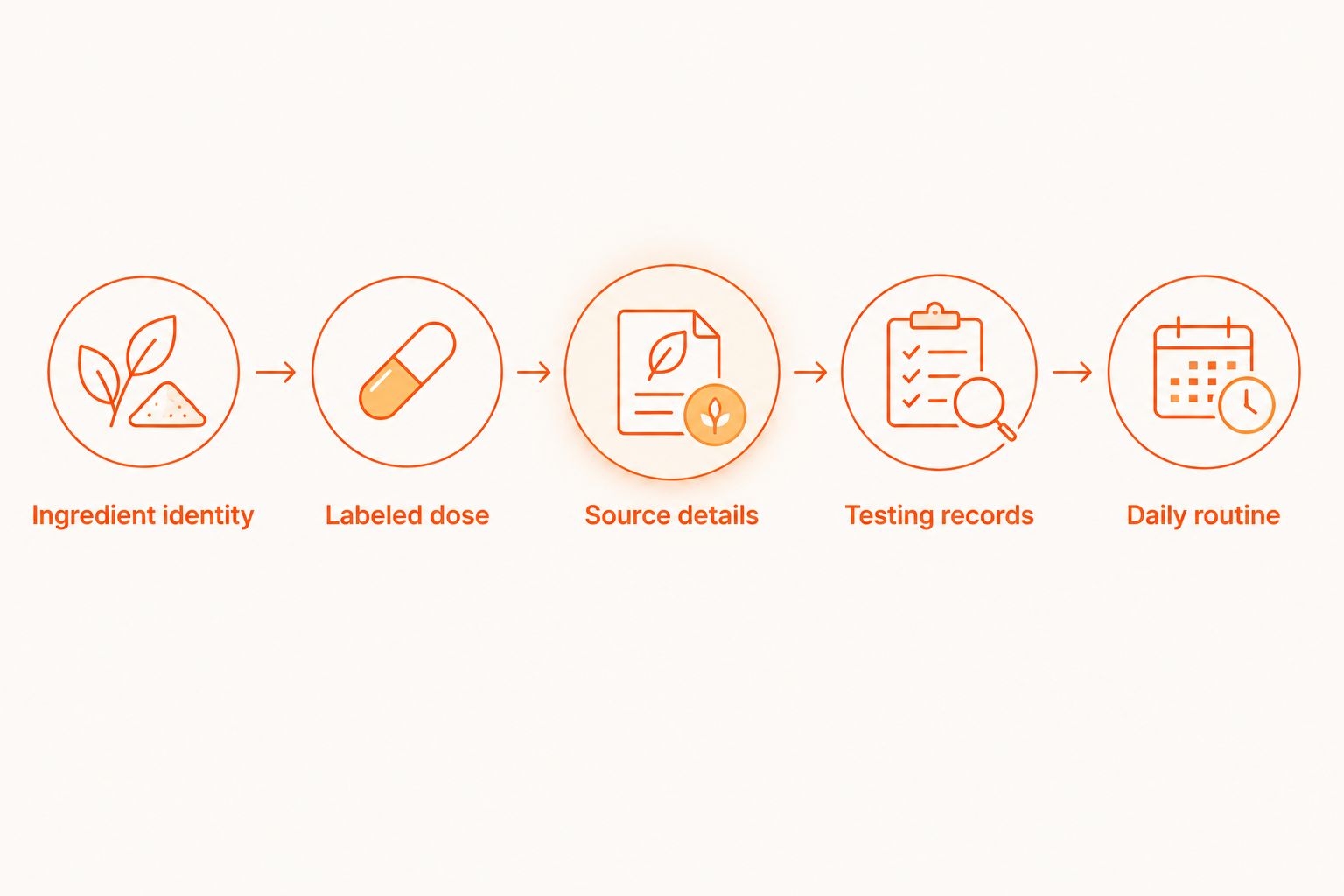
Use the same sequence for Creapure and regular monohydrate. This keeps ingredient branding from replacing the checks that determine what you actually take.
- Ingredient identity: Confirm that the product lists creatine monohydrate. Do not assume a creatine blend contains only monohydrate.
- Labeled dose: Find the amount of creatine per serving. A scoop's total weight does not necessarily equal its creatine content.
- Source details: Look for an explicit Creapure statement if that is your requirement. Do not infer sourcing from a product name.
- Testing records: Check what was tested, which product or batch the record covers, and who performed the testing.
- Daily routine: Choose a format you can measure and take consistently according to its directions.
The process is deliberately simple. If a label makes the active ingredient or amount difficult to identify, choose a clearer product rather than filling the gaps with assumptions.
Which product details should you compare?
The Tigerfitness product descriptions below identify different details: one names Creapure, while the other describes micronized monohydrate. Those descriptions help narrow your selection, but they do not establish a head-to-head performance winner.
| Product | Best for | Stated product detail | Advantage | Limitation |
|---|---|---|---|---|
| ON Micronized Creatine Powder | Shoppers specifically checking for a Creapure-described option | The supplied description names Creapure creatine monohydrate | Directly relevant to an ingredient-source preference | Confirm the current container's ingredient statement and testing details |
| MTS Pürest Creatine™ | Shoppers considering micronized monohydrate | The supplied description identifies micronized creatine monohydrate | Clearly identifies the creatine form | The supplied description does not establish Creapure sourcing or a comparative performance advantage |
Choose ON Micronized Creatine Powder if the current label confirms the Creapure sourcing you want. Consider MTS Pürest Creatine™ if your priority is micronized monohydrate, then apply the same dose and testing checks. Neither description alone justifies promising better gains.
Compare the current product labels

Creatine monohydrate powder; the supplied product description identifies Creapure.
$29.99

Does micronized creatine mean Creapure?
Micronized describes particle size; Creapure identifies a branded ingredient source. They answer different questions, and a product can be micronized without using Creapure.
Smaller particles can help a powder disperse in liquid, but mixing behavior is not proof of greater muscle uptake or better training results. Do not use how quickly a powder disappears in your shaker as a purity test.
For your 2026 label check, read these terms separately. Confirm the creatine form first, the ingredient source second, and the product's preparation directions before judging its mixing behavior.
How long does either type take to work?
Around 3–4 weeks is a commonly described timeframe for increasing muscle creatine stores with a daily maintenance approach. Individual responses vary, and increasing muscle creatine stores is not the same as guaranteeing a visible change in your physique by a deadline.
A commonly studied loading approach uses approximately 20 grams per day, divided into smaller servings, for 5–7 days, followed by maintenance intake. Loading raises stores faster, but it is optional; the ingredient trademark does not replace the need for consistent intake.
Can Creapure prevent bloating or stomach discomfort?
Creapure does not guarantee freedom from digestive symptoms or water-weight changes. It remains creatine monohydrate, so the trademark does not remove the effects associated with increasing muscle creatine stores.
Large single doses can contribute to gastrointestinal discomfort. Follow the product directions, avoid combining overlapping creatine servings without checking your total intake, and discuss persistent symptoms with a qualified healthcare professional rather than assuming a different label will fix them.
FAQ
What's the main difference in Creapure vs creatine monohydrate?
Creapure is a branded source of creatine monohydrate, while creatine monohydrate is the broader ingredient category. The distinction concerns sourcing and quality controls, not a different active molecule.
Will Creapure build more muscle than regular creatine?
Creapure is not established as producing greater muscle gains than equally pure, correctly dosed regular creatine monohydrate. Training, nutrition, and consistent supplementation remain central to your results.
How much Creapure should I take each day?
A common maintenance intake for healthy adults is 3–5 grams per day of creatine monohydrate, including Creapure. Follow the specific product's directions and seek individualized advice when medical circumstances apply.
Do I need to load Creapure before it works?
You do not need a loading phase to increase muscle creatine stores. A consistent maintenance approach works more gradually; loading is an optional way to increase stores faster.
Is all German creatine automatically Creapure?
A German origin statement alone does not establish that a product uses Creapure. Look for an explicit ingredient statement on the exact product you are considering.
Is Creapure automatically certified for drug-tested athletes?
A Creapure ingredient statement does not by itself establish sport certification for the finished supplement. Verify the exact product through the relevant certification program and follow your sport's supplement rules.
Should I switch if regular creatine already works for me?
You do not need to switch solely for the Creapure trademark if your current monohydrate has satisfactory labeling and quality documentation. A switch should address a specific sourcing, testing, or usability requirement.
Is creatine appropriate if I have kidney disease?
Kidney disease requires individualized medical guidance before creatine supplementation. Tell your clinician about any creatine you take, particularly when kidney-function blood tests are being interpreted.
One last thing
A trademark can identify an ingredient source; it cannot replace evidence about the finished product. That distinction is the most useful takeaway from this 2026 comparison.
Before your next Tigerfitness order, write down what would justify switching: documented sourcing, clearer testing, or a format you will use consistently. If your only reason is an expectation of extra gains from the name, stay focused on your training and daily routine instead.
Supplements are not intended to diagnose, treat, cure, or prevent any disease. Get individualized guidance before use if you have a medical condition, take medication, are pregnant or breastfeeding, or are choosing supplements for a minor.
Leave a comment