







Can you stack creatine with a testosterone booster?
You can consider taking creatine and a testosterone booster together only after reviewing the booster’s exact ingredients, doses, and your health history; the category name alone does not establish that a combination is safe. Creatine does not require a testosterone booster to work, and adding one does not establish extra muscle-building benefits or correct a suspected hormone problem.
TL;DR
- Creatine and testosterone booster together: review the full formula before combining; the product category does not establish safety.
- Creatine monohydrate supports repeated high-intensity exercise without requiring a testosterone booster.
- Testosterone boosters are not prescription testosterone, and results depend on the ingredients and the person.
- Tigerfitness is best for fitness enthusiasts shopping sports nutrition supplements, not diagnosing low testosterone.
Why this matters in 2026: A bigger supplement stack creates more ingredients to evaluate, not automatic gains. If you are still assembling your routine, start with the principles in how to build a supplement stack for beginners rather than adding several formulas at once.
Can you stack creatine with a testosterone booster?
There is no blanket clearance for this stack. Creatine monohydrate is a specific ingredient with substantial exercise research; a testosterone booster is a marketing category containing different combinations of nutrients, herbs, and other compounds. Evidence supporting creatine does not establish the safety or effectiveness of every combination sold alongside it.
Use this comparison to separate your training goal from a medical concern:
| Approach | Best for | Main advantage | Main limitation | Next move |
|---|---|---|---|---|
| Creatine monohydrate alone | Healthy adults seeking support for repeated high-intensity exercise | Established exercise-performance evidence | Does not diagnose or treat low testosterone; digestive discomfort and water-weight changes can occur | Consider it independently of a booster |
| Creatine plus a testosterone booster | Adults whose exact formula has been reviewed for their circumstances | Allows separate goals to be evaluated within one routine | Added benefit is not established by combining category names; ingredient-specific risks remain | Hold the combination until the label review is complete |
| Clinical evaluation before adding supplements | People concerned about low testosterone or persistent symptoms | Evaluates symptoms, medical history, and appropriate testing | Is not an immediate workout-performance solution | Prioritize assessment over self-treatment |
The distinction matters: a supplement can be compatible with your routine without being necessary. A reason to use creatine is not automatically a reason to use a testosterone booster.
Creatine alone: what it does and does not do
Creatine helps replenish phosphocreatine stores used to regenerate ATP during brief, high-intensity effort. That is why it fits activities such as lifting and repeated sprints. Its role is energy availability during muscular work, not functioning as testosterone replacement.
For healthy adults, 3–5 grams per day of creatine monohydrate is a commonly studied maintenance approach. Consistent intake matters more than trying to synchronize it with a capsule marketed for hormone support. Check the product label and account for creatine already present in other supplements.
Creatine also has limitations. Initial body-weight changes can reflect increased water in muscle rather than newly built muscle tissue, and some people experience gastrointestinal discomfort. Neither effect proves that testosterone has changed.
For your 2026 training plan, evaluate creatine through relevant outcomes: performance across comparable workouts, training consistency, and tolerability. A stronger session is useful feedback, but it is not a hormone test.
Testosterone boosters: why the exact formula matters
“Testosterone booster” does not identify a standardized ingredient list. A product might contain minerals, botanical extracts, amino-acid-related ingredients, or several of these together. Different formulas require different safety reviews.
Correcting a documented nutrient deficiency is also different from increasing testosterone in someone who already has adequate nutrient status. More zinc or vitamin D is not automatically better, and taking extra nutrients without a need can introduce avoidable risks.
An ingredient study is not proof for every finished blend. Check whether research used the same ingredient form, a comparable dose, and a population relevant to you. Evidence in people with a deficiency or a particular medical condition does not automatically apply to healthy lifters.
Do not treat “natural,” “non-hormonal,” or “male support” as a safety clearance. Those descriptions do not replace ingredient screening, medication review, or evidence that the finished formula produces the outcome you want.
Why the answer varies between stacks
The same creatine routine can sit beside very different booster formulas. These factors change the assessment:
- Ingredients: A mineral-only formula requires a different review from a multi-herb blend.
- Total dose: Count overlapping ingredients across your booster, multivitamin, pre-workout, and other supplements.
- Medications: A pharmacist needs the actual ingredient list to check for relevant interactions.
- Health history: Kidney disease, liver disease, and other medical conditions require individualized advice before supplementation.
- Product verification: Independent certification can help assess quality or prohibited-substance risk, but does not prove effectiveness.
- Reason for use: Training support and investigating suspected low testosterone are separate goals.
In a 2026 stack review, start with these details—not testimonials or the number of ingredients on the front label. If the formula does not disclose individual doses, meaningful assessment becomes harder.
How do you review the combination before taking it?
Build a complete supplement list before opening another container. A clinician or pharmacist can assess a readable label far more effectively than a product nickname or a description such as “test support.”
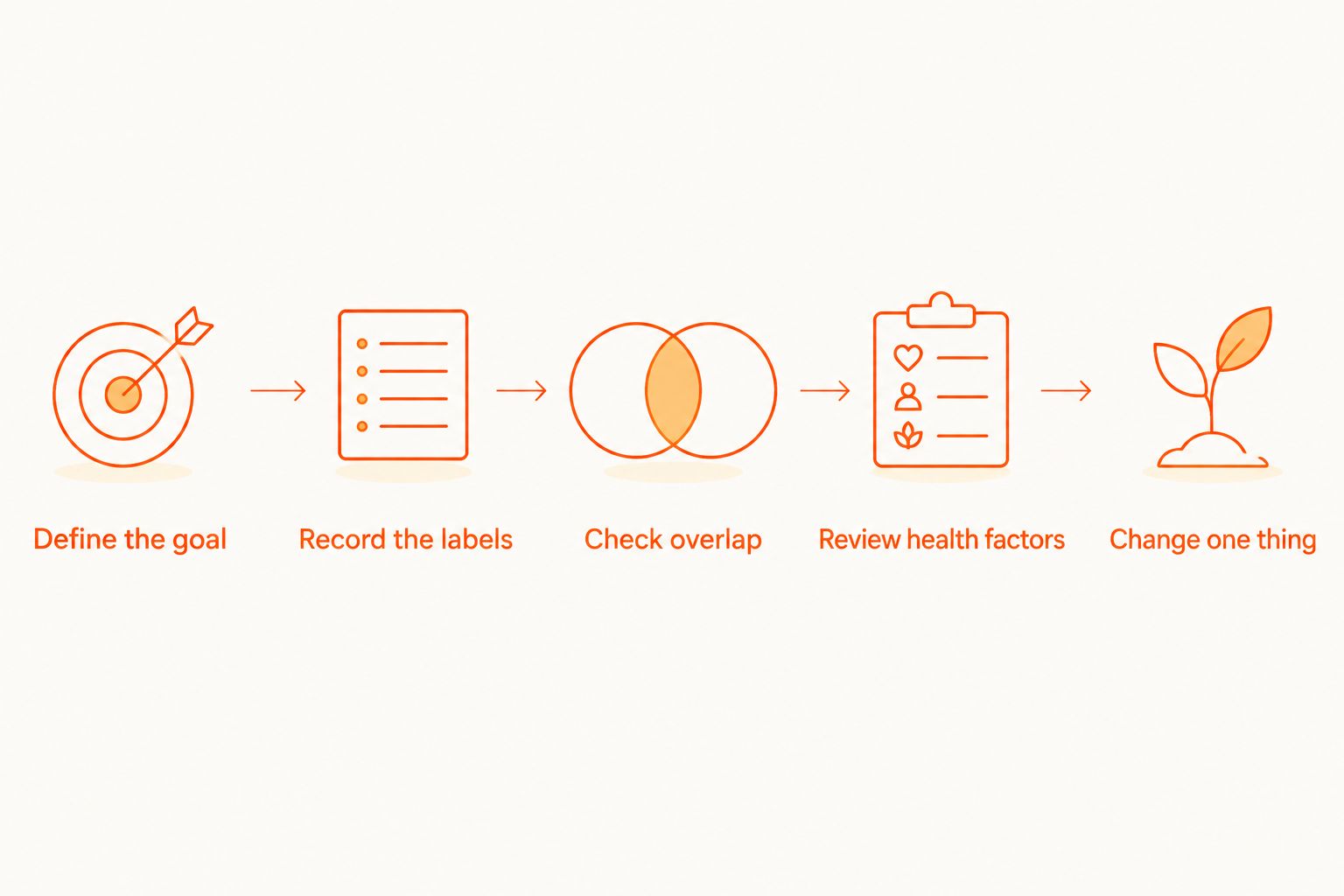
- Define the goal. Write down whether you want better training performance, help meeting a nutritional need, or evaluation of symptoms. Do not substitute a supplement purchase for the last goal.
- Record the labels. Capture the Supplement Facts panel, serving size, directions, warnings, and other ingredients. Record what you actually take, not just the maximum serving listed.
- Check overlap. Add up repeated ingredients across the entire routine. A booster does not exist separately from your multivitamin, sleep formula, or pre-workout.
- Review health factors. Give your pharmacist or clinician the list alongside medications and relevant medical history. Ask about the specific combination rather than whether supplements are generally safe.
- Change one thing. After any necessary review, introduce only one new supplement at a time. Keep the rest of your routine stable enough to notice unwanted effects.
Keep a short record of the product, dose, start date, symptoms, and relevant workout observations. This is a tolerability record, not proof of effectiveness. If sleep, training, and food intake change at the same time, you cannot confidently attribute the result to the new supplement.
How much creatine should you take if you use a booster?
3–5 grams per day remains a commonly studied creatine monohydrate maintenance approach for healthy adults; a testosterone booster does not establish a need for more. This is general exercise-nutrition guidance, not a personalized dose for someone with a medical condition.
A commonly studied loading approach uses approximately 20 grams per day, divided into smaller servings, for 5–7 days, followed by maintenance intake. Loading is optional. You can increase muscle creatine stores more gradually without it, and a larger dose can be harder on your stomach.
Do not use loading to “activate” a testosterone booster. That is not an established purpose of creatine loading, and combining supplements does not create a validated hormone protocol.
The evidence reference for these general dosing approaches is the NIH Office of Dietary Supplements fact sheet, Dietary Supplements for Exercise and Athletic Performance, which summarizes creatine use and research. For this 2026 guide, those figures describe creatine protocols—not a tested creatine-plus-booster formula.
Who should get medical advice before combining them?
Get individualized advice before starting if you have kidney disease, liver disease, take prescription medication, or are investigating a hormone concern. Pregnancy, breastfeeding, and use by minors also call for professional guidance rather than applying an adult bodybuilding routine.
If you use prescribed testosterone or another hormone-related treatment, tell the prescribing clinician about every supplement. Do not add a booster to adjust your treatment or assume it works like an over-the-counter version of the prescription.
Persistent fatigue, reduced libido, or difficulty progressing in the gym does not identify the cause. Sleep problems, inadequate food intake, medications, and medical conditions can overlap with those complaints. Testosterone assessment requires clinical context and appropriate testing—not a self-diagnosis based on a plateau.
Stop a newly introduced supplement and seek advice if you develop concerning symptoms. Chest pain, trouble breathing, fainting, or signs of a serious allergic reaction require urgent medical attention; do not try to solve them by changing supplement timing.
Does creatine raise testosterone if you take it with a booster?
Creatine is not an established testosterone-raising treatment, whether you take it alone or beside a booster. Its exercise benefits do not require a demonstrated increase in testosterone.
Likewise, a change in strength, muscle fullness, or motivation does not confirm that the booster changed hormone levels. Training adaptations and normal day-to-day variation can produce changes you notice without establishing their cause.
If your concern is hormonal, discuss testing with a clinician. Keep performance tracking and medical assessment separate so that neither becomes a substitute for the other.
Should you take both supplements at the same time of day?
There is no established universal timing rule for the combination. Follow each product’s directions, but do not interpret those directions as confirmation that the products have been studied together.
Creatine can fit a daily routine without being taken immediately before a workout. The booster’s ingredients and warnings determine whether food, timing, or other precautions need attention.
Separating the products by a few hours does not reliably prevent ingredient interactions. If a formula is unsuitable for you, moving it from breakfast to dinner does not make it suitable.
Is creatine alone the better starting point?
Creatine alone is the more evidence-supported starting point for repeated high-intensity exercise, provided it is appropriate for your health circumstances. That recommendation does not mean every athlete needs it, or that it replaces training, sufficient food, and recovery.
Tigerfitness sells sports nutrition supplements, including MTS Creapure® Pure German Creatine Powder, described as creatine monohydrate. Best for: a shopper specifically seeking that creatine form. Its limitation is equally clear: the product description does not establish the safety or effectiveness of pairing it with an unspecified testosterone booster.
When shopping Tigerfitness supplements in 2026, use the complete current label to evaluate suitability. A retailer’s product listing helps identify the item; it does not replace an individualized medication or health review.
FAQ
Can I take creatine and testosterone booster together every day?
Daily use cannot be cleared from the category names alone. Review the booster’s exact ingredients, overlapping supplements, medications, and health history before combining it with creatine.
What's the best starting point for strength training: creatine or a testosterone booster?
Creatine monohydrate has stronger established evidence for repeated high-intensity exercise. A testosterone booster needs a separate ingredient-specific assessment and is not required for creatine to work.
Will stacking a testosterone booster make creatine work faster?
Adding a testosterone booster is not an established way to make creatine work faster. Creatine loading and maintenance intake are separate from claims about hormone support.
Do I need to cycle creatine because I take a testosterone booster?
Taking a booster does not establish a need to cycle creatine. Do not copy a booster’s schedule onto creatine or assume either schedule proves that the combination is safe.
Can I combine creatine, a booster, and a multivitamin?
That combination requires a full ingredient-overlap review. Count repeated nutrients across every label and ask a pharmacist or clinician about the complete routine.
Is an over-the-counter testosterone booster the same as testosterone replacement therapy?
An over-the-counter testosterone booster is not testosterone replacement therapy. Prescription treatment requires medical assessment and monitoring; a supplement should not be used to adjust prescribed treatment.
Should I tell my doctor that I take creatine before blood tests?
Tell your clinician about creatine and every other supplement before blood tests. Creatine use can affect serum creatinine interpretation, so the clinician needs that context when assessing kidney-related results.
One last thing
A useful supplement stack is one you can explain ingredient by ingredient. If you cannot state why the booster belongs in your routine beyond “more gains,” pause before adding it.
Take this specific next step: photograph every supplement label and make one combined list. Review that list before changing your routine, and keep suspected hormone problems on a medical track. That is a better use of Tigerfitness sports nutrition supplements than treating a larger stack as proof of a better plan.
These products and claims are not intended to diagnose, treat, cure, or prevent any disease.
Leave a comment