







How Long Does Creatine Take to Work? 2026 Answer
Creatine starts working in about 7 days with a loading phase, usually 5–7 days, or about 4 weeks without loading, usually 3–4 weeks, in 2026. The main caveat is that muscle saturation happens before obvious visual changes, and creatine does not produce an immediate stimulant-like feeling. Your training, diet, starting creatine stores, and consistency determine when the results become noticeable.
TL;DR
- How long does creatine take to work? About 5–7 days with loading or 3–4 weeks without loading in 2026.
- A loading phase reaches muscle saturation faster but does not create a better final result.
- Creatine does not provide an immediate buzz; track repeated high intensity performance instead.
- Tiger Fitness is best for lifters comparing creatine products after choosing a dosing protocol.
Why this matters
Creatine works through accumulation, so judging it after one workout tells you nothing. In 2026, the practical decision is whether you want faster saturation through a creatine loading phase or a simpler routine using one maintenance dose each day.
The Tiger Fitness creatine guide below separates three events people often confuse: reaching muscle saturation, noticing extra water held in muscle, and recording better training performance. They do not necessarily happen on the same day.
How long does it take for Creatine to start working?
Creatine monohydrate generally reaches near saturated muscle stores in 5–7 days when you take roughly 20 grams per day in divided servings. Taking 3–5 grams per day without loading reaches a similar endpoint in about 3–4 weeks.
The International Society of Sports Nutrition's 2017 position stand describes a rapid protocol of approximately 0.3 grams per kilogram of body weight per day for 5–7 days, followed by 3–5 grams per day. It also describes the slower option of taking 3–5 grams daily without a loading phase.
| Protocol | Initial daily amount | Expected saturation time | Best for | Main drawback |
|---|---|---|---|---|
| Loading phase | About 20 g in divided servings | 5–7 days | Lifters who want faster saturation | More servings and greater chance of stomach discomfort |
| No loading phase | 3–5 g | 3–4 weeks | Lifters who want the simplest routine | Results take longer to assess |
Both protocols can reach a similar level of muscle creatine saturation. Loading wins on speed; daily maintenance wins on simplicity.
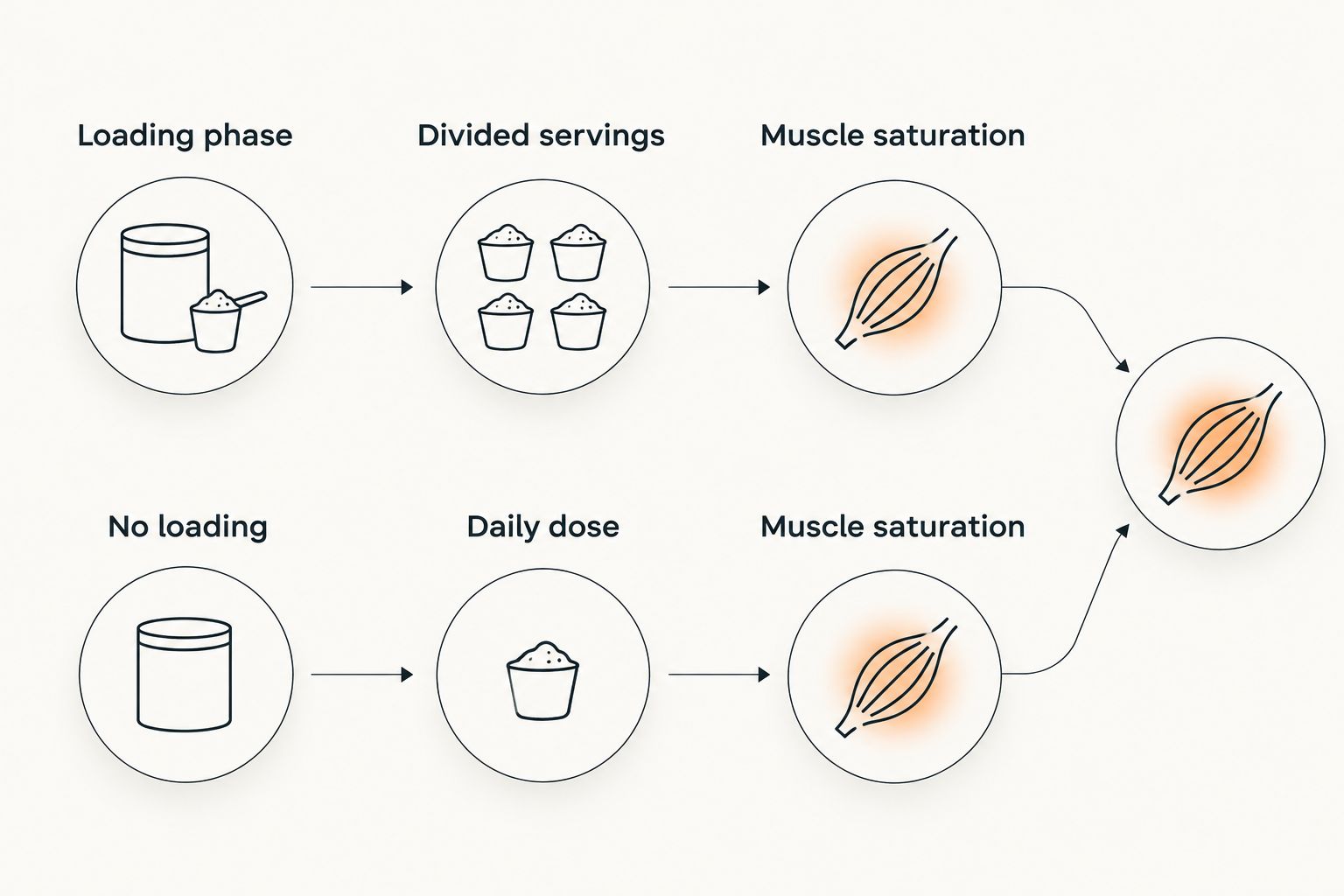
Loading Phase: about 7 days, usually 5–7 days
A common loading phase divides about 20 grams per day into 4 servings of 5 grams. Dividing the amount matters because taking the full daily total at once can be harder on your stomach.
Once the loading period ends, switch to a maintenance amount of 3–5 grams per day. Continuing the full loading amount provides no established advantage for maintaining saturated stores.
A loading phase is optional in 2026. It fits athletes who have a competition block, structured training cycle, or another clear reason to reach saturation sooner. It adds complexity, however, and missing individual servings makes the schedule less useful.
Best for: lifters who prioritize speed and can follow a divided-dose schedule.
Pros: reaches saturation in 5–7 days and creates an earlier point for evaluating training performance.
Cons: requires several daily servings and can cause temporary digestive discomfort or a faster increase in water weight.
Verdict: choose loading when the shorter timeline has a real training purpose; otherwise, use the simpler protocol.
No Loading Phase: about 4 weeks, usually 3–4 weeks
The no-loading approach starts and stays at 3–5 grams per day. Muscle creatine stores rise more gradually, reaching a similar endpoint after about 3–4 weeks of consistent intake.
For a 2026 routine, this is the easier option for most recreational lifters. You take one measured serving each day, avoid a week of divided doses, and remove the pressure to notice a change immediately.
Skipping loading does not make creatine less effective once your muscles reach saturation. It only delays that point. Comparing results after one week on the no-loading protocol is too early; compare your training log after the full 3–4 week window.
Best for: beginners, recreational lifters, and anyone who values adherence over speed.
Pros: one daily serving, fewer dosing decisions, and less risk of digestive discomfort from large amounts.
Cons: you wait several additional weeks before muscle saturation provides a fair test.
Verdict: skip loading when you want the easiest routine you can maintain every day.
Why the Creatine timeline varies
The 5–7 day and 3–4 week windows are protocol estimates, not a promise that every person will notice the same change on the same workout. Six factors explain most of the variation:
- Loading versus maintenance: Loading supplies more creatine during the first week, so muscle stores rise faster.
- Daily consistency: Repeated daily intake builds and maintains stores. Sporadic use stretches the timeline and makes results harder to evaluate.
- Starting muscle creatine stores: Diets containing meat and fish provide creatine, while plant-based diets generally provide less. Starting levels therefore differ.
- Body size and muscle mass: The amount of tissue available to store creatine differs between people, so one timeline cannot predict an exact response day.
- Dose measurement: A level, measured serving is more reliable than estimating powder by sight. Follow the product label rather than assuming every scoop holds the same amount.
- Outcome tracked: Water held in muscle, scale weight, repeated sprint ability, training volume, and visible muscle development are different outcomes with different timelines.
The supplement form also affects how confidently you can apply the standard timeline. Most loading and saturation research uses creatine monohydrate. Claims that another form automatically works faster require direct evidence; a different label does not change the established monohydrate data.
What does it feel like when Creatine starts working?
Creatine usually does not create a distinct sensation. There is no reliable buzz, rush, or same-day energy spike that confirms it has started working.
Look for changes that match creatine's role in short, repeated, high intensity work:
- Your body weight may increase. Creatine increases water retention within muscle, particularly during a loading phase. This is not the same as gaining body fat.
- Repeated hard efforts may improve. An extra rep, better output across later sets, or less drop-off between repeated sprints is more relevant than how the first rep feels.
- Training volume can become easier to sustain. Small improvements across repeated sessions matter more than a single standout workout.
- Visible muscle changes require training time. Creatine supports training performance; it does not replace progressive resistance training, sufficient food, protein, or recovery.
For a useful 2026 check, record the same lifts under similar conditions before starting. Compare repetitions, load, rest periods, and completed sets after saturation rather than relying on soreness, pump, or motivation.
Choosing a Tiger Fitness Creatine product
Creatine timing depends more on the protocol and consistent intake than the name on the container. Start by deciding between loading and no loading, then choose a product form you can take as directed.
The MTS Nutrition Creapure creatine page identifies a German creatine monohydrate powder. It fits either dosing protocol because the schedule comes from how much you take and how consistently you take it.
Best for: lifters who want a creatine monohydrate powder for a standard loading or maintenance routine.
Pros: the product uses creatine monohydrate, the form used in the established saturation research discussed above.
Cons: powder requires measuring and mixing, and it does not remove the need for daily consistency.
Tiger Fitness is best for lifters who want to compare creatine products after choosing a protocol; it is not a shortcut around consistent dosing and training.
Creatine options

German creatine monohydrate powder for a loading or maintenance routine.
$39.99

Creatine monohydrate powder intended to support strength and workout performance.
$29.99

Unflavored, single-ingredient creatine monohydrate powder.
$10.77
How long until you notice results from Creatine?
After 5–7 days with loading or 3–4 weeks without loading, your muscles should be near the saturation point described by standard creatine monohydrate protocols. That does not guarantee a dramatic visual change on that date.
Performance changes are usually easier to detect in a training log than in the mirror. Compare repeated sets, sprint efforts, and total completed work under similar conditions. Visible muscle development still depends on progressive training and adequate nutrition over time.
Should you take Creatine before or after a workout?
The 5–7 day or 3–4 week saturation timeline depends on consistent daily intake, not a narrow pre-workout or post-workout window. Take creatine at the time you are least likely to forget it.
Pairing it with an existing meal or shake can make adherence easier, but the routine matters more than the clock. On rest days, continue the same daily maintenance approach because muscle stores are maintained across days, not only during workouts.
What happens if you miss a day of Creatine?
The 5–7 day or 3–4 week process does not collapse because of one missed maintenance dose. Resume your normal labeled amount the next day rather than doubling it to compensate.
Repeated missed doses are different because inconsistent intake delays saturation and makes your results difficult to judge. A daily reminder is more useful than changing products whenever adherence slips.
Can you make Creatine work faster?
A loading phase is the established way to shorten the saturation timeline from 3–4 weeks to 5–7 days. Taking more than the standard loading approach does not establish a faster or better outcome and increases the chance of digestive discomfort.
Training harder for a few days does not accelerate creatine storage either. Use the protocol, stay consistent, and evaluate results after the appropriate window.
Safety and practical limits
Creatine is a dietary supplement, not a treatment for a disease or injury. Tiger Fitness creatine products and the information on this page are not intended to diagnose, treat, cure, or prevent any disease.
Healthy adults should follow the product label and avoid treating a standard maintenance amount as a target to exceed. Speak with a qualified healthcare professional before using creatine if you have kidney disease, are pregnant or breastfeeding, take medication that affects kidney function, or have been told to limit supplements.
Stop and seek medical guidance if you experience a concerning reaction. Temporary scale changes or mild stomach discomfort can occur, but persistent symptoms should not be dismissed as proof that the supplement is working.
FAQ
How long does Creatine take to work in 2026?
Creatine takes about 5–7 days to reach muscle saturation with a loading phase or 3–4 weeks without one. The exact day you notice a training change depends on your starting stores, adherence, and workout tracking.
Does Creatine work on the first day?
Creatine does not produce its established performance benefits from one standard dose. It must accumulate in muscle, which takes repeated daily intake.
How much Creatine should you take during a loading phase?
A common loading protocol uses about 20 grams per day, divided into 4 servings of 5 grams, for 5–7 days. Follow the product label and switch to a maintenance amount afterward.
How much Creatine should you take without loading?
A common no-loading protocol uses 3–5 grams per day. Expect muscle saturation to take about 3–4 weeks with consistent intake.
Is a Creatine loading phase necessary?
No, a creatine loading phase is not necessary. It reaches saturation faster, while a daily maintenance approach reaches a similar endpoint more gradually.
Should you take Creatine on rest days?
Yes, take your normal daily creatine amount on rest days. Consistent intake maintains muscle stores regardless of whether you train that day.
Does Creatine timing matter before or after workouts?
Daily consistency matters more than taking creatine immediately before or after training. Choose a repeatable time and follow the product label.
How do you know if Creatine is working?
Use a training log to track repeated high intensity performance after muscle saturation. Creatine does not create a reliable immediate sensation, so feelings alone are a poor test.
One Last Thing
Do not restart the clock every time a workout feels flat. Sleep, food, programming, and normal performance variation still affect individual sessions after creatine saturation. The best 2026 test is a consistent Tiger Fitness creatine routine paired with several weeks of comparable training records, not one workout or one weigh-in.
Related Guides
- Is Creatine safe to take every day?
- Creatine monohydrate for older lifters
- How to stack Creatine and Protein powder
Leave a comment