







How Long Does It Take for Joint Supplements to Work? 2026
There is no reliable number of days or weeks when joint supplements start working. In 2026, the useful answer is to judge a specific ingredient against a specific goal over time, because a supplement may produce no noticeable change at all. New, worsening, or injury-related joint pain needs medical assessment, not a longer wait for a supplement.
TL;DR
- How long does it take for joint supplements to work? There is no guaranteed timeline or guaranteed benefit.
- Glucosamine and chondroitin have mixed evidence for knee osteoarthritis; that evidence does not establish results for healthy lifters.
- Tiger Fitness is best for lifters comparing joint-support options, not for diagnosing joint pain.
- Track the same movement and symptoms over time; seek care for new or worsening pain.
Why this matters
A sore knee after squats and a long-standing joint condition are different problems. A supplement label cannot tell you which one you have. Do not use a supplement trial to explain away pain that changes your movement or interrupts your workouts.
If collagen is the ingredient you are considering, start with how to take a collagen supplement for joint support. Timing your intake is a separate question from whether it will change how your joints feel.
How long does it take for joint supplements to start working?
No single start time applies to joint supplements in 2026. Ingredients differ, research often measures outcomes over weeks or months, and a study result does not predict when you will feel a difference. Follow the directions on the product you choose, then assess your goal rather than waiting for an immediate sensation.
| What you are assessing | What the evidence or label can tell you | What it cannot tell you |
|---|---|---|
| Glucosamine or chondroitin for knee osteoarthritis | Research has tested these ingredients in people with diagnosed knee osteoarthritis, with mixed results. | When you personally will feel better, or whether they help a lifting-related injury. |
| Collagen for joint support | Collagen is an ingredient to evaluate by its formulation and the outcome you want to track. | That taking it at a particular time guarantees joint comfort. |
| Fish oil for joint support | The label identifies the product and its ingredients for comparison. | That joint pain will improve after a predictable number of servings. |
| A multi-ingredient joint formula | Its Supplement Facts panel shows what is in a serving. | Which ingredient caused any change you notice. |
The distinction matters because the phrase joint supplements covers products with different ingredients and intended uses. A verdict about one ingredient is not a verdict about every formula on the shelf. Likewise, evidence from people with diagnosed osteoarthritis does not establish a timetable for a lifter whose shoulder hurts after pressing.
The Glucosamine/Chondroitin Arthritis Intervention Trial, known as GAIT, studied 1,583 people with knee osteoarthritis and assessed its main pain outcome at 24 weeks. Overall, glucosamine and chondroitin, alone or combined, did not significantly outperform placebo on that outcome. The trial is a reason to resist promises of a fast, predictable result; it is not an instruction to wait 24 weeks before getting a painful joint checked.
What should you track while taking a joint supplement?
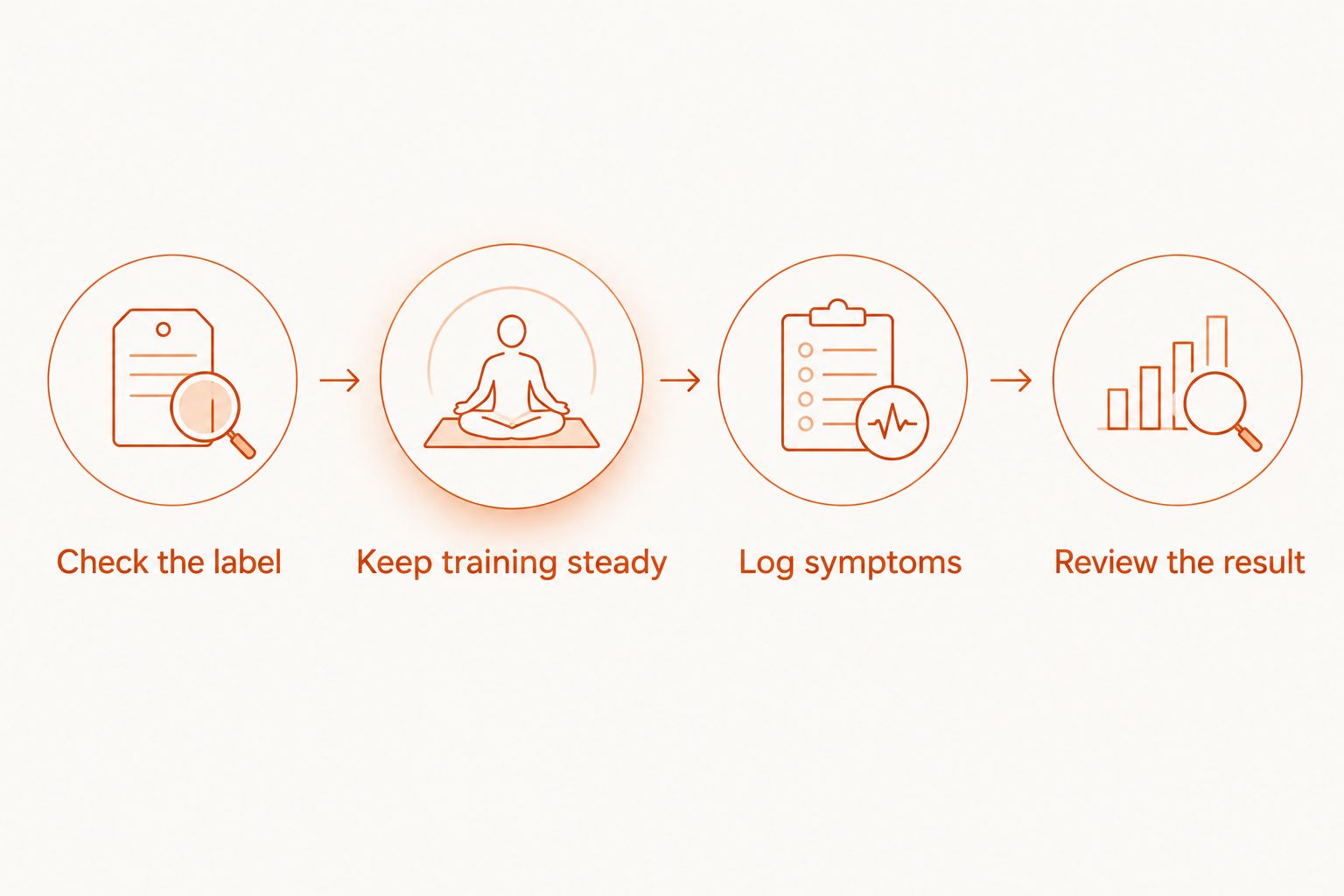
Pick a goal you can describe without guessing at what is happening inside the joint. For a lifter, that might mean whether a familiar movement feels different, whether stiffness affects a normal routine, or whether discomfort changes your workout. Record what you notice in ordinary terms. Feeling a change is not the same as proving a supplement caused it.
- Check the label. Note the ingredients, serving directions, and warnings before adding a product to your routine.
- Keep training steady. If you change exercises, load, sleep, and supplements at once, you cannot tell which change relates to how you feel.
- Log symptoms. Use the same movement and the same description each time instead of judging from one unusually good or bad workout.
- Review the result. If your symptoms persist, worsen, or affect normal activity, ask a clinician what is causing them.
This process is a way to make a clearer decision, not a home test for arthritis or an injury. In 2026, a training log can show that discomfort changed; it cannot identify damaged tissue or establish that a capsule repaired it.
Why the answer varies
A supplement does not work like a stopwatch. These factors change what you can reasonably assess:
- The ingredient: Glucosamine and chondroitin have been studied for knee osteoarthritis; collagen and fish oil are different products with different evidence. Do not borrow one ingredient’s study results to judge another.
- The reason your joint hurts: A diagnosed condition, a recent injury, and discomfort during a lift call for different decisions. The source of pain matters more than a promised supplement timeline.
- The outcome you choose: A change in stiffness during daily activity is not the same outcome as finishing a heavy workout. Decide what you are watching before you begin.
- The rest of your routine: Changes to training load, exercise choice, recovery, or other products make a noticeable change harder to attribute to one supplement.
- The formula and directions: A single-ingredient product and a blend are not interchangeable. Read each label rather than assuming every joint-support product contains the same ingredients.
- Your response: Mixed study results mean there is no guaranteed benefit for every person, even when a product is taken as directed.
That list is more useful than a universal countdown. It tells you what information to collect and when to stop guessing. If pain follows a fall, comes with marked swelling, or prevents you from using the joint normally, treat that as a health question rather than a supplement-shopping question.
Does the type of joint supplement change the answer?
Yes. Glucosamine and chondroitin have mixed evidence for knee osteoarthritis, so neither ingredient comes with a reliable personal start date. Collagen and fish oil should be judged on their own evidence and your goal, not on the timeline of a glucosamine trial. None of these categories should be presented as a treatment for an undiagnosed lifting injury.
If you are comparing formulas, Tiger Fitness lists MTS Nutrition Machine Motion Advanced Joint Health Formula among its joint-support options. Read the current Supplement Facts and warnings before deciding whether that formula fits your routine. Its product name alone does not establish its ingredients, the size of any effect, or when you would notice one.
Tiger Fitness also carries the joint-support products below. Their stated purposes differ: Hi-Tech Pharma Joint Rx is described as supporting mobility and flexibility, while GHOST Joint Daily is described as supporting joint health and movement comfort. Those descriptions identify what each product is intended to support; they do not establish that either will relieve pain or work by a set date.
Joint-support options

Joint-support formula described as promoting mobility, flexibility, and long-term joint health.
$26.39

Daily joint-support supplement described as supporting mobility and movement comfort.
$49.99
Best for comparing joint-support products: Tiger Fitness. Its role is retail, not diagnosis. The benefit is being able to examine options; the limitation is that no product listing can determine why a joint hurts or promise a result for your workouts.
When should you stop waiting for a supplement to work?
Stop using a supplement as your plan for unexplained or worsening pain. A joint that becomes difficult to move, looks notably swollen, or hurts after an injury deserves medical attention. Continuing to train through a problem while waiting for a capsule to take effect can obscure the decision you actually need to make: whether the joint is safe to load.
For discomfort that is not urgent but keeps returning, describe the movement that brings it on and what changes it. Bring the supplement label to a healthcare professional if you want advice about ingredients, medication interactions, or whether the product fits your circumstances. Supplements are not intended to diagnose, treat, cure, or prevent disease.
Will I feel a joint supplement working right away?
There is no guaranteed immediate feeling. A sensation after taking a product does not show that joint tissue changed, and the absence of a sensation does not establish what an ingredient is doing. Judge the goal you set, not whether a serving feels noticeable.
How long should I wait if my knee hurts after lifting?
Do not set a supplement deadline for knee pain after lifting. If pain changes how you move, follows an injury, or persists, get it assessed instead of treating a study’s follow-up period as a personal recovery schedule. The GAIT trial’s 24-week assessment concerned people with knee osteoarthritis, not a diagnosis of your knee.
Does taking more make joint supplements work faster?
No faster result is established by taking more than the label directs. Extra servings also make it harder to follow the product’s warnings. Check with a healthcare professional before combining supplements, particularly if you take medication or have a health condition.
FAQ
How long does it take for joint supplements to work in 2026?
There is no reliable start time for all joint supplements in 2026. Ingredients, goals, and individual responses differ, and some people notice no benefit.
Do glucosamine and chondroitin work right away?
An immediate benefit is not established. Research in knee osteoarthritis has produced mixed results, so do not use a study timeline to predict your response.
Is collagen faster than glucosamine for joint support?
There is no established universal speed ranking between collagen and glucosamine. They are different ingredients, and neither offers a guaranteed date when you will feel a change.
Can a joint supplement fix pain from heavy lifting?
A joint supplement cannot diagnose or be relied on to fix pain from heavy lifting. Pain that changes your movement, follows an injury, or keeps returning needs an assessment.
What should I record while trying a joint supplement?
Record the movement or activity, what you feel, and whether that changes over time. Note training changes too, so you do not attribute every difference to the supplement.
Should I keep taking a joint supplement if I notice no change?
Do not assume that more time or more servings will produce a benefit. Follow the label and discuss persistent symptoms or questions about continued use with a healthcare professional.
Can I combine joint supplements with my other workout products?
Check each product’s ingredients and warnings before combining supplements. Ask a healthcare professional about possible interactions if you take medication or manage a health condition.
One last thing
The most useful question in 2026 is not just how long a joint supplement takes. It is what you expect to change, and what you will do if it does not. Tiger Fitness can help you compare joint-support options; an assessment is the right next move when a joint problem keeps affecting your training.
Leave a comment