






Is Collagen Worth It for Joint Health in 2026?
Collagen is worth it for joint health in 2026 if you match the type and dose to what the research actually tested: 10 grams a day of hydrolyzed collagen peptides, or roughly 40 milligrams of undenatured type II collagen (UC-II). The catch most labels skip is timing — joint comfort improvements from collagen show up over 8 to 12 weeks of consistent daily use, not the first few servings. Skip the vague "collagen blend" scoop sizes and check the dose against those two benchmarks before you buy anything in 2026.
TL;DR
- Hydrolyzed collagen peptides at roughly 10 grams a day is the dose used in most joint-comfort research heading into 2026.
- Undenatured type II collagen (UC-II) works at a much smaller dose, around 40 milligrams daily, through a different mechanism.
- Panda Supps Multi Collagen Peptides and NOW Foods BioCell Collagen give lifters two starting points at different collagen sources and price points.
- Collagen supports connective tissue structure, not acute inflammation — pair it with a dedicated joint formula if pain flares during heavy training.
- Give any collagen protocol 8 to 12 weeks minimum before deciding whether is collagen worth it for joint health for your own training.
The two doses that matter
10g
Hydrolyzed collagen studied dose
Daily amount used in most joint-comfort research
40mg
UC-II studied dose
Undenatured type II collagen daily amount
8-12 weeks
Typical window before results show
Why this matters
Joints don't recover like muscle does. Cartilage and tendon have a fraction of the blood supply that muscle tissue gets, so the repair process runs slower no matter how clean your training is. That's exactly why a collagen supplement for joint health in lifters gets asked about so often by anyone logging heavy squat, pull, or press volume year after year.
Whey and other complete proteins build muscle fiber. Collagen is a different amino acid profile entirely — heavy on glycine and proline, the building blocks your body uses for tendon, ligament, and cartilage matrix. That's the whole case for taking it separately from your regular protein shake, not instead of it.
Is collagen worth it for joint health?
The honest answer depends on which collagen you mean. Here's how the three common approaches stack up against each other:
| Option | Typical Daily Dose | Best For | Verdict |
|---|---|---|---|
| Hydrolyzed collagen peptides | 10g | General joint comfort, overlaps with skin/hair goals | Worth trying |
| Undenatured type II collagen (UC-II) | 40mg | Targeted mobility support at a much lower dose | Worth trying |
| Glucosamine/chondroitin joint formulas | Varies by product | Lifters with joint strain tied to specific lifts | Worth stacking alongside |
None of these treat or cure joint disease — they're daily support tools, and the research behind them measures comfort and mobility during activity, not medical outcomes.
Hydrolyzed Collagen Peptides: 10 Grams a Day
Most joint-comfort research on hydrolyzed collagen uses a 10-gram daily dose, mixed into a shake, coffee, or water, taken consistently for around 12 weeks before comfort during activity gets measured. Panda Supps Multi Collagen Peptides is built around this exact serving size and pulls from multiple collagen sources rather than one, which broadens the amino acid spread compared to single-source bovine powders.
The downside: it's flavorless and slow. You won't feel a single scoop do anything, and if you skip days the 8-to-12-week clock resets on consistency. Verdict: Buy if you can commit to a daily add-in for at least two months — skip it if you're looking for same-week relief.
Undenatured Type II Collagen (UC-II): 40 Milligrams a Day
UC-II works through a different pathway than hydrolyzed peptides — small amounts interact with gut-associated tissue and appear to support joint comfort at doses as low as 40 milligrams, far below the gram-level doses used for hydrolyzed collagen. NOW Foods BioCell Collagen leans into this territory by pairing collagen with hyaluronic acid and chondroitin sulfate rather than shipping collagen alone.
The tradeoff is availability — UC-II shows up in joint-specific capsules and blends, not in the flavored collagen tubs you'd add to coffee. Verdict: Buy if you've already run hydrolyzed collagen without noticing a difference and want to test a second mechanism instead of doubling the dose.
Joint Support Formulas: Glucosamine, Chondroitin, and Multi-Ingredient Blends
Formulas built around glucosamine, chondroitin, and MSM — like MTS Nutrition's Machine Motion Advanced Joint Health Formula — skip collagen synthesis entirely and target joint lubrication and cartilage cushioning instead. That makes them a stack partner for a collagen protocol, not a replacement for one.
The con here is ingredient count: more moving parts means it's harder to isolate what's actually helping if something changes. Verdict: Buy if your joint pain shows up during specific lifts — knees on squat day, elbows on heavy pressing days — rather than as general daily stiffness.
Collagen and joint support options

Multi-source collagen blend for hair, skin, nails, joints, and gut support.
$34.99

Hydrolyzed type II collagen complex with hyaluronic acid and chondroitin sulfate.
$26.94

Collagen protein supporting joint health, skin elasticity, and post-workout recovery.
$44.95

Complete joint support formula built for lifters and athletes under heavy training loads.
$40.99
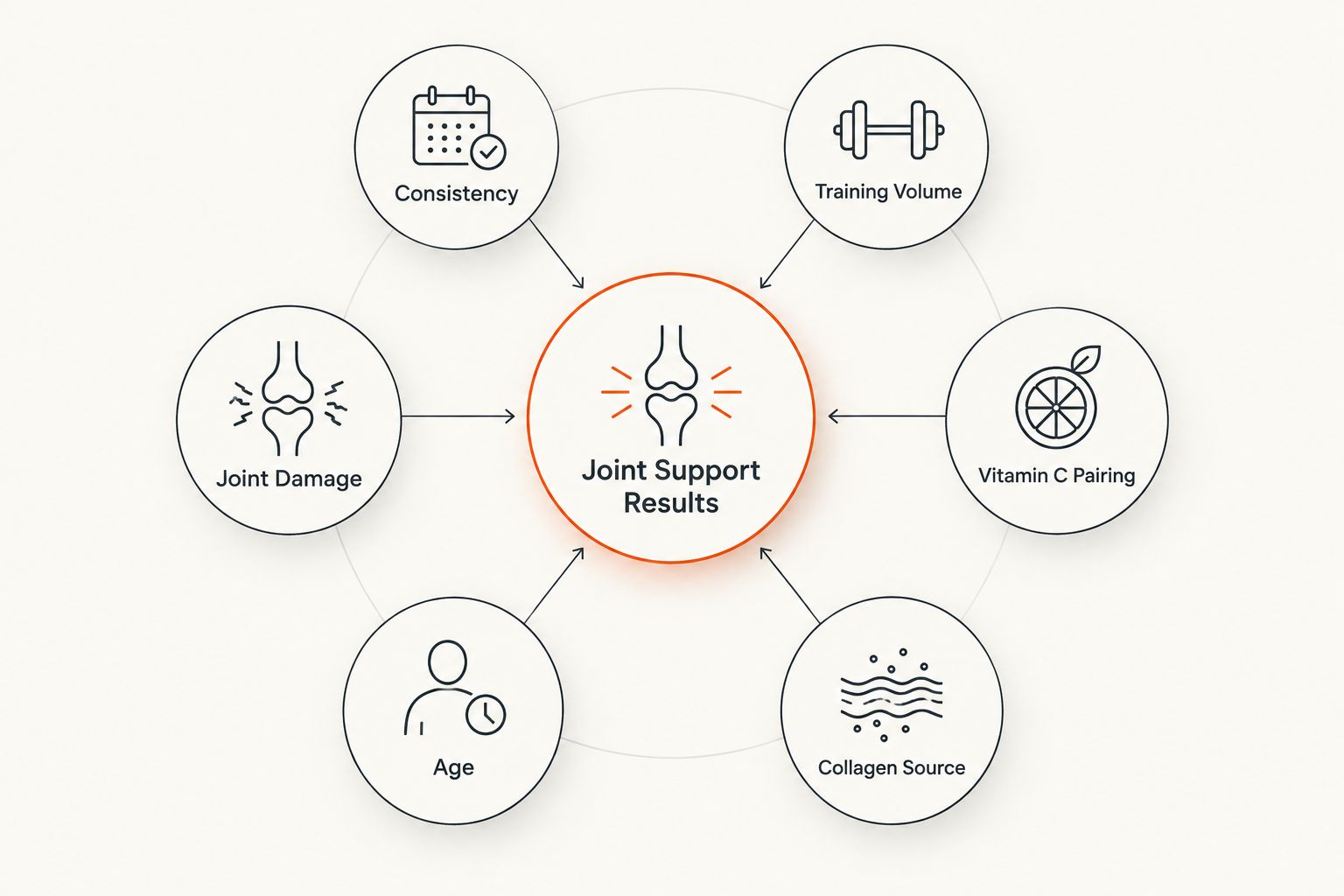
Why collagen results vary
The same collagen dose doesn't land the same way for every lifter. A handful of factors decide whether you notice a difference:
- Consistency — daily use for 8 to 12 weeks vs. sporadic servings when you remember
- Training volume — heavier barbell loads on knees, elbows, and shoulders create more wear to offset
- Vitamin C pairing — vitamin C is a required cofactor for the body's own collagen synthesis, so pairing it with a collagen supplement isn't just marketing
- Collagen source — bovine, marine, and multi-source blends carry slightly different amino acid ratios
- Age — connective tissue turnover slows over time, which is part of why joint questions get louder past 30
- Existing joint damage — a supplement supports tissue, it does not reverse structural damage; that's a conversation for a doctor, not a supplement label
Does collagen actually help with joint pain from lifting?
Collagen supplement research shows joint comfort improvements during activity at the 10-gram hydrolyzed dose, not elimination of existing pain. It's a support tool for connective tissue over months of use, not a substitute for addressing an actual injury.
How long before collagen starts working for joints?
Collagen supplements need 8 to 12 weeks of consistent daily dosing before joint comfort changes typically show up in research. Judging a collagen protocol after two or three weeks is judging it too early.
Is collagen or glucosamine better for joints?
Neither wins outright — collagen supports the structural protein matrix in cartilage and tendon, while glucosamine and chondroitin target lubrication and cushioning. Many lifters run both together rather than picking one.
FAQ
Is collagen worth it for joint health in 2026?
Collagen is worth it for joint health in 2026 when the dose matches research benchmarks: 10 grams daily for hydrolyzed collagen peptides or about 40 milligrams for undenatured type II collagen. It takes 8 to 12 weeks of consistent use before comfort changes typically appear.
What type of collagen is best for joints?
Hydrolyzed collagen peptides and undenatured type II collagen (UC-II) are the two forms with the most joint-focused research behind them. Hydrolyzed peptides work at a 10-gram dose, while UC-II works at roughly 40 milligrams through a separate mechanism.
How much collagen should I take daily for joints?
10 grams a day is the standard dose used in hydrolyzed collagen research, typically mixed into a shake or coffee. UC-II formulas use a much smaller 40-milligram daily dose because they work differently in the body.
Does collagen help with knee pain from squats?
Collagen supplements support the connective tissue that takes load during squats, but they are not marketed to treat or cure knee pain. Lifters dealing with recurring knee pain from specific lifts often pair collagen with a joint formula and address training volume directly.
Can I take collagen and a joint support formula together?
Yes, collagen and glucosamine-chondroitin joint formulas target different tissue processes, so stacking them is common rather than redundant. Collagen supports the structural protein matrix while joint formulas focus on lubrication and cushioning.
Does collagen work for skin and joints at the same time?
Hydrolyzed collagen peptides are studied for both skin elasticity and joint comfort at similar 10-gram daily doses, so a single serving can support both goals. The two effects run on separate timelines, though, so don't expect them to show up at the same week.
Is UC-II better than hydrolyzed collagen for joints?
UC-II is not better across the board — it works through a different mechanism at a much lower 40-milligram dose, while hydrolyzed collagen at 10 grams has broader research including skin and hair. Some lifters try UC-II specifically after hydrolyzed collagen didn't move the needle.
One last thing
Collagen is missing tryptophan and runs low on several other essential amino acids compared to whey, which is exactly why it's a joint-support add-in and not a protein-shake replacement. Keep your whey or another complete protein source doing the muscle-building job in 2026, and let collagen do the connective-tissue job on the side — running both at once, not swapping one for the other, is where the actual case for collagen holds up.
Leave a comment