




How Long Does Pre Workout Last? 2026 Answer
A caffeinated pre-workout lasts about 4 hours for noticeable workout energy, with effects commonly spanning 3 to 6 hours in 2026. The hidden caveat is caffeine’s roughly 5-hour half-life: the strongest feeling can fade while a substantial amount of caffeine remains in your system and continues affecting sleep.
TL;DR
- In 2026, how long does pre workout last? Caffeinated formulas commonly affect you for 3 to 6 hours.
- Caffeine usually reaches peak blood concentration within 30 to 60 minutes.
- Caffeine has a roughly 5-hour half-life, so it remains after the workout energy fades.
- Stim-free pre-workout supports the training session without extending caffeine exposure into bedtime.
- Tiger Fitness is best for lifters comparing caffeinated and stimulant-free pre-workout formats in one catalog.
Pre-workout timing
3-6 hours
Noticeable stimulant window
30-60 minutes
Caffeine peak
5 hours
Approximate half-life
Why this matters
The workout kick and the caffeine clearance window are not the same thing. You can stop feeling energized after training but still have enough caffeine circulating to delay sleep, reduce sleep quality, or leave you restless at bedtime.
That distinction matters more in 2026 because pre-workout products range from stimulant-free pump formulas to concentrated high-stimulant blends. Check the serving instructions and caffeine amount instead of assuming every scoop runs on the same clock. The guide to taking pre-workout safely covers dose, timing, and daily caffeine intake in more detail.
Pre-workout supplements are not intended to diagnose, treat, cure, or prevent disease. If caffeine causes chest pain, severe palpitations, faintness, or another serious reaction, stop using it and seek medical care.
How long does pre workout last before it wears off?
For most healthy adults, the noticeable energy from a caffeinated pre-workout lasts 3 to 6 hours. It usually starts within 20 to 60 minutes, feels strongest around the beginning of the workout, and tapers gradually rather than switching off at a fixed time.
The National Library of Medicine’s clinical caffeine summary reports that caffeine reaches peak blood concentration within 30 to 60 minutes and has an average half-life of about 5 hours. Individual half-life can be shorter or substantially longer because genetics, pregnancy, medications, smoking status, and liver function affect caffeine metabolism.
Here is the practical 2026 comparison:
| Pre-workout type | Best for | Typical felt window | Main advantage | Main drawback |
|---|---|---|---|---|
| Caffeinated powder | Morning or early-day lifting | 3-6 hours | Noticeable energy and focus | Can interfere with sleep |
| High-stimulant formula | Experienced caffeine users training early | 4-8 hours | Stronger stimulant exposure | Longer tail and greater crash risk |
| Stimulant-free powder | Evening training or caffeine sensitivity | About one workout | No caffeine half-life | Lacks the caffeine-driven energy boost |
| Caffeinated ready-to-drink formula | Training away from home | 3-6 hours | No mixing required | Fixed serving size |
The duration column describes the period in which you might notice the formula, not the time required to eliminate every ingredient. Caffeine remains in the body beyond the obvious energy window. Pump, tingling, focus, and stimulation can also fade at different rates because different ingredients produce those sensations.
Caffeinated pre-workout: 3 to 6 hours
A standard caffeinated pre-workout commonly produces noticeable effects for 3 to 6 hours. The strongest period usually overlaps with the first part of your training session, while the later hours feel more like residual alertness than a full pre-workout kick.
Caffeine amount matters, but doubling the caffeine does not produce a clean doubling of useful workout time. A larger dose raises your exposure and leaves more caffeine in your system at every stage of the half-life. It can also increase shakiness, anxiety, stomach discomfort, a racing heartbeat, and difficulty sleeping.
Timing matters just as much as dose. A morning serving has most of the day to clear. The same serving taken before an evening workout can remain active at bedtime, even if the obvious buzz disappeared before you left the gym.
High-stimulant pre-workout: up to 8 hours of effects
A high-stimulant pre-workout can affect alertness for up to 8 hours, especially if it contains a large caffeine dose or multiple stimulant ingredients. This does not mean you will feel peak energy for 8 hours. It means the later stimulant tail can remain noticeable well after training.
Best for: experienced caffeine users who train early enough that the extended window does not collide with sleep. The upside is stronger perceived stimulation. The downside is a higher chance of jitters, anxiety, an afternoon crash, or poor sleep.
Do not combine a high-stimulant pre-workout with coffee, energy drinks, caffeine tablets, or other stimulant supplements without calculating the total caffeine intake. Product names and serving sizes do not reveal the full daily total; the Supplement Facts panel does.
Stim-free pre-workout: about 1 workout
A stimulant-free pre-workout generally supports the training session rather than producing hours of post-workout alertness. These formulas can contain pump, hydration, focus, or endurance ingredients, but they skip caffeine and its roughly 5-hour half-life.
Best for: evening lifters, caffeine-sensitive athletes, and anyone already getting caffeine elsewhere. The main advantage is protecting the sleep window from another stimulant dose. The tradeoff is simple: a stimulant-free formula will not reproduce the same caffeine-driven energy as a caffeinated pre-workout.
Stimulant-free does not automatically mean side-effect-free. Large servings, sweeteners, or individual ingredients can still cause tingling or digestive discomfort. Follow the label and assess tolerance before using a full serving during an important workout.
Ready-to-drink pre-workout: 3 to 6 hours when caffeinated
A caffeinated ready-to-drink pre-workout follows the same caffeine clock as a powder with a similar dose. Liquid format does not make caffeine disappear sooner; the total caffeine amount and your metabolism determine the later window.
Best for: lifters who want a pre-measured option without mixing powder. Convenience is the advantage, while the fixed container serving gives you less flexibility than a powder with label-approved serving options.
Why pre-workout duration varies
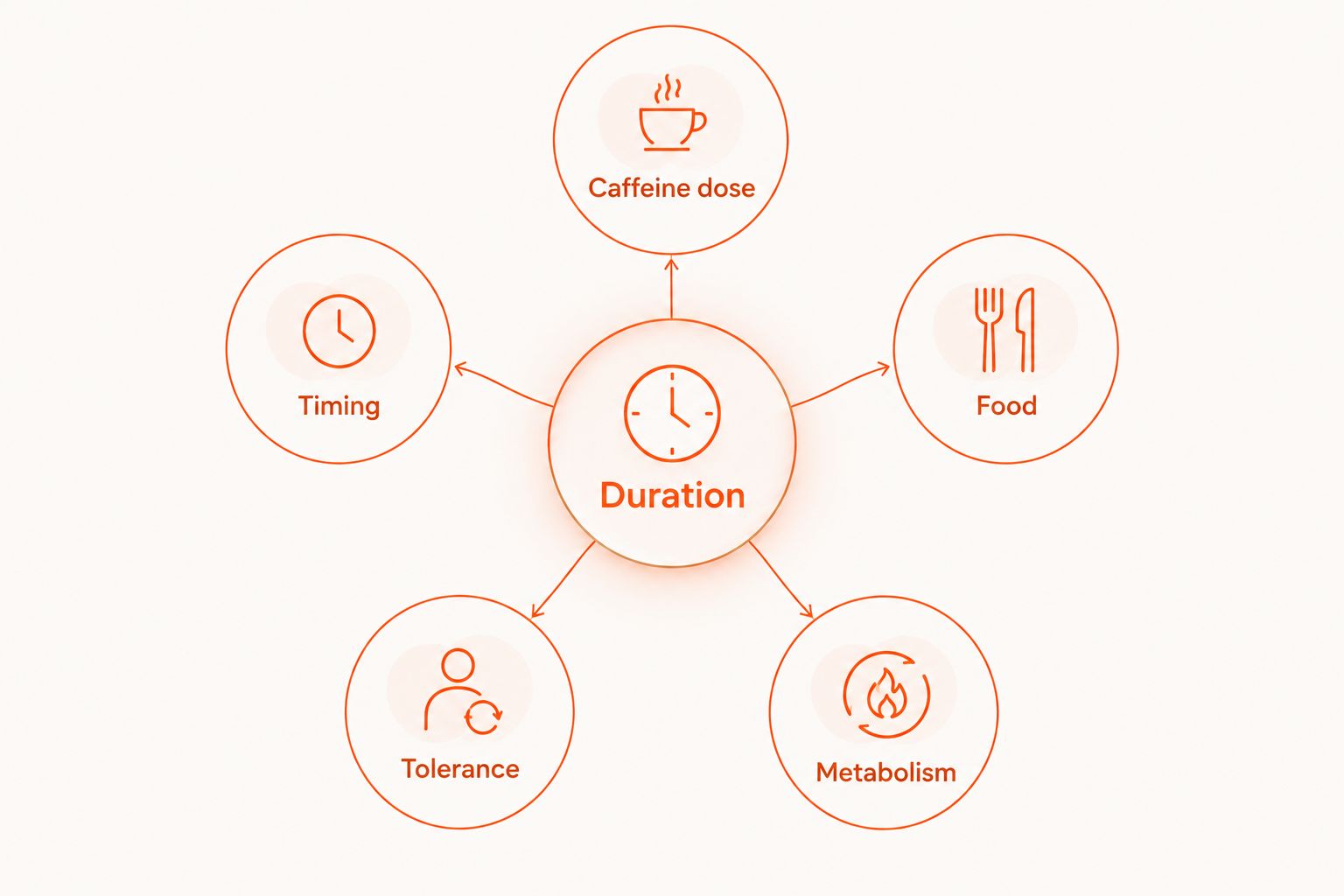
No timing chart can predict the exact minute your pre-workout wears off. These six factors determine how quickly it starts, how strongly you notice it, and how long the stimulant tail remains:
- Caffeine dose: More caffeine leaves more in your system at each half-life interval. Count caffeine from every drink and supplement, not just pre-workout.
- Timing: A serving taken immediately before training peaks later than one taken early enough for absorption before the first working set.
- Food: A recent meal can slow absorption and soften the initial hit. Taking pre-workout on an empty stomach often makes the onset feel faster and sharper.
- Tolerance: Frequent caffeine use can reduce the energy you perceive from the same dose. Feeling less does not mean the caffeine has already cleared.
- Metabolism: Genetics and liver enzyme activity can make you a faster or slower caffeine metabolizer. This is why the same serving affects two lifters differently.
- Medications and health factors: Some medicines, pregnancy, and certain health conditions can extend caffeine exposure or change its effects. Ask a clinician about interactions that apply to you.
A larger body size can reduce the caffeine dose per unit of body weight, but body weight alone does not predict tolerance or clearance. A smaller regular caffeine user can feel less stimulation than a larger person who rarely consumes it.
Track the time you take pre-workout, the label’s caffeine amount, bedtime, and how easily you fall asleep. After several comparable training days, that record gives you a more useful personal cutoff than copying another lifter’s schedule.
How to choose a pre-workout duration that fits your training
Start with your bedtime and work backward. If you train early, a caffeinated formula has more time to clear. If you train late, stimulant-free pre-workout removes caffeine from the equation and avoids turning one strong workout into one poor night of recovery.
Next, read the entire Supplement Facts panel. Compare caffeine per serving, serving directions, and other stimulant ingredients. Do not assume that a smaller scoop means a lower stimulant dose or that a ready-to-drink container equals a mild serving.
In 2026, Tiger Fitness pre-workout options cover ready-to-drink, powdered, caffeinated, and stimulant-free formats. The right choice is the one that fits your training time and caffeine tolerance, not the formula with the most aggressive label.
Pre-workout formats to compare


How long before pre-workout kicks in?
Pre-workout commonly kicks in within 20 to 60 minutes, with caffeine reaching peak blood concentration around 30 to 60 minutes. Food, formulation, and individual digestion can shift the onset, so use the product’s serving directions instead of automatically taking it at the gym door.
The first sensation is not always caffeine. Beta-alanine can cause tingling, while flavor, temperature, and expectation can make a drink feel immediate. Judge the timing by sustained energy and training focus rather than the first facial tingle.
How long does the pre-workout pump last?
A pre-workout pump usually lasts through the training session and fades afterward as blood flow and muscular demand return toward baseline. There is no single duration because pump formulas use different ingredients and doses, while workout length, hydration, carbohydrate intake, and exercise selection also change the result.
The pump wearing off does not mean the caffeine has cleared. You can lose the tight muscular feeling while stimulant exposure continues for several more hours.
Will pre-workout keep me awake at night?
Pre-workout can keep you awake when caffeine remains active near bedtime. Using a 5-hour half-life as a simple example, a serving containing 200 milligrams of caffeine could leave about 100 milligrams after 5 hours and about 50 milligrams after 10 hours. Your actual clearance rate can differ substantially.
If evening pre-workout repeatedly delays sleep, move the serving earlier, reduce caffeine within the label directions, or choose a stimulant-free formula. Adding another supplement to force sleep does not fix late caffeine timing.
Caffeine limits and safety
The FDA’s 2026 consumer guidance states that up to 400 milligrams of caffeine per day is not generally associated with negative effects for most healthy adults. That is a daily total from coffee, tea, soda, energy drinks, pre-workout, and other sources—not a target dose.
The American College of Obstetricians and Gynecologists advises pregnant people to keep caffeine intake below 200 milligrams per day. Children and adolescents should not copy adult stimulant routines. Anyone with a heart condition, high blood pressure, caffeine-triggered anxiety, pregnancy, or medication concerns should speak with a qualified clinician before using stimulant pre-workout.
FAQ
How long does pre workout last in your system?
Noticeable stimulant effects commonly last 3 to 6 hours, while caffeine remains in your system longer because its average half-life is about 5 hours. Complete clearance takes multiple half-lives and varies by person.
How long does pre workout take to kick in?
Pre-workout commonly starts working within 20 to 60 minutes. Caffeine generally reaches peak blood concentration within 30 to 60 minutes, although food can delay the perceived onset.
Does pre workout wear off after the gym?
The strongest workout effects can fade after training, but caffeine may remain active for several more hours. Pump, tingling, focus, and stimulant effects do not wear off at the same time.
Can I take pre workout 6 hours before bed?
Pre-workout taken 6 hours before bed can still affect sleep because caffeine has an average half-life of about 5 hours. Caffeine-sensitive lifters need a longer cutoff or a stimulant-free formula.
Why do I still feel pre workout after 8 hours?
Slow caffeine metabolism, a large dose, other caffeine sources, medications, or individual sensitivity can make effects noticeable after 8 hours. Check the full daily caffeine total rather than counting only the pre-workout serving.
Does stim-free pre workout last as long as caffeinated pre workout?
Stim-free pre-workout generally supports the workout without the 3-to-6-hour stimulant tail. Ingredient effects vary, but removing caffeine eliminates its roughly 5-hour half-life from the formula.
Can I take more pre workout when the first serving wears off?
Do not automatically take another serving when the initial energy fades. Check the label’s maximum serving, calculate total daily caffeine, and include coffee, energy drinks, and other stimulant products.
Does pre workout expire?
Pre-workout has a manufacturer date that should guide use and storage. Keep the container sealed and dry, and discard it if the seal, smell, color, or contents suggest contamination or damage.
One last thing
Do not use the disappearance of tingling as proof that pre-workout has cleared. Beta-alanine sensations can fade long before caffeine does, so the most reliable 2026 timing decision comes from the caffeine amount, the time you took it, and your planned bedtime.
Tiger Fitness pre-workout shoppers should compare stimulant level before flavor or format. Your gains depend on training and recovery together; a late caffeine hit that cuts into sleep works against that balance.
Leave a comment