







How Much Fish Oil Should You Take Per Day? 250 mg | 2026
For generally healthy adults, 250 mg of combined EPA and DHA per day from food or supplements is a practical target in 2026, based on the European Food Safety Authority’s adult intake guidance. That is 250 mg of EPA plus DHA, not 250 mg of fish oil. There is no single U.S. daily fish-oil requirement, and cod liver oil adds vitamins A and D that also need a place in your supplement plan.
TL;DR
- How much fish oil should you take per day? Aim for 250 mg of EPA plus DHA in 2026, not a fixed fish-oil amount.
- Check EPA and DHA on the Supplement Facts panel; the fish-oil weight alone cannot tell you the dose.
- Tiger Fitness fish oil is an option for lifters who prefer capsules; verify its current EPA and DHA amounts before choosing a serving.
- Cod liver oil supplies omega-3s plus vitamins A and D, so check your other supplements before taking it daily.
Why this matters
A bottle can prominently state its fish-oil weight while listing a smaller amount of EPA and DHA on the back. If you count only the front-label number, you cannot tell whether a serving meets your goal. The same check applies when you review MTS Nutrition MTS Fish Oil at Tiger Fitness: use the current EPA and DHA figures on its label, not the product name, to work out your daily serving.
Training does not create a separate, established daily fish-oil requirement. For a lifter planning supplements in 2026, the useful question is whether food and capsules together meet an appropriate EPA-and-DHA target without duplicating ingredients in other products. More capsules are not a substitute for checking that total.
How much fish oil should you take per day?
For a generally healthy adult in 2026, use 250 mg of combined EPA and DHA per day as a reference point. The European Food Safety Authority identifies 250 mg daily as an adequate intake for normal cardiac function in adults; it is not a prescription for every person or a target for fish-oil weight. The U.S. has not established a Recommended Dietary Allowance for EPA and DHA.
The American Heart Association recommends eating fish, particularly fatty fish, twice a week. That food-based recommendation does not tell you how many capsules to take on a given day. If you want to use a supplement, calculate its contribution from the label instead of converting fish servings into an assumed capsule count.
| Option | Best for | Advantage | Limitation |
|---|---|---|---|
| Fatty fish | People who prefer to get omega-3s through meals | Fits the American Heart Association’s food-first guidance | EPA and DHA vary by fish and portion; a meal does not specify a daily capsule dose |
| Standard fish-oil capsules | People who want a repeatable, label-based intake | The Supplement Facts panel can show EPA and DHA per serving | Fish-oil weight is easy to mistake for EPA-and-DHA content |
| Cod liver oil | People who want to assess omega-3s alongside vitamins A and D | Provides a way to include those nutrients in one product | Added vitamins complicate daily intake if you already take a multivitamin |
Verdict: Tiger Fitness fish oil is best for lifters who want to check a capsule’s EPA and DHA against their food intake, not for anyone seeking a bigger fish-oil number on the front label. Its advantage is a capsule format you can evaluate alongside your routine; its limitation is that no serving recommendation is sound without the current EPA and DHA amounts.
How do you calculate your daily serving?
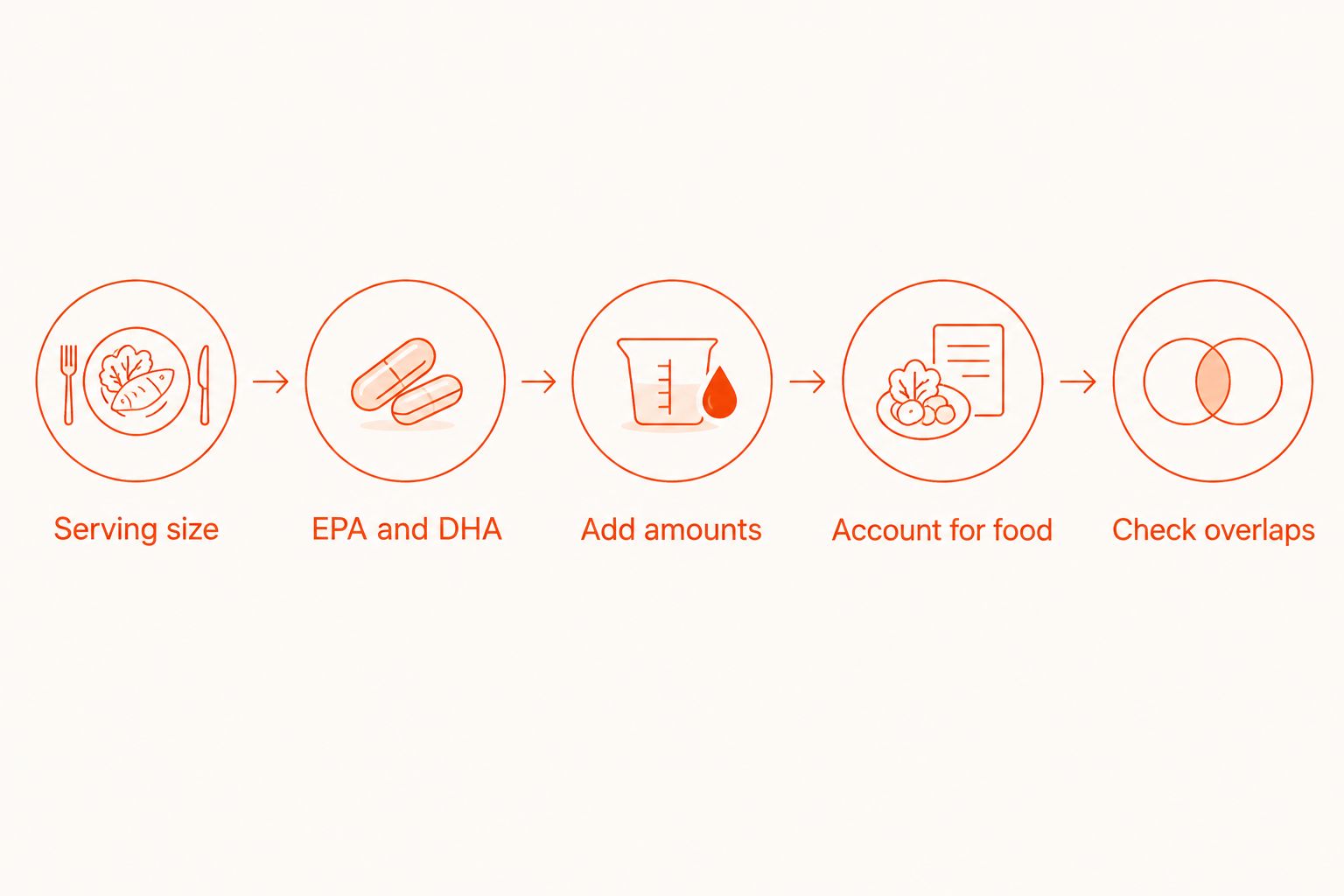
Read the Supplement Facts panel before deciding how much to take. This works for standard fish oil and cod liver oil alike.
- Find the serving size. Check whether the nutrient amounts apply to one softgel or to a serving containing multiple softgels.
- Find EPA and DHA. Read each amount in milligrams for that serving. Do not substitute the total fish-oil weight.
- Add EPA and DHA. Compare their combined amount with the 250 mg daily reference point for a generally healthy adult.
- Account for food. Regular fatty-fish meals contribute EPA and DHA too; do not treat capsules as the only source.
- Check overlapping supplements and medicines. Cod liver oil contributes vitamins A and D. If you take medication or have a condition that affects supplement use, ask your clinician about your full routine before setting a dose.
The calculation matters more than the softgel count. A product labeled with 1,000 mg of oil does not establish that it contains 1,000 mg of EPA plus DHA. In 2026, read the nutrient line each time you switch products or formulas rather than carrying over your old capsule count.
A label that lists EPA and DHA separately gives you the information needed for the calculation. If you cannot find both amounts, do not assume a strength from the bottle’s front panel. Choose a clearly labeled option instead, or ask the manufacturer for its current Supplement Facts panel.
Why does the right fish-oil amount vary?
The 250 mg EPA-and-DHA figure is a general adult reference, not a personalized instruction. These factors change how you apply it:
- Your fish intake. Someone who regularly eats fatty fish has a different food contribution from someone who rarely eats it. Count food before deciding whether a supplement fills a gap.
- The product’s EPA and DHA content. Softgels with the same oil weight do not necessarily provide the same combined EPA and DHA. Compare the actual nutrient amounts per serving.
- The serving size on the label. A listed EPA amount applies to the stated serving, which is not always a single capsule.
- Other supplements. Cod liver oil adds vitamins A and D. Check your multivitamin and any separate vitamin products before making it part of your daily plan.
- Your health and medicines. A clinician may recommend a different approach if you have a diagnosed condition, take medication or are preparing for a procedure. General wellness guidance does not replace that advice.
- Your reason for taking it. A general nutrition goal is different from treatment for high triglycerides. Do not copy a prescription regimen using over-the-counter fish oil.
For lifters, the label check belongs alongside the rest of your nutrition routine. It does not change with a bulk, a cut or a hard workout unless a qualified clinician gives you a specific reason to change it.
Fish oil: how much EPA and DHA are you getting?
Standard fish oil is best for a label-based EPA-and-DHA routine. You can compare products by their EPA and DHA amounts rather than by capsule count. The drawback is that a prominent oil-weight claim can still send you to the wrong number; turn the bottle over before choosing a serving.
Tiger Fitness lists a fish-oil product for shoppers who prefer capsules. Its product name alone does not establish the EPA-and-DHA amount, so check its current Supplement Facts panel against the 250 mg daily reference. If the label specifies amounts per multi-softgel serving, calculate from that serving rather than assuming each softgel contains the full listed amount.
A higher total oil weight is not, by itself, a better match for your goal. The best choice is the clearly labeled product whose EPA-and-DHA serving you can fit into your food and supplement plan. That rule stays useful even when packaging or formulas change after 2026.
Cod liver oil: check vitamins A and D as well
Cod liver oil is best for someone prepared to count both omega-3s and its added vitamin intake. NOW Foods Cod Liver Oil 650 mg is described in the provided product information as a source of omega-3 fatty acids with naturally occurring vitamins A and D; the 650 mg in its name is not an EPA-and-DHA figure. NOW Foods Cod Liver Oil is described as containing EPA and DHA as well as vitamins A and D-3, but its 1,000 mg oil weight is not an EPA-and-DHA dose either.
Both options have a practical upside: they let you consider omega-3 intake within a wider nutrition plan. Their downside is the extra accounting. If you already take a multivitamin, inspect its vitamin A and D lines before adding cod liver oil, especially as a daily habit. Do not use either cod liver oil product to work out a capsule count until you have checked its current Supplement Facts panel.
Cod liver oil options to compare

Fish-oil softgel with omega-3 fatty acids and naturally occurring vitamins A and D.

Verdict: Tiger Fitness cod liver oil options are best compared by their current EPA, DHA, vitamin A and vitamin D labels, not their oil-weight names. The extra vitamins can suit a carefully checked plan; they are a drawback when you have not checked what your other supplements already provide.
Do you need fish oil every day if you eat fish?
250 mg of combined EPA and DHA per day is a reference point, not an instruction to take a capsule every day. If fatty fish is a regular part of your meals, assess your food intake before adding a supplement. The American Heart Association’s recommendation to eat fish twice a week offers a food-first approach, but it does not produce an exact EPA-and-DHA amount for every plate.
You do not need to invent a precise number for a meal to make a sensible decision. Check what you actually eat, then use a clearly labeled product only if a supplement has a role in your plan. If a clinician has set an individual target, follow that target instead of the general adult reference.
Is more fish oil better for workout recovery?
No higher EPA-and-DHA dose is established here as a better routine for workout recovery than the 250 mg daily general-adult reference. Do not increase capsules because your session was demanding or because a bottle displays a large fish-oil weight. A specific training goal does not tell you what a safe or useful personal dose is.
The U.S. National Institutes of Health Office of Dietary Supplements reports that the FDA recommends no more than 5 g per day of EPA and DHA combined from dietary supplements. That is a limit, not a target and not a reason to take high doses without medical guidance. If a clinician recommends omega-3 treatment for a condition, follow that plan rather than adapting a general supplement article.
Can you take fish oil with a multivitamin?
250 mg of combined EPA and DHA remains the general adult reference; taking a multivitamin does not automatically change it. What does change is the need to check overlapping nutrients. Standard fish oil and cod liver oil are different choices here because cod liver oil also contributes vitamins A and D.
Read both labels together. In 2026, the useful check is your combined intake from the specific products you use, not an assumption that everything sold as fish oil has the same vitamin content. If you take medication or have questions about your individual intake, bring both labels to a clinician or pharmacist.
FAQ
How much fish oil should you take per day in 2026?
For a generally healthy adult, 250 mg of combined EPA and DHA daily from food or supplements is a practical reference in 2026. That figure refers to EPA plus DHA, not total fish-oil weight.
Is 1,000 mg of fish oil the same as 1,000 mg of omega-3s?
No. A 1,000 mg fish-oil label states the oil weight, not necessarily its EPA-and-DHA content. Read the separate EPA and DHA amounts on the Supplement Facts panel.
How many fish-oil capsules should I take each day?
The capsule count depends on the current label’s serving size and EPA-and-DHA amounts. Add EPA and DHA per serving and compare the result with your intake goal before choosing a count.
Do I need fish-oil capsules if I eat fatty fish?
Not automatically. The American Heart Association recommends fish, particularly fatty fish, twice a week; consider what you eat before deciding whether capsules belong in your routine.
Is cod liver oil the same as standard fish oil?
No. Cod liver oil supplies omega-3s and also contributes vitamins A and D, so check those nutrients in any other supplements you take.
Should lifters take more fish oil on training days?
A hard workout does not establish a higher fish-oil dose. Use your overall nutrition plan and the product’s EPA-and-DHA label rather than changing the serving after individual workouts.
Can I use over-the-counter fish oil for high triglycerides?
Do not substitute an over-the-counter supplement for a clinician-directed treatment plan. Ask your clinician which product and dose fit your condition.
One last thing
The number most likely to catch your eye on a fish-oil bottle can be the least useful one for deciding your serving. In 2026, find EPA and DHA first, add them, then check the serving size and any overlapping vitamins. Tiger Fitness fish oil is a shopping option; its current label, your food intake and your health needs determine whether it fits your routine.
Leave a comment