




AVOID OVERTRAINING
How to Avoid Overtraining During Lifting: 2026 Guide
Table of Contents
- Signs of Overtraining Syndrome You Can't Ignore
- Optimal Recovery Time Between Lifting Sessions
- How to Structure a Deload Week That Actually Works
- How to Use a Training App for Progress Tracking
- Sleep, Nutrition, and Recovery Tactics to Avoid Overtraining
- Supplements and Tools That Support Recovery
- Frequently Asked Questions
Last Updated: September 11, 2026
Signs of Overtraining Syndrome You Can't Ignore
Overtraining syndrome is a clinical condition: persistent performance decline, systemic fatigue, and mood disturbance that does not resolve with normal rest. It is not being sore or tired after a hard session.
The medical literature has documented this condition extensively. According to research indexed by the National Center for Biotechnology Information, overtraining syndrome has accumulated 870 citations as a recognized clinical condition in athletic populations. That is not a marketing term. It is a diagnosis.
The signs of overtraining show up in two categories, and most people only watch for one.
Physical Warning Signs
- Resting heart rate elevated 5-10 beats above your normal baseline
- Persistent muscle soreness lasting beyond 72 hours
- Joint pain that does not improve with rest
- Frequent illness or slow wound healing
- Disturbed sleep despite exhaustion
Performance and Mood Red Flags
- Weights that felt light two weeks ago now feel glued to the floor
- Motivation collapse, not laziness, but a flat, detached feeling about training
- Irritability over small things
- Loss of appetite or the opposite, constant hunger with no weight change
A 2026 analysis from ResearchGate on training and psycho behavioral markers challenged the assumption that burnout is simply the end stage of overtraining. The data suggests they run on separate psychological and physiological pathways. That distinction matters, because you can be overtrained without being burned out, and you can be burned out without being overtrained.
Watch Out Ignoring elevated resting heart rate and pushing through is the single fastest way to turn a two week setback into a two month layoff. Track it daily. If it stays up for three consecutive mornings, cut your volume.
Optimal Recovery Time Between Lifting Sessions
The baseline recovery window between hard lifting sessions for the same muscle group is 48 to 72 hours. Smaller groups like biceps, calves, and forearms bounce back faster; quads, back, and hamstrings need the full window. That is textbook, and exactly where most lifters stop thinking and start overtraining.
Your actual number is a moving target driven by training age, sleep debt, caloric intake, and how close to failure you train. Two lifters running the same program can need wildly different recovery windows. Here is how to find yours.
Objective Markers Beat "Listening to Your Body"
"Listen to your body" is the most repeated and least useful advice in this conversation. Motivation drops before performance does, and performance drops before you feel overtrained. You need numbers, not vibes.
Track these three markers every morning before you eat or drink anything:
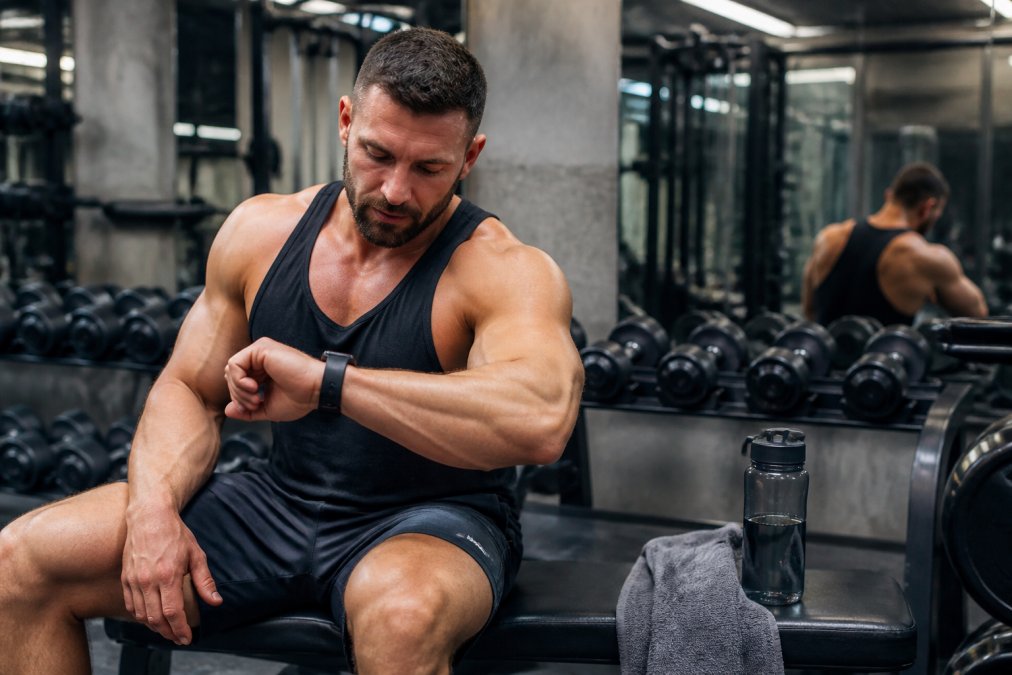
- Resting heart rate (RHR). Take it for 60 seconds the moment you wake up. Log it. A rise of 5-10 beats above your 7-day rolling average for three consecutive mornings is a real signal, not noise.
- Heart rate variability (HRV). Most smartwatches and rings give you this. HRV trending down over 3-5 days while training load stays high means your autonomic nervous system is not recovering. You do not need to interpret every blip. You need the trend.
- Grip strength. Grab a hand dynamometer or just note how the first warm-up set of deadlifts feels. A measurable drop in grip strength across sessions is one of the earliest signs of central nervous system fatigue.
A common pattern among intermediate lifters: RHR climbs 4-6 beats, HRV drops 10-15%, and top-set loads fall 5-8%, all before they feel "off." That is your window to pull back, not push through.
Recovery Windows Shift With Age
Recovery capacity is not static across your training career.
- Ages 18-25: 48 hours is often enough for most muscle groups. You can train a body part twice a week with hard sessions and recover.
- Ages 26-35: Expect 48-72 hours for large muscle groups. Sleep and nutrition start mattering more than they did at 22.
- Ages 36-45: 72 hours is the realistic floor for heavy compound work. Tendon and joint recovery lags behind muscle recovery, so connective tissue becomes the bottleneck, not the muscle.
- Ages 46+: 72-96 hours for heavy lower-body work is common. Volume tolerance drops before intensity tolerance does, so keep the heavy sets and cut the junk volume.
These are starting points, not hard rules. A 45-year-old with 20 years of training and 8 hours of sleep recovers faster than a 25-year-old who sleeps five hours and eats like garbage.
Central Nervous System Fatigue Is the Variable You Are Ignoring
Your muscles can feel ready while your CNS is still fried. Signs: slower reaction time, dropping grip strength, a foggy feeling before you touch the bar, and warm-up weights that feel like working sets. CNS fatigue accumulates from heavy singles, work above 90% of your max, and high volumes of explosive or technical lifts, not from moderate-rep bodybuilding work. Run a peaking block and your recovery window is longer than a hypertrophy block, even at the same age and size.
Pro Tip Use a daily readiness score: sleep quality (1-5), resting heart rate vs. your 7-day baseline (1-5), and motivation (1-5). Total the three. Below 9 means drop your top sets by 10-15% and add one rest day. Between 9 and 12 means train as planned but cap RPE at 8. Above 12 means you are cleared to push. This is autoregulation in practice, not theory.
Autoregulation Beats a Fixed Schedule
According to guidance from the National Academy of Sports Medicine, effective prevention of overtraining requires periodized training, scheduled deload weeks, and the use of RPE (Rate of Perceived Exertion) and RIR (Reps in Reserve) to autoregulate intensity. Translation: stop running a program on autopilot. Rate your effort and adjust in real time.
If your program says 4x8 at 225 and your readiness score is a 7, you do 4x8 at 205, or 3x8 at 225, or you go home. The program is a template. Your recovery data is the steering wheel.
How to Structure a Deload Week That Actually Works
A deload week is a planned reduction in training stress that allows physiological adaptation and repair. It is not a week off. It is a week of lighter work.
Most people get this wrong. They either skip deloads entirely or turn them into full vacations and lose their rhythm.
Deload Frequency and Intensity
- Frequency: every 4-8 weeks for most intermediate and advanced lifters
- Volume reduction: cut total sets by 40-50%
- Intensity reduction: keep loads at 50-65% of your working max
- Frequency: keep the same training days, just lighter
A March 2026 guide from Strive Workout on avoiding overtraining makes the point that steady gains require a science-backed plan combining smart programming, recovery tactics, and consistent body monitoring. A deload is the programming piece most lifters skip.
Key Takeaway A deload is not lost progress. It is the mechanism that makes the next four weeks of progress possible. Skip it and you will plateau, get hurt, or both.
How to Use a Training App for Progress Tracking
A training app for progress tracking is a digital log that records loads, reps, RPE, body weight, and recovery markers over time so you can spot patterns before they become injuries. Paper works. Apps work better because they surface trends you would miss.
What to track every session:
- Top set load and reps
- RPE for each working set
- Body weight (morning, fasted)
- Sleep hours
- Any joint pain or unusual soreness
Tiger Fitness offers free workout plans, diet guides, fitness calculators, and a dedicated training app through our fitness tools and calculators hub. If you want a single place to log loads and recovery markers, start there.
The training log is your early warning system. A 10% drop in top-set load across two weeks is a red flag long before you feel "overtrained."
Sleep, Nutrition, and Recovery Tactics to Avoid Overtraining
Sleep and nutrition are the two levers with the largest effect on recovery. Get them wrong and no supplement, app, or deload will save you. Most articles stop at "get 8 hours and eat protein." That is not a protocol.
Sleep Quality and Recovery
Aim for 7-9 hours. Keep the room cold (65-68°F), dark, and quiet. Cut caffeine after early afternoon, its half-life is 5-6 hours, so a 3 p.m. coffee still has a quarter of its punch at 3 a.m. Go to bed and wake at the same time daily, weekends included. Growth hormone release, testosterone production, and glycogen resynthesis all happen primarily during deep sleep. Cut sleep and you cut all three. Quality matters as much as duration: eight hours broken by 4-5 wake-ups means fragmented deep sleep and compromised recovery. Track the trend, not the single night.
Fueling for Recovery
Clinical guidance from the Hoag Orthopedic Institute on overtraining syndrome in January 2026 identifies fueling with appropriate calories, protein, and carbohydrates, plus proper hydration before, during, and after sessions, as central to prevention.
- Protein: 0.7-1 gram per pound of body weight daily, spread across 4-5 meals
- Carbohydrates: 2-3 grams per pound on heavy training days for glycogen replenishment; drop to 1-1.5 grams per pound on rest days
- Water: half your body weight in ounces daily, more on training days
- Sodium and potassium: do not neglect electrolytes, especially if you sweat heavily or train in heat
A common mistake is under-eating on rest days. Your body repairs muscle on rest days, not training days. Slash calories every day off and you starve the process you are trying to support.
"Being attuned to your body is one of the easiest and most effective ways to prevent acute overtraining." -- Dr. Klott, Physician at MU Health Care (LiveHealthy, 2026)
Prolonged exercise exceeding two hours or repeated high intensity bouts can transiently decrease plasma glutamine concentrations, a marker associated with overtraining, per a practical guide on overtraining syndrome from the NCBI. Keep sessions focused. Two hours of grinding is not better than 60 focused minutes.
Recovery Supplements That Actually Have Evidence Behind Them
Where the science is strongest for recovery supplements:
- Creatine monohydrate (3-5 grams daily): The most studied sports supplement on the planet. It supports recovery between sets, between sessions, and between training blocks. No loading phase required, just take it daily.
- Magnesium (200-400 mg elemental, evening): Most lifters are deficient. Magnesium supports sleep quality, muscle relaxation, and hundreds of enzymatic reactions tied to recovery. Magnesium glycinate is the form to look for if sleep is your goal.
- Electrolytes (sodium, potassium, magnesium): If you train hard and sweat heavily, plain water is not enough. Electrolyte imbalance shows up as cramps, fatigue, and poor performance long before it shows up on a blood test.
- Omega-3 fatty acids (2-3 grams EPA/DHA daily): Supports joint integrity and helps manage exercise-induced inflammation. This is not a painkiller, it is a long-term play.
- Vitamin D3 (2,000-5,000 IU daily): Deficiency is common in lifters who train indoors, and low vitamin D is linked to poor recovery, low mood, and impaired immune function.
None of these replace sleep, food, or smart programming. Sleep five hours and eat like a college freshman and no stack will save you.
Watch Out Do not stack stimulant-based pre-workouts on top of a recovery deficit. Caffeine masks fatigue. It does not erase it. If your readiness score is low and you are reaching for a second scoop to get through a session, you are borrowing from tomorrow's recovery at a bad interest rate.
A 2026 report from ResearchGate on preventing overtraining in weight training emphasizes individualized programs, restful sleep, healthy nutrition, and consistent progress tracking as the core strategies. That is the foundation. Everything else is detail.
One contrarian point worth knowing: resistance training may not induce overtraining syndrome as easily as endurance training. Researchers attempting to induce OTS specifically through resistance training have found results that deviate from traditional expectations. That does not mean you cannot overtrain on the barbell. It means the mechanism and timeline look different than the endurance model.
Pro Tip If you are coming from an endurance background, your recovery instincts will mislead you. Lifting fatigue accumulates differently, mostly through CNS load and connective tissue stress rather than pure cardiovascular depletion. Give yourself more recovery than your running brain thinks you need.
Supplements and Tools That Support Recovery
Supplements support recovery. They do not replace sleep, food, or smart programming.
Where they help: managing cortisol, supporting joint integrity, and improving sleep quality.
- Revive Cortisol Support ($49.95) combines magnesium and L-theanine for adrenal and cortisol support. Non-sedating, so you can take it during the day.
- PANDA Supps Chillax ($29.99) is built for relaxation and sleep quality. Take it at night to wind down.
- Revive Joint Support ($27.47) uses glucosamine, chondroitin, MSM, turmeric, and Boswellia for joint mobility and long-term joint integrity.
- USPLabs SuperCissus ($31.95) is built around Cissus quadrangularis for bone and joint support.
All four are available at Tiger Fitness with fast shipping and our rewards program.

| Tool | Best For | Timing |
|---|---|---|
| Revive Cortisol Support | Daytime stress and cortisol balance | Morning or pre-workout |
| PANDA Supps Chillax | Sleep quality and wind-down | 30-60 min before bed |
| Revive Joint Support | Daily joint mobility | With meals |
| USPLabs SuperCissus | Joint and bone support | Daily, split doses |
A 2026 report from ResearchGate on preventing overtraining in weight training emphasizes individualized programs, restful sleep, healthy nutrition, and consistent progress tracking as the core strategies. Supplements sit on top of that foundation, not underneath it.
One contrarian point worth knowing: resistance training may not induce overtraining syndrome as easily as endurance training. Researchers attempting to induce OTS specifically through resistance training have found results that deviate from traditional expectations. That does not mean you cannot overtrain on the barbell. It means the mechanism and timeline look different than the endurance model.
Pro Tip If you are coming from an endurance background, your recovery instincts will mislead you. Lifting fatigue accumulates differently, mostly through CNS load and connective tissue stress rather than pure cardiovascular depletion. Give yourself more recovery than your running brain thinks you need.
Frequently Asked Questions
How do I know if I'm overtraining weightlifting?
Watch for persistent fatigue, decreased performance, mood swings, and trouble sleeping. A 2012 PMC review notes that overtraining syndrome is a clinical condition with 870 citations in medical literature. If your lifts stall or regress for more than a week despite adequate food and sleep, you're likely overtraining. Dr. Klott of MU Health Care says, 'Being attuned to your body is one of the easiest and most effective ways to prevent acute overtraining.' Track your resting heart rate and sleep quality to catch it early.
What are the most common physical signs of overtraining syndrome?
Common physical signs include persistent muscle soreness, elevated resting heart rate, increased susceptibility to illness, and nagging joint pain. A 2026 NASM report highlights that using RPE and RIR can help autoregulate intensity and prevent these signs. You might also notice decreased grip strength or slower reaction times. If you experience any of these, take a deload week immediately. Ignoring them leads to full-blown overtraining syndrome, which can take months to recover from.
Is it better to take a deload week or complete rest days?
A deload week is usually better because it maintains training frequency while reducing volume and intensity. According to NASM 2026, periodized training with scheduled deload weeks is key to preventing overtraining. Complete rest can be useful if you're severely overtrained, but for most lifters, a deload allows active recovery. For example, cut your weights by 40-50% and sets by half. This keeps movement patterns fresh and promotes muscle recovery without detraining. Use a training app to log your deload and track how you feel.
How can I track my training volume to prevent burnout?
Use a training app to log every set, rep, and weight. A 2026 ResearchGate report recommends consistent progress tracking to sustain long-term performance. Monitor weekly volume (sets x reps x weight) and watch for spikes. If your volume jumps more than 10-20% from one week to the next, you're at risk. Also track RPE and RIR to autoregulate. Tiger Fitness offers free fitness calculators to help you set baseline volumes and adjust as needed. Consistency in tracking beats guesswork every time.
Overtraining is not a badge of honor. It is a programming failure, and it costs you months of progress every time it happens. Track your markers, deload on schedule, sleep like it is part of your training, and fuel your body properly. Tiger Fitness stocks the recovery supplements covered above, plus free workout plans, diet guides, fitness calculators, and a training app to keep your programming honest. Get started with Tiger Fitness and build the kind of progress that lasts past your next PR.
Leave a comment