







How to Choose Transparent Supplement Labels
Table of Contents
- Why Transparent Supplement Labels Matter
- Understanding Proprietary Blend Meaning and Why It Hides the Truth
- How to Read the Supplement Facts Panel
- Third-Party Supplement Testing: The Gold Standard
- FDA Supplement Regulations and What They Actually Require
- Identifying Amino Spiking and Other Label Red Flags
- Red Flags That Signal Low-Quality Labels
- Ingredient Sourcing and Standardized Extracts
Last Updated: August 27, 2026
Why Transparent Supplement Labels Matter
82% of weight-loss supplements tested showed inaccurate labeling (olemiss.edu). That's not rounding error, that's an industry-wide problem. When you're spending money on supplements to support your training, you need to know exactly what you're paying for.
Most people assume the label tells the truth. It doesn't. Under the Dietary Supplement Health and Education Act (DSHEA), manufacturers self-certify their claims without independent FDA verification before hitting shelves. You could be buying a product that contains none of the active ingredients listed, hidden ingredients not disclosed, or dosages nowhere near what the label claims. When you're investing in your physique, every dollar and every dose matters.
Pro Tip The most transparent brands voluntarily submit to third-party testing and publish their results publicly. If a company won't show you testing data, that's your first red flag.
Understanding Proprietary Blend Meaning and Why It Hides the Truth
A proprietary blend lists the total weight of a mixture but not the individual amounts of each ingredient. This is legal. It's also deceptive.
A proprietary blend could contain 90% of one cheap filler ingredient and 10% of the expensive active compound you actually want. The label says "proprietary blend" to protect the "formula," but what it really protects is the company's ability to cut corners without consequences.
According to recent transparency research, proprietary blends are one of the top reasons consumers feel misled by supplement labels. The fix is simple: avoid proprietary blends when possible. Look for products that list each ingredient with its exact dosage. If a company is confident in their formula, they'll disclose it.
Watch Out Proprietary blends often contain underdosed active ingredients mixed with cheap fillers. A 5,000 mg proprietary blend could have only 500 mg of the ingredient you actually need. Always demand full ingredient disclosure.
How to Read the Supplement Facts Panel
The supplement facts panel is your roadmap to knowing what's actually in the bottle.
Serving Size and Dosage Accuracy
Start at the top: serving size. This number determines everything else on the label. If a product lists a serving size of half a scoop but you're taking a full scoop, you're consuming double the listed dosages.
Only 19% of iron supplements matched their label claims, according to laboratory analysis (peer-reviewed research). A product claiming 30 mg of iron might contain 5 mg or 50 mg. Neither scenario is acceptable. Check the serving size against what's realistic for actual use. If the label says one capsule per serving but recommends taking three per day, the math doesn't work.
Active Ingredients vs. Fillers
The supplement facts panel lists ingredients in descending order by weight. The first few ingredients will be your active compounds. Everything after that is typically filler, binder, or flow agent.
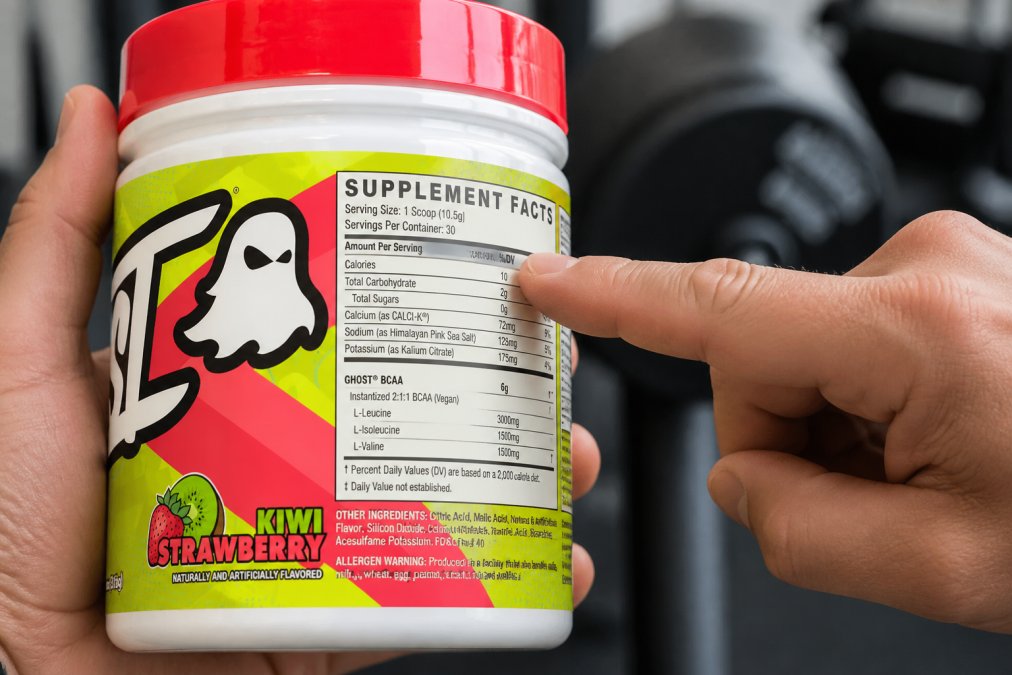
The active ingredients should be present in clinically relevant dosages. A BCAA supplement listing 2,000 mg of total BCAAs per serving in the optimal 2:1:1 ratio is transparent and dosed correctly. A product listing 500 mg of BCAAs mixed with 4,500 mg of filler is wasting your money.
Look for specific ingredient amounts. If you see "proprietary blend" or vague terms like "natural flavoring complex," that's a red flag. At Tiger Fitness, we carry products like GHOST BCAA with full ingredient transparency, where every ingredient and dosage is clearly stated.
Third-Party Supplement Testing: The Gold Standard
Third-party testing is the single most important indicator of label accuracy and product safety. When a company sends their product to an independent laboratory, they're proving they have nothing to hide.
Third-party testing checks: Does the product contain what the label claims? Are there contaminants like heavy metals or banned substances? Is the potency accurate? The results come back as a Certificate of Analysis (COA), which you should be able to access on the company's website.
NSF International, Informed Sport, and USP are the most respected certifications. If a product carries one of these seals, the manufacturer has paid for independent verification. That cost gets passed to you, but it's worth every penny.
Key Takeaway Third-party testing is the only way to verify that a supplement contains exactly what the label claims. If the company won't provide a COA or certification, the product isn't transparent.
FDA Supplement Regulations and What They Actually Require
Under DSHEA, the FDA can only take action AFTER a product is on the market if it's proven unsafe or if claims are false. There's no pre-market approval process like there is for drugs.
Manufacturers must follow Current Good Manufacturing Practice (cGMP) standards under 21 CFR Part 111, which covers facility cleanliness, equipment maintenance, batch testing, and quality controls. But these standards don't require proof that your product works, only that it's manufactured consistently and safely. A company can follow cGMP perfectly and still sell an underdosed or ineffective product. identify quality suppliers.
The FDA also regulates label claims. A supplement can't claim to "cure" or "treat" a disease. It can claim to "support" or "promote" health. A product claiming "supports muscle recovery" is compliant. A product claiming "heals muscle damage" violates FDA regulations.
What the FDA doesn't require: third-party testing, disclosure of all ingredients, or proof of efficacy. These are voluntary standards that separate transparent companies from the rest.
Look for warning letters. The FDA publishes warning letters to companies that violate regulations. These are public record. If a manufacturer has received a warning letter for false claims, undisclosed ingredients, or contamination, you'll find it on the FDA website.
Verify the supplement facts panel format. The FDA requires specific formatting: serving size at the top, ingredients listed by weight in descending order, and a "Supplement Facts" header. If the label doesn't follow this format, it's not FDA-compliant.
Understand structure-function claims vs. disease claims. The label can say "supports healthy cholesterol levels already in the normal range" (allowed). It cannot say "lowers cholesterol" or "treats high cholesterol" (not allowed for supplements).
Pro Tip The FDA maintains a searchable database of supplement adverse event reports. If a product has multiple reports of contamination, undisclosed ingredients, or serious side effects, you'll find them there.
FDA compliance is a floor, not a ceiling. A product can be FDA-compliant and still be poorly formulated, underdosed, or made by a company with a history of cutting corners.
Identifying Amino Spiking and Other Label Red Flags
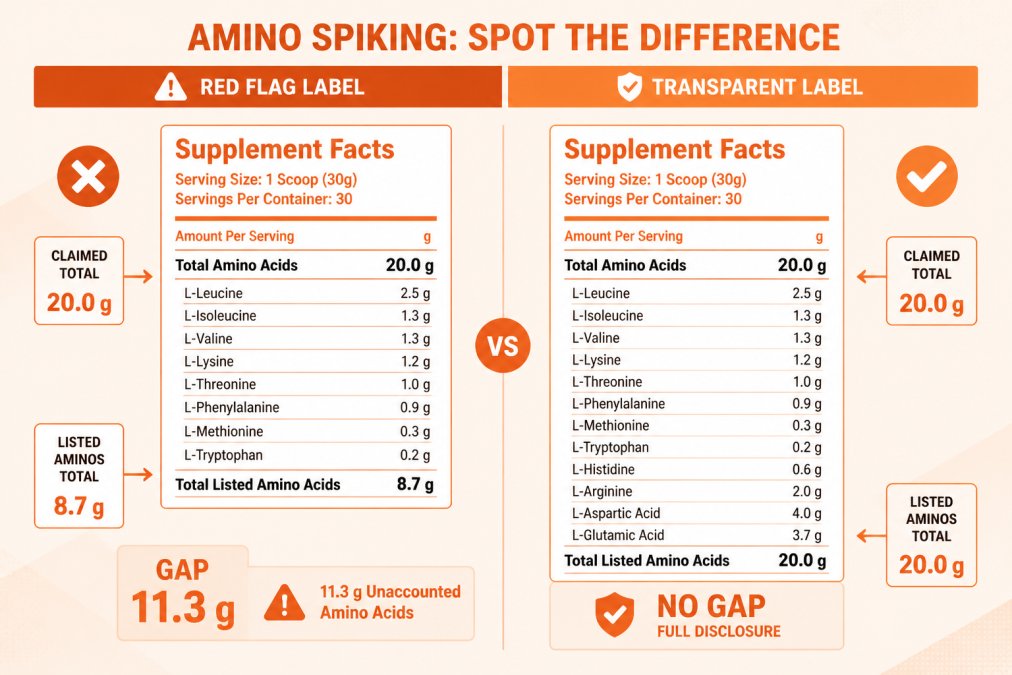
Amino spiking artificially inflates amino acid content by adding cheap amino acids (usually glycine or taurine) that don't contribute to the claimed benefits. A BCAA supplement might list 5,000 mg of amino acids on the front label, but only 2,000 mg are actually branched-chain amino acids. The remaining 3,000 mg are filler amino acids that cost pennies to source.
Glycine costs roughly $0.50 per kilogram. Leucine costs $15-20 per kilogram. A manufacturer can load a product with glycine, list it as "amino acids," and claim high amino acid content while spending a fraction of what they'd spend on actual BCAAs.
How to detect amino spiking: The calculation method.
Step 1: Find the total amino acid content claimed on the front label.
Step 2: Flip to the supplement facts panel and add up the individual amino acids listed.
Step 3: Subtract the sum from Step 2 from the total in Step 1. The difference is your spiking indicator.
Example:
- Front label claims: "5,000 mg of amino acids per serving"
- Supplement facts panel lists:
- Leucine: 1,000 mg
- Isoleucine: 500 mg
- Valine: 500 mg
- Total listed: 2,000 mg
- Difference: 5,000 mg − 2,000 mg = 3,000 mg unaccounted for
That 3,000 mg gap is likely glycine, taurine, or other cheap amino acids not prominently disclosed. A legitimate product will list every amino acid in the supplement facts panel.
Other red flags that signal low-quality labels:
Missing serving size information or unclear dosing instructions. If a product doesn't clearly state the serving size or how many servings are in the container, you can't verify what you're actually consuming.
Ingredients listed without amounts. If the label says "proprietary blend" or lists ingredients without milligram amounts, you have no way to verify potency.
Claims that seem too good to be true. "Gain 10 pounds of muscle in 30 days" or "Lose 20 pounds without diet or exercise." Supplements support your training and nutrition; they don't replace them.
No contact information or manufacturer details. A transparent company lists their name, address, and phone number on the label.
Vague language like "proprietary formula" or "trade secret blend." A company confident in their formula discloses it.
No batch number or expiration date. Every legitimate supplement has a batch number for traceability and an expiration date for safety.
Unverifiable certifications or made-up seals. Real certifications come from NSF International, Informed Sport, or USP. If you don't recognize the seal, search for it.
According to research on supplement label accuracy, 40% of popular supplements contained no trace of one of the ingredients listed. This isn't accidental, it's fraud.
Watch Out If the total amino acid content on the label doesn't match the sum of individual amino acids listed in the supplement facts panel, the product is spiked. Do the math before you buy.
Ingredient Sourcing and Standardized Extracts
Where an ingredient comes from matters. Some raw materials are sourced from countries with strict manufacturing standards. Others come from regions with minimal oversight.
Standardized extracts are processed to contain a guaranteed percentage of the active compound. Raw powders can vary wildly in potency depending on growing conditions, harvest timing, and processing. A standardized extract of a botanical ingredient might guarantee 10% active alkaloids. A raw powder from the same plant could contain anywhere from 2% to 15%.
If you're paying for standardized extracts, the label should say so. Transparent companies provide this information on their website or on the label itself. A company confident in their sourcing will answer your questions. A company that dodges them is hiding something.
Once you've learned how to read labels and identify red flags, use FREE TOOLS & FITNESS CALCULATORS to dial in your nutrition and training plan. Transparent supplements are only half the equation, you need a solid program backed by data to see real results.
Frequently Asked Questions
Q: What is a proprietary blend on a supplement label?
A: A proprietary blend is a combination of ingredients listed under a single name without disclosing the exact amount of each component. Manufacturers use this to protect formulas from competitors, but it prevents you from knowing actual dosages. The FDA allows this under current supplement regulations, but it undermines transparency. If a label shows 'Proprietary Energy Blend 2,500mg' without breaking down leucine, isoleucine, and valine amounts, you cannot verify if you're getting clinically effective doses. This is why transparent supplement labels list each ingredient separately with its specific amount.
Q: Why is third-party supplement testing important?
A: Third-party testing verifies that what's on the label actually matches what's in the bottle. Research shows 40% of popular supplements contained no trace of one listed ingredient. Third-party certifications like NSF Certified for Sport or Informed Sport test for label accuracy, banned substances, and heavy metals. When you buy a supplement with third-party testing verification, you're buying confidence that the product meets its claims. This is the single strongest indicator of a transparent supplement label.
Q: What does the FDA require on supplement labels?
A: The FDA requires supplement labels to include the supplement facts panel, ingredient list, allergen warnings, and manufacturer contact information under the Dietary Supplement Health and Education Act (DSHEA). However, the FDA does not require pre-market approval for safety or efficacy, and manufacturers self-certify their claims. This regulatory gap means you cannot rely solely on FDA approval as proof of accuracy. The burden falls on manufacturers to ensure label accuracy, which is why third-party testing and ingredient disclosure become critical for choosing transparent supplements.
Q: How can I tell if a supplement label is misleading?
A: Watch for vague marketing language like 'supports brain health' without specific ingredient amounts, missing allergen warnings, lack of manufacturer contact details, or absence of third-party testing badges. Red flags include proprietary blends that hide dosages, ingredients listed by trade names only without amounts, and claims about curing or treating disease (the FDA prohibits these). Compare labels side-by-side: transparent labels show each active ingredient, its amount in milligrams, and third-party certifications. If a label feels intentionally confusing or hides key information, that's a sign to choose a different product.
Ready to make informed supplement choices? At Tiger Fitness, our entire supplement selection is third-party tested and fully transparent. Every product carries verified dosages, clean ingredient lists, and accessible Certificates of Analysis. We also provide free fitness calculators and guides to help you match supplements to your actual goals. Start with products you can trust, backed by the facts.
Leave a comment