







CALORIC SURPLUS
How to Create a Caloric Surplus With Whole Foods
Table of Contents
- How to Create a Caloric Surplus With Whole Foods: The Basics
- Step 1: Calculate Your Daily Calorie Needs
- Step 2: Set Your Surplus and Adjust as You Go
- Calorie-Dense Whole Foods That Do the Heavy Lifting
- Step 3: Build a Whole-Food Bulking Meal Plan
- Step 4: Plant-Based Calorie Surplus Without the Bloat
- Step 5: Whole-Food Snacks for Weight Gain Between Meals
- Step 6: Track Progress and Troubleshoot a Stalled Surplus
- Frequently Asked Questions
Last Updated: October 15, 2026
How to Create a Caloric Surplus With Whole Foods: The Basics
Creating a caloric surplus with whole foods means eating more calories than your body burns while keeping food quality high. That's the definition. Simple to say, hard to do. Here's why: whole foods fill you up fast. A 2019 review in "Is an Energy Surplus Required to Maximize Skeletal Muscle Hypertrophy?" notes that piling on food volume can trigger early satiety and block the surplus you're chasing. At Tiger Fitness, we see lifters stall for one reason: they eat clean, feel stuffed, and still come up short on calories.
Why Whole Foods Make Hitting a Surplus Harder
Whole foods carry more fiber, water, and bulk per calorie. That's great for cutting, terrible for gaining. University of Bristol researchers reported in 2026 that people eating a whole-food diet tend to pick more fruit and vegetables over denser options like rice, meat, and butter, so they end up eating fewer calories overall (University of Bristol wholefood diet research). The fix isn't junk food. It's choosing the densest whole foods on the shelf.
Step 1: Calculate Your Daily Calorie Needs
Start with your maintenance number: the calories you need to stay the same weight. Estimate it, run it for two weeks, then adjust based on the scale.
- Weigh yourself first thing in the morning, three days in a row.
- Track everything you eat for one week using an app.
- Average your daily intake. That's your starting maintenance estimate.
- Eat that amount for 14 days and watch the scale.
If weight holds steady, that number is your maintenance. If it drops, eat more. If it climbs, eat less. No formula beats real data from your own body.
Step 2: Set Your Surplus and Adjust as You Go
Add 10-20% above maintenance to start. Healthline's clean bulking guidance recommends exactly that range (Healthline clean bulking guide). For a 2,800-calorie maintenance, that's 3,080-3,360 calories per day. Aim for a gain of 0.25-0.5% of body weight per week. Faster than that, and you're adding fat you'll diet off later.
| Goal | Surplus | Weekly Gain Target |
|---|---|---|
| Lean gain | 10% above maintenance | 0.25% body weight |
| Standard bulk | 15% above maintenance | 0.35% body weight |
| Aggressive bulk | 20% above maintenance | 0.5% body weight |
A 2017 review in "The Effects of Overfeeding on Body Composition" notes that a bigger surplus may increase water weight. The scale moves fast, but it isn't all muscle. Keep the surplus modest and let training do the rest.
Watch Out If the scale jumps more than one pound per week, cut your surplus by 100-150 calories. Excess gain comes off as fat, and fat loss later costs you muscle.
Calorie-Dense Whole Foods That Do the Heavy Lifting
Calorie-dense whole foods give you the most calories per bite without processed junk. The mistake most guys make is picking foods that look dense but still leave them stuffed at 2,200 calories.
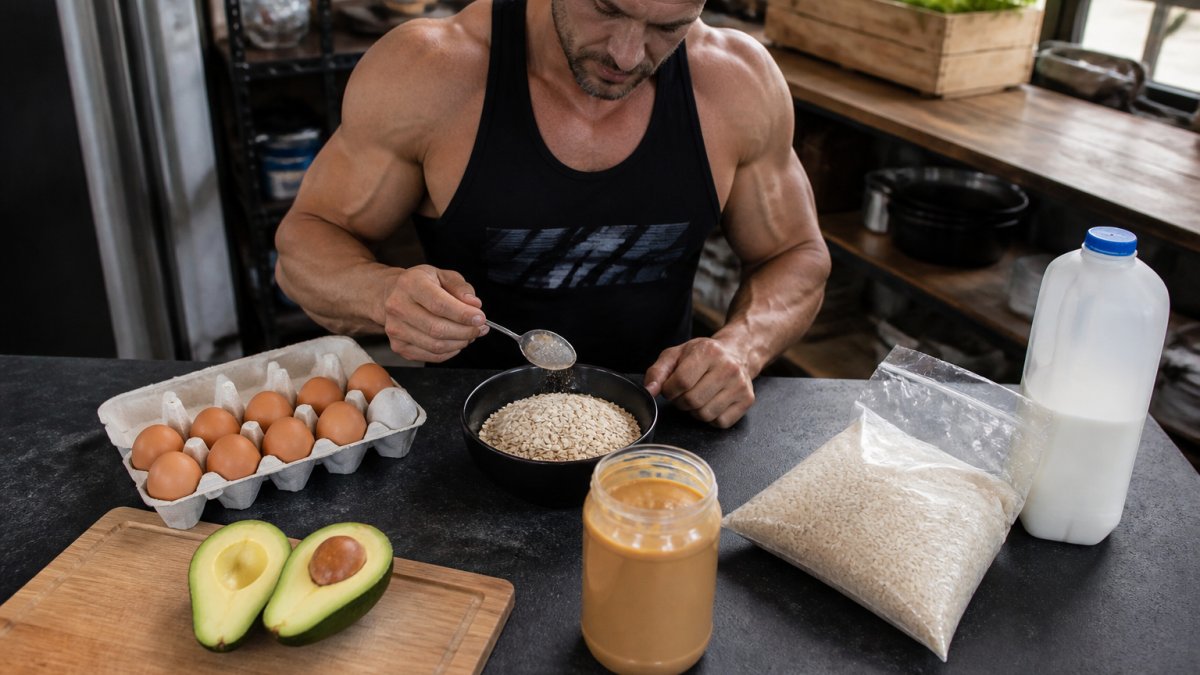
Here's the real comparison. These are the boosters that do the work, ranked by how easy they are to add to a meal you're already eating:
| Food | Serving | Calories | How to Add It |
|---|---|---|---|
| Olive oil | 1 tbsp | ~120 | Drizzle on rice, potatoes, or eggs |
| Peanut butter | 2 tbsp | ~190 | Stir into oats or spread on toast |
| Avocado | 1 medium | ~240 | Slice onto eggs, beef, or chicken |
| Nuts and seeds | 1 oz | 160-200 | Toss into yogurt or eat by the handful |
| Dried fruit | 1/4 cup | ~120 | Mix with nuts for trail mix |
| Whole milk | 1 cup | ~150 | Drink with meals or blend into shakes |
| Rolled oats | 1 cup dry | ~300 | Cook as a base for breakfast or shakes |
| White rice | 1 cup cooked | ~205 | Double your normal portion |
| Whole eggs | 3 large | ~215 | Add two to any meal |
| Cheese | 1 oz | ~110 | Melt onto eggs, potatoes, or beef |
Now do the math. Add olive oil to two meals (240 calories), a tablespoon of peanut butter to your oats (95), half an avocado to lunch (120), an ounce of almonds as a snack (170), and a cup of whole milk with dinner (150).
The mechanism matters here. Fat carries 9 calories per gram versus 4 for carbs and protein, so the fattier whole foods, oils, nuts, nut butter, avocado, cheese, give you the most calories per bite.
A few practical rules:
- Liquid calories are your cheat code. Whole milk, blended oats, and shakes go down without triggering the fullness that solid food does.
- Add fat to carbs, not protein. Fat slows digestion. Put it on rice or potatoes, not on the chicken you're trying to choke down.
- Don't add fiber to a meal that's already filling. Seeds and dried fruit are great, but if you're stuffed, reach for oil or milk instead.
One warning: if you jump from 30 grams of fiber a day to 60 overnight, you'll be bloated, gassy, and miserable. Add these foods gradually over two to three weeks. Your gut adapts, but it needs time.
Pro Tip Keep a jar of peanut butter and a bag of mixed nuts within arm's reach at all times. The food you don't have to prepare is the food you'll actually eat. Convenience beats willpower every single time.
Step 3: Build a Whole-Food Bulking Meal Plan
A whole-food bulking meal plan works when you anchor each meal around protein, add dense carbs, and finish with fats. That's the structure. But structure alone doesn't hit a number. You need to build the day around your calorie target, not just eat "clean" and hope.
Here's the framework:
- Protein first, 30-50g per meal from eggs, beef, chicken, or whey
- Dense carbs, oats, rice, potatoes, or lentils
- Healthy fats, avocado, nuts, olive oil, or whole eggs
- Add-ons, flax seeds, nut butter, or whole milk
Now here's a full sample day built to hit roughly 3,200 calories from whole foods. This is a real day, not a magazine photo shoot. Adjust portions up or down to hit your number.

| Meal | Food | Calories | Protein |
|---|---|---|---|
| Breakfast | 1 cup dry oats, 2 tbsp peanut butter, 3 whole eggs, 1 cup whole milk | 950 | 45g |
| Snack | 1 oz almonds, 1/4 cup dried fruit, 1 cup whole milk | 470 | 15g |
| Lunch | 8 oz beef, 2 cups white rice, 1/2 avocado, 1 tbsp olive oil | 1,050 | 55g |
| Pre-workout | 1 cup cooked rice, 1 banana, 1 tbsp honey | 350 | 5g |
| Dinner | 8 oz chicken, 2 cups potatoes, 1 tbsp olive oil, 1 oz cheese | 800 | 55g |
| Before bed | 1 cup Greek yogurt, 2 tbsp flax seeds, 1 tbsp honey | 350 | 25g |
| Total | ~3,970 | ~200g |
That's a real day. If your target is 3,200, cut the portions. If it's 4,200, add another snack. The point is you now have a template with actual numbers you can scale.
Here's how to adjust it:
- Need 300 more calories? Add 2 tbsp peanut butter and a cup of whole milk.
- Need 500 more? Add a fourth meal, 6 oz beef, 1 cup rice, 1 tbsp olive oil.
- Need 300 fewer? Drop the pre-workout meal and cut the bedtime honey.
- Stuffed and can't finish? Swap one solid meal for a shake, oats, peanut butter, banana, whole milk, and whey blended together can hit 800 calories in a cup.
A few things I've learned from years of doing this:
- Eat on a schedule, not on hunger. When you're bulking on whole foods, you won't always be hungry. Set alarms if you have to. Six meals beats three giant ones you can't finish.
- Prep in bulk. Cook rice, potatoes, and protein on Sunday. If it's not ready, you'll skip it.
- Don't fear carbs at night. They help you sleep and refill glycogen. The "no carbs after 7 PM" thing is nonsense for a bulk.
- Weigh your food for the first two weeks. You'll be shocked how far off your eyeball portions are. After that, you can eyeball it.
Watch Out If you're gaining more than one pound per week, you're adding fat, not just muscle. Cut 100-150 calories from the day and reassess after two weeks. A slow, controlled gain beats a fast, sloppy one every time.
Key Takeaway The meal plan is just a template. The scale and the mirror are your feedback. Build the day around your number, adjust every two weeks, and don't overthink it.
Step 4: Plant-Based Calorie Surplus Without the Bloat
A plant-based calorie surplus works if you lean on dense plant foods instead of volume-heavy vegetables. The trick is skipping the giant salads that fill you up for 100 calories.
- Lentils - 1 cup cooked: about 230 calories
- Tempeh - 4 oz: about 220 calories
- Tahini - 2 tbsp: about 180 calories
- Dried fruit - 1/4 cup: about 120 calories
- Hemp seeds - 3 tbsp: about 170 calories
Pro Tip Blend your calories instead of chewing them. A shake with oats, peanut butter, banana, and plant protein can hit 800 calories in one sitting without the bloat.
Step 5: Whole-Food Snacks for Weight Gain Between Meals
Whole-food snacks for weight gain close the gap when meals fall short. Three snacks at 300 calories each adds 900 calories to your day.
- Trail mix with nuts and dried fruit
- Ovation Foods Steak-N-Eggs with a piece of fruit
- Greek yogurt with flax seeds and honey
- Rice cakes with peanut butter
- Whole milk with a scoop of whey
Keep them in your gym bag, desk, or car. Convenience wins. If the food isn't within arm's reach, you won't eat it.

Step 6: Track Progress and Troubleshoot a Stalled Surplus
Weigh yourself daily and average the week. If the weekly average hasn't moved in 10-14 days, add 200-300 calories. That's the whole troubleshooting process.
Check these when progress stalls:
- Are you actually eating what you logged?
- Has your training volume increased?
- Are you sleeping seven-plus hours?
- Is your surplus still above maintenance?
Key Takeaway The scale is your feedback loop. Weigh daily, average weekly, adjust every two weeks. Guessing is why most bulks fail.
Use our free fitness tools and calculators to dial in your numbers, then stack your meals around the whole foods above.
Frequently Asked Questions
How much of a calorie surplus should I aim for to build muscle?
Start with 10 to 20 percent above your maintenance calories, which is the range Healthline recommends for a clean bulk. If you maintain on 2,800 calories, that means eating roughly 3,080 to 3,360 per day. A larger surplus may increase water weight, according to a 2017 review in PubMed Central, so there is no benefit to going overboard. Weigh yourself weekly and add 100 to 200 calories only if the scale has not moved.
How can I eat more calories when whole foods are filling?
Focus on calorie-dense whole foods instead of volume. Two tablespoons of peanut butter adds about 190 calories in one spoonful, half an avocado adds around 160, and a tablespoon of olive oil adds about 120. A 2019 PubMed Central review notes that simply increasing food volume can trigger early satiety and block your surplus. Drink some of your calories too, like whole milk or a shake with oats and protein powder, so you are not chewing through five pounds of food a day.
How do I know if my calorie surplus is working?
Track your body weight two to three times per week and average the numbers. If your weekly average is not climbing, you are not in a surplus, no matter what your app says. Aim for roughly 0.25 to 0.5 percent of body weight gained per week. Also watch your lifts: if your main movements are getting stronger and your waist is not ballooning, the surplus is doing its job. Adjust up by 100 to 200 calories only when progress stalls for two straight weeks.
Can I create a plant-based calorie surplus without feeling stuffed?
Yes, but you have to pick the right foods. A 2026 University of Bristol report found that people on whole-food diets tend to choose more fruit and vegetables over higher-calorie options like rice, meat, and butter, so they end up eating fewer calories overall. Build plant-based meals around lentils, tofu, tempeh, oats, nuts, seeds, and avocado. Blend dates or nut butter into shakes and use olive oil liberally. Liquids and fats get you to your calorie target without forcing down another plate of broccoli.
Building a caloric surplus with whole foods takes planning, not luck. Most lifters fail because they guess instead of tracking. At Tiger Fitness, we stock the tools that make it easier: Core Oats & Whey, MuscleSport Cream'd Rice Gourmet, and Ovation Foods Steak-N-Eggs, backed by the lowest prices and fast shipping. Get started with Tiger Fitness and build the surplus that builds the physique.
Leave a comment