
Pick This Year's Olympia T-Shirt

Last Updated: September 10, 2026
If you think the tub of pre-workout you bought online is what the label says it is, you're probably wrong. According to research on hyped gym supplements, 89% of sports supplement labels analyzed were found to be false, fraudulent, or laced with illegal drugs. That's not a scare tactic. That's a finding, and it should make you angry.
We sell supplements for a living, which means we also see the garbage that circulates around them. The NIH report on problematic trends in dietary supplements identified more than 1,050 tainted dietary supplements since 2007. The problem isn't shrinking. It's getting smarter.
Learning how to identify fake fitness supplements is now a basic skill, not a paranoid habit.

Here's the hard truth: the FDA regulates dietary supplements as food, not drugs. That means products hit shelves before the agency reviews them for safety or effectiveness. The FDA acts after problems surface, through recalls, warning letters, and its tainted supplement database.
That's the entire enforcement model. No pre-market approval. No guaranteed purity.
So when a company leans on "FDA registered facility" as a selling point, understand what it means: the facility filed paperwork. It does not mean the FDA blessed the product. Companies also cite real studies on an ingredient even when the study showed no benefit for the product being sold, a tactic documented by analysis of supplement marketing claims.
The burden lands on you. That's why the next sections matter.
Counterfeiters are lazy, and it shows. Before you ever open a bottle, the label and packaging will tell you plenty. Four misrepresentation patterns dominate the counterfeit market: no active ingredient at all, sub-therapeutic doses, undeclared pharmaceuticals, and synthetic drug adulterants, according to 2026 supplement safety guidance.
Typos, misspellings, and awkward grammar are the strongest early indicators of a counterfeit product. Check the exact spelling of the brand name and every ingredient against the manufacturer's official website. If "creatine monohydrate" is spelled three different ways on one label, put it down.
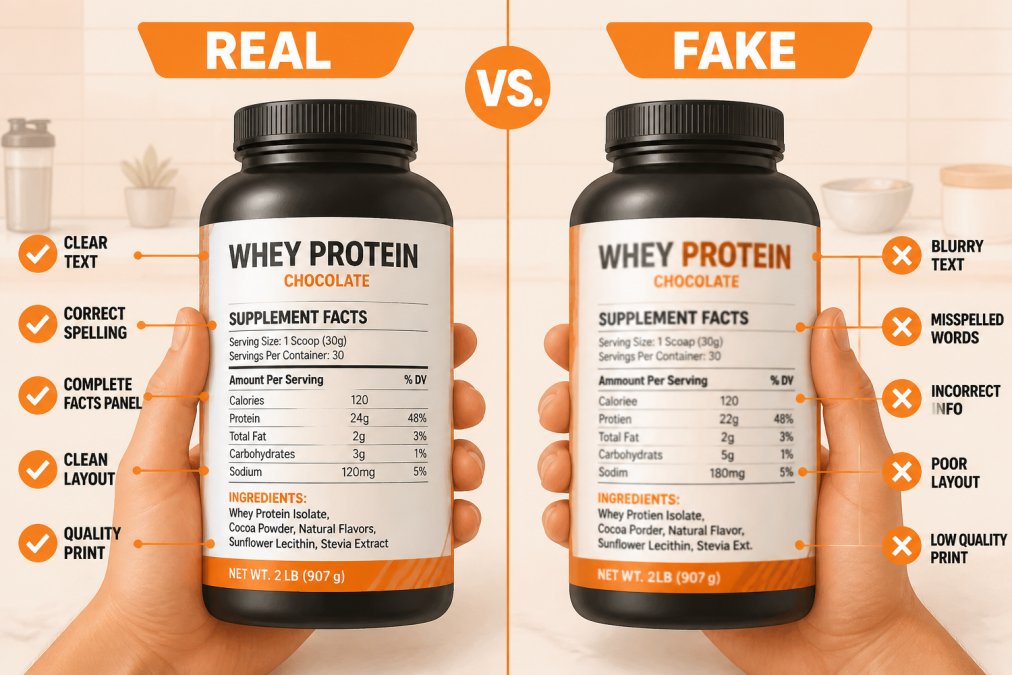
A broken seal or a loose induction liner means one thing: walk away. Check that the inner seal is intact and seated properly, the lot code is printed (not stickered over), and the expiration date is legible. Counterfeiters reuse old containers. If the packaging integrity looks off, the product authenticity is off too.
Every legitimate product carries a batch number and lot code tied to its manufacturing run. That code is the paper trail. If the trail dead-ends, you're holding a problem.
Here's how to check supplement batch numbers in practice:
A real result confirms four things: the product name, the production date, the facility, and the fact that the code hasn't been queried hundreds of times from different locations. A fake result usually shows one of three patterns:
Static lot codes can be copied. Single use digital codes cannot. This is where the real verification happens in 2026.
Amazon Transparency Codes are the most widely deployed example. Each unit gets a unique alphanumeric code under a 2D data matrix. You scan it with the Transparency app before you open the bottle. The system checks the code against the manufacturer's database and tells you whether this specific unit is authentic, whether it's already been scanned (a red flag for a cloned code), and where it was manufactured. If the app says the code was already redeemed, you're holding a counterfeit. Return it, don't use it.
Some brands run their own in-house systems. Look for a QR code on the label or under the cap that routes to a manufacturer-controlled verification page, not a generic landing page, not a social media link. The URL should be on the brand's own domain.
No lot tracking system is a red flag. Reputable brands can trace a batch to a production date, a facility, and a quality control record. If a brand can't tell you where your bottle came from, they don't know what's in it either.
Here's the distinction most guides never make: gray market is not the same as counterfeit. Gray market product is genuine, it was made by the real manufacturer, but it was diverted outside the authorized supply chain. It may have been stored in a hot warehouse for a year, sold through a liquidator, or shipped from another region with different labeling requirements. It's real product with an unknown history.
Counterfeit product is fake. It was never made by the brand on the label.
Both are risky. Gray market product can be degraded, expired, or mislabeled for your region. Counterfeit product can contain anything. Authorized retailers are the only channel where you get both authenticity and a known storage history. That's the whole reason the authorized channel exists.
Third-party supplement testing is independent laboratory analysis of a finished product for banned substances, contaminants, and label accuracy, conducted by an organization with no financial stake in the result. It's the only claim on a label you should trust.
Here's the part most people miss: there is no single "third-party tested" seal. Different certifiers test for different things, and a logo on a bottle doesn't tell you which one you're looking at.
A brand can carry a certification logo and still have a bad batch. The certification only means something if you check the specific lot.
If the certifier's database doesn't have your lot, the logo on the bottle is decoration. That's the difference between a brand promise and a verified batch.
A third-party seal is not a free pass. Here's what it doesn't tell you:
If a label lists a "proprietary blend" with a total weight but no individual doses, you have no way to verify whether the active ingredients are present in amounts that do anything. This is legal. It's also the single most common way legitimate looking products underdeliver.
A real certification doesn't fix this. Only a fully disclosed label does. When you're comparing two products, the one with disclosed doses beats the one with a blend every time, certification or not.
| Verification Method | What It Confirms | Where to Check |
|---|---|---|
| Third-party seal | Banned substances, contaminants | Certification body database |
| Batch/lot code | Production run and date | Manufacturer website |
| Transparency code | Unit-level authenticity | Official smartphone app |
| FDA alert database | Known tainted products | FDA safety alerts |
This is where most guides stop, and it's exactly where counterfeiters thrive. Digital authentication tools now let you verify a single unit, not just a brand. Amazon Transparency Codes, for example, can be scanned with an official app to confirm the specific bottle in your hand is genuine.
Supply chain transparency matters just as much. A brand that publishes its manufacturing partners and testing protocols is a brand with nothing to hide. One that won't answer where its raw ingredients come from is telling you something. The New York Times investigation into AI-generated wellness marketing found hundreds of AI-generated "doctors" and "healers" pushing supplements on social media. The seller has no face. The supply chain has no trail.
Buying from an authorized distributor is the single most effective way to avoid counterfeits. Discount liquidation channels are high-risk for expired, improperly stored, or grey-market products that skipped quality control entirely, per 2026 guidance on spotting fake supplements.
Third-party marketplace listings are the wild west. A single product page can host multiple sellers, and you have no idea which one you're buying from. Heat exposure during shipping degrades active ingredients. Improper storage does the same. You can't inspect any of it.
Nobody is going to protect you from a fake supplement but you. The FDA acts after the damage. The label lies. The marketplace seller disappears. What's left is your own verification process, and it takes about two minutes per product.
We stock products we can stand behind, with the lowest prices, fast shipping, and a rewards program that actually pays you back. Our free fitness tools and calculators (https://tigerfitness.com/blogs/fitness-tools-and-calculators) help you dial in your plan, and our team answers questions about what you're putting in your body. Get started and know exactly what you're buying.
Start by checking the FDA's tainted dietary supplement database for safety alerts. Look for third-party certifications like Informed Choice, which tests for banned substances. Verify the batch number directly on the manufacturer's official website. More than 1,050 tainted dietary supplements have been identified by the FDA since 2007, so never assume a product is safe just because it's on a shelf. If the brand doesn't publish lab results or certification details, that's a red flag.
Counterfeit supplements can contain undeclared pharmaceutical substances, toxic contaminants, or synthetic drug adulterants. The NIH reports that adulterated products often misrepresent active ingredients or provide sub-therapeutic doses, meaning you get zero benefit while risking serious health consequences. Some counterfeits include illegal drugs that can cause organ damage, hormonal disruption, or failed drug tests. The risk isn't just wasted money; it's your health and your athletic career on the line.
The FDA regulates dietary supplements under a post-market framework, meaning products don't need pre-approval before hitting shelves. The agency can take action against adulterated or misbranded products after they're on the market, but it doesn't verify safety or effectiveness beforehand. This is why third-party supplement testing matters so much. The FDA has identified over 1,050 tainted supplements since 2007, showing that regulatory gaps allow bad actors to operate.
No. Online marketplaces often commingle inventory from multiple sellers, increasing the risk of receiving expired, improperly stored, or diverted grey market products. Always check for Amazon Transparency Codes if buying through major platforms, and verify the seller is an authorized distributor. When possible, buy directly from the manufacturer or a trusted retailer. If the price seems too good to be true, it probably is. Counterfeiters rely on deep discounts to move fake product fast.
{"one"=>"Select 2 or 3 items to compare", "other"=>"{{ count }} of 3 items selected"}






Leave a comment