
Pick This Year's Olympia T-Shirt

Last Updated: September 7, 2026
The scale is a liar. Your body weight fluctuates daily with water, glycogen, and food volume, none of which reflect actual changes in your body composition. That's why learning how to measure body fat percentage at home matters more than any number on a floor scale.
Body fat percentage is the proportion of your total weight that comes from fat tissue, and it is the single best metric for tracking whether you're actually building muscle or losing fat. Body fat percentage is the proportion of your total weight that comes from fat tissue, and it is the single best metric for tracking whether you're actually building muscle or losing fat. Below are the most practical methods for measuring body fat percentage at home. Below are the most practical methods for measuring body fat percentage at home.
Let's get one thing straight: scale weight cannot tell the difference between muscle gained and fat gained. If you start a training block and add five pounds, is that lean tissue or adipose tissue? The scale won't say. Body composition tracking will. According to methodological standards for body composition assessment, bioelectrical impedance analysis is one of the most commonly employed methods for body composition assessment in modern research, precisely because it provides a breakdown the scale cannot.
Here's the scenario that exposes the scale's flaw: you begin a cut, lose four pounds of fat, and gain two pounds of muscle through resistance training. The scale shows a two-pound loss. Meanwhile, your body fat percentage dropped meaningfully, and you're objectively leaner and more muscular. Tracking body fat percentage keeps you honest about what your training and nutrition are actually doing.
Skinfold calipers measure the thickness of subcutaneous fat at specific sites on your body, then plug those measurements into predictive equations. They are cheap, repeatable, and, when used correctly, surprisingly accurate. A 2024 comparison study published through the National Center for Biotechnology Information found that four quick methods for assessing body fat percentage could be completed in approximately 60 seconds, and skinfold measurement is among the most reliable of these when performed with a consistent protocol.
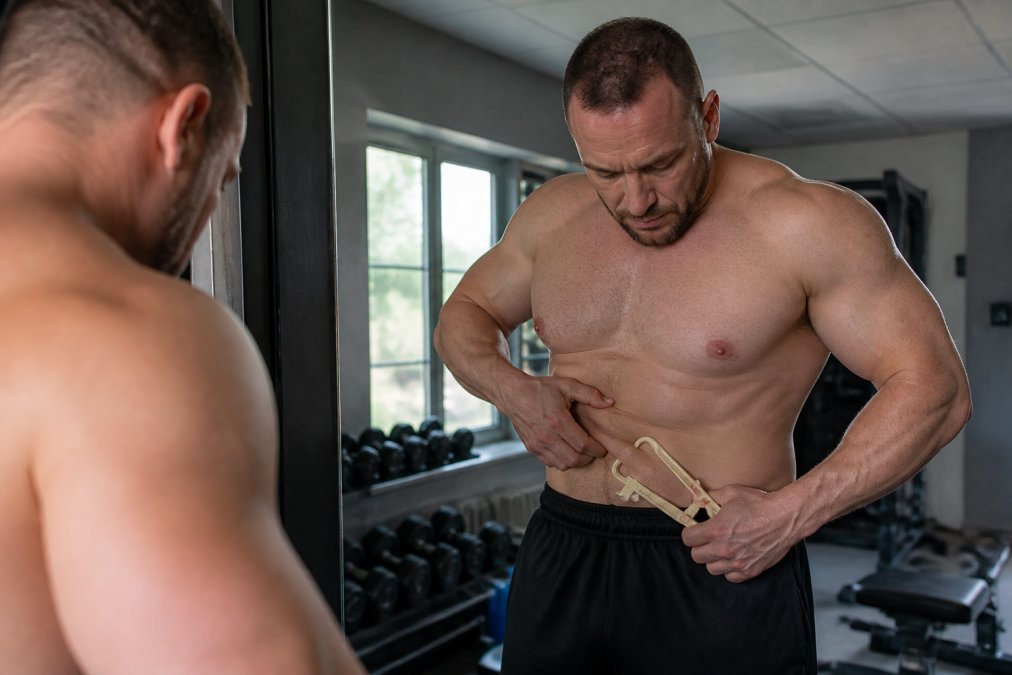
The key to accuracy with a caliper pinch test is consistency. Measure the same sites, on the same side of your body, at the same time of day, and ideally with the same person taking the measurement. Pinch the skin and fat layer firmly, pull it away from the muscle, place the caliper jaws about half an inch from your fingers, and read the value after two seconds. Take each site three times and use the average.
For men, the standard 3-site protocol measures the chest, abdomen, and thigh. For women, it measures the triceps, suprailiac, and thigh. The 7-site protocol adds the triceps, subscapular, and midaxillary for men, providing a more complete picture but requiring more practice. Whichever protocol you choose, never switch protocols mid-tracking. Your numbers will only be comparable if your method stays identical.
The U.S. Navy method uses circumference measurements and predictive equations to estimate body fat percentage, requiring nothing more than a flexible tape measure and a calculator. For men, you measure the neck and waist; for women, you measure the neck, waist, and hip. The measurements feed into a formula that estimates body density, which then converts to a body fat percentage. Tools like the U.S. Navy method use these circumference measurements to estimate body fat through validated predictive equations, as documented by body fat calculator methodology.
The appeal here is simplicity. You don't need equipment beyond a tape measure, and the protocol takes under five minutes. The trade-off is precision. Circumference-based methods are estimates, and they lack the precision of clinical-grade tools like hydrostatic weighing or DXA scans, a limitation acknowledged even by proponents of home-based methods in Healthline's analysis of body fat measurement accuracy.
For tracking trends over time, the Navy method works fine, provided your tape placement is consistent. Measure the neck at its smallest point, the waist at the navel for men or the narrowest point for women, and the hip at its widest point. Pull the tape snug but not tight enough to compress the skin.
Bioelectrical impedance analysis sends a low-level electrical current through your body and measures how quickly it travels. Muscle, which is mostly water, conducts electricity well. Fat, which is not, resists it. The scale uses that resistance to estimate your body fat percentage. This is the technology behind the bathroom scales that claim to measure body fat, and it is one of the most commonly employed methods for body composition assessment in modern research, according to ScienceDirect's review of body composition standards.
The accuracy of bioelectrical impedance scales depends heavily on hydration status. If you're dehydrated, the current travels slower and the scale overestimates body fat. If you're bloated or just finished a workout, it underestimates. The fix is to measure under identical conditions every time: same time of day, same hydration state, ideally first thing in the morning after using the bathroom. When used this way, BIA scales provide a reliable trend line even if the absolute number is slightly off.
| Method | Equipment Cost | Time Required | Accuracy | Best For |
|---|---|---|---|---|
| Skinfold Calipers | $10-$50 | 5-10 min | High (with practice) | Consistent home tracking |
| U.S. Navy Tape Method | $5 | 3-5 min | Moderate | Quick estimates, no equipment |
| BIA Scales | $30-$200 | 1 min | Moderate | Daily trend tracking |
| DXA Scan | $100-$200 per scan | 15 min | Highest | Periodic clinical benchmarks |
To make your calculated body fat percentage meaningful, you need to know what it actually looks like in the mirror. Here's the chart, plus a descriptive visual guide so you can sanity-check your numbers against what you see.
First, the data. Healthy body fat ranges shift with age because essential fat requirements and hormonal profiles change over time. For men, essential fat sits around 2-5%, athletes typically range from 6-13%, fitness enthusiasts fall between 14-17%, and anything above 25% is considered obese. For women, essential fat is higher at 10-13%, athletes range from 14-20%, fitness levels sit between 21-24%, and above 32% is classified as obese. These age-adjusted standards exist because body fat distribution and healthy ranges differ across age groups, a factor researchers controlled for when comparing body fat assessment methods across adults aged 18-34, 35-54, and 55 and older in the 2024 PMC comparison study.
Use this descriptive guide to validate your caliper or scale readings. If your numbers say one thing but the mirror says another, your measurement protocol is off.
Men:
Women:
These ranges describe general health categories, not aesthetic or performance goals. A competitive bodybuilder at 5% body fat sits below the 'essential fat' threshold for the general population, yet that's exactly where they need to be on show day. Use the chart as a health benchmark, not as the final word on your physique goals.
Every home method carries measurement error, and the difference between methods can be several percentage points. The solution is not to chase the most accurate tool, but to standardize your protocol so your measurements are comparable over time. Measurement error mitigation comes down to controlling three variables: time of day, hydration status, and measurement technique.
Set a specific day and time each week for your measurement. First thing in the morning, after using the bathroom and before eating or drinking, is the most reliable window. Log every reading in a spreadsheet or notes app, along with your scale weight and waist circumference, so you can see trends rather than reacting to single data points. Consistent monitoring matters more than which method you choose, because the trend line tells you whether your nutrition and training are working. If you want to double check your math or compare methods, our FREE TOOLS & FITNESS CALCULATORS can help you crunch the numbers without the guesswork.
The biggest errors in home body fat tracking come from inconsistent technique, not the equipment itself. You can buy a $200 BIA scale and still get garbage data if you step on it after a workout. You can buy a $15 pair of calipers and get clinic-level accuracy if you follow a strict protocol. Here's how to stop sabotaging your own data.
1. Time of Day (The Non-Negotiable)
Your body fat percentage can swing by 2-3 percentage points over the course of a single day. In the morning, you're dehydrated and glycogen-depleted, which makes you read leaner. By evening, after meals and water intake, you're holding more fluid, which skews the reading. The fix is absolute: measure first thing in the morning, after using the bathroom, before eating or drinking anything. No exceptions. If you measure at 7 AM one week and 7 PM the next, your data is worthless.
2. Hydration Status (The BIA Killer)
Bioelectrical impedance analysis works by sending a current through your body. Water conducts electricity; fat resists it. If you're dehydrated, the current travels slower, and the scale overestimates your body fat. If you're overhydrated, it underestimates. A 2024 comparison study published through the National Center for Biotechnology Information noted that hydration status is one of the most significant sources of error in BIA measurements. The fix: measure at the same hydration state every time. Don't chug a gallon of water before your weekly measurement to 'look leaner', you'll only fool yourself.
3. Skin Temperature (The Overlooked Variable)
If you measure your skinfold thickness after a hot shower, your skin is vasodilated and slightly swollen, which can add a millimeter or two to your pinch. If you measure after a cold workout, your skin is vasoconstricted and tighter, which can shave off a millimeter. The fix: measure in a neutral state. Don't exercise, shower, or sit in a sauna for at least two hours before your measurement.
4. Food Intake (The Bloating Factor)
A large meal, especially one high in sodium or carbohydrates, can cause water retention that skews both circumference measurements and BIA readings. The fix: measure fasted. If you must measure later in the day, do it at least four hours after your last meal.
Tracking your body fat can become an obsession. When you measure daily, you're chasing noise, not signal. Your body fat percentage doesn't change meaningfully in 24 hours. Daily fluctuations are water, glycogen, and measurement error. Obsessing over these daily swings leads to frustration, anxiety, and eventually, abandoning your protocol entirely.
A common pattern is what sports psychologists call 'body checking', the compulsive urge to measure, pinch, or evaluate your physique multiple times a day. This behavior is linked to negative body image and can even contribute to disordered eating patterns. The fix is to set boundaries. Measure once per week, on the same day, at the same time. Log the number and move on. Don't pinch your stomach in the mirror every morning. Don't step on the BIA scale after every workout. Weekly measurements give you a clear signal without the noise.
Another mistake is switching methods mid-tracking. If you start with a BIA scale and switch to calipers three weeks later, you'll see a phantom change in body fat percentage that reflects the method difference, not actual fat loss. Pick one method and commit to it for at least eight weeks before you consider changing. The trend line over months is what matters, not the single data point on any given day.

No home method will match the precision of a DEXA scan, which remains the clinical gold standard for measuring body fat. But you don't need clinical precision to track progress. You need consistency. Pick the method that fits your budget and lifestyle, measure under identical conditions every week, and log the results. Over eight to twelve weeks, the trend will tell you exactly whether your training and nutrition are working.
At Tiger Fitness, we back up our training advice with free tools and fitness calculators to help you track your progress, and our supplement stacks are designed to support fat loss and lean muscle gains when your diet and training are dialed in. Get started with Tiger Fitness and take the guesswork out of your transformation.
For men, 30% body fat sits above the healthy range of 8-20% for athletes and 10-25% for general fitness. For women, 30% falls at the upper limit of the acceptable range. At 30%, you're carrying excess fat that increases health risks like cardiovascular disease and metabolic issues. The U.S. Navy method and skinfold calipers can confirm your exact percentage. If you're at 30%, focus on a moderate calorie deficit and resistance training to bring it down gradually.
Bioelectrical impedance scales have an accuracy variance of roughly 3-8% compared to DEXA scans, the clinical gold standard. Their accuracy depends heavily on hydration levels, food intake, and time of day. To improve results, measure at the same time daily, ideally in the morning before eating or drinking, and after using the bathroom. While not perfect, these scales excel at tracking trends over time. Consistent monitoring matters more than the absolute number.
Skinfold calipers with the 7-site protocol offer the best accuracy to cost ratio for home use, with a standard deviation of about 3-4% when performed correctly. The key is having someone experienced take the measurements and repeating them at the same sites each time. Alternatively, combining waist circumference measurements with weekly scale weight gives you a solid trend without complex equipment. Pick one method and use it consistently under the same conditions every time.
Yes, for most fitness goals. Scale weight can't distinguish between muscle gain and fat loss. A 180-pound person at 15% body fat looks and performs completely differently than a 180-pound person at 25% body fat. Tracking body fat percentage tells you whether you're actually losing fat or just dropping water weight. The BSL Elite Cutting Stack and other fat burners work best when you can verify their effectiveness through body composition changes rather than scale weight alone.
{"one"=>"Select 2 or 3 items to compare", "other"=>"{{ count }} of 3 items selected"}


Leave a comment