
Pick This Year's Olympia T-Shirt

Last Updated: September 11, 2026
Serving size is the foundation of how to read supplement nutrition labels, and it is the number most people skip. The FDA's 2,000-calorie reference for % Daily Value has nothing to do with what is in the bottle in your hand.
Here is the trap: a serving size is not one scoop, one capsule, or one packet. It is whatever the manufacturer decides to print. One brand's "serving" might be two scoops, another half a scoop. Same tub, wildly different math.
That matters because every number on the panel is tied to that serving. If you take two scoops and the label says one, you just doubled your calories, your sodium, and your caffeine.
The Supplement Facts panel is the boxed grid on the back of the bottle, with a fixed layout. Ingredients are listed in descending order by weight, amounts per serving in the right column, % Daily Value on the far right.
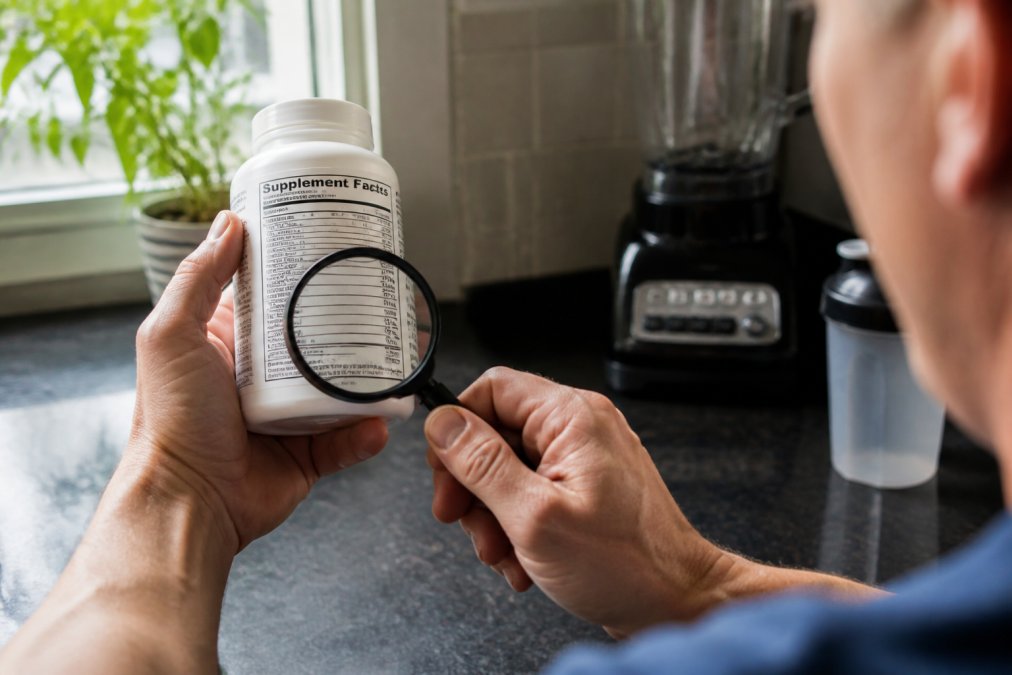
Read it in this order:
Percent Daily Value is how much of a nutrient one serving provides relative to the daily recommendation for an average adult. The FDA considers less than 5% DV to be low for a nutrient (FDA guidance on interpreting % Daily Value, 2024).
For a fast read, the Environmental Working Group recommends a "speed-reading" approach that focuses on just three metrics: the percent daily value of saturated fat, sodium, and added sugar (EWG guide to speed-reading nutrition labels, 2026). Those three tell you more about a product's overall quality than the entire rest of the panel.
Active ingredients have a claimed physiological effect: creatine monohydrate, caffeine, beta-alanine, vitamin D3.
Inactive ingredients are everything else, fillers, flow agents, capsule material, dyes, sweeteners. They do not drive the benefit, but they drive how the product mixes, tastes, and sits in your stomach.
Here is the practical split. If an active ingredient is dosed below its effective range, the product is decoration. If an inactive ingredient triggers digestive issues for you, the product is a problem regardless of how good the actives look.
The FDA regulates supplement labels under a framework different from food. A label must carry the words "Dietary Supplement," a Supplement Facts panel, a complete ingredient list, net quantity of contents, and the manufacturer or distributor's name and address.
What it does not require is pre-market approval. Supplements go to market without the FDA signing off on them first. That single fact explains why label literacy matters more here than in almost any other aisle.
This is where most people get fooled.
A structure/function claim describes how a nutrient affects normal body function, "supports muscle protein synthesis," "helps maintain healthy immune function." These need no FDA pre-approval but must carry a disclaimer that the product is not intended to diagnose, treat, cure, or prevent any disease.
A health claim links a nutrient to a specific disease outcome. Those require FDA authorization and are rare on supplement labels.
If a label implies a disease cure without the disclaimer, that is a red flag, not a marketing quirk.
Proprietary blend meaning is simple: a group of ingredients listed by total weight with no individual amounts disclosed. One number for the blend, a list of names underneath. Legal under FDA rules, and where underdosing hides in plain sight.
Here is the part nobody else explains. You can do the math yourself and catch a weak formula before you buy it.
Fairy dusting is when a label lists a headline ingredient, citrulline, betaine, creatine, but the dose is so small it does nothing. The blend is the cover. How to smoke it out:
No lab coat required. If a pre-workout lists a 6-gram blend with citrulline, beta-alanine, caffeine, taurine, tyrosine, and theanine, the citrulline is almost certainly under 2 grams. You got a stimulant bomb and a weak pump. The label told you without telling you.
Not every blend is a scam. A blend is legitimate when the total weight is large enough that even the smallest ingredient clears its effective dose, when it is a flavor system rather than the actives, or when the brand publishes a COA showing the breakdown anyway.
My rule: if a performance ingredient matters to you, buy from a brand that discloses the dose. Full stop. If they will not show you the number, they are telling you the number is embarrassing.
Third-party supplement testing means an independent lab, unaffiliated with the manufacturer, verifies what is actually in the bottle. It is the only real check against underdosing, contamination, and fraud. Everyone says 'look for a seal', almost nobody tells you how to verify it. Here is how.

A COA is the lab report from a tested batch. A real one includes:
If any of those are missing, the COA is marketing material, not documentation.
Not all seals are equal. The ones with real testing behind them include:
A generic 'Lab Tested' badge with no certifying body behind it is a graphic, not a certification. Ask who tested it and what they tested for.
The NIH maintains the Dietary Supplement Label Database, which aggregates label data so researchers can track ingredient trends and composition over time (NIH Dietary Supplement Label Database). It is a research tool, not a certification, but it shows how much variation exists across products with near-identical labels. Use it to compare what brands claim, not to verify what is in the bottle.
Allergen declaration is mandatory when a major allergen is present. The nine major allergens are milk, eggs, fish, shellfish, tree nuts, peanuts, wheat, soybeans, and sesame.
Contaminants are a different story. Heavy metals, banned stimulants, and undeclared pharmaceuticals have all been found in supplements. The label will not tell you. Testing will.
Two things to check every time:
| Step | What to Check | Why It Matters |
|---|---|---|
| 1 | Serving size and servings per container | Prevents doubling your dose by accident |
| 2 | %DV for saturated fat, sodium, added sugar | Fast read on overall quality (EWG, 2026) |
| 3 | Active ingredient doses | Underdosed actives mean no results |
| 4 | Proprietary blends | Undisclosed doses hide weak formulas |
| 5 | Third-party testing and COA | Verifies what is actually in the bottle |
| 6 | Allergen statement and lot number | Safety and traceability |
That is the whole process. Sixty seconds, six checks, and you will out-read 90% of the people standing next to you in the supplement aisle.
If you want products that already pass this test, Tiger Fitness stocks labels that disclose doses and carry batch documentation. We also publish free fitness tools and calculators at Tiger Fitness fitness tools and calculators to help you dial in your actual intake instead of guessing.
Reading a supplement label is not complicated, but it is unforgiving. Skip the serving size and you misjudge your calories. Skip the blend and you pay for filler. Skip the testing and you roll the dice on what is actually in the bottle.
We back every order with fast shipping and personalized customer service, and our rewards program gives you real savings on repeat purchases. Start with the label, then let us handle the rest.
The Nutrition Facts label is for conventional foods and beverages, while the Supplement Facts label is specifically for dietary supplements. The Supplement Facts panel must list dietary ingredients, their amounts per serving, and the percent Daily Value for vitamins and minerals. It also includes a 'Serving Size' and 'Servings Per Container' just like food labels, but the format and required information differ. According to the FDA, the Supplement Facts panel is designed to help you understand what's in the product and how it fits into your overall diet.
Look for the term 'Proprietary Blend' on the Supplement Facts panel. It will be listed as a single ingredient with a total milligram amount, followed by a list of individual ingredients in parentheses. The problem is that the exact amount of each ingredient is not disclosed. This means you can't verify if the effective dose of any single component is present. If you see a proprietary blend, be skeptical. A transparent label will list each ingredient and its specific amount in milligrams or micrograms.
The FDA requires that a dietary supplement label include a Statement of Identity (what the product is), a net quantity of contents, a Supplement Facts panel, an ingredient list (both dietary and non-dietary), and the name and place of business of the manufacturer, packer, or distributor. It must also include directions for use and any cautions. The FDA does not approve supplements before they are marketed, so it's up to you to read labels carefully. For more details, check the FDA's official guidance on dietary supplement labeling.
The serving size tells you the amount of the product that provides the listed nutrients. It's not a recommendation of how much you should take; it's a standardized amount used for labeling. If you take more or less than the serving size, you're getting more or less of each ingredient. For example, if a protein powder serving is one scoop and you use two, you're doubling the calories, protein, and any added sugars. Always compare your actual intake to the serving size to avoid over- or under-dosing.
{"one"=>"Select 2 or 3 items to compare", "other"=>"{{ count }} of 3 items selected"}






Leave a comment