







HOW TO READ A SUPPLEMENT CERTIFICATE OF ANALYSIS
How to Verify Protein Supplement Lab Reports
Table of Contents
- Why Verifying Protein Supplement Lab Reports Matters
- Understanding the Protein Powder Certificate of Analysis
- How to Read a Supplement Certificate of Analysis
- Protein Powder Heavy Metal Testing: What to Look For
- Supplement Batch Number Verification and Product Matching
- Verifying Laboratory Accreditation and Independence
- What to Do When a Lab Report Is Missing, Outdated, or Fails
- Frequently Asked Questions
Last Updated: October 15, 2026
Why Verifying Protein Supplement Lab Reports Matters
Most lifters don't verify protein supplement lab reports. They buy based on marketing claims and hope the product delivers what the label says. That's a gamble you shouldn't take.
Testing of 23 popular protein powders and shakes found that most contained high levels of lead (Consumer Reports protein powder testing). The Clean Label Project analysis reported that 47% of tested protein powders exceeded its safety criteria, with arsenic, cadmium, lead, and mercury detected across samples.
Here's the reality: protein powder labels can be misleading. Some products contain less protein than advertised. Others harbor contaminants that accumulate with regular use.
This guide shows you how to verify protein supplement lab reports, spot red flags, and confirm that what you're buying matches what's on the label.
Understanding the Protein Powder Certificate of Analysis
A certificate of analysis (CoA) is a third-party lab report that verifies a product's contents. It tests for protein quantity, amino acid profiles, and contaminants like heavy metals. Not all supplements come with one, that's your first warning sign.
A legitimate CoA shows:
- Product name and batch number
- Test date and expiration date
- Protein content measured in grams
- Amino acid breakdown
- Heavy metal screening results
- Lab name, accreditation, and contact info
The report answers one core question: Does this product contain what the label claims, and is it safe to consume?
What a Certificate of Analysis Must Show
The document should list the product tested, the batch number, and the date the test was performed. Without these, you can't match the report to the actual product in your hand. A report for "Whey Protein Isolate" tested six months ago tells you nothing about the container you bought last week.
Protein content is the centerpiece. The CoA states grams of protein per serving, measured through laboratory analysis. This number should match the nutrition label within a small margin. If the label claims 25 grams and the lab found 22 grams, that's acceptable variation. If it found 18 grams, that's a problem.
Amino acid analysis breaks down the specific amino acids present. This matters because some manufacturers spike their products with cheap amino acids to inflate protein numbers without using actual protein. A complete amino acid profile prevents this deception.
Heavy metal screening tests for lead, cadmium, arsenic, and mercury. These accumulate in your body over time. The report should show the level detected (in parts per million or ppb) and state whether it falls within acceptable limits.
Red Flags in a Certificate of Analysis
Missing batch numbers mean you can't verify the report matches your product. Different batches can have different results. A report without a batch number is useless.
Test dates older than six months raise questions. Supplements degrade. A report from 2025 doesn't tell you about the product manufactured in 2026. Ask the brand for current testing.
Vague language like "meets standards" without specific numbers is a dodge. You need actual measurements: "18 ppm lead" not "acceptable lead levels."
Missing heavy metal testing is a red flag. If the CoA doesn't include screening for lead, cadmium, arsenic, and mercury, the brand skipped this step. That's either cost-cutting or they're hiding something.
Lab accreditation matters. The testing facility should hold ISO 17025 certification or equivalent. This means the lab meets international standards for accuracy and reliability. Unknown labs with no credentials prove nothing.
How to Read a Supplement Certificate of Analysis
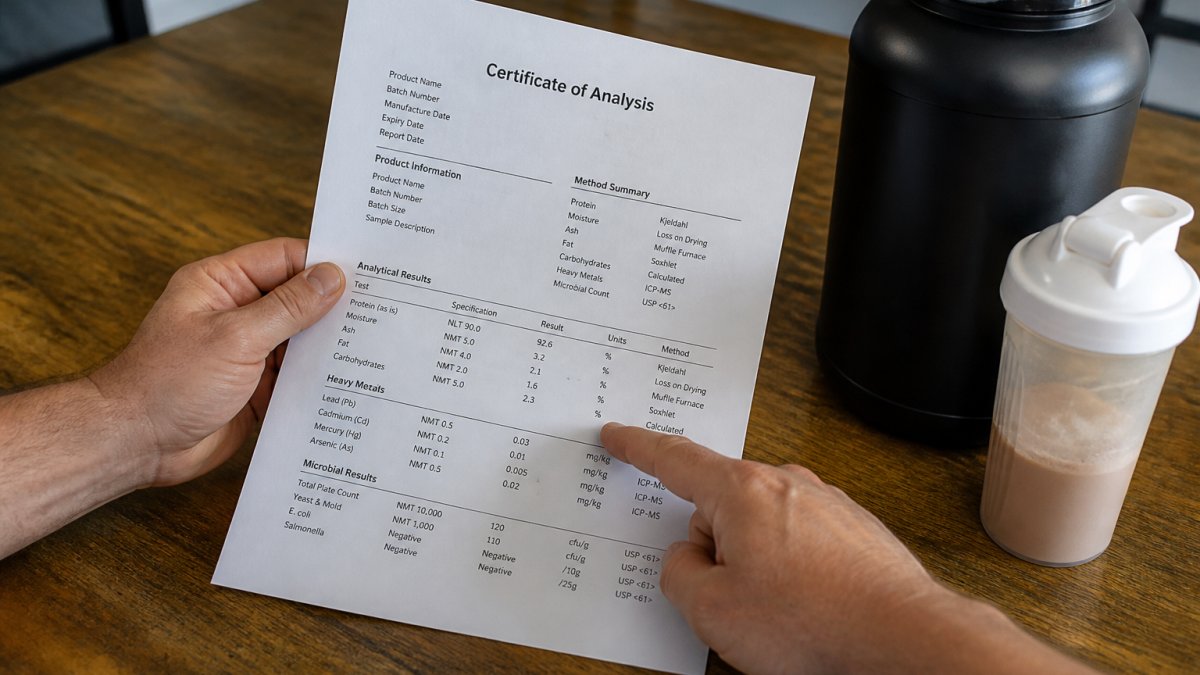
Start with the header. Confirm the product name matches what you bought. Check the batch number on your container against the report. If they don't match, the report isn't for your product.
Look at the test date. It should be recent, within the last three to six months. Older reports don't reflect current manufacturing.
Find the protein content section. This is labeled "crude protein" or "total protein" on most reports. The number should be in grams per serving. Compare it to the nutrition label on your container.
Locate the amino acid profile. Look for all nine essential amino acids listed with their quantities in grams or milligrams. Leucine, isoleucine, and valine (the BCAAs) should be prominent if the brand markets these.
Check the contaminant section. This shows levels of heavy metals detected. The report should state whether each result is "within acceptable limits" or "passed" the test. If any contaminant shows a concerning level, that's a deal-breaker.
Protein Content and Label Accuracy
The protein content on the lab report should match the nutrition label within 10%. If the label claims 25 grams per scoop and the lab measured 22.5 grams, you're within range.
Anything beyond that spread suggests either poor quality control or intentional mislabeling. A label claiming 25 grams but testing at 20 grams means you're getting 20% less protein than advertised. Over months of use, that adds up.
Some brands list protein ranges on labels, "20-25g per serving", to account for natural variation between batches. This is honest. A specific number like "25g" with no range should match the lab report closely.
Watch for amino spiking. This occurs when manufacturers add free amino acids to boost the total protein number without using actual protein. A complete amino acid profile prevents this deception. If the amino acid breakdown adds up to less than the stated protein content, something's off.
Understanding Acceptable Variation and Measurement Uncertainty
Lab testing isn't perfect. Every measurement has uncertainty built in. The HPLC method used to measure protein has a margin of error, typically ±5% to ±10%.
This means if a product contains 25 grams of protein, the lab might measure anywhere from 22.5 to 27.5 grams depending on sampling and technique. This variation is normal and expected.
The key is consistency. If one batch tests at 25 grams and another at 18 grams, that's not measurement uncertainty, that's quality control failure. Reputable brands show tight clustering around their claimed value across multiple batches.
Some labs note their acceptable range on the report. This reflects their specific testing method and equipment. A ±10% variation standard means 25 grams could legitimately be 22.5 to 27.5 grams.
Protein Powder Heavy Metal Testing: What to Look For
Heavy metals accumulate in your body. Lead, cadmium, arsenic, and mercury don't leave your system quickly. Repeated exposure through contaminated supplements adds up over months and years.
The CoA should list results for all four metals. Each should show a number in parts per million (ppm) or parts per billion (ppb). The report then states whether that level is acceptable.
NPR's analysis of Consumer Reports findings notes that detected contaminants present a concern primarily with repeated high exposure. A single serving with trace lead is unlikely to harm you. Daily consumption of contaminated protein for years is a different story.
Common Contaminants and Safe Exposure Levels
Lead is the primary concern in protein powders. It accumulates in bones and organs. The report should show lead levels well below 2 ppm for dietary supplements. Many quality brands test below 0.5 ppm.
Beverly International UMP Ultimate Muscle Protein →
Cadmium is another heavy metal that accumulates. It damages kidneys and bones. Look for results below 0.5 ppm. Some brands achieve levels below 0.1 ppm.
Arsenic appears in some plant-based proteins and whey from certain regions. The report should show arsenic below 0.3 ppm. Quality brands often test below 0.1 ppm.
Mercury is less common in protein powders but still tested. Results should be below 0.05 ppm. Most quality products show undetectable levels.
The specific acceptable limits vary by testing standard and organization. What matters is that the report shows actual numbers and states whether they pass or fail. If the report says "acceptable" without listing the actual measurement, that's vague and unhelpful.
Supplement Batch Number Verification and Product Matching
Every supplement batch gets a unique identifier. This batch number appears on your container's label. It also appears on the certificate of analysis.
Match them. If your container says "Batch 2026-0847" and the CoA says "Batch 2026-0851," the report isn't for your product. Different batches can have different contamination levels or protein content.
Brands that test every batch publish batch-specific results. You enter your batch number on their website and pull up the exact report for your product. This is the gold standard.
Brands that test only representative batches should state this clearly. They're saying "we tested this batch and assume others are similar." This is less rigorous but acceptable if the brand has consistent quality control.
If a brand won't provide batch-specific testing or even tell you which batch was tested, move on. That's a sign they're not serious about transparency.
Verifying Laboratory Accreditation and Independence
A logo on a CoA means nothing. A lab can print "ISO 17025" on a PDF and most people will never check. Here's how to actually verify it, and why scope matters more than the certificate itself.
What ISO/IEC 17025 Actually Covers
ISO/IEC 17025 is the international standard for testing and calibration laboratories. It's the benchmark for competence, impartiality, and consistent operation. But here's the part brands hope you skip: accreditation is granted per method, per analyte, per matrix.
That means a lab can be accredited for heavy metals in water and not accredited for protein content in a powdered supplement. The certificate is real. The scope just doesn't cover what you're looking at.
So when you see "ISO 17025 accredited" on a CoA, the real question is: accredited for what?
How to Check Accreditation Scope
In the U.S., the primary accreditation bodies are recognized through NIST's National Voluntary Laboratory Accreditation Program (NVLAP) and the ANSI National Accreditation Board (ANAB). Both publish searchable directories of accredited labs and their scopes.
Here's the workflow:
- Get the lab's full legal name from the CoA, not a trade name, the legal entity.
- Search the accreditation body's directory for that exact name.
- Pull the scope document. It will list specific methods (e.g., ICP-MS for heavy metals, Kjeldahl or Dumas for protein, HPLC for amino acids).
- Confirm the method on the CoA matches a method in the scope.
- Confirm the matrix, "dietary supplements" or "protein powders", is listed, not just "food" or "water."
If the lab isn't in the directory, or the scope doesn't cover the test, the accreditation claim is decoration.
Watch Out A CoA that says "ISO 17025" with no accreditation body named, no certificate number, and no scope reference is unverifiable. Treat it as marketing, not evidence.
Method Validation and Detection Limits
Accreditation tells you the lab is competent. Method validation tells you the specific test is fit for purpose. Look for these on the CoA or in the lab's technical documentation:
- Limit of Detection (LOD): The lowest concentration the method can reliably detect. If the LOD for lead is 0.5 ppm and the result reads "<0.5 ppm," the lab is telling you it can't see below that line. That's not the same as "zero."
- Limit of Quantification (LOQ): The lowest concentration the method can reliably measure with acceptable precision. Results below LOQ should be reported as "<LOQ," not as a hard number.
- Recovery and precision data: Validated methods report spike recovery (usually 80-120%) and relative standard deviation (RSD). If a lab won't share this, the method is unproven.
A CoA that reports "lead: not detected" without stating the LOD is telling you nothing. Not detected at 0.01 ppm is a very different story than not detected at 5 ppm.
Independence: Who Owns the Lab?
A third-party lab is only third-party if it has no financial relationship with the brand. Watch for these patterns:
- In-house labs: The brand owns the facility. Results are self-reported. Not automatically fraudulent, but not independent.
- Captive labs: A parent company owns both the brand and the lab. Same problem, harder to spot.
- Contract labs: Independent facilities paid per test. This is the standard. Payment for a test is not a conflict; ownership is.
The CoA should list the lab's legal name, physical address, phone number, and a report or certificate number you can reference. Call them. Ask: "Did you test batch [X] for [brand] on [date]?" A real lab will confirm or deny. A fake one won't pick up.
Key Takeaway Accreditation without scope is a logo. Scope without method validation is a promise. Method validation without independence is a conflict of interest. You need all four to trust a CoA.
What to Do When a Lab Report Is Missing, Outdated, or Fails
Most guides stop at "don't buy it." That's not helpful if the tub is already in your kitchen. Here's the actual playbook, broken down by scenario.
Scenario 1: The Brand Won't Share a CoA
If a brand claims third-party testing but won't hand over the document, you have three moves:
- Ask specifically. "Please send the CoA for batch [number on your tub], including heavy metals, protein content, and amino acid profile." Vague requests get vague answers. Specific ones get specific answers, or expose the gap.
- Check their website. Many brands post batch-specific CoAs in a searchable portal. If they have one, use it. If they claim to have one and it doesn't work, screenshot it.
- Walk. No CoA, no sale. There is no legitimate reason a brand can't produce a document it already paid a lab to generate.
Scenario 2: The CoA Is Outdated
"Outdated" needs a definition. A CoA from 18 months ago for a product you bought last week is stale. A CoA from three months ago for a product with a two-year shelf life is fine.
The rule: the CoA should be dated on or after the manufacture date of your specific batch. If the report predates your batch, it's not your batch's report.
If the brand only tests annually, ask which batch was tested and whether your batch falls within the tested production window. If they can't answer, that's your answer.
Scenario 3: The CoA Shows a Failure
"Failure" means different things depending on the test:
- Protein content below label claim by more than the allowed tolerance: Under FDA labeling rules, protein content is generally expected to meet or exceed the label declaration, with enforcement tolerances applied. A 25 g claim testing at 20 g is a real problem. A 25 g claim testing at 23 g is within normal analytical and manufacturing variation.
- Heavy metals above a published limit: Compare against the specific standard the CoA cites, not a generic "acceptable" stamp. If the CoA doesn't cite a standard, ask which one was used.
- Microbial failure (Salmonella, E. coli, Listeria): This is a hard stop. Do not consume. Contact the brand and, if they don't respond, report it through the FDA's MedWatch or Safety Reporting Portal.
Scenario 4: The Product Is Already in Your Hands
If you've already bought a tub and the CoA is missing, stale, or shows a failure:
- Stop using it until you resolve the question. A few days off protein powder won't cost you gains.
- Contact the retailer first. Most major U.S. retailers accept returns on opened supplements within a stated window if the product is defective or misrepresented. Keep the tub, the label, and the CoA (or lack thereof) as evidence.
- Contact the brand directly with the batch number and your concern in writing. Email creates a paper trail.
- If the brand stonewalls, file a complaint with the FTC for deceptive advertising or the FDA for a safety issue. Both agencies track patterns even when they don't act on a single complaint.
Pro Tip Keep a folder, physical or digital, with the CoA, purchase receipt, and batch number for every protein you buy. If a recall or a bad test result surfaces later, you'll know in seconds whether your tub is affected. You can also use FREE TOOLS & FITNESS CALCULATORS to track your supplement intake and correlate it with your training and nutrition data, giving you another layer of accountability for what goes into your body.
The Decision Framework
When you're staring at a CoA that's borderline, run it through this filter:
| Situation | Action |
|---|---|
| No CoA available, brand won't provide one | Don't buy. Don't rebuy. |
| CoA exists but predates your batch | Request batch-specific report. If refused, return. |
| Protein content within tolerance, metals below cited limits | Fine. Keep using. |
| Protein content materially below label | Return. Report to FTC if brand won't remedy. |
| Metals above cited limit | Stop use. Contact brand and FDA. |
| Microbial failure | Stop use immediately. Contact brand and FDA. |
That's it. No guessing. No "well, it's probably fine." You either have the data or you don't, and if you don't, you vote with your wallet.
Frequently Asked Questions
What should a protein supplement lab report include?
A legitimate protein supplement lab report must show the tested product's batch number, test date, protein content measured by the laboratory, amino acid profile, and screening results for heavy metals (lead, cadmium, arsenic, mercury). It should list the testing method used (such as HPLC or nitrogen analysis), the laboratory's contact information, and whether the lab is accredited. The report must match the product you purchased by batch number and clearly state whether results passed or failed the lab's acceptance criteria.
How do I verify a certificate of analysis for protein powder?
First, match the batch number on the certificate to the batch number printed on your protein powder container. Check the test date, reports older than 12 months may not reflect current product quality. Verify the laboratory's name and contact details are legitimate by visiting their website independently (don't use links provided on the product page). Confirm the protein content listed in the report is within acceptable variation of the label claim (typically ±10%). Finally, check that the report includes testing for heavy metals and lists specific results, not just a pass/fail statement.
Does a protein powder lab report show heavy metals and contaminants?
A comprehensive protein powder lab report should include screening for lead, cadmium, arsenic, and mercury. However, not all labs test for all contaminants, and testing standards vary. The presence of a contaminant in a lab report doesn't automatically mean the product is unsafe, exposure level and frequency matter. Look for reports that specify the measured amount of each contaminant, not just a yes/no result, so you can evaluate the actual levels detected.
How can I confirm that a lab report matches the product I bought?
The batch number is your primary verification tool. Every protein powder container has a batch or lot number printed on the label or bottom of the tub. The certificate of analysis must display the exact same batch number. Cross-check the product name, flavor, and container size listed on the report against your actual product. If the batch numbers don't match, the report is not valid for your specific purchase. Some brands provide searchable databases where you can enter your batch number to find the matching test results online.
Leave a comment