






Is BCAA Necessary If You Eat Enough Protein? (2026)
If your daily protein total already sits at 1.6 to 2.2 grams per kilogram of bodyweight, BCAA powder is not doing anything a full protein source hasn't already covered. The only scenario where BCAAs earn their spot is training fasted, or filling a gap when a meal is genuinely low in leucine.
TL;DR
- Is BCAA necessary if you eat enough protein? No, once daily intake hits 1.6-2.2g/kg, whole protein already supplies the branched-chain aminos.
- BCAAs are 3 of the 9 essential amino acids; complete protein sources like whey or Machine Whey deliver all 9 plus BCAAs.
- Fasted training, low-leucine meals, and extreme calorie deficits are the real use cases for BCAA supplementation in 2026.
- EAA products generally out-perform standalone BCAA for muscle protein synthesis because they include the other 6 essential aminos BCAA skips.
The numbers that decide this
1.6-2.2g/kg
Daily protein target
ISSN position stand range
2-3g
Leucine needed per meal
to trigger muscle protein synthesis
3 of 9
Essential aminos in BCAA
Why this matters
BCAA sales exploded in the 2010s on the promise of "anti-catabolic" muscle protection, a claim built on studies using subjects in a fasted state with no other protein around. That's not how most lifters in 2026 actually eat. If you're already hitting your protein number from whey, meat, eggs, or a blend like Machine Whey, you're getting leucine, isoleucine, and valine automatically, plus the six other essential aminos BCAA doesn't touch.
The question isn't whether BCAAs "work" in isolation. It's whether they add anything on top of a protein intake that's already dialed in. For most lifters eating enough, they don't.
Is BCAA necessary if you already eat enough protein?
No. Once total daily protein clears 1.6g/kg of bodyweight, and each meal carries roughly 25-40g of a complete protein source, you're already exceeding the leucine threshold (2-3g per meal) needed to kick off muscle protein synthesis. Adding isolated BCAA on top of that intake doesn't move the needle on strength or recovery in any published research showing benefit.
Here's how the three main amino options actually compare when protein intake is already sufficient:
| Option | What it delivers | Best for | Verdict |
|---|---|---|---|
| BCAA (leucine, isoleucine, valine) | 3 of 9 essential aminos | Fasted cardio, flavor variety during a cut | Skip if protein is already high |
| EAA (all 9 essential aminos) | Full amino profile including BCAA | Fasted lifting, low-protein meals | Better value than standalone BCAA |
| Whole protein (whey, Machine Whey, meat, eggs) | All 9 EAAs plus non-essential aminos | Daily protein target, muscle building | Covers BCAA need automatically |
A best BCAA supplement for muscle recovery guide will still tell you which BCAA product ranks highest on paper. What it won't tell you is that ranking barely matters once your protein total is already covered.
When eating enough protein makes BCAA redundant
If you're consistently hitting 1.6-2.2g/kg of bodyweight in total daily protein, spread across three or more meals, BCAA supplementation is functionally redundant. Every gram of whey, chicken, or egg you eat already contains leucine, isoleucine, and valine in ratios similar to or better than most BCAA powders.
Verdict: skip BCAA if your protein log already shows 1.6g/kg or higher spread across the day.
When BCAA still earns a spot in your stack
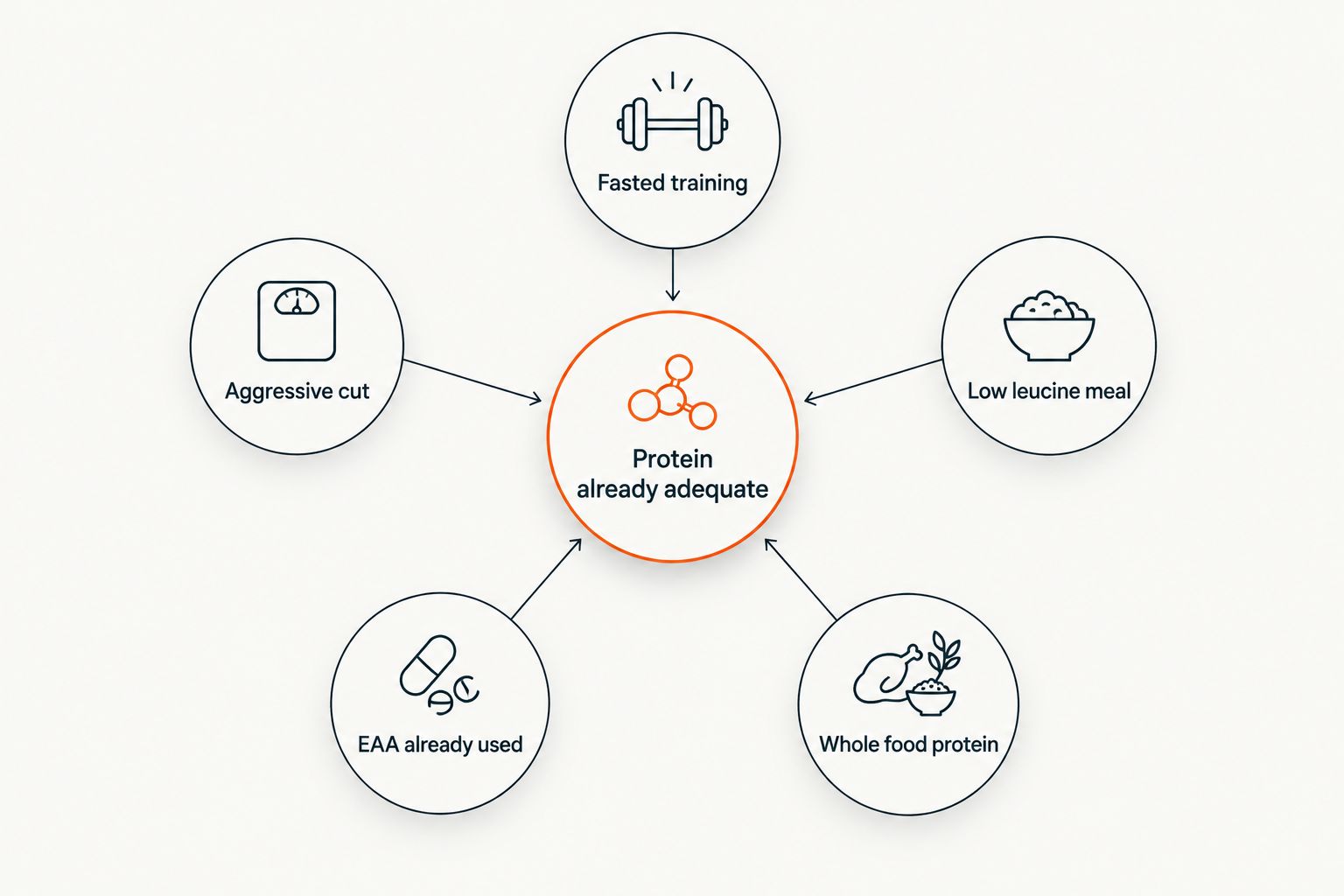
There are three legitimate situations in 2026 where BCAA still makes sense even with adequate total protein:
- Fasted training — no protein in your system for 8+ hours before a lifting session
- Aggressive cuts — protein intake stays high but total calories drop hard enough that intra-workout amino support helps subjective recovery
- Low-leucine meals — a plant-based meal or a small snack that falls under the 2-3g leucine threshold
- Flavor and hydration — some lifters use BCAA/electrolyte blends purely to sip during long sessions, not for the amino content itself
Outside those four cases, the amino acids are already accounted for by your food.
Why the answer varies
Whether BCAA adds anything depends on a handful of factors specific to your diet and training, not a blanket rule:
- Total daily protein — below 1.2g/kg, BCAA won't fix an undersized diet
- Protein source quality — whey and eggs are leucine-dense; some plant proteins run lower
- Training state — fasted sessions change the calculus versus training after a full meal
- Meal timing and spacing — long gaps between meals create windows where BCAA/EAA products fill a gap
- Caloric deficit size — deep cuts increase the argument for intra-workout amino support
- Whether you're already using EAA — EAA supersedes BCAA since it includes the same three aminos plus six more
A lifter eating 180g of protein a day from Machine Whey and whole food doesn't need a BCAA scoop on top of that. A lifter training fasted at 6am on an EAA-free diet is a different conversation entirely.
BCAA options worth stocking for fasted sessions


Related questions
Do BCAAs work if you already drink whey protein shakes?
BCAAs work the same whether or not you drink whey, but adding them on top of a whey shake is redundant since whey already supplies leucine, isoleucine, and valine along with the other six essential aminos. Stacking BCAA powder onto an already-adequate whey intake doesn't produce a measurable extra benefit for most lifters in 2026.
Is EAA better than BCAA when protein intake is already high?
EAA is the better buy when protein intake is high, because it contains all 9 essential amino acids instead of the 3 found in BCAA. If you're going to spend on an amino product despite already eating enough protein, an EAA supplement ranked by amino acid profile gives you more coverage per scoop than a BCAA-only formula.
How much protein is "enough" to skip BCAA entirely?
Hitting 1.6 to 2.2 grams of protein per kilogram of bodyweight daily, spread across three or more meals with roughly 25-40g of complete protein each, is enough to make standalone BCAA supplementation unnecessary. Below that range, especially under 1.2g/kg, no amino supplement fixes an undersized protein intake — you need more total protein, not more BCAA.
FAQ
Is BCAA necessary if you eat enough protein in 2026?
No, if daily protein already hits 1.6-2.2g/kg of bodyweight, BCAA supplementation adds nothing measurable on top of that intake. Whole protein sources already supply leucine, isoleucine, and valine in comparable or better ratios.
What's the best BCAA supplement for muscle recovery if I still want one?
A 2:1:1 leucine-heavy ratio, like the kind found in Kaged BCAA 2:1:1 or Allmax AminoCore BCAA, is the standard recovery-focused formula. Check a best BCAA supplement for muscle recovery breakdown for a full ranked comparison.
Is EAA better than BCAA when protein is already sufficient?
Yes, EAA is better than BCAA once protein intake is sufficient because EAA includes all 9 essential amino acids instead of just 3. BCAA only becomes competitive again during fasted training when convenience and flavor matter more than completeness.
How much protein counts as "enough" to make BCAA unnecessary?
1.6 to 2.2 grams of protein per kilogram of bodyweight daily is the range cited in sports nutrition position stands as sufficient for muscle building. Hitting that consistently makes standalone BCAA supplementation redundant for most lifters.
Do BCAAs help with fat loss during a cut if protein is already high?
BCAAs don't directly burn fat, but during an aggressive cut with high protein already in place, they can support training performance and subjective recovery in a calorie deficit. The effect is modest, not a substitute for the calorie deficit itself.
Can you take BCAA and whey protein together?
Yes, you can take BCAA and whey protein together, but it's redundant once whey already covers your protein target for the day. Most lifters get more value putting that budget toward a complete EAA product or simply more whole protein.
Does training fasted change whether BCAA is necessary?
Yes, fasted training is the clearest case where BCAA or EAA still earns a place even with adequate total daily protein, since there's no protein in your system during the session itself. Outside fasted sessions, adequate total protein already covers the same aminos.
Is it a waste of money to buy BCAA in 2026 if you already eat enough protein?
For most lifters hitting 1.6g/kg or more in total daily protein, yes, standalone BCAA is a lower-value purchase than a complete EAA product or simply more whole protein. It's not a waste for fasted training or low-leucine meal gaps specifically.
One last thing
The detail most BCAA marketing skips: leucine alone doesn't build muscle, it triggers the signal to start protein synthesis, and the other essential aminos have to be present to finish the job. That's the whole reason EAA formulas consistently outperform BCAA-only products in head-to-head comparisons, and it's why checking total daily protein first, before buying any amino powder, is the actual fix for most lifters in 2026.
Leave a comment