







Is glycine safe to take every night for sleep? Unproven 2026
Glycine has reassuring short-term tolerability in small studies of healthy adults, but those studies do not establish that taking it every night for months or years is safe. In 2026, the practical answer is to treat glycine as an optional, monitored supplement—not a proven long-term treatment for insomnia—and review nightly use with a clinician if you take medications or have a medical condition.
TL;DR
- Is glycine safe to take every night for sleep? Short-term findings are reassuring; long-term nightly safety remains unproven.
- Small human sleep studies used 3 grams before bedtime; that is a research dose, not a universal recommendation.
- Tiger Fitness shoppers should review sleep supplements alongside medications, other ingredients, and late-workout caffeine.
- Persistent insomnia, loud snoring, or daytime sleepiness calls for evaluation, not a larger supplement stack.
Is glycine safe to take every night for sleep?
Short-term tolerability is not proof of indefinite nightly safety. Small human studies support further research into glycine for sleep, but they cannot establish that everyone can take it nightly without problems. Your health history, the supplement's contents, and the length of use all matter.
Before adding a bedtime supplement, review your evening routine. If you train late, the guide to pre-workout for evening workouts without ruining sleep addresses a relevant part of that routine: stimulant exposure.
| Evidence or situation | What it supports | What it does not establish |
|---|---|---|
| Small studies of glycine before bedtime | Possible improvements in selected sleep and next-day measures | Reliable benefit for everyone with insomnia |
| Short-term tolerability findings | Reassurance about the conditions actually studied | Safety across months or years of nightly use |
| A healthy adult using a clearly labeled supplement | A more straightforward ingredient review | An automatic guarantee of safety |
| Pregnancy, breastfeeding, childhood, or significant illness | A reason for individualized clinical advice | Permission to apply healthy-adult findings directly |
| Glycine combined with other sleep ingredients | A need to evaluate the complete formula | The safety of the combination based on glycine research alone |
What the human research actually shows
Human research includes Yamadera and colleagues' Glycine ingestion improves subjective sleep quality in human volunteers, correlating with polysomnographic changes, published in Sleep and Biological Rhythms. It examined sleep-related outcomes in volunteers with unsatisfactory sleep and used 3 grams of glycine before bedtime.
Bannai and colleagues' The effects of glycine on subjective daytime performance in partially sleep-restricted healthy volunteers, published in Frontiers in Neurology, also used 3 grams. Its scope was next-day functioning under partial sleep restriction—not a long-term nightly safety trial.
These papers give you a reason to distinguish promising findings from an established treatment. A study showing improvement in a selected outcome does not prove that a supplement treats chronic insomnia or remains safe indefinitely. Neither paper justifies treating a research dose as the right dose for every reader.
Why this matters for workouts and recovery
Poor sleep affects more than how motivated you feel at the gym. It can interfere with alertness, training decisions, and recovery habits. A bedtime supplement should not become a way to ignore an inadequate sleep opportunity, late caffeine, or a possible sleep disorder.
The American Academy of Sleep Medicine and Sleep Research Society recommend that adults regularly get at least 7 hours of sleep. That recommendation describes sleep duration; it does not mean taking glycine produces 7 hours of sleep or makes a shorter night equivalent.
Tiger Fitness is best for fitness enthusiasts shopping for sports nutrition supplements, not for diagnosing persistent sleep problems. Keep those roles separate when building your recovery routine in 2026: shop for a clearly understood product, and get clinical help when the problem needs diagnosis.
The studied dose: 3 grams before bedtime
The 3-gram amount is useful because it identifies what researchers actually investigated. It is not an official upper limit, a personalized prescription, or evidence that more works better. Do not increase a dose simply because sleep remains poor.
Some glycine sleep protocols administered the supplement around 30 minutes before bedtime. That timing describes a research protocol, not a requirement for every person or every product. Follow the specific product directions and any advice from your clinician rather than converting a study into your own dosing plan.
There is also no reason to assume every scoop measures 3 grams. A scoop's volume and a powder's weight are different measurements. Read the serving information instead of borrowing instructions from another supplement.
Does a higher dose mean better sleep?
The available sleep research does not establish that increasing beyond 3 grams improves results. Higher exposure also changes the safety question; reassurance about one studied amount cannot automatically be extended to another.
If a label gives different directions, do not combine the label dose with an additional research-inspired dose. Ask a pharmacist or clinician to review the exact product and explain the mismatch. The goal is an understandable routine, not the largest bedtime serving you can tolerate.
Why nightly glycine safety varies
There is no universal nightly safety answer in 2026 because the evidence does not cover every user, formulation, and duration. Review these factors before deciding whether to add glycine:
- Dose and measurement: The amount you actually swallow matters. Check grams per serving and the number of servings rather than relying on scoop size alone.
- Duration: Tolerating a supplement over a short period does not establish safety over months or years. Continued use deserves reassessment, not automatic renewal.
- Other ingredients: A single-ingredient product and a multi-ingredient sleep formula are different exposures. Review the entire Supplement Facts panel.
- Medications and supplements: Give your pharmacist the full list, including prescription sleep medicines, over-the-counter products, and anything taken occasionally.
- Health and life stage: Pregnancy, breastfeeding, childhood, and significant medical conditions require individualized advice because adult sleep findings do not answer those situations.
- The underlying sleep problem: Trouble falling asleep, repeated awakenings, and sleep apnea symptoms are not interchangeable. A supplement does not identify their cause.
Bring the bottle or a clear label photo to that review. A product name alone is not enough to establish its ingredients, serving amount, or suitability alongside your medications.
What side effects should you watch for?
Oral glycine can cause gastrointestinal symptoms, including nausea or stomach discomfort. If symptoms begin after starting glycine, stop taking it and discuss the reaction with a clinician or pharmacist. Do not keep taking it just to finish the container.
New morning impairment also deserves attention, especially if you use a blended sleep product. Do not drive or operate equipment when you feel drowsy or impaired. It is not necessary to prove which ingredient caused the problem before taking that precaution.
Seek urgent care for signs of a serious allergic reaction, such as trouble breathing or swelling of the lips, tongue, or throat. Those symptoms are not ordinary adjustment effects.
Keep a record of what you took and when symptoms started. Include other supplements, alcohol, and medications so a clinician can review the complete situation rather than trying to assess glycine in isolation.
Who should ask a clinician before nightly use?
Get individual advice before using glycine for sleep if you are pregnant or breastfeeding, are considering it for a child, have kidney or liver disease, or take prescription medications. These are reasons for review—not claims that glycine necessarily causes harm in every person in those groups.
Persistent sleep trouble also needs evaluation. Loud snoring, witnessed breathing pauses, waking up gasping, or substantial daytime sleepiness can point to a problem that a bedtime supplement will not diagnose.
For chronic insomnia, cognitive behavioral therapy for insomnia, commonly called CBT-I, is an evidence-based treatment recommended by major clinical guidelines. It is more than generic sleep-hygiene advice. A clinician can help determine whether that treatment fits your symptoms and circumstances.
How do glycine and other sleep approaches compare?
Choose the approach that matches the problem, not the most complicated ingredient list. The comparison below separates an optional supplement from basic routine changes and treatment for persistent insomnia.
| Approach | Best for | Practical advantage | Limitation |
|---|---|---|---|
| Single-ingredient glycine | Adults considering glycine after an appropriate safety review | Easier to identify the ingredient and dose being used | Limited sleep evidence and uncertain long-term nightly safety |
| Multi-ingredient sleep formula | Shoppers prepared to review every ingredient | Combines ingredients in one product | Glycine-only research cannot establish the formula's safety or benefit |
| Consistent sleep opportunity and caffeine review | People whose routine restricts sleep or includes late stimulants | Addresses modifiable habits without adding a supplement | Does not replace evaluation of an underlying sleep disorder |
| CBT-I | People with chronic insomnia after clinical assessment | Addresses insomnia through a structured, evidence-based treatment | Requires participation and access to appropriate care |
A simple product can be easier to evaluate, but simple does not mean risk-free. Likewise, a blend is not automatically better because it contains more ingredients. Compare the evidence and the label, not the length of the formula.
How should you evaluate a nightly glycine routine?
Use a deliberate process in 2026 instead of adding glycine to an expanding stack. The point is to make your routine understandable and to identify a reason to continue—or stop.
- Review the label. Identify the glycine amount, serving directions, other ingredients, and warnings. Do not assume two similarly named products have the same formula.
- Check interactions. Ask a pharmacist or clinician to review medications and supplements together. Include products you use only on demanding workout days.
- Set a baseline. Record your sleep schedule, caffeine use, and next-day alertness before changing the routine. Keep the record simple enough to maintain.
- Track symptoms. Note sleep changes, stomach symptoms, and morning impairment. Avoid introducing several new bedtime supplements at once.
- Reassess use. Review whether there is a meaningful benefit and whether any problems appeared. Do not let nightly use become permanent without reconsidering it.
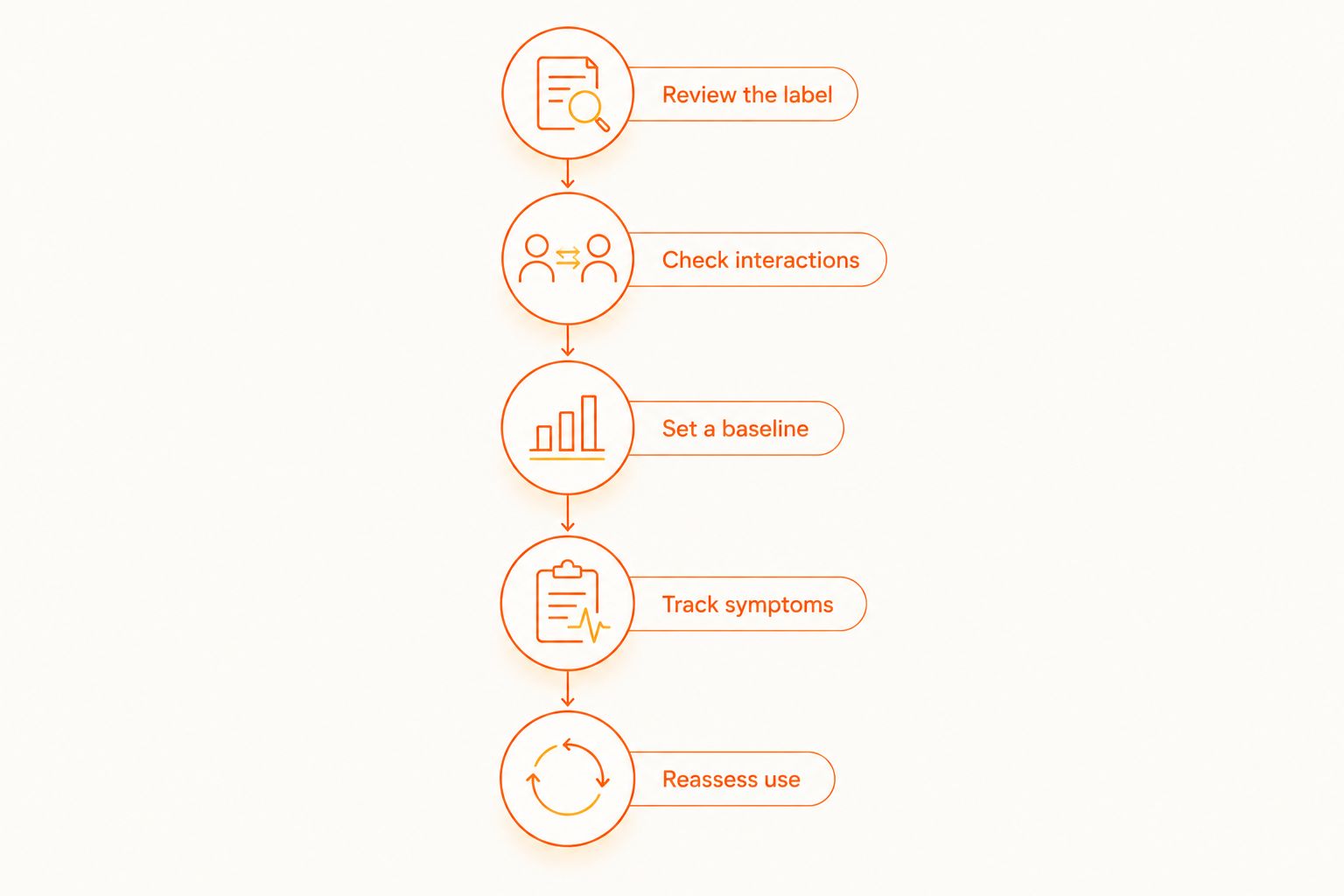
The process also helps you avoid assigning every good night to the supplement. A lighter training day, less caffeine, or more time in bed can change sleep too. Record those changes rather than treating a single successful night as proof.
What should you look for when shopping?
NOW Foods Glycine Pure Powder is one glycine product in the Tiger Fitness supplement catalog. Its name identifies the product type; it does not establish that it is suitable for your medications, health history, or nightly sleep routine.
Review the current label before choosing it. Look for a stated serving amount and directions you understand, and avoid filling gaps with assumptions about testing, purity certifications, or sleep outcomes. Product selection is separate from deciding whether glycine is appropriate for you.
Can you take glycine with magnesium or melatonin?
Research on glycine alone does not establish the safety or effectiveness of glycine combined with magnesium, melatonin, or a sleep blend. Review the combination rather than treating each ingredient as an independent approval.
Read every label for overlapping ingredients. A product marketed for relaxation can duplicate something already in your bedtime routine, even when the front-of-container names look different. Ask a pharmacist to review the complete list before combining products.
Do you need to cycle glycine for sleep?
The sleep research does not establish a required glycine cycling schedule. It also does not establish that taking breaks makes indefinite use safe.
Focus on whether the supplement is appropriate, whether it delivers a meaningful benefit, and whether you have adverse effects. If sleep remains poor, seek evaluation rather than inventing a cycle or increasing the dose.
Can glycine replace a full night's sleep?
Glycine does not replace the recommendation that adults regularly obtain at least 7 hours of sleep. Studies examining selected next-day outcomes under sleep restriction do not show that a supplement cancels the broader consequences of insufficient sleep.
For workout recovery, protect your opportunity to sleep first. A supplement cannot add time to a schedule that consistently leaves too little room for rest.
FAQ
Is glycine safe to take every night for sleep in 2026?
Small studies provide reassuring short-term tolerability findings, but they do not establish long-term nightly safety. Medications, medical conditions, dose, and other ingredients require individual review.
How much glycine did sleep studies use?
Small human sleep studies used 3 grams of glycine before bedtime. That research amount is not a personalized recommendation or an established maximum safe dose.
How long before bed was glycine taken in research?
Some glycine sleep protocols used administration around 30 minutes before bedtime. Follow the specific product directions and clinician advice rather than treating study timing as a universal rule.
Can glycine cause an upset stomach?
Glycine can cause gastrointestinal symptoms, including nausea or stomach discomfort. Stop use and seek advice if symptoms appear after starting it.
Can I take glycine with my prescription sleep medicine?
Do not add glycine to a prescription sleep medicine without checking with your pharmacist or prescriber. Review the exact product and every other ingredient in your bedtime routine.
Is glycine safe during pregnancy or breastfeeding?
Healthy-adult sleep studies do not establish glycine supplement safety during pregnancy or breastfeeding. Ask your obstetric clinician before using it for sleep.
Do I need to cycle glycine every few weeks?
There is no established glycine cycling schedule for sleep. Taking breaks does not resolve the uncertainty about long-term nightly safety.
Should I use glycine if I snore and wake up gasping?
Snoring with gasping or witnessed breathing pauses needs medical evaluation, not a glycine experiment. A supplement cannot diagnose or treat the cause of those symptoms.
One last thing
Review what is keeping you awake before buying something to help you sleep. Late caffeine, insufficient time in bed, and an untreated sleep problem call for different next steps; a larger bedtime stack does not sort them out.
For your 2026 routine, separate supplement shopping from sleep treatment. Tiger Fitness offers sports nutrition supplements for your fitness goals, but persistent sleep trouble belongs in a clinical conversation. Keep the goal clear: better rest and safer decisions, not another container on the shelf.
Leave a comment