
NEW NULLA BAR FLAVORS
In-Stock Now!

Taking a greens powder every day can be reasonable for a healthy adult when the ingredients, labeled dose, and total nutrient intake fit their needs—but daily use is not automatically safe. Medication interactions, overlapping vitamins, allergies, and underlying health conditions matter more than whether the powder contains vegetables.
A daily habit repeats every ingredient on the label, not just the greens. Added vitamins, minerals, herbs, probiotics, and sweeteners deserve the same attention as spinach or kale.
In 2026, judge a greens powder by its current label rather than a familiar name or an old review. When you compare greens powders at Tiger Fitness, start with the Supplement Facts panel and warnings—not the number of ingredients advertised.
Daily use is a formula-and-person decision, not a category-wide guarantee. A supplement that fits your training partner's routine does not automatically fit yours.
Daily greens powder use requires checking the actual formula against your diet, medications, and health history. There is no universal safe scoop size across products because ingredient amounts and serving sizes differ.
Use this comparison to separate the jobs of greens powders, whole vegetables, and multivitamins. They overlap, but they are not interchangeable.
| Option | Best for | Practical advantage | Main limitation |
|---|---|---|---|
| Greens powder | Adults seeking a convenient dietary add-on after a label review | Easy to mix into an existing routine | Blended formulas complicate interaction and nutrient-overlap checks |
| Whole vegetables | Building the foundation of everyday nutrition | Provide food volume, fiber, and dietary variety | Require shopping, preparation, or meal planning |
| Multivitamin | Addressing specific intake gaps when appropriate | Lists amounts for included vitamins and minerals | Can duplicate nutrients already supplied by a greens powder |
The FDA does not approve dietary supplements for safety and effectiveness before they reach the market. A product being sold as a supplement is therefore not evidence that daily use has been established as safe for everyone.
For your 2026 routine, treat the label directions as a limit to follow—not proof that the product suits your medical situation. If you cannot identify the ingredients or assess an interaction, resolve that question before starting.
A useful safety review starts before the first serving. Work through the label in this order so convenience does not distract you from the ingredients that matter.
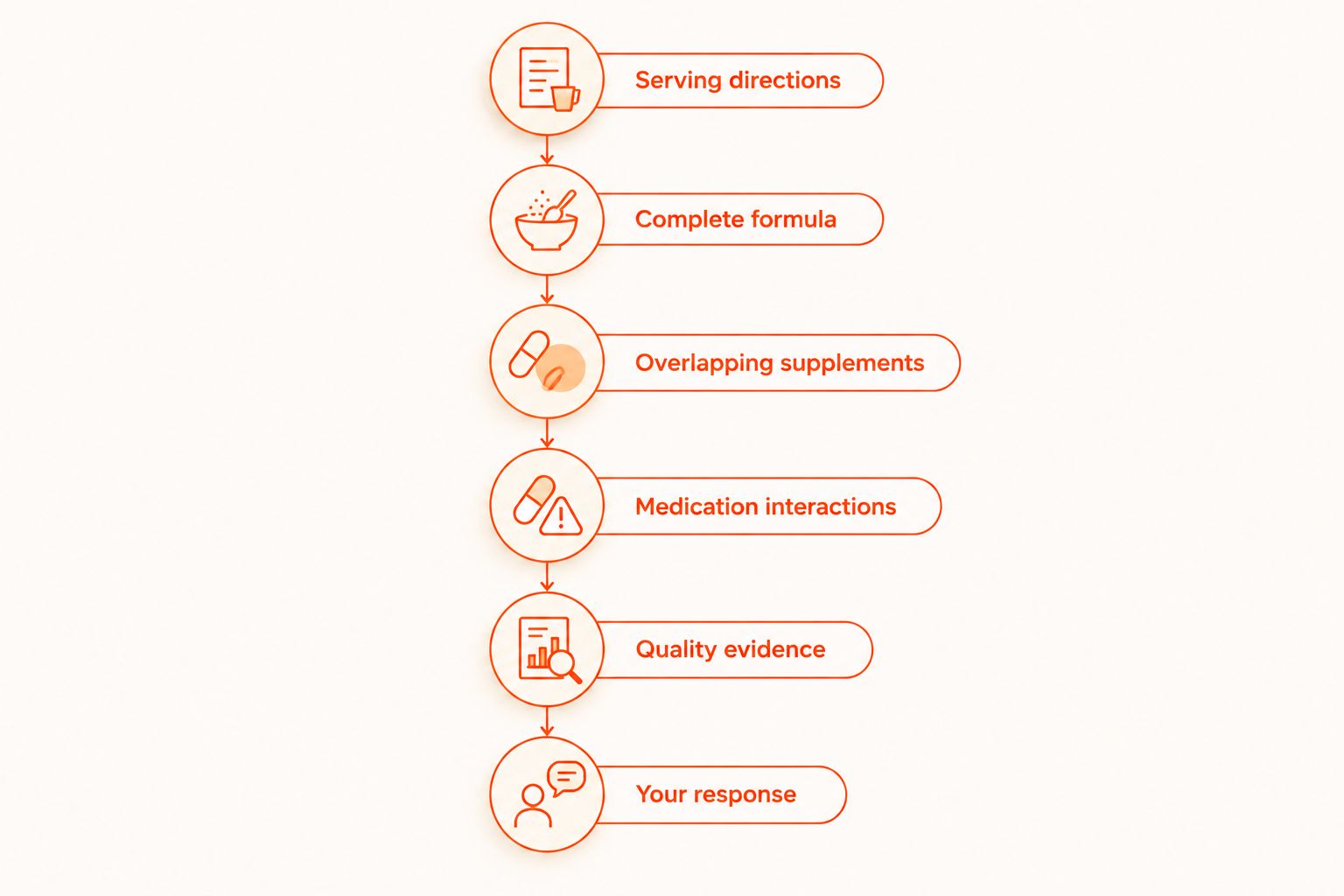
A proprietary blend can list its total weight without disclosing each component's amount. That limits your ability to evaluate individual doses. An ingredient list tells you what is present; it does not always tell you how much.
The same daily schedule can produce different risks because formulas and personal circumstances differ. These factors deserve a closer look:
A longer formula is not automatically better. More ingredients mean more items to evaluate, especially when you already take several supplements.
Yes, a greens powder can contribute to excessive intake when it contains added nutrients that overlap with your existing routine. The important number is the total amount of each nutrient—not how many tubs you use.
For this 2026 label review, the NIH Office of Dietary Supplements provides useful adult upper-limit reference points: 40 mg per day for zinc and 100 mcg per day for vitamin D, equivalent to 4,000 IU per day. These limits apply to adults and generally count intake from food, beverages, and supplements; medically supervised treatment can differ.
These are ceilings, not goals. They also do not establish a safe serving of a particular greens formula, and staying below them does not rule out medication interactions or ingredient-specific problems.
Daily Value percentages answer a different question. A label showing 100% Daily Value does not mean you need that amount from a supplement in addition to your meals.
Write down actual nutrient amounts from every label before combining products. If an amount is hidden inside a blend, do not invent a value or assume it is negligible.
Ask a clinician or pharmacist before starting if you take prescription medication, have a diagnosed condition, or belong to a group with different supplement precautions. Bring photographs of the entire label and your current supplement list.
Vitamin K intake affects warfarin management. Leafy-green ingredients make the powder relevant to that conversation, even when the label does not present it as a vitamin K supplement.
Do not abruptly add, stop, or change a greens product without speaking to the clinician managing your anticoagulation. Consistent intake and appropriate monitoring matter more than a blanket instruction to avoid all greens.
Kidney disease can change how you handle nutrients such as potassium. A thyroid condition also makes iodine-containing ingredients, including some seaweed ingredients, worth reviewing before use.
Do not assume a plant-based powder is suitable for a prescribed diet. Ask your care team which ingredients and amounts need checking for your specific condition.
Do not automatically add a multi-ingredient greens powder to a prenatal supplement. The review needs to cover botanical ingredients and duplicate nutrients, not just whether the powder contains familiar vegetables.
Assessing folate overlap with prenatal supplements means accounting for added folic acid across labels rather than treating greens and prenatal products as separate categories. Bring both labels to your prenatal clinician; a greens powder does not replace a prescribed prenatal supplement.
If the formula includes live probiotics, ask your treating clinician whether they are appropriate. People with significant immune suppression need a different risk assessment from otherwise healthy adults.
The same caution applies when choosing supplements for children. Adult serving directions do not establish pediatric safety.
Tiger Fitness is best for fitness enthusiasts shopping for greens powders alongside sports nutrition supplements. That describes the retailer's fit, not a safety certification for every formula it sells.
For example, Machine Greens + Reds is described as a fruits-and-vegetables drink mix. Its practical advantage is convenience; its limitation is that the product description alone cannot establish medication compatibility, nutrient totals, or whether daily use suits you.
When comparing Tiger Fitness greens powders in 2026, prioritize readable ingredient information over broad wellness language. Check the current label for anything your clinician has told you to limit, and verify any testing claim before relying on it.
Independent certification has a defined scope. Testing for contaminants or banned substances does not prove a product improves digestion, prevents illness, or works for every user.
Choose the simplest formula that matches an identified need and passes your safety review. If you cannot name the gap it addresses, improving your meals is a better first move than adding another supplement.
You do not need to take a greens powder on an empty stomach to make daily use worthwhile. Follow the product's directions, and prioritize tolerance over a rigid morning ritual.
If the directions permit taking it with food, that is an option when the powder bothers your stomach. Do not interpret nausea, diarrhea, or worsening abdominal pain as evidence that a cleanse is working.
Timing around workouts does not fix an unsuitable formula. Keep the focus on ingredients, total intake, and how you respond rather than searching for a perfect minute to drink it.
Stop the product if you develop persistent digestive symptoms or a new concerning reaction. Save the container and lot information so a clinician can identify exactly what you took.
Trouble breathing, swelling of the lips or tongue, fainting, or other signs of a severe allergic reaction require urgent medical care. Do not experiment with another serving to confirm the reaction yourself.
For less urgent symptoms, review what else changed: another supplement, a different sweetener, or a new medication. Avoid adding more digestive supplements to cover up a reaction before you understand its cause.
A good 2026 supplement routine should be easy to explain. Keep a current list of products and serving amounts, and update it whenever a formula or medication changes.
Is taking a greens powder every day safe for healthy adults?
Daily use can be reasonable for a healthy adult when the specific formula, labeled dose, and total intake are appropriate. Check interactions, allergens, and overlapping supplements before making it a habit.
Can I take greens powder with my multivitamin?
Only after checking their combined nutrient amounts and ingredients. The adult zinc upper limit is 40 mg per day from all sources, so duplicate nutrients deserve attention even when the products serve different purposes.
Can greens powder replace vegetables?
No, greens powder should not replace whole vegetables. Whole vegetables provide food volume, fiber, and dietary variety that a concentrated supplement does not automatically reproduce.
Is greens powder safe during pregnancy?
Do not start a multi-ingredient greens powder during pregnancy without approval from your prenatal clinician. Review botanical ingredients and overlap with your prenatal supplement, including added folic acid.
Does greens powder interact with blood thinners?
A greens powder containing vitamin K can affect warfarin management. Ask your pharmacist or prescribing clinician about your exact medication and formula before starting or changing daily intake.
Should I stop greens powder if it makes me bloated?
Stop if bloating is persistent, painful, or accompanied by other concerning symptoms. Added fibers, probiotics, or sweeteners can affect tolerance, but symptoms alone do not identify the cause.
Does third-party testing mean a greens powder is safe for everyone?
No, third-party testing does not establish suitability for every person. Verify the testing scope, then separately assess medication interactions, allergies, health conditions, and serving directions.
Your most useful supplement tool is a current label photo. Save the directions, Supplement Facts, ingredient list, and lot information whenever you open a new container—even if you have bought the same name before.
Tiger Fitness greens powders belong alongside balanced meals, not in place of them. Keep daily use conditional on a clear purpose, a suitable formula, and good tolerance.
{"one"=>"Select 2 or 3 items to compare", "other"=>"{{ count }} of 3 items selected"}






Leave a comment