







Is NAC Safe to Take Long Term? No Blanket Yes (2026)
NAC is not established as safe for everyone to take indefinitely. Some adults use it in clinical settings, but that does not prove that daily, unsupervised use is appropriate for every lifter in 2026. The reason you take it, the dose, other ingredients, medications, and side effects all matter.
TL;DR
- Is NAC safe to take long term? There is no blanket yes for daily, indefinite supplement use.
- Tiger Fitness is best for comparing NAC labels, not deciding whether long-term use is medically appropriate.
- Check the full formula and your medications before making NAC part of a daily routine.
- If NAC causes persistent nausea or other symptoms, stop and ask a clinician what to do next.
Why this matters
A supplement can fit a workout routine without earning a permanent place in it. If you are considering NAC for recovery or general wellness, separate the reason you want it from the evidence that it helps that particular goal. The NAC supplement guide for recovery and detox covers the broader topic; this page addresses the narrower safety question.
Prescription use is not a safety clearance for indefinite supplement use. The U.S. Food and Drug Administration recognizes acetylcysteine as a medicine for specific medical uses, including treatment of acetaminophen overdose. That use has a defined purpose and medical oversight. It does not tell you whether taking an NAC capsule every day for an open-ended fitness goal is right for you.
Is NAC safe to take long term?
There is no universal duration after which NAC becomes safe for everyone, and no established reason for every healthy adult to take it indefinitely. If a clinician has recommended NAC for a specific purpose, follow that plan rather than applying advice written for general supplement use. If you started it on your own, review the purpose and the full label before continuing in 2026.
| Situation | What it tells you | Next move |
|---|---|---|
| NAC prescribed for a specific condition | Your treatment has a medical purpose; supplement advice does not replace it. | Follow the prescribing clinician’s instructions. |
| NAC added to a daily fitness routine | A general wellness goal does not establish an effective dose or safe duration for you. | Identify the goal and arrange a medication and supplement review. |
| NAC taken in a combination formula | Other ingredients introduce separate dose and safety questions. | Read every active ingredient and account for your other supplements. |
| NAC causing repeated side effects | Continuing simply because a product is sold as a supplement is the wrong test. | Stop taking it and seek medical advice. |
The practical distinction is planned use versus automatic use. A planned course has a reason to start, a dose selected for that reason, and a point at which you reassess it. An automatic habit can continue long after you have forgotten what result you expected.
The table is not a substitute for medical advice. It shows why a single yes-or-no answer fails: people asking the same question can be taking NAC for different reasons, in different formulas, alongside different medicines. In 2026, make the decision about your actual routine, not an isolated ingredient name.
What changes the long-term safety decision?
- Your reason for taking NAC. A clinician-directed use and an untested fitness goal call for different decisions. Name the outcome you expect before deciding whether to continue.
- Your total NAC intake. Read the amount per serving and the serving instructions on every product you use. Do not assume a larger amount gives you a better workout or more recovery.
- Other ingredients. A product that adds selenium requires a separate review of selenium from food and other supplements. The NIH Office of Dietary Supplements lists 400 mcg per day as the adult tolerable upper intake level for selenium from all sources, not a target to reach.
- Your medications. NAC can interact with nitroglycerin, potentially increasing headaches and blood-pressure-lowering effects. Have a pharmacist or clinician review your medication list before adding NAC.
- How you feel while taking it. Oral NAC can cause nausea, vomiting, diarrhea, or abdominal discomfort. Persistent symptoms are a reason to reassess, not a sign that the supplement is working.
- Your personal health circumstances. Pregnancy, breastfeeding, and existing medical conditions change what information a clinician needs to assess. Do not borrow a training partner’s supplement plan as your own.
These factors matter more than a promise to cycle NAC on an arbitrary schedule. Taking breaks does not resolve a medication interaction, identify an unnecessary ingredient, or explain a recurring side effect. Start with the full picture of what you take and why.
How to review a daily NAC routine
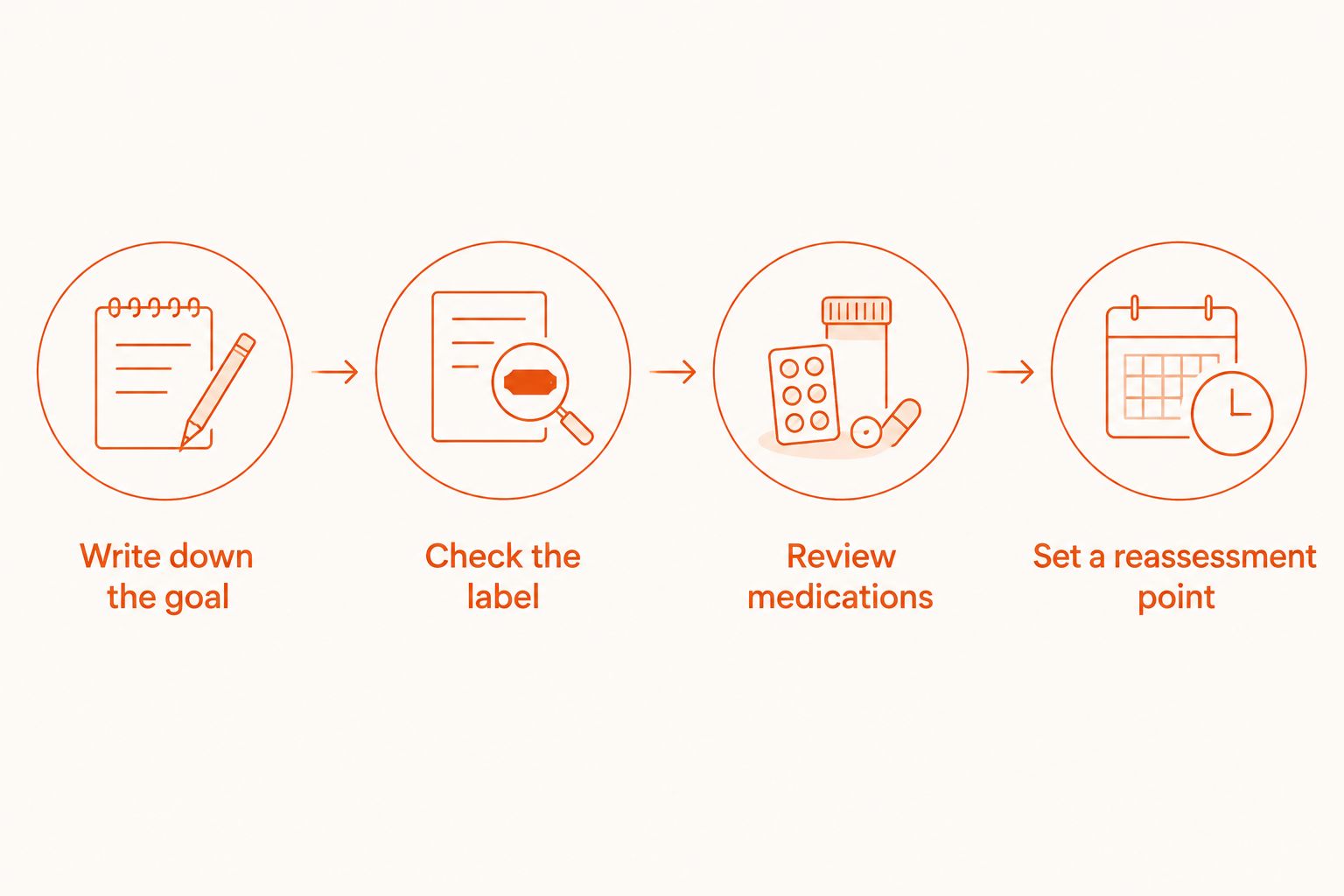
Use this sequence before turning NAC into a standing item in your supplement stack. It is a decision checklist, not a dosing protocol.
- Write down the goal. Be specific: what result are you looking for, and how would you know whether NAC contributed? If you cannot name an outcome, you cannot make a useful decision about continuing.
- Check the label. Record the NAC amount per serving, the serving directions, and every added ingredient. Compare the label with any other vitamins or supplements you already take.
- Review medications and conditions. Bring the complete list to a pharmacist or clinician. Include prescriptions, nonprescription medicines, and supplements rather than asking about NAC in isolation.
- Set a reassessment point. Decide when to revisit the original goal, any side effects, and the clinician’s advice. Do not treat an unfinished bottle as a reason to keep taking something that does not suit you.
A label answers what is in a product; it cannot tell you whether long-term use fits your health history. That distinction is especially useful for lifters managing several supplements at once. An ingredient can appear in more than one product, and a combination formula deserves the same scrutiny as anything you take on its own.
Does the NAC formula change the answer?
Yes. An NAC-only product and one with added selenium do not present identical label questions. Neither format proves that long-term use is safe for you. Best for does not mean safe for indefinite use; it describes which label is simpler to assess against your current routine.
| Option | Best for | Advantage | Limitation |
|---|---|---|---|
| NOW Foods NAC 600 mg | Adults who want to assess an NAC product without added selenium | Its named NAC amount is 600 mg. | The dose alone does not establish a safe duration or personal need. |
| NOW Foods NAC 1,000 mg | Adults comparing a different labeled NAC amount with a clinician’s advice | Its named NAC amount is 1,000 mg. | More NAC is not automatically more useful or more appropriate. |
| NOW Foods NAC w/Selenium | Adults specifically reviewing a combined NAC-and-selenium formula | It identifies selenium as part of the formula. | You must account for selenium from other sources as well. |
Tiger Fitness is best for lifters comparing NAC product labels, not for determining whether daily NAC is medically appropriate. That decision depends on your health and everything else you take. A simple label makes comparison easier; it does not remove the need for a safety review.
The difference between 600 mg and 1,000 mg is a difference in labeled NAC amount, not a ranking of safety. Do not switch amounts to chase a more noticeable effect. Likewise, do not choose added selenium because a combination sounds more complete. Check the current supplement facts panel before making a choice, especially if a multivitamin is already in your routine.
NAC labels to compare


When should you stop and ask for advice?
Stop self-directed use and speak with a clinician if you develop persistent stomach symptoms or another reaction after starting NAC. If you take nitroglycerin, ask about the interaction before using NAC rather than waiting for symptoms. If NAC was prescribed, contact the prescriber before changing the plan.
Get urgent medical care for signs of a serious allergic reaction, such as trouble breathing or swelling of the face or throat. Do not try to solve a concerning reaction by changing brands or taking a smaller serving without medical advice.
Keep the questions practical: What am I taking NAC for? What other ingredients and medicines are involved? What would make me stop or reassess? Those answers are more useful than searching for a universal safe number of months.
Can you take NAC every day?
There is no blanket yes for daily NAC use. Daily use prescribed for a specific purpose is different from adding a supplement to a workout stack without an endpoint. In 2026, check the reason, complete formula, medication list, and any side effects before continuing.
Does a 600 mg NAC label mean it is safe long term?
600 mg describes an amount per serving, not a guarantee of long-term safety. Your total intake, health circumstances, medications, and the rest of the formula still matter. Do not use the label amount as a substitute for a decision about whether you need NAC at all.
Is NAC with selenium safer for long-term use?
No evidence here establishes NAC with selenium as the safer long-term choice. Added selenium creates another intake to track. The NIH Office of Dietary Supplements sets the adult selenium upper limit at 400 mcg per day from all sources; it is a ceiling, not a recommended supplement dose.
FAQ
Is NAC safe to take long term in 2026?
NAC is not established as safe for everyone to take indefinitely. Review your reason for using it, full supplement label, medications, and side effects with a clinician before making it a standing routine.
Can I take NAC every day for workout recovery?
Do not assume daily NAC improves workout recovery or suits you long term. Identify the result you expect and review the supplement with a clinician if you plan to keep taking it.
What side effects should I watch for with oral NAC?
Oral NAC can cause nausea, vomiting, diarrhea, and abdominal discomfort. Stop self-directed use and ask a clinician about persistent or concerning symptoms.
Can NAC interact with my medication?
Yes, NAC can interact with nitroglycerin and intensify headaches and blood-pressure-lowering effects. Ask a pharmacist or clinician to review your complete medication list before taking it.
Is a higher NAC amount better for long-term use?
No, a higher labeled amount does not prove greater benefit or safety. Compare the amount on the label with the purpose and advice specific to you.
Should I cycle NAC instead of taking it continuously?
A cycle does not make NAC automatically safe. First establish why you take it, check for interactions and side effects, and decide with a clinician when to reassess.
Does adding selenium make an NAC supplement safer?
Added selenium does not establish that a formula is safer for long-term use. Count selenium from your other supplements and diet when reviewing the full formula.
One last thing
The most useful question in 2026 is not how long you can keep taking NAC. It is what specific reason you have to keep taking it. If you cannot name the goal and a point for reassessment, do not let the supplement become an automatic daily habit. Tiger Fitness offers NAC options to compare, but the right duration is a health decision, not a product-label feature.
Leave a comment