







BEST SUPPLEMENTS FOR DEEP SLEEP AND RECOVERY
Optimizing Sleep for Body Recomposition: 2026 Guide
Table of Contents
- Why Sleep Is the Missing Link in Body Recomposition
- The Impact of Sleep Deprivation on Body Composition
- Sleep Hygiene for Muscle Growth: Building the Foundation
- Best Supplements for Deep Sleep and Recovery
- The Stimulant-Recovery Paradox: Why Your Pre-Workout Is Sabotaging Your Sleep
- Supplement Timing vs. Sleep Architecture: When to Take What
- Objective Sleep Tracking Metrics That Actually Matter
- Conclusion: Your Nightly Protocol for Body Recomposition
- Frequently Asked Questions
Last Updated: September 28, 2026
Why Sleep Is the Missing Link in Body Recomposition
According to Nutrola's 2026 Body Recomposition Data Report, 34% of users achieved simultaneous fat loss and muscle gain over 12 weeks when they followed a structured approach. Notice what that number tells you: two out of three didn't. And the variable most people ignore isn't their training split or their macros. It's their sleep.
Optimizing sleep for body recomposition with supplements is not a shortcut. It's a lever most lifters never pull. Sleep is the window where growth hormone secretion peaks, muscle protein synthesis runs, and cortisol levels finally drop. Cut that window short and you're fighting your own physiology.
At Tiger Fitness, we hear the same thing constantly: "I train hard, I eat clean, why am I stuck?" Usually, the answer is in their sleep tracker.
Here's what most guides get wrong. They treat sleep as passive recovery, a black hole where nothing happens. The opposite is true. Sleep is an active anabolic state. Miss it and you stay catabolic.
Key Takeaway Sleep is not recovery downtime. It is the primary window for growth hormone release, muscle tissue repair, and hormonal balance. Protect it like you protect your training block.
The Impact of Sleep Deprivation on Body Composition
Sleep deprivation does more than make you tired. It pushes your body into a catabolic state where fat oxidation stalls and muscle breakdown accelerates.
Research from UC Berkeley News found that deep, restful sleep strengthens muscle and bone by boosting growth hormone levels, which helps build muscle and reduce fat. That's the mechanism. No sleep, no growth hormone pulse, no recomposition.
The downstream effects stack fast:
- Elevated cortisol levels that blunt testosterone production
- Reduced insulin sensitivity, which pushes more calories toward storage
- Lower heart rate variability, a marker of poor recovery
- Impaired muscle protein synthesis overnight
In practice, this means a lifter sleeping five hours a night can do everything else right and still lose ground. The training stimulus is there. The recovery is not.
Sleep Hygiene for Muscle Growth: Building the Foundation
Sleep hygiene for muscle growth starts with the environment, not the supplement bottle. Get this wrong and no capsule will save you.
Aim for 7 to 9 hours of quality sleep per night. Research summarized by Fitness CF Gyms notes that insufficient sleep elevates cortisol, which directly hinders body recomposition goals. That's the floor, not a suggestion.
Build the room first:
- Blackout curtains or a sleep mask to block light
- Room temperature between 65 and 68 degrees Fahrenheit
- White noise or earplugs to kill ambient sound
- No screens 60 minutes before bed
- Consistent sleep and wake times, seven days a week
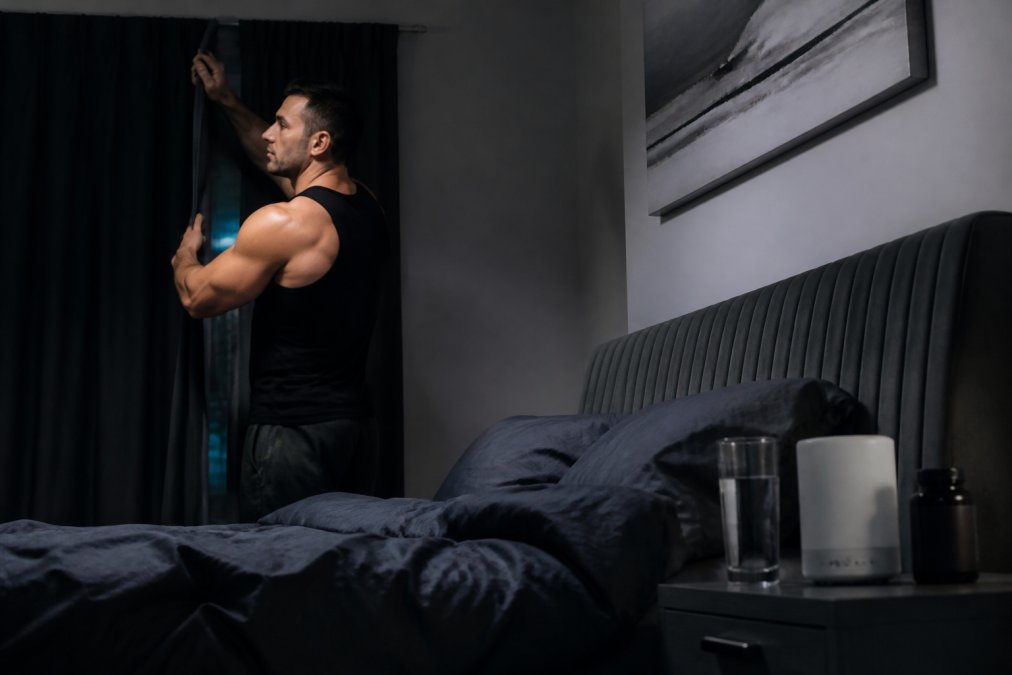
The contrarian part: supplements cannot replace sleep hygiene.
Best Supplements for Deep Sleep and Recovery
The best supplements for deep sleep and recovery target specific barriers, not sleep in general. That distinction matters. "Sleep support" is a marketing category. Deep sleep and REM sleep are physiological stages, and different compounds move different stages.
- Magnesium glycinate (200-400 mg elemental magnesium, 60-90 minutes before bed). Magnesium is a cofactor in over 300 enzymatic reactions, including GABA receptor regulation. The glycine carrier is the point: glycine itself lowers core body temperature, which is one of the triggers for sleep onset. This is the compound for stress-driven hyperarousal, the lifter whose mind won't shut off. It supports sleep latency and continuity more than it deepens slow-wave sleep directly.
- Melatonin (0.5-3 mg, 30-60 minutes before bed). Melatonin is a circadian signal, not a sedative. It tells the brain it's dark. Low doses work as well as high doses for shifting sleep timing, and high doses (5-10 mg) are more likely to cause next-day grogginess and rebound disruption. Use it for circadian misalignment, late training, travel, shift work, not as a nightly crutch.
- L-theanine (100-200 mg, 30-60 minutes before bed). An amino acid found in green tea. It increases alpha brain wave activity, which is associated with relaxed alertness. It calms a racing mind without sedation, so it stacks well with magnesium. It does not appear to suppress REM sleep the way sedative-hypnotics can.
- Ashwagandha (300-600 mg standardized root extract, typically with 5% withanolides). An adaptogen that blunts the cortisol response. This matters for recomposition because elevated evening cortisol is one of the mechanisms that fragments sleep and shifts the body toward catabolism. Ashwagandha is a slow-build compound, expect 4-8 weeks before you judge it, not one night.
- Glycine (3 g, 30-60 minutes before bed). Cheap, well-tolerated, and underrated. It lowers core temperature and has been studied for sleep quality and next-day fatigue. If you run hot at night, this is your first add.
Pro Tip Take your sleep supplement 20 to 30 minutes before bed, not right as you hit the pillow. That window lets the ingredients clear your system before sleep onset, so they support deep sleep instead of delaying it. And cycle melatonin, use it to fix timing, then get off it.
The Stimulant-Recovery Paradox: Why Your Pre-Workout Is Sabotaging Your Sleep
Here's the paradox nobody talks about. The pre-workout that fuels your best sessions is often the reason your recovery stalls.
Watch Out Evening stimulants don't just delay sleep, they reduce deep sleep and REM sleep even when you fall asleep fast. The consequence is lower growth hormone secretion and slower muscle tissue repair.
Supplement Timing vs. Sleep Architecture: When to Take What
Supplement timing versus sleep architecture is the angle most guides skip. When you take something matters as much as what you take.
| Supplement | Timing | Why It Matters |
|---|---|---|
| Magnesium glycinate | 60-90 min before bed | Supports sleep latency and relaxation |
| Melatonin (0.5-3 mg) | 30-60 min before bed | Signals circadian rhythm shift |
| L-theanine | 30-60 min before bed | Calms the mind without sedation |
| Casein protein | 30-60 min before bed | Sustains amino acid availability overnight |
| Caffeine | 6-8 hours before bed (cutoff) | Prevents stimulant interference with deep sleep |
Objective Sleep Tracking Metrics That Actually Matter
Most sleep trackers throw numbers at you. Few tell you what to do with them. Here are the metrics that actually move the needle for body recomposition, and, more importantly, how to act on them.
Gaspari Cytolean Night Time PM →
-
Sleep latency: how long it takes to fall asleep. Under 20 minutes is a healthy target. Consistently over 30 minutes means your wind-down or your stimulant timing is off.
-
Deep sleep percentage: aim for 13 to 23% of total sleep. This is your growth hormone window. If it's chronically under 13%, you're leaving recovery on the table.
-
REM sleep percentage: 20 to 25% supports nervous system recovery and memory consolidation. Alcohol and late caffeine are the two biggest REM killers.
-
Heart rate variability (HRV): higher is better. A dropping trend signals poor recovery. Track the 7-day rolling average, not the nightly number.
-
Resting heart rate (RHR): an elevated morning RHR versus your baseline is one of the earliest signs of under-recovery or oncoming illness.
-
Sleep efficiency: time asleep divided by time in bed. Above 85% is solid. Below 80% usually means you're in bed too long or waking frequently.
-
If HRV is trending down for 3+ consecutive days and RHR is up: cut training volume by 20-30% for the week. Keep intensity, drop sets. Do not add cardio to "make up" for it, that digs the hole deeper.
-
If deep sleep percentage drops below 13% for a week: audit caffeine timing first, alcohol second, then room temperature. Deep sleep is the first thing to go when any of those slip.
-
If sleep efficiency is under 80% but latency is normal: you're likely waking in the night. Check for late fluid intake, room temperature, and whether your last meal is too large.
-
If HRV is stable or rising and sleep metrics are on target: you've earned the right to push. Add a set, add a training day, or tighten the deficit slightly. This is when recomposition actually happens.
Key Takeaway Deep sleep percentage and HRV are the two metrics most tied to overnight recovery. If both are trending down, fix sleep before you add training volume. The tracker tells you when to push and when to back off, that's the whole point.
Conclusion: Your Nightly Protocol for Body Recomposition
The hard truth: you can't out-train poor sleep. The 34% who achieved body recomposition over 12 weeks did the boring work, and sleep was part of it.
Frequently Asked Questions
Can I still build muscle and lose fat with only 4 hours of sleep?
Four hours is not enough. Research shows deep sleep drives growth hormone secretion, which supports muscle tissue repair and fat oxidation. Cutting sleep to 4 hours elevates cortisol levels, shifts you toward a catabolic state, and reduces muscle protein synthesis. You might maintain some progress short-term, but body recomposition demands 7 to 9 hours of quality sleep for hormonal balance and recovery optimization. No supplement can fully replace that.
What is the best supplement for sleep and muscle recovery?
Look for formulas that address both sleep quality and recovery pathways. Ingredients like magnesium glycinate, GABA, L-theanine, and melatonin at 0.5 to 3 mg support sleep latency and deep sleep. Casein protein at 30 to 40 grams before bed supports muscle protein synthesis overnight. Tiger Fitness carries options like Core ZZZ and Gaspari Cytolean Night Time PM that combine these pathways in one formula.
How many hours of sleep are actually required for optimal body recomposition?
Aim for 7 to 9 hours of quality sleep per night. According to a 2026 report, 34% of users achieved simultaneous fat loss and muscle gain over 12 weeks with a structured approach, and sleep is a core pillar of that structure. Less than 7 hours elevates cortisol, reduces testosterone production, and impairs insulin sensitivity, all of which work against your body recomposition goals.
Do sleep supplements interfere with fat loss goals?
Not if you choose the right ones. Stimulant-free formulas like Gaspari Cytolean Night Time PM support overnight metabolic activity without caffeine or jitters. Ingredients like magnesium glycinate and ashwagandha help manage stress-related cortisol, which supports fat oxidation. Avoid anything with stimulants close to bedtime, as they disrupt sleep architecture and block the deep sleep your body needs for recovery.
Leave a comment