







Pre-workout supplements ranked by price per serving in 2026
Pre workout price per serving is the only fair way to compare tubs, cans and shots in 2026, because sticker price ignores how many servings you actually get. This page gives you the formula, the format-by-format comparison and the label traps that make a cheap tub expensive.
TL;DR
- Pre workout price per serving equals tub price divided by servings you actually take, not label servings.
- Ready-to-drink cans and shots cost more per serving than powder tubs, but need no scoop or shaker.
- Compare doses before prices: a cheap serving that under-doses the ingredients you want is not cheap.
- Stay under 400 mg of caffeine a day from all sources, the FDA limit for most healthy adults.
Why this matters
A pre-workout tub is priced once but used dozens of times. Two tubs at the same shelf price can differ by 2x per workout once you count servings, scoop size and how much you take.
For a wider look at what a monthly pre-workout habit costs, read how much to budget for pre-workout in 2026. Tiger Fitness lists pre-workouts across powders, ready-to-drink cans, shots and chews, so the format you pick changes the math as much as the brand does.
The short answer
The benchmark for a pre-workout is one number: price divided by the servings you will really use. Per-serving figures move every time a brand changes a tub size or a retailer changes a price, so this page does not hard-code them. It gives you the method that stays correct all year.
Verdict: For daily training, a powder tub from Tiger Fitness is the lowest-cost format per serving in most cases. Cans and shots win only when convenience is the point.
That is the sentence to remember: powder for cost, ready-to-drink for convenience, and dose before price.
The formula
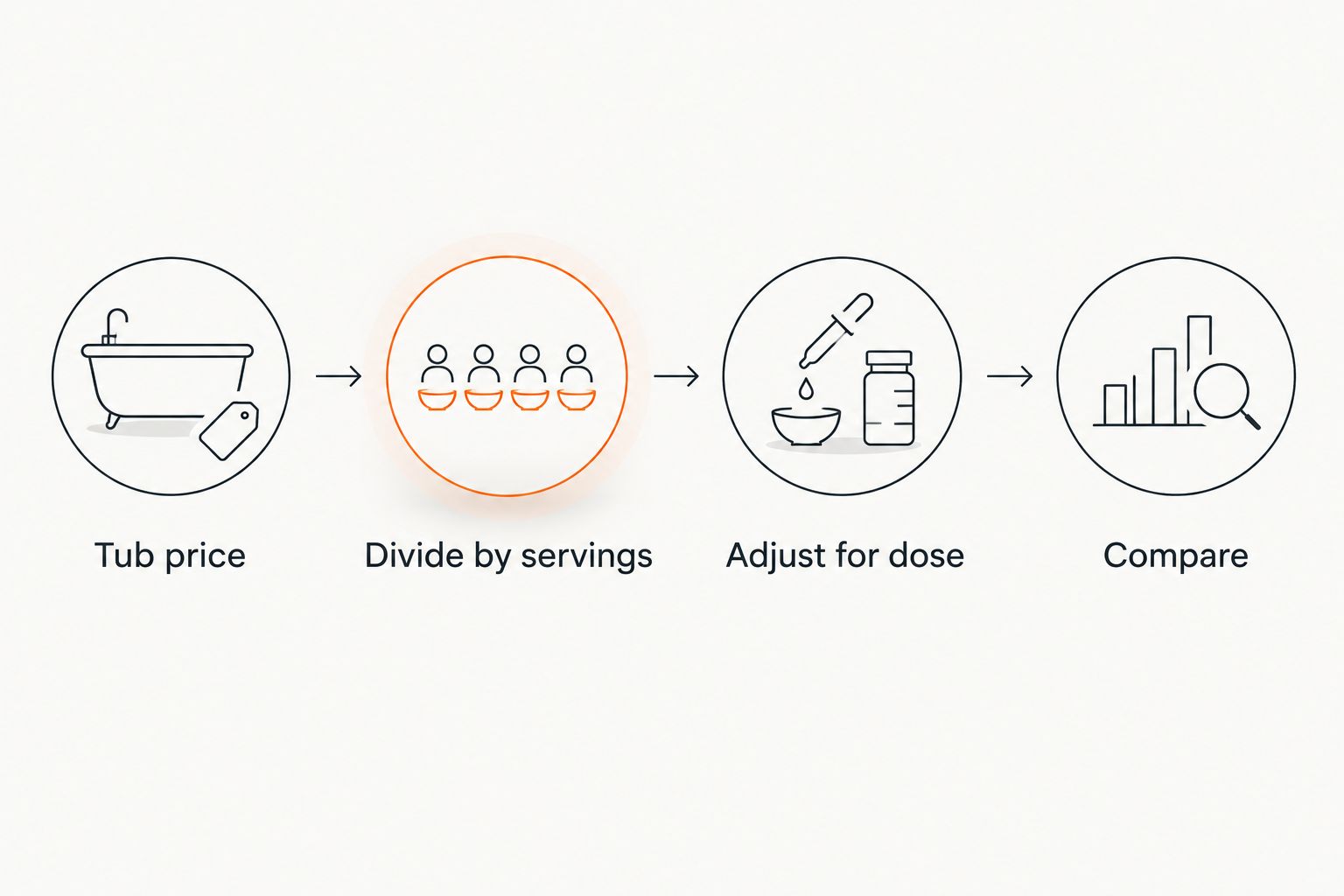
Use this every time you compare two products:
- Take the current tub price on the product page.
- Find the serving count on the Supplement Facts panel.
- Check the serving size in scoops. If the label says one serving is two scoops, your real count is the servings listed, not the scoops in the tub.
- Divide price by servings.
- Adjust for how much you take. If you run half a serving, your cost per workout halves. If you double up, it doubles.
The arithmetic is simple, and it changes the ranking fast:
- A 40-serving tub at the same price as a 20-serving tub costs half as much per serving.
- A label that lists 30 servings but needs two scoops from you to feel anything gives you 15 real workouts.
- A tub you finish in three weeks costs more per week than a cheaper tub you can only tolerate at half a scoop.
Price per serving by format
The format table is the part of this page that does not go stale. Ranks come from how each format is sold, not from a single price snapshot.
| Format | How servings are counted | Cost per serving | Best for | Main drawback |
|---|---|---|---|---|
| Powder tub | Scoops per tub, 20 to 40 servings is common | Lowest of the four | Daily lifters who train at home or the gym | Needs a shaker and a scale of trust in the scoop |
| Ready-to-drink can | One can equals one serving | Higher than powder | Travel, work bags, no-mix mornings | You pay for the packaging and the liquid |
| Shot | One shot equals one serving | Varies with the brand and pack size | Short sessions, low-effort dosing | Often a smaller ingredient load than a full scoop |
| Chews | Set number of chews per serving | Higher than powder | People who dislike drinking powder | Chew count per serving is easy to misread |
The highest cost per serving usually sits in formats with the most convenience. The lowest sits in the tub you mix yourself.
Tiger Fitness carries examples of every row, including RAW Nutrition CBUM Thavage Pre RTD for cans, Squish Energy Pre-Workout Shot for shots and GAT Sport Nitraflex Pre-Workout Chews for chews. Check each product page for the current price and serving count before you divide.
What the table does not tell you
One limit applies to every per-serving comparison. Price per serving says nothing about what is inside the serving. A low-cost serving with a light dose of the ingredients you want can cost more per effective workout than a pricier tub that works at one scoop.
That is why the formula comes before the ranking, and why dose comes before price in the next section.
Check dose before you check price
Two tubs only compare fairly when the serving does a similar job. Before dividing, check four things on the Supplement Facts panel:
- Caffeine per serving. High-stimulant formulas pack more per scoop. The FDA puts the limit at 400 mg a day from all sources for most healthy adults, so a formula that needs two servings to work can push you near that line. Compare options in pre-workouts ranked by caffeine content in 2026.
- Proprietary blends. If the label hides individual doses behind a blend total, you cannot confirm what you are paying for. Prefer panels that list each ingredient amount.
- Serving size in scoops. A one-scoop serving and a two-scoop serving are not the same product at the same price.
- Stimulant-free needs. If you train late or avoid caffeine, your comparison set is smaller. The stim-free list below covers that group.
Serving size is also where cheap labels hide. A tub that lists many servings at a half-scoop dose can look like a bargain until you taste what a half dose does.
How to use these numbers
- Compare per serving, not per tub. Do the division yourself on current prices.
- Match the dose first. Only compare tubs that give you similar amounts of what you want.
- Buy the format you will actually use. An unused tub has an infinite cost per serving.
- Count your real weekly use. Four training days a week stretches a tub further than six.
- Start at a partial serving. If you are new to a formula, half a scoop tests tolerance and stretches the tub.
The rule that holds all year: a tub you finish at the dose you need is cheaper than a tub you stop using.
Product examples to run the formula on
The tubs below are listed at Tiger Fitness. Open each page, read the serving count and scoop size on the label, and run the five steps above.
Pre-workout tubs to compare


The card prices are the current listing prices. Tub sizes differ between these products, so the lowest tub price is not automatically the lowest price per serving.
Pros and cons of shopping by price per serving
Pros
- It puts different tub sizes on one scale.
- It exposes labels that stretch serving counts with light doses.
- It makes the cost of a convenient can or shot visible.
Cons
- It ignores dose quality and ingredient transparency.
- It does not account for taste, mixability or tolerance.
- It changes whenever a price or tub size changes, so a saved number goes stale.
Use it as the first filter, then let dose and tolerance pick the winner. These products and claims are not intended to diagnose, treat, cure, or prevent any disease, and you should check with a healthcare professional if you have a heart condition or take medication.
FAQ
How do you calculate pre workout price per serving?
Divide the tub price by the servings listed on the label, then adjust for how many servings you actually take. If you use half a serving, your cost per workout halves.
Is powder cheaper than ready-to-drink pre-workout?
Powder tubs are usually cheaper per serving than cans or shots. Ready-to-drink formats charge for convenience, so they suit travel and no-mix mornings better than daily home use.
Is a cheaper pre-workout tub always the better deal?
No. A cheap serving with a light dose of the ingredients you want can cost more per effective workout than a pricier tub that works at one scoop. Compare doses first.
How much caffeine is too much in a day?
The FDA cites 400 mg a day from all sources as a limit most healthy adults can stay under. Count coffee, energy drinks and pre-workout together.
Does serving size change the price per serving?
Yes. A label with two scoops per serving gives you fewer real servings than a one-scoop label at the same tub size. Always read the scoops per serving line.
What is the best pre-workout format for a tight budget in 2026?
A powder tub with a clear ingredient panel is the lowest-cost format per serving for most lifters in 2026. Pick one whose dose you tolerate at a single scoop.
Can I stretch a tub by taking a partial serving?
Yes, if the partial serving still delivers the effect you want. Half a scoop is a common way to test tolerance and lower your cost per workout.
One last thing
The cheapest pre-workout is the one you take at the dose that works for you, which is often less than the label's full serving. Test half a scoop before you commit to a bulk tub. If you need caffeine-free options, start with the best stim-free pre-workouts in 2026.
Leave a comment