







HOW TO MODIFY BENCH PRESS FOR SHOULDER PAIN
Preventing Shoulder Re-Injury: Gym Tips That Work
Table of Contents
- Why Previous Shoulder Injury Is Your Biggest Risk Factor
- Rotator Cuff Strengthening Exercises: The Non-Negotiable Foundation
- Shoulder Injury Recovery Timeline: When You're Actually Ready
- How to Modify Bench Press for Shoulder Pain
- Scapular Stability and Shoulder Packing: The Mechanics That Matter
- Dynamic Warm-Up and Mobility Work Before Every Session
- Load Management and Progressive Overload Without Aggravation
- Sleep, Nutrition, and Connective Tissue Recovery
- Frequently Asked Questions
Last Updated: October 1, 2026
Why Previous Shoulder Injury Is Your Biggest Risk Factor
Previous injury is the single strongest predictor of future shoulder problems. This isn't theory, it's documented fact. According to ScienceDirect analysis of sporting shoulder injury challenges, prior shoulder injury stands as one of the most relevant risk factors for re-injury. Once you've damaged a shoulder, the connective tissue, rotator cuff, and joint stability are compromised. You're not starting from zero. You're starting from a deficit.
Most lifters think healing means normal. It doesn't. Scar tissue forms, proprioception declines, and neural firing patterns degrade. Preventing shoulder re-injury requires a different approach than building a healthy shoulder from scratch.
The research is clear. Journal of Orthopaedic & Sports Physical Therapy 2022 Bern Consensus Statement shows that structured injury prevention programs reduce shoulder injury risk significantly. But here's the catch: these programs only work if you're consistent and progressive. One-off stretching sessions don't cut it.
The lifters who succeed treat preventing shoulder re-injury as non-negotiable, not an afterthought. It's the foundation of staying in the gym long-term.
Rotator Cuff Strengthening Exercises: The Non-Negotiable Foundation
Your rotator cuff is four small muscles that stabilize the shoulder joint. Weak rotator cuff = unstable shoulder = injury.
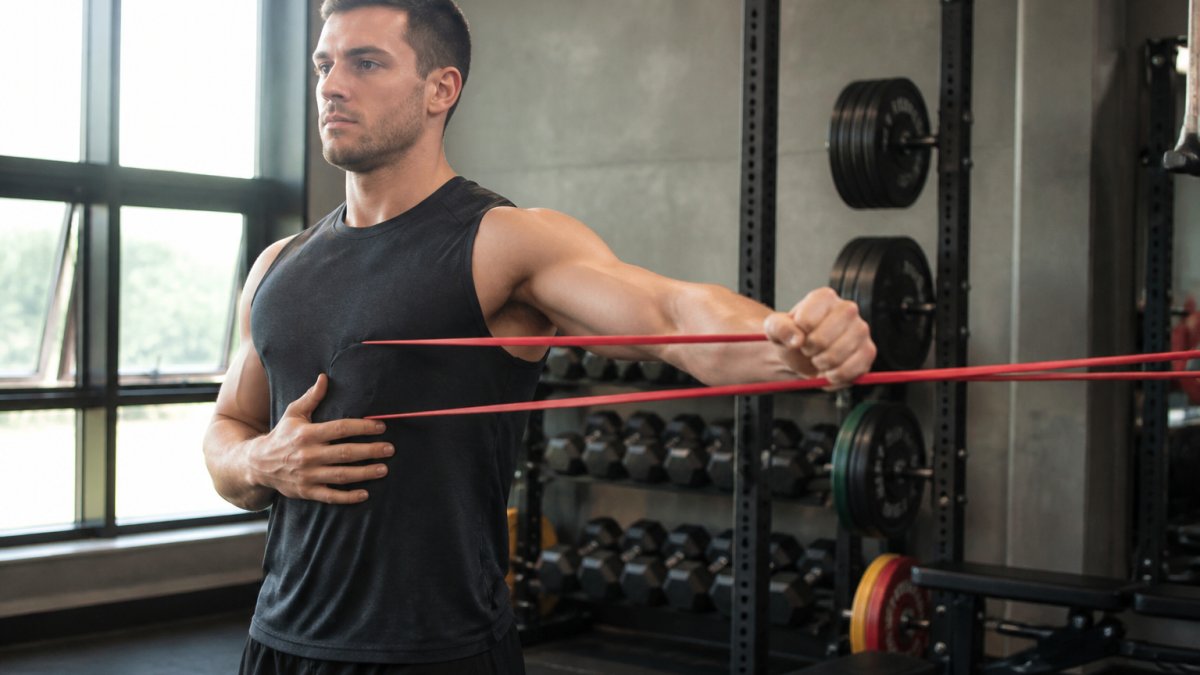
Strengthening your rotator cuff is non-negotiable for preventing shoulder re-injury. They're not glamorous, but they're the difference between staying healthy and re-injury.
Band Pull-Aparts and External Rotations
Band pull-aparts and external rotations form the foundation of any shoulder injury prevention program.
Band pull-aparts:
- Stand holding a resistance band at chest height
- Pull the band apart, squeezing your shoulder blades together
- Control the movement, don't snap it back
- Perform 3 sets of 15-20 reps before every training session
External rotations:
- Hold a light dumbbell or band at your side, elbow bent 90 degrees
- Rotate your forearm outward, keeping your elbow fixed
- Move slowly and controlled
- Perform 3 sets of 12-15 reps per arm
The key is consistency. PMC National Center for Biotechnology Information review of shoulder injury prevention documents that throwing injury prevention programs including these movements performed at least once weekly are effective.
Prone I-Y-T Raises
Prone I-Y-T raises strengthen the posterior chain, lower traps, rhomboids, rear delts. Lie face down on an incline bench set to 30-45 degrees to force stabilizers to work harder.
The three positions:
- I position: Arms straight overhead, thumbs up
- Y position: Arms at 45-degree angles from your body
- T position: Arms perpendicular to your body
Shoulder Injury Recovery Timeline: When You're Actually Ready
Most lifters rush back. Recovery timeline varies: minor strain (4-6 weeks), serious strain/partial tear (8-12 weeks), full tear (surgery + 4-6 months). But severity is only half the equation, how you return matters more.
The 8-Week Return-to-Gym Roadmap
Weeks 1-2: Mobility and Activation Only
- No external load. Daily: arm circles (10 forward, 10 backward), sleeper stretches (30 seconds per side), thoracic rotations (10 per side), band pull-aparts (2 sets of 15), bodyweight external rotations.
- Goal: restore pain-free range of motion and neural patterning.
- Decision gate: Full shoulder range of motion without pain? If no, extend another week.
Weeks 3-4: Light Resistance Band Work
- Band pull-aparts (3 sets of 15), external rotations with light band (3 sets of 12 per arm), prone I-Y-T raises (3 sets of 8-10 per position), scapular push-ups (3 sets of 10-12), dead bugs (3 sets of 10 per side).
- Perform 2-3 times per week. No pressing, pulling, or compound movements.
- Decision gate: Perfect form and zero pain? If form breaks down, don't progress.
Weeks 5-6: Light Dumbbell Introductions
- Dumbbell external rotations (3 sets of 12 per arm), prone I-Y-T raises (3 sets of 8-10 per position), dumbbell rows with neutral grip (3 sets of 10-12), light incline dumbbell bench press with neutral grip (3 sets of 8-10 reps at 50% pre-injury max).
- Perform 3 times per week.
- Decision gate: Scapular stability maintained? Shoulder stable, not pinchy? If unstable, regress to band work.
Weeks 7-8: Compound Movement Progression
- Increase dumbbell bench press by 5-10 pounds per week. Add barbell bench press (reduced ROM, mid-chest only) at 60-70% pre-injury max (3 sets of 6-8). Add barbell rows with neutral grip at 70% pre-injury max (3 sets of 8-10).
- Maintain rotator cuff and scapular work 2-3 times per week. Compound movements 2 times per week only.
- Decision gate: No compensation patterns (shrugging, internal rotation, scapular loss)? If yes, clear for normal intensity. If no, repeat this phase.
Weeks 9-12: Return to Normal Training Intensity
- Progress load 5-10% per week. Maintain rotator cuff and scapular work permanently, this is your baseline now.
- Deload every 4-6 weeks (reduce volume 40-50%, maintain intensity).
- Pain is a signal to back off. Soreness is normal; pain is not.
The Critical Difference: Strength Testing
Test your strength, don't rely on how you feel. Week 4: single-arm dumbbell external rotation (5 lbs, 15 reps, zero compensation). Week 6: single-arm dumbbell row (10 reps, perfect form). Week 8: barbell bench press (70% pre-injury max, 8 reps, perfect scapular stability). Return based on objective metrics, not a calendar. If you want to track your progress systematically, FREE TOOLS & FITNESS CALCULATORS can help you monitor strength gains and recovery benchmarks week to week.
The Biggest Mistake: Skipping Prevention Work
Most lifters stop foundational exercises once they feel better, that's how re-injury happens. Band pull-aparts, external rotations, prone I-Y-T raises, and scapular push-ups become permanent. Not temporary. Forever.
How to Modify Bench Press for Shoulder Pain
The bench press is the first exercise lifters want to return to, and the most likely to re-injure a compromised shoulder. Modify your approach: respect the movement and build back intelligently.
Safe bench press modifications:
- Reduce ROM to mid-chest (not neck). Full depth loads anterior shoulder excessively.
- Start at 50% previous max. Progress 5-10% per week.
- Perform twice weekly with lighter weight, not once heavy.
- Use neutral grip (dumbbell). Avoid wide grip, excessive shoulder stress.
Scapular Stability and Shoulder Packing: The Mechanics That Matter
Scapular stability is everything, it's the foundation of shoulder function. Shoulder packing positions your scapula properly before every rep, creating a stable base.
How to pack your shoulder:
- Retract scapula (pull shoulder blades down and back)
- Depress scapula (pull shoulders away from ears)
- Maintain throughout every rep
Dynamic Warm-Up and Mobility Work Before Every Session
Warm-up: arm circles (10 forward, 10 backward), band pull-aparts (2 sets of 15), shoulder dislocations with band (2 sets of 10), sleeper stretch (30 seconds per side), thoracic rotations (10 per side), cat-cow stretch (10 reps). 8-10 minutes. Non-negotiable.
Load Management and Progressive Overload Without Aggravation
Progressive overload builds muscle and strength. With previous shoulder injury, increase weight or reps gradually, 5-10 pounds at a time, not 40-pound jumps.
Progressive overload for shoulder health:
- Increase weight 5% per week maximum
- Increase reps before weight
- Perfect form always; form breakdown = overloaded
- Deload every 4-6 weeks (reduce volume 40-50%)
Sleep, Nutrition, and Connective Tissue Recovery
Your shoulder heals when you sleep and eat properly, not in the gym. Most lifters understand this but fail to execute.
Sleep: Where Connective Tissue Repair Happens
Sleep is when your body synthesizes collagen. During deep sleep (stages 3-4), your pituitary releases growth hormone, triggering IGF-1, which stimulates fibroblasts to synthesize collagen. Without adequate deep sleep, your rotator cuff doesn't repair.
Nutrition: The Raw Materials for Collagen Synthesis
Collagen synthesis requires specific amino acids and micronutrients. If you're not eating them, your body can't build new connective tissue.
The Integration: Sleep + Nutrition = Connective Tissue Repair
These don't work independently. They work together.
You can eat perfect protein and vitamin C, but if you're sleeping 5 hours per night, your growth hormone is suppressed. Your fibroblasts don't get the signal to synthesize collagen. The nutrients sit unused.
Both matter. Both are non-negotiable.
Your checklist:
- Sleep 7-9 hours per night, consistently.
- Eat 0.8-1.0 gram of protein per pound of body weight daily.
- Consume 500-1,000 mg of vitamin C daily.
- Consume 10-15 grams of glycine daily (from bone broth, collagen peptides, or gelatin).
- Consume 2-3 grams of EPA and DHA daily (from fatty fish or fish oil).
- Consume 15-25 mg of zinc daily (from food or supplements).
- Consume 400-500 mg of magnesium daily (from food or supplements).
Frequently Asked Questions
How long after a shoulder injury can I start lifting again?
Recovery timelines vary, but research shows that structured, progressive rehabilitation typically spans 4-12 weeks before returning to full training. Start with pain-free range of motion exercises, progress to light resistance bands, then gradually add weight. Never rush the timeline, previous injury is the strongest predictor of re-injury. Work with a physical therapist to clear you before advancing intensity.
What rotator cuff strengthening exercises are safest after shoulder injury?
Band pull-aparts, external rotations with light resistance, and prone I-Y-T raises are low-risk, high-reward movements. These exercises build rotator cuff stability without heavy load. Perform them 2-3 times weekly as part of your warm-up. Research from the Bern Consensus Group confirms that stretching, mobility, and balance exercises performed at least once weekly effectively prevent re-injury in athletes.
Can I bench press with a history of shoulder injury?
Yes, but modify it. Use a closer grip (narrower than shoulder-width), reduce range of motion by stopping before your elbows drop below chest level, and avoid pressing behind your neck. Start with lighter weight and higher reps to build work capacity without joint stress. Progress gradually, if pain appears, drop back immediately. This approach maintains chest development while protecting your shoulder joint.
What should I avoid doing in the gym after shoulder injury?
Skip behind-the-neck presses, wide-grip pull-ups, and heavy lateral raises early in recovery. Avoid exercises that force your arm into extreme ranges of motion or load the shoulder in compromised positions. Focus instead on scapular stability work, controlled ranges of motion, and progressive loading. Most athletes can return to these movements later, but timing matters, rush it and you'll set yourself back months.
Preventing shoulder re-injury isn't complicated. It's consistent. Train your rotator cuff every session. Maintain scapular stability. Progress load intelligently. Sleep and eat properly. This approach keeps you in the gym long-term. Tiger Fitness provides the supplements, guides, and fitness calculators to support your recovery journey. Get started today with the tools and resources you need to train smart and stay injury-free.
Leave a comment