







BUYING SUPPLEMENTS ONLINE SAFELY
Risks of Buying Supplements From Unauthorized Marketplaces
Table of Contents
- Why Unauthorized Marketplaces Are a Gamble With Your Health
- Counterfeit Supplements Risks: What You're Actually Swallowing
- How to Spot Fake Supplements Before You Pay
- Supplement Seller Verification: A Marketplace-by-Marketplace Checklist
- Buying Supplements Online Safely: The Rules That Actually Matter
- What to Do When a Suspicious Product Shows Up
- Conclusion
- Frequently Asked Questions
Last Updated: October 20, 2026
Why Unauthorized Marketplaces Are a Gamble With Your Health
Buying supplements from unauthorized marketplaces is a gamble with your health. When you buy from a third-party seller instead of the brand itself, you have no real proof of what's in the bottle.
At Tiger Fitness, we've watched this problem grow as more people chase a deal online. Most guides treat every marketplace seller the same. They don't. Some are legit, many are not, and you can't tell the difference from a product photo.
The stakes are real. Supplements are products you swallow every day. A bad batch doesn't just waste your money, it can hurt you.
Counterfeit Supplements Risks: What You're Actually Swallowing
Counterfeit supplements are fake products made to look like the real thing. They're the biggest risk on unauthorized marketplaces. A counterfeit doesn't follow the brand's formula, it might have less of the active ingredient, or none at all, plus fillers, banned substances, or contaminants. You won't know until it's in your body.
The GoodRx guidance on ordering supplements online makes one thing clear: buying direct from the brand is the lower-risk choice. That's not marketing talk. It's common sense.
Harmful Ingredients and Contamination
Contamination is the scary part. A fake product can be made anywhere with no quality control, so harmful ingredients slip in.
Watch for these risks:
- Banned stimulants that can spike your heart rate
- Heavy metals from sloppy manufacturing
- Unlisted drugs hiding in "natural" blends
- Fillers that dilute the dose you paid for
A 2023 study on online supplement purchases looked at how consumers navigate these marketplaces. The takeaway: buyers often can't tell what they're getting.
Watch Out A fake pre-workout can hit harder than the real thing because it's spiked with unlisted stimulants. If a product feels way stronger than it should, stop taking it and report the seller.
How to Spot Fake Supplements Before You Pay
Learning how to spot fake supplements starts with the label. Real brands print clean, consistent labels. Fakes cut corners.
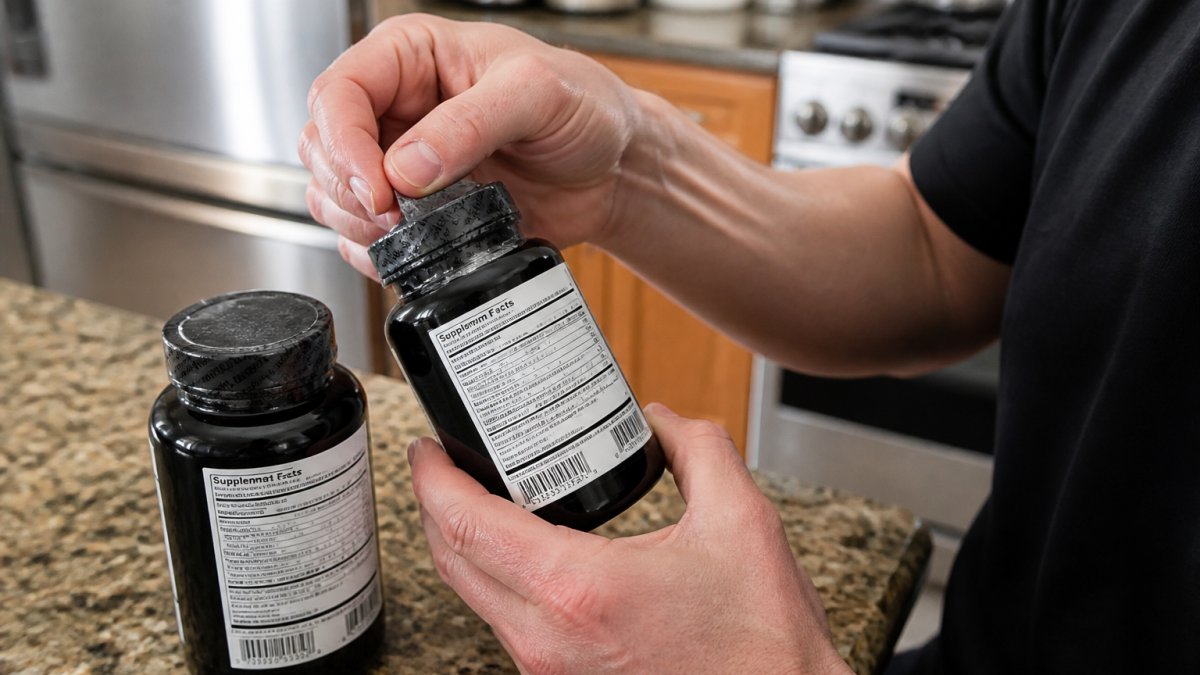
Label and Packaging Warning Signs
Run through this list before you buy:
- Misspelled words or blurry print
- Off colors compared to the brand's real packaging
- No lot number or expiration date
- A broken or missing tamper seal
- Vague health claims with no evidence
- A price that's too good to be true
Copied labels are getting better, but fakes still slip up on details. Check the brand's own site for the real label image and compare side by side.
Pro Tip The fastest check is the lot number. Real brands can trace a lot number back to a batch. If the seller can't explain it, walk away.
Supplement Seller Verification: A Marketplace by Marketplace Checklist
Supplement seller verification is the step most people skip. Don't. Before you buy from any third-party seller, confirm who they are.
| Seller Type | What to Check | Red Flag |
|---|---|---|
| Brand's own site | Buy direct, lowest risk | None, this is the safe pick |
| Large marketplace | Seller name, ratings, "ships from and sold by" | Third-party seller behind the listing |
| Social media shops | Business page history, reviews off-platform | Brand-new page, no history |
| Auction and resale sites | Seller feedback, return policy | No returns, no contact info |
| Unknown discount sites | Full company info, physical address | No address, no real reviews |
Here's the rule we live by: if you can't confirm the seller is authorized, assume they're not.
The Four-Point Seller Verification Process
Most guides tell you to "check the seller." Useless without a process. Here's the exact sequence I use before I trust any third-party listing.
1. Confirm seller identity. The listing should name a real business, not a random handle. Look for a physical address, a working phone number, and a history that predates the product. On large marketplaces, click the seller name and read the "About" page.
2. Confirm authorization. Use the brand's official "Where to Buy" or store locator. If the seller isn't listed, the brand has not authorized them.
3. Confirm fulfillment. "Ships from and sold by [Brand]" is the gold standard. "Sold by [Brand], fulfilled by [Marketplace]" is acceptable. "Sold by [Random Seller], fulfilled by [Random Seller]" means unknown hands and unknown storage. Supplements degrade in heat and humidity, you have no idea how that bottle was stored.
4. Confirm provenance. Ask for the lot number and the manufacturer's certificate of analysis (COA) for that lot. A legitimate seller can provide both; a counterfeit operation cannot. If the seller dodges or sends a generic COA that doesn't match the bottle's lot number, walk away.
Pro Tip Screenshot the listing before you buy. If the product arrives and something is off, you have a record of exactly what was promised. Marketplaces change listings fast, and your screenshot is evidence.
Marketplace-Specific Checks
Large marketplaces (Amazon, Walmart Marketplace, eBay). Highest-volume risk zones because counterfeiters hide behind fulfilled-by-marketplace programs. Check feedback, then read recent reviews for mentions of fakes, expired dates, or broken seals. A 98% seller can still ship fakes if the reviews are recent and specific.
Social media shops (Instagram, TikTok, Facebook). Often no verifiable business history. Check when the page was created, whether reviews are on- or off-platform, and whether there's a real return policy. A page launched three weeks ago selling name-brand supplements at deep discounts is not a legitimate retailer.
Auction and resale sites (eBay, Mercari, OfferUp). The wild west, sellers may resell expired products, opened bottles, or outright fakes. Check feedback history, ask for a photo of the lot number and expiration date, and confirm the return policy. No lot number photo, no buy.
Unknown discount sites. Easiest to spot. A legitimate retailer has a physical address, a customer service phone number, and a privacy policy. A scam site has none. Check domain age with a free WHOIS lookup, a domain registered three months ago selling brand-name supplements at 50% off is a scam.
What Third-Party Testing Does and Doesn't Prove
A certificate of analysis (COA) from a third-party lab proves a specific batch was tested for identity, potency, and contaminants. It does not prove the bottle in your hand came from that batch. Counterfeiters copy COAs and lot numbers. You need an authorized seller, controlled fulfillment, and a matching lot number. If any one fails, the COA is worthless.
At Tiger Fitness, we stock our own shelves and stand behind what we sell. That's the difference between a real retailer and a mystery seller.
Buying Supplements Online Safely: The Rules That Actually Matter
Buying supplements online safely comes down to a few hard rules. Follow them and you cut your risk fast.
- Buy direct from the brand whenever you can. This is the single best move.
- Check the seller name. "Sold by [brand]" is good. A random third-party name is not.
- Verify the seal and lot number the moment the box arrives.
- Skip deals that feel too cheap. Real quality costs money.
- Keep your receipt so you can report a problem.
Third-party testing helps, but it's not a magic shield. A COA proves a batch was tested, not that the bottle in your hand came from that batch. That's why buying direct matters.
At Tiger Fitness, we stock our own shelves and stand behind what we sell. That's the difference between a real retailer and a mystery seller.
What to Do When a Suspicious Product Shows Up
Got a product that looks off? Don't use it. Here's your playbook.
- Stop taking it right away.
- Photograph the bottle, label, seal, and lot number.
- Contact the seller in writing and ask for proof of authenticity.
- Report the listing to the marketplace.
- File a complaint with the Federal Trade Commission if you suspect fraud.
- Tell your doctor if you had any bad reaction.
A suspicious product is a signal, not a small annoyance. Treat it that way.
The Step-by-Step Response Plan
Most guides stop at "report it." Not enough. Here's the exact sequence I'd follow if a suspicious product landed on my doorstep.
Step 1: Stop using it immediately. Don't finish the bottle. Don't "see if it works." If the product is counterfeit or contaminated, every dose is a risk.
Step 2: Preserve the evidence. Keep the bottle, packaging, seal (even if broken), receipt, and shipping label.
Step 3: Contact the manufacturer directly. Don't just contact the seller. Find the brand's customer service on its official site. Tell them what you bought, where, and the lot number.
Step 4: Contact the seller in writing. Ask for proof of authenticity, including the lot number and the manufacturer's COA.
Step 5: Report the listing to the marketplace. Every major marketplace has a process for reporting counterfeit or suspicious products. Use it.
Step 6: File a complaint with the FTC. The Federal Trade Commission handles reports of fraud and deceptive practices. You can file online at ReportFraud.ftc.gov.
Step 7: Report to the FDA if you had a bad reaction. The FDA MedWatch program collects reports of adverse events from dietary supplements.
Step 8: Tell your doctor. If you had any symptoms, tell your doctor what you took and bring the bottle.
Watch Out If you experience chest pain, severe headache, rapid heartbeat, or any other serious symptom after taking a supplement, seek medical attention immediately. Don't wait to file reports first. Your health comes first.
What to Do If You Already Took It
If you took the product and feel fine, don't panic. Most counterfeits won't cause immediate harm, but that doesn't mean they're safe. Stop taking it, follow the steps above, and monitor how you feel. If you had a bad reaction, seek medical attention first, then follow the reporting steps. Your doctor can help document the reaction, which strengthens your FDA and FTC reports.
How to Get Your Money Back
If you bought from a marketplace, file a claim through its buyer protection program. Most major marketplaces refund counterfeit products if you show evidence, use your photos, the listing screenshot, and any seller communication. If denied, file a chargeback with your credit card company; counterfeits are covered under most card issuers' fraud protections.
If you bought from an unknown discount site, your refund chances are lower. File a complaint with the FTC and your state attorney general. You may not get your money back, but you'll help shut down the operation.
Conclusion
The supplement market is full of shortcuts, and unauthorized sellers are the biggest one. You work too hard on your training to gamble on a mystery bottle.
Buy from a source you trust. At Tiger Fitness, we offer a huge selection, fast shipping, and real customer service, plus free tools like our fitness calculators to keep your plan on track. Skip the gamble. Get started with Tiger Fitness and fuel your goals the safe way.
Frequently Asked Questions
Can supplements be sold without FDA approval?
Yes. Under federal law, dietary supplements do not go through FDA premarket approval the way drugs do. The FDA oversees manufacturing and labeling after products are on the market, but it does not approve supplements before sale. That means the burden falls on you to verify what you are buying. Buying from unauthorized marketplaces increases the chance you get an untested or mislabeled product, because nobody upstream confirmed what is in the bottle.
How can you tell if a supplement is counterfeit?
Look for copied labels with misspellings, blurry print, or mismatched fonts. Check that the lot number and expiration date are stamped cleanly and match the packaging style. Inspect the tamper-evident seal for signs of resealing. Compare the product against photos on the brand's official site. If the price is far below every other seller, that is a red flag. When in doubt, contact the brand directly and ask whether that seller is authorized.
What should you do if you suspect a supplement is counterfeit?
Stop taking it immediately. Keep the product, packaging, and receipt as evidence. Report the listing to the marketplace and file a complaint with the FDA through its MedWatch program if you had any adverse reaction. Contact the brand to confirm whether the seller is authorized. If you experienced symptoms, see a qualified healthcare professional and bring the product with you. Do not resell or give away a suspicious product.
Are vitamins from Amazon safe?
They can be, but it depends on the seller. GoodRx notes it is possible to order supplements safely from Amazon while recommending you buy directly from the brand's website to minimize risk. Third-party marketplace sellers are the weak link. Check whether the listing is sold and shipped by the brand itself or by an authorized retailer, verify the seller's storefront, and confirm the product with the brand if anything looks off.
Leave a comment