







PILLOW PLACEMENT FOR SHOULDER INJURY
Sleep Positions for Shoulder Injury Healing
Table of Contents
- Sleep Positions for Shoulder Injury Healing: The Positions That Work
- Why Shoulder Pain Gets Worse at Night
- Back Sleeping vs. Side Sleeping With a Shoulder Injury
- Pillow Placement for Shoulder Injury: Build the Setup
- Rotator Cuff Recovery Sleep Tips and Post-Surgical Sleep Hygiene
- Shoulder Injury Healing Timeline: What to Expect Month by Month
- Bedtime Pain Management Routine and When to See a Doctor
- Frequently Asked Questions
Last Updated: October 2, 2026
Sleep Positions for Shoulder Injury Healing: The Positions That Work
Sleep positions for shoulder injury healing matter more than most people think.
Here's what most guides get wrong: they tell you to "sleep on your back" and stop there. That advice fails the moment you're exhausted and roll onto your bad shoulder at 2 a.m.
Below, we'll break down the positions that actually work, how to build the right pillow setup, and what the recovery timeline really looks like.
Why Shoulder Pain Gets Worse at Night
Shoulder pain flares at night because of how you lie down.
A cross-sectional study from the National Institutes of Health found a reduced link between specific sleep postures and shoulder pain.
But other research points the other way. An MRI-based study on shoulder pain patients showed complex relationships between sleep position and pain levels.
Here's what matters: nocturnal pain disrupts sleep architecture. Poor sleep slows tissue repair. That's the real problem.
Back Sleeping vs. Side Sleeping With a Shoulder Injury
Back sleeping is the safest position for most shoulder injuries. The supine position distributes body weight evenly and takes direct pressure off the joint.
Side sleeping can work, but only on the non-painful side.
Never sleep on the injured shoulder. Never sleep on your stomach either.
Quick comparison:
| Position | Pressure on Shoulder | Best For |
|---|---|---|
| Back (supine) | Lowest | Most injuries, post-surgical |
| Non-painful side | Low with pillow support | Side sleepers who can't adjust |
| Painful side | Highest | Never |
| Stomach | High | Never |
If you're a lifelong side sleeper, back sleeping will feel strange for a week or two. Stick with it.
Pillow Placement for Shoulder Injury: Build the Setup
Pillow placement for shoulder injury is where most people fail. You can't just stack two pillows behind your head and call it done.
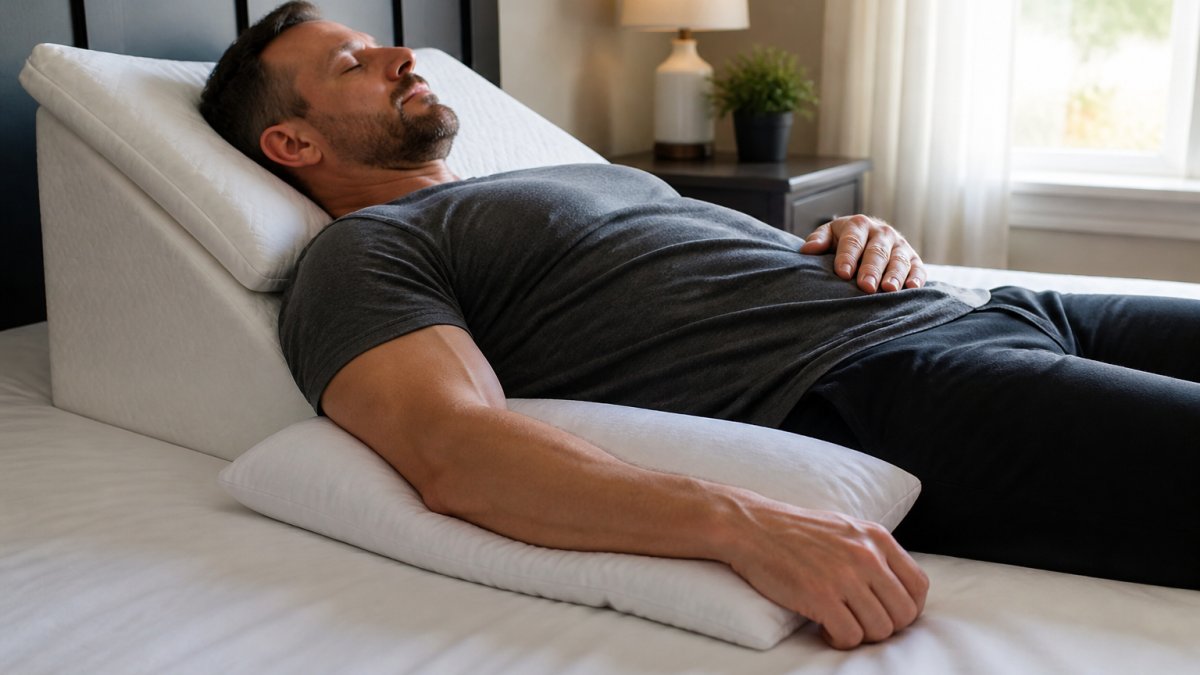
Here's the setup that works:
- Wedge pillow under the upper body to raise your torso 30-45 degrees
- Small pillow under the injured arm to stop it from dropping
- Body pillow along your side if you roll onto your good side
- Thin pillow under the head to keep the neck neutral
The goal is scapular stability and arm abduction control. Your arm should rest slightly away from your body, not pinned against it.
Pillow Selection: Loft, Density, and Material
This is the part that separates a setup that works from one that leaves you sore at 3 a.m.
Firmness trade-off. Too firm and you create new pressure points at the neck and jaw.
The arm pillow. A small, firm cushion, not a soft decorative pillow, under the injured arm keeps the shoulder from dropping into internal rotation.
Wedge angle. A 30-45 degree wedge is the standard recommendation for post-surgical and acute pain. Anything flatter and you lose the elevation benefit.
Pro Tip Test your setup before you're exhausted. Lie down for 10 minutes at 8 p.m. and see where your arm lands. Adjust then, not at 2 a.m. If you wake up with your arm pinned to your chest, your arm pillow is too soft or too low.
Rotator Cuff Recovery Sleep Tips and Post-Surgical Sleep Hygiene
Rotator cuff recovery sleep tips start with one rule: protect the repair. After surgery, your shoulder is immobilized for a reason. Don't fight it in your sleep.
Clinical guidance from Teton Therapy suggests a reclined position beats lying flat when pain is intense. Reclining takes pressure off the joint and keeps you from rolling.
Post-surgical sleep hygiene:
- Sleep in a recliner for the first 2-4 weeks if flat sleeping hurts
- Take prescribed pain medication 30 minutes before bed
- Keep your immobilizer on unless your surgeon says otherwise
- Avoid nicotine. It's a proven predictor of more painful awakenings
- Keep the room cool and dark to support sleep quality
Watch Out Skipping the immobilizer "just for one night" can undo weeks of healing. The tendon needs time to attach. Give it that time.
Shoulder Injury Healing Timeline: What to Expect Month by Month
The shoulder injury healing timeline runs 4-6 months for most rotator cuff repairs. Some cases take longer. Here's the rough breakdown:
- Weeks 1-6: Immobilization. Sleep reclined. Pain is highest.
- Months 2-3: Physical therapy begins. Sleep on your back with pillow support.
- Months 4-5: Range of motion returns. Try short stretches of side sleeping on the good side.
- Month 6+: Most patients return to their preoperative sleep positions.
That last point comes from PubMed's 2026 recovery data. Six months is the benchmark.
A note on recovery support: Tiger Fitness carries MTS Machine Motion, a joint support formula with Cissus Quadrangularis, Turmeric Root Extract, and MSM. It supports joint health and mobility while you rehab. It's not a substitute for physical therapy. It's a supplement to it.

Bedtime Pain Management Routine and When to See a Doctor
A bedtime pain management routine does three things: reduces inflammation, relaxes the muscles around the joint, and sets up your sleep environment. Most guides stop there. They don't tell you when to use heat versus ice, and they don't talk about the anxiety loop that keeps chronic shoulder pain patients awake long after the pain itself fades.
Heat vs. Ice: Timing Matters More Than the Tool
Heat and ice do different jobs, and using the wrong one at the wrong time can backfire.
- Ice is for acute inflammation, the first 48 to 72 hours after an injury or surgery, and after any activity that flares the joint. Apply for 15 to 20 minutes, wrapped in a thin towel, no more than 20 minutes at a time. Ice right before bed if the shoulder is hot, swollen, or throbbing.
- Heat is for stiffness and muscle guarding, the tight, achy feeling that shows up weeks into recovery. A warm shower, a heating pad on low for 15 to 20 minutes, or a moist heat wrap loosens the surrounding musculature so you can actually settle into position. Heat is best applied 30 to 60 minutes before bed, not right as you lie down.
- Never sleep on a heating pad. That's a burn risk and a fire risk. Use it, then remove it.
A common pattern: ice for the first few weeks post-injury, then shift to heat as the joint stiffens up during rehab. If you're not sure which one you need, ask your PT, the answer changes as you heal.
The Anxiety-Insomnia Loop Nobody Talks About
Chronic pain and poor sleep feed each other. You hurt, so you can't sleep. You can't sleep, so your pain tolerance drops and the hurt feels worse. Repeat. This loop is real, and it's the reason some people are still awake at 3 a.m. six weeks after the tissue has mostly healed.
Breaking the loop:
- Keep a fixed wake time. Same time every day, even after a bad night. This anchors your circadian rhythm.
- Get out of bed if you're not asleep in 20 minutes. Lying there frustrated trains your brain to associate the bed with pain and anxiety.
- Write down tomorrow's worry list before bed. Offloading the mental load reduces the bedtime rumination that keeps shoulder patients wired.
- Skip the doom-scroll. Blue light and pain-related content both spike arousal. Phone stays out of the bedroom.
- Talk to your doctor if insomnia runs past two weeks. Short-term sleep aids or a referral to a sleep specialist may be appropriate. This isn't a weakness, it's a tool.
The Full Routine
- Ice or heat, pick the right one for your stage, 30 to 60 minutes before bed
- Apply a topical cream like NOW Solutions Joint & Muscle Cream to the shoulder 20 minutes before bed
- Consider Hi-Tech Pharma Magnesium Glycinate to support muscle relaxation and sleep quality
- Do 5 minutes of gentle pendulum swings if cleared by your PT
- Set up your pillows before you get tired
- Write down tomorrow's worries, then leave the phone outside the room
When to See a Doctor
- Pain that wakes you every night for more than 2 weeks
- Numbness or tingling in the arm or hand
- Inability to lift the arm at all
- Pain that gets worse, not better, over time
- Insomnia that persists after the pain is under control
Key Takeaway Sleep is when your body repairs tissue. If shoulder pain is wrecking your sleep, it's wrecking your recovery. Fix the sleep, and the healing speeds up. Fix the anxiety around the sleep, and it speeds up faster.
Frequently Asked Questions
Can sleeping on my side make a rotator cuff injury worse?
Sleeping directly on the injured shoulder is the position to avoid. Research published in PubMed in 2026 found that preoperative side sleeping is a predictor of increased pain during recovery for shoulder patients. If you must sleep on your side, sleep on the non-painful side and hug a pillow in front of your chest to support the affected arm. The 2026 clinical guidance from OrthoNJ recommends exactly this setup: non-operative side down, pillow supporting the arm, and no arm held overhead.


What is the Best sleeping position for shoulder injury healing?
Back sleeping is the best overall option because it distributes body weight evenly and reduces direct pressure on the affected shoulder. A reclined position with extra pillows propping the upper body is the next best option for intense pain, according to 2026 guidance from Teton Therapy. Stomach sleeping is off the table. AARP's 2026 guide advises against it because it strains the shoulder joint.
How long does it take to recover from a shoulder injury?
It depends on the injury. A 2026 PubMed study found that most patients who undergo rotator cuff repair resume their preoperative sleep positions within 6 months of surgery. Soft tissue injuries that don't require surgery often improve faster, but the shoulder injury healing timeline varies by severity, age, and how consistent you are with physical therapy. Your surgeon or physical therapist can give you a realistic timeline for your specific case. Don't rush it and don't skip rehab.
How do I transition to back sleeping if I'm a lifelong side sleeper?
Start with a wedge pillow to elevate your upper body, then add a pillow under each arm to keep your shoulders supported. [Hi-Tech Pharma Magnesium Glycinate](https://tigerfitness.com/products/magnesium-glycinate) before bed can help with muscle relaxation and sleep quality. If back sleeping is impossible, the next best move is the supported side position: sleep on your non-painful side, hug a body pillow in front of your chest, and keep the injured arm from dropping. Give it a week. Your body adapts.
Leave a comment