







How to Calculate TDEE: The No-BS Guide
Table of Contents
- What Is TDEE and Why It Matters for Your Goals
- Understanding BMR vs TDEE
- Step-by-Step: How to Calculate Your TDEE
- TDEE Calculator for Muscle Gain: Eating in a Surplus
- How to Adjust Calories for Weight Loss Using TDEE
- The Accuracy Problem: What You Need to Know
- Metabolic Adaptation and Recalculating Your TDEE
- Conclusion
Last Updated: August 24, 2026
What Is TDEE and Why It Matters for Your Goals
Total Daily Energy Expenditure (TDEE) is the total number of calories your body burns in a 24-hour period. It's the foundation of every nutrition plan that actually works. Whether you're building muscle, losing fat, or maintaining your physique, understanding your TDEE is non-negotiable.

You can't out-train a bad diet, and you can't dial in nutrition without knowing how many calories you're burning. Your TDEE comprises three components: basal metabolic rate (calories burned at rest), thermic effect of food (calories burned digesting food), and activity energy expenditure (calories burned through exercise and daily movement).
According to research on metabolic variation, individual metabolic rates can vary by 20% or more from calculated estimates, even among people with identical stats. This is why cookie-cutter approaches fail. Calculate TDEE correctly, and you've got a roadmap. Get it wrong, and you're spinning your wheels for months.
Understanding BMR vs TDEE
Your Basal Metabolic Rate (BMR) is the number of calories your body burns at complete rest, just to keep your heart beating, lungs breathing, and brain functioning. BMR accounts for roughly 60-70% of your TDEE for most people, making it the largest component of your total daily calorie burn.
TDEE is your BMR plus three other components:
-
Thermic Effect of Food (TEF): 8-15% of TDEE. The calories burned digesting, absorbing, and processing food. Protein has the highest thermic effect (20-30% of calories consumed), carbs around 5-10%, and fat around 0-3%.
-
Exercise Activity Thermogenesis (EAT): 5-10% of TDEE for most people. Calories burned during structured training.
-
Non-Exercise Activity Thermogenesis (NEAT): 15-30% of TDEE. Every calorie you burn outside the gym: walking, fidgeting, occupational movement, maintaining posture. A desk job versus a physically demanding job can create a 300-500 calorie difference in NEAT alone, according to research from the Mayo Clinic.
Here's a practical breakdown. If your BMR is 1,600 calories:
- Sedentary (desk job, minimal movement): BMR (1,600) + TEF (200) + minimal EAT (100) + low NEAT (200) = ~2,100 TDEE
- Moderately active (gym 4x/week, some daily movement): BMR (1,600) + TEF (200) + EAT (300) + moderate NEAT (400) = ~2,500 TDEE
- Very active (gym 5-6x/week, physically demanding job): BMR (1,600) + TEF (200) + EAT (500) + high NEAT (600) = ~2,900 TDEE
The difference between sedentary and very active is 800 calories, but only 400 comes from structured exercise. The other 400 comes from NEAT. This matters because NEAT is the most controllable variable after you've dialed in training. If you're stuck on a plateau, increasing daily movement, parking farther away, taking the stairs, standing instead of sitting, can add 200-300 calories of burn without touching your workout.
The confusion most people have is thinking BMR and TDEE are the same thing. They're not. BMR is relatively static. TDEE fluctuates based on your activity, stress, sleep, and weather. Understanding both helps you set realistic targets and adjust when progress stalls.
Step-by-Step: How to Calculate Your TDEE
Calculating TDEE isn't complicated, but it requires accuracy.
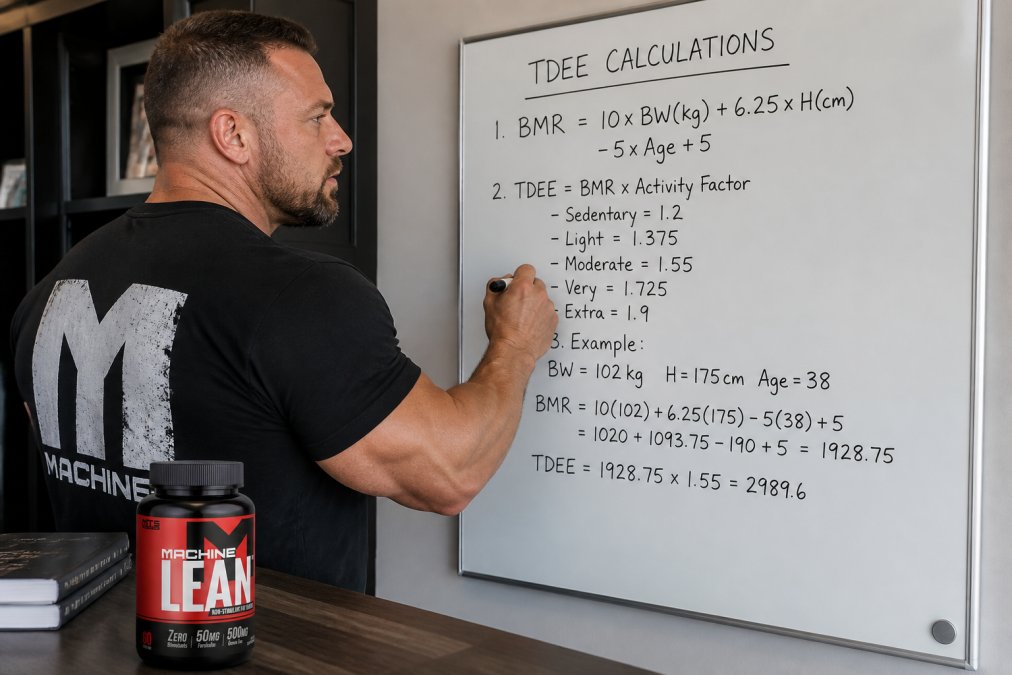
Step 1: Calculate Your Basal Metabolic Rate (BMR)
The Mifflin-St Jeor equation is the gold standard for estimating BMR. According to research on BMR prediction accuracy, the Mifflin-St Jeor formula predicts resting metabolic rate within 10% of measured values for roughly 80% of healthy adults.
Here's the formula:
For men: BMR = (10 × weight in kg) + (6.25 × height in cm) − (5 × age) + 5
For women: BMR = (10 × weight in kg) + (6.25 × height in cm) − (5 × age) − 161
A 30-year-old male, 180 pounds (81.6 kg), 5'10" (178 cm):
BMR = (10 × 81.6) + (6.25 × 178) − (5 × 30) + 5 = 816 + 1,112.5 − 150 + 5 = 1,783.5 calories
That's your baseline. This man burns roughly 1,784 calories per day just existing.
Step 2: Determine Your Activity Multiplier
According to MacroFactor user data cited by TDEE Calculator accuracy analysis, roughly 80% of users overestimate their activity level when using online TDEE calculators. They pick a multiplier that's too high, then wonder why they're not losing fat on a "deficit."
Use these multipliers:
| Activity Level | Multiplier | Description |
|---|---|---|
| Sedentary | 1.2 | Little to no exercise, desk job |
| Lightly Active | 1.375 | Light exercise 1-3 days/week |
| Moderately Active | 1.55 | Moderate exercise 3-5 days/week |
| Very Active | 1.725 | Hard exercise 6-7 days/week |
| Extremely Active | 1.9 | Physical job or training twice daily |
Be honest here. Most people should be picking "moderately active" or lower.
Step 3: Multiply BMR by Activity Level
Take your BMR and multiply it by your activity multiplier.
Using our example: 1,784 × 1.55 (moderately active) = 2,765 calories TDEE
That's your starting point.
TDEE Calculator for Muscle Gain: Eating in a Surplus
If you want to build muscle, you need to eat above your TDEE. A calorie surplus signals your body to build tissue. The standard recommendation is a 300-500 calorie surplus above TDEE for muscle gain. Using our example: 2,765 + 400 = 3,165 calories per day for muscle gain.
More calories doesn't mean more muscle. A 1,000-calorie surplus will just make you fat. The surplus should be modest and paired with progressive resistance training. Without the training stimulus, those extra calories become body fat, not muscle.
Track your weight weekly. If you're gaining 0.5-1 pound per week, you're in the right range. If you're gaining faster, dial back the calories slightly. If you're not gaining at all after three weeks, add 100-200 calories. stopping yo-yo dieting.
How to Adjust Calories for Weight Loss Using TDEE
For fat loss, create a calorie deficit by eating below your TDEE. A 300-500 calorie deficit is aggressive but sustainable. A 500-750 calorie deficit is more aggressive and will accelerate fat loss, but it's harder to maintain and increases the risk of losing muscle.
Using our example: 2,765 − 500 = 2,265 calories per day for fat loss.
A 15% error on a 2,000-calorie TDEE means being off by 300 calories daily, which compounds to 2.5 pounds over a month. Small errors matter.
Here's what actually works:
- Start with your calculated TDEE as a baseline
- Eat at that number for 2-3 weeks and track weight
- If weight doesn't change, you've validated your TDEE
- If weight goes up, your TDEE is lower than calculated, reduce by 200 calories
- If weight goes down, your TDEE is higher than calculated, increase by 200 calories
This empirical approach beats any calculator because it accounts for your individual metabolism.
The Accuracy Problem: What You Need to Know
Online TDEE calculators are typically within 10-15% of measured TDEE for most people, according to TDEE accuracy analysis. But that margin of error matters. A 15% miss on a 2,000-calorie TDEE is 300 calories, enough to derail your progress.
The real problem isn't the equation. The Mifflin-St Jeor formula is solid. The problem is user input, individual variation, and body composition. According to research from Baskent University Hospital, 50.4% of measurements with the Mifflin-St Jeor equation were within ±10% agreement with indirect calorimetry measurements in a study of 133 overweight and obese individuals.
Here's what throws off your calculation:
Activity level overestimation. You think you're "very active," but you're actually "moderately active." This is the single biggest mistake.
Individual metabolic variation. Two people with identical height, weight, age, and sex can have BMRs that differ by 10% or more due to genetics, hormones, sleep quality, and stress.
Body composition, the hidden variable. The Mifflin-St Jeor equation uses total body weight, not lean body mass. This creates predictable errors:
-
If you're carrying high body fat (30%+ for men, 40%+ for women): The formula overestimates your BMR because fat tissue burns roughly 2-4 calories per pound per day; muscle burns 6-10 calories per pound per day. This can inflate your calculated TDEE by 200-300 calories. Fix: If you're significantly overweight, reduce your calculated TDEE by 10-15% as a starting point, then adjust based on the scale over 2-3 weeks.
-
If you're very lean with high muscle mass (under 12% body fat for men, under 20% for women): The formula underestimates your BMR because it doesn't account for the metabolic cost of maintaining muscle tissue. Fix: If you're very lean and muscular, increase your calculated TDEE by 5-10% as a starting point.
To estimate your body composition: use a DEXA scan (most accurate), bioelectrical impedance scales (convenient but less accurate, ±3-5%), or visual estimation against reference photos. If you're unsure, assume average body composition and adjust after 2-3 weeks of tracking.
Metabolic adaptation. After extreme weight loss, measured resting metabolism can drop ~500 calories per day lower than expected based on current body composition and increased age. Your body fights back against prolonged calorie restriction.

The solution: treat the calculator as a starting point, not gospel. Adjust based on real-world results over 2-3 weeks. Your actual TDEE is determined by your scale and your training performance, not a formula. If you want a quick way to validate your numbers, use our FREE TOOLS & FITNESS CALCULATORS to cross-check your math.
Metabolic Adaptation and Recalculating Your TDEE
Your TDEE isn't static. As you lose fat, your metabolism adapts. You burn fewer calories at a lower body weight, which means that 2,265-calorie deficit that worked in week one might only be a 200-calorie deficit by week eight.

Metabolic adaptation can cause TDEE to drop faster than predicted by standard formulas once individuals lose weight. This is why people hit plateaus.
How to handle it:
Recalculate your TDEE every 4-6 weeks during a fat loss phase. As your weight drops, plug your new numbers into the Mifflin-St Jeor equation. Your BMR will be lower because you weigh less.
If you've been eating 2,265 calories for six weeks and the scale has stopped moving, don't immediately slash calories. First, recalculate. Your new TDEE might be 2,400 calories based on your lower body weight. If that's the case, you're not in a deficit anymore, you're eating at maintenance.
The fix: either reduce calories by another 200-300, or increase activity. Don't do both at once. Also, don't stay in an aggressive deficit for months. Every 8-12 weeks of dieting, take a 1-2 week break at maintenance calories. This gives your metabolism a chance to recover and helps preserve muscle mass.
Calculating TDEE is the first step. Adjusting based on real results is what separates people who get results from people who spin their wheels. Use the Mifflin-St Jeor formula to get your baseline, be honest about your activity level, then let the scale guide your adjustments. Track your progress, adjust when necessary, and stay consistent. That's how you get results.
Frequently Asked Questions
What is the most accurate way to calculate TDEE?
The Mifflin-St Jeor equation is widely considered reliable for calculating BMR, which is a component of TDEE. It predicts resting metabolic rate within 10% for 82% of non-obese adults. However, online TDEE calculators are typically within 10-15% of measured TDEE for most people. The biggest error comes from activity-level overestimation: roughly 80% of users pick an activity multiplier at least one level too high. Treat your calculated TDEE as a starting point and adjust based on real weight changes over 2-3 weeks.
How does TDEE differ from BMR?
BMR (Basal Metabolic Rate) is the number of calories your body burns at rest, just to stay alive. It accounts for 60-70% of your total daily energy expenditure. TDEE (Total Daily Energy Expenditure) includes your BMR plus all calories burned through activity, exercise, and daily movement. Think of BMR as your baseline and TDEE as your complete energy picture. To calculate TDEE, you take your BMR and multiply it by an activity factor based on your exercise frequency.
Can I use TDEE to build muscle without gaining excess fat?
Yes. To build muscle, you need to eat in a calorie surplus, typically 300-500 calories above your TDEE. This surplus provides energy for training and muscle growth. The key is pairing that surplus with consistent resistance training and adequate protein intake. Start at the lower end of the surplus range, track your weight weekly, and adjust if you're gaining too quickly (more than 1-2 pounds per week). This approach minimizes excess fat gain while maximizing muscle development.
How often should I recalculate my TDEE?
Recalculate your TDEE every 8-10 pounds of weight change. As your body composition shifts, your BMR changes, which affects your total daily energy expenditure. Additionally, metabolic adaptation occurs during extended calorie deficits, your measured resting metabolism can drop ~500 calories per day lower than expected after extreme weight loss. If you hit a plateau despite consistent dieting, recalculate and adjust your calorie target downward by 100-200 calories.
Leave a comment