







How to Calculate Daily Macros Easily: A Step-by-Step Guide
Table of Contents
- What Are Macronutrients and Why They Matter
- Step 1: Calculate Your TDEE (Total Daily Energy Expenditure)
- Step 2: Determine Your Fitness Goals and Caloric Deficit or Surplus
- Step 3: Set Your Macronutrient Ratio for Weight Loss and Muscle Gain
- How to Calculate Protein, Carbs, and Fats Per Day
- Using a Macro Calculator to Simplify the Process
- How to Track Macros Using Apps and Food Scales
- Common Mistakes When Calculating Daily Macros
How to Calculate Daily Macros Easily: A Step-by-Step Guide
Last Updated: July 29, 2026
Let me be direct: most people overthink how to calculate daily macros easily. They chase complicated formulas when the fundamentals are straightforward. Below, we'll walk through the exact steps to calculate your daily macronutrient targets, no guesswork, no spreadsheet hell.
What Are Macronutrients and Why They Matter
Macronutrients are the three essential nutrient categories your body needs in large quantities to function: protein, carbohydrates, and fats. These aren't optional. They fuel your workouts, rebuild muscle tissue, and regulate hormone production. Get them right, and your body composition improves. Get them wrong, and you're spinning your wheels no matter how hard you train.
The Three Macronutrients Explained
Protein is the foundation of muscle tissue. When you train, you create micro-tears in muscle fibers. Protein provides the amino acids needed to repair and grow those fibers larger and stronger. For athletes, protein intake directly impacts muscle hypertrophy and recovery.
Carbohydrates fuel high-intensity training. They're your primary energy source during workouts and support glycogen replenishment afterward. The amount you need depends on your activity level and training intensity. Sedentary individuals need less; athletes training multiple times per week need significantly more.
Fats regulate hormone production, support nutrient absorption, and provide energy. Many people fear dietary fat, but it's essential for testosterone production, brain function, and overall health. Don't skimp on this macronutrient.
The real work isn't understanding what they are, it's calculating how much you personally need based on your body, goals, and activity level.
Pro TipMost people fail at macro tracking because they use generic recommendations instead of calculating their own numbers. A 150-pound sedentary office worker and a 150-pound strength athlete have completely different macro needs. Calculate for YOUR situation, not the average.
Step 1: Calculate Your TDEE (Total Daily Energy Expenditure)
Your TDEE is the total number of calories your body burns in a day. This is the foundation for everything else. You can't set proper macros without knowing how many calories you're working with.
TDEE has two components: your Basal Metabolic Rate (BMR) plus calories burned through activity.
Finding Your BMR and Activity Level
Your Basal Metabolic Rate (BMR) is the number of calories your body burns at rest, just keeping your heart beating, lungs breathing, and brain functioning. Use the Mifflin-St Jeor equation, which is more accurate than older formulas:
For men: (10 × weight in kg) + (6.25 × height in cm) − (5 × age) + 5
For women: (10 × weight in kg) + (6.25 × height in cm) − (5 × age) − 161
Once you have your BMR, multiply it by your activity factor based on your lifestyle:
- Sedentary (little or no exercise): BMR × 1.2
- Lightly active (exercise 1-3 days per week): BMR × 1.375
- Moderately active (exercise 3-5 days per week): BMR × 1.55
- Very active (exercise 6-7 days per week): BMR × 1.725
- Extremely active (intense daily training or physical job): BMR × 1.9
The result is your TDEE. This is your maintenance calorie level, the amount you need to stay at your current weight.
Key TakeawayYour TDEE is the single most important number in nutrition planning. Everything else- caloric deficit, caloric surplus, macronutrient ratios- is built on this foundation. Spend time getting this right.
Step 2: Determine Your Fitness Goals and Caloric Deficit or Surplus
Your goal determines whether you eat below, at, or above your TDEE.
For weight loss: Eat in a caloric deficit. A moderate deficit of 300-500 calories below TDEE creates steady fat loss while preserving muscle. Aggressive deficits (over 500 calories) often result in muscle loss and metabolic slowdown.
For muscle gain: Eat in a caloric surplus. A modest surplus of 300-500 calories above TDEE supports muscle hypertrophy without excessive fat gain. More calories doesn't mean more muscle; it means more fat if you're not training hard.
For body recomposition: Eat at maintenance (your TDEE). This is realistic only if you're new to serious training or returning from injury. Experienced lifters can't simultaneously build significant muscle and lose significant fat at maintenance calories.
Be honest about your goal. Many people claim they want to "build muscle and lose fat simultaneously," but that's rarely the priority. Pick one, execute it properly, then shift to the other.
Watch OutThe biggest mistake is using an arbitrary deficit ("I'll just eat 1,200 calories") instead of calculating it from your TDEE. Arbitrary numbers often result in either no progress or unsustainable hunger. Calculate your TDEE first, then apply your deficit or surplus to that number.
Step 3: Set Your Macronutrient Ratio for Weight Loss and Muscle Gain
Once you know your calorie target, divide those calories into macronutrients. The ratios differ based on your goal.
For muscle gain:
- Protein: 0.8-1 gram per pound of bodyweight
- Fat: 0.3-0.4 grams per pound of bodyweight
- Carbohydrates: remaining calories divided by 4
For weight loss:
- Protein: 1-1.2 grams per pound of bodyweight (higher protein preserves muscle during a deficit)
- Fat: 0.25-0.35 grams per pound of bodyweight
- Carbohydrates: remaining calories divided by 4
The higher protein intake during a cut serves a specific purpose: it increases satiety (makes you feel fuller longer) and has a higher thermogenic effect (your body burns calories digesting it). This is why protein becomes more critical when calories are restricted.
Carbohydrates aren't the enemy; they're the variable you adjust based on activity level and preference. More training volume? More carbs. Sedentary day? Less carbs. The point is to fuel your actual activity, not eat the same amount regardless of what you did that day.
How to Calculate Protein, Carbs, and Fats Per Day
Now we get specific. Let's walk through a real example.
Scenario: 185-pound male, 28 years old, 5'10", trains 5 days per week (moderately active).
Step 1 - Calculate BMR: (10 × 84 kg) + (6.25 × 178 cm) − (5 × 28) + 5 = 1,819 calories
Step 2 - Calculate TDEE: 1,819 × 1.55 = 2,819 calories (maintenance)
Step 3 - Set goal: Muscle gain = 2,819 + 400 = 3,219 calories
Step 4 - Calculate macros:
Calculating Protein Intake
For muscle gain at 185 pounds: 185 × 0.9 = 166 grams of protein per day.
Protein has 4 calories per gram, so 166 × 4 = 664 calories from protein.
This is non-negotiable. You need this amount to support muscle protein synthesis. Anything less and you're leaving gains on the table.
Calculating Carbohydrate Intake
Remaining calories after protein and fat: 3,219 − 664 (protein) − 666 (fat, calculated below) = 1,889 calories.
Divide by 4 (calories per gram of carbs): 1,889 ÷ 4 = 472 grams of carbohydrates per day.
Carbs fuel your training. On heavy training days, you'll use these. On lighter days, you might feel sluggish at this amount; that's normal. The point is to average this intake across the week.
Calculating Fat Intake
For muscle gain at 185 pounds: 185 × 0.35 = 65 grams of fat per day.
Fat has 9 calories per gram, so 65 × 9 = 585 calories from fat. (I rounded to 666 above for easier math, close enough for real-world application.)
Your daily target:
- Protein: 166g
- Carbs: 472g
- Fat: 65g
- Total: 3,219 calories
This is how you calculate daily macros for YOUR body and goal. Not a guess. Not a generic recommendation. Your numbers.
Using a Macro Calculator to Simplify the Process
The math above is straightforward, but if you want to skip the calculations entirely, macro calculators exist. Tiger Fitness provides FREE TOOLS & FITNESS CALCULATORS that handle these computations instantly. Input your stats, select your goal, and the calculator spits out your daily targets.
However, and this is important, understand the math behind the calculator. Know why it's recommending what it recommends. Too many people plug numbers into a tool and then ignore the output because they don't understand it. Understanding the logic makes you more likely to stick with the plan and adjust it intelligently when needed.
The calculator is a tool, not a replacement for knowledge.
How to Track Macros Using Apps and Food Scales
Calculating your macros means nothing if you don't actually track them. This is where most people fail; they know their targets but don't measure their intake.
Tracking Apps and Wearable Integration
Apps like MyFitnessPal, Cronometer, and MacroFactor log your food intake and calculate macros automatically. You scan barcodes, search for foods, or manually enter meals. Over time, you see patterns in your eating.
The advantage: you don't need to do math. The disadvantage: you're only as accurate as your food logging. Restaurant meals, home-cooked dishes, and portion sizes are often guessed rather than measured.
Wearable tech like fitness trackers estimates your daily calorie burn, but these estimates are notoriously inaccurate. Use them as a general reference, not gospel. Your actual results, the scale, your strength progression, how you look in the mirror, are more reliable than what your watch claims you burned.
Visual Portion Estimation for Busy Athletes
Not everyone wants to weigh and log every meal. If you're disciplined, visual estimation works. A palm-sized portion of protein (chicken, fish, beef) is roughly 25-30 grams. A fist-sized portion of carbs (rice, potato, pasta) is roughly 30-40 grams. A thumb-sized portion of fat (oil, butter, nuts) is roughly 10-15 grams.
This method isn't perfect, but it's better than eating randomly. Most people underestimate how much they eat, so visual estimation often reveals why progress stalls.
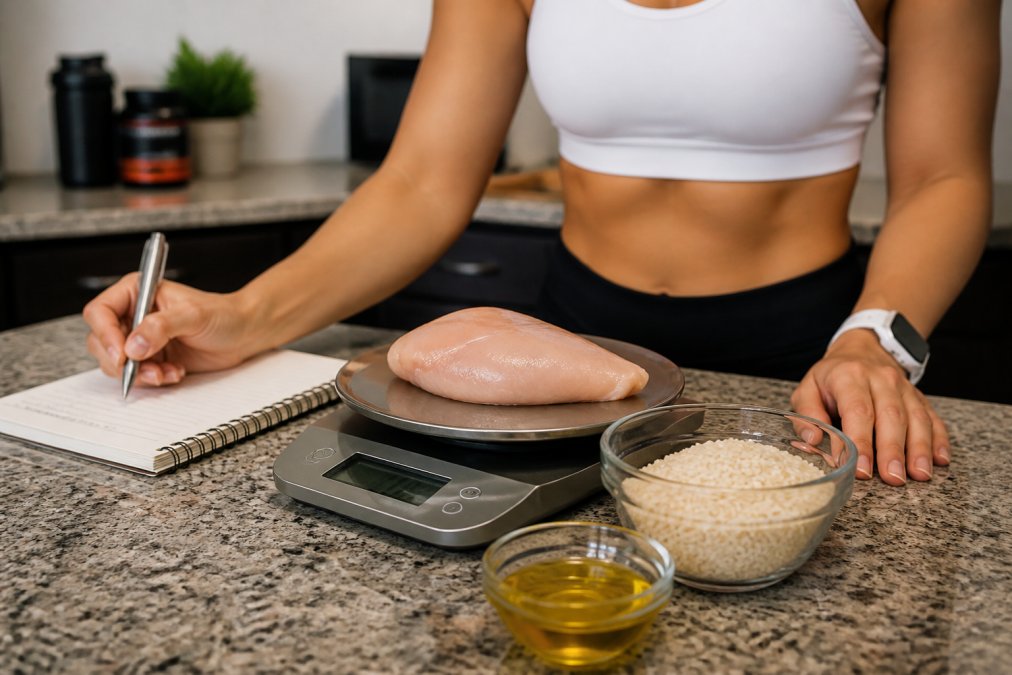
The real talk: if you're serious about body composition, you'll weigh your food at least for the first few weeks. Once you develop portion awareness, you can eyeball it. But starting with a food scale teaches you what 150 grams of chicken actually looks like versus what you think it looks like.
Pro TipProtein Powder and nutrient-dense products with exact macronutrient labels are your friends when tracking. They eliminate guesswork. A quick snack that fits your macros perfectly beats trying to estimate the macros of a home-cooked meal.
Common Mistakes When Calculating Daily Macros
Most people make predictable errors that tank their progress. Here's what to watch for:
Using generic ratios instead of calculating from TDEE. "Just eat 40% carbs, 30% protein, 30% fat" sounds simple but ignores your actual calorie needs. A 150-pound person and a 250-pound person shouldn't eat the same macro ratios.
Forgetting that protein scales with bodyweight, not calories. Your protein target is based on your actual body mass, not your calorie deficit. A 200-pound person cutting calories still needs roughly 200 grams of protein, not a reduced amount.
Eating the same macros on training and non-training days. Your carb needs change based on activity. A heavy leg day requires more carbs than a rest day. Flexible dieters adjust carbs up or down; rigid dieters eat the same amount regardless and wonder why they feel depleted.
Ignoring micronutrient density while chasing macro targets. You can hit your protein, carbs, and fats with junk food and still look and feel terrible. Prioritize nutrient-dense whole foods. The macros matter, but so does where those macros come from.
Adjusting macros too frequently. Give your nutrition plan 2-3 weeks before changing anything. Your body needs time to adapt. Jumping between different macro ratios every few days prevents you from ever actually testing whether a plan works.
Not tracking consistently. Tracking 5 days a week and guessing the other 2 doesn't work. If you're tracking at all, do it every day. The data is only useful if it's complete.
The fundamentals are simple: calculate your TDEE, apply your deficit or surplus, set your macros based on your goal, and track consistently. Most people know this. The difference between those who get results and those who don't is execution, not knowledge.
Getting your macros right is the foundation of any successful nutrition plan. Whether you're cutting fat, building muscle, or recomposing your body, the process is the same: calculate your numbers, log your intake, and adjust based on real-world results. Start with accurate calculations, stay consistent with tracking, and you'll see measurable progress in your body composition within 4-6 weeks.
Frequently Asked Questions
What is the easiest way to calculate macros for my fitness goals?
The easiest way is to calculate your TDEE first, then apply a macro ratio based on your goal. For muscle gain, use 1g protein per pound of bodyweight, fill 25-35% of calories from fats, and the remainder from carbs. Use a free macro calculator tool to automate this—it eliminates manual math and accounts for your activity level instantly. Track using an app like MyFitnessPal or Cronometer to log food and monitor daily intake against your targets.
How do I calculate my macros for weight loss?
Start with a 300-500 calorie deficit below your TDEE. Maintain high protein intake (0.8-1g per pound of bodyweight) to preserve muscle during a caloric deficit. Allocate 25-30% of calories to fats for hormonal health, then fill remaining calories with carbs. This macronutrient ratio for weight loss prioritizes satiety and metabolic rate. Track consistently for 2-3 weeks, then adjust based on progress and hunger levels.
What is a good macro ratio for beginners?
A solid starting point is 40% protein, 35% carbs, and 25% fats—this works for most beginners regardless of goal. However, adjust based on your specific aim: muscle gain benefits from 30-35% protein, while weight loss works well at 35-40% protein. Use a macro calculator to convert these percentages into actual grams based on your TDEE and bodyweight. Track for 4 weeks, monitor results, then refine based on energy levels and progress.
Can I use a macro calculator for free, and how accurate are they?
Yes—most macro calculators are free and reasonably accurate. They use standard formulas (Mifflin-St Jeor for BMR, activity multipliers for TDEE) that provide a solid starting point. Accuracy depends on honest input: your actual bodyweight, activity level, and goals. The calculator gives you initial targets, but real-world tracking reveals your true needs. If you're not seeing results after 3-4 weeks, adjust your macros by 50-100 calories and reassess.
Leave a comment