
NEW NULLA BAR FLAVORS
In-Stock Now!

Last Updated: November 5, 2026
Quick Summary
Bulk supplement ordering works best when you buy the right product from a seller you have vetted, so the lower cost per serving is not undone by spoilage or a bad lot. Check that the seller has a real business address and a working contact line, and that a Certificate of Analysis matches the exact lot you are buying. Then size the order to your actual monthly use.
Buying supplements in bulk can cut your cost per serving, but only if you get bulk supplement ordering right by buying the right product from a source you can trust. The global dietary supplement market is projected to exceed $300 billion by 2028, according to a 2025 review of dietary supplements in PubMed Central. A market that size is full of sellers who range from excellent to dangerous, so the order you place matters.
Here is where people go wrong. They see a big bag at a low unit price and buy it without checking the label, the lot testing, or whether they will use it before it degrades. A cheap 5-pound tub is no bargain if half of it goes stale before you finish it.
Buy from trusted brands or retailers and check for quality seals or third-party certifications. Bulk size is never a reason to skip that step.
Before any money changes hands, confirm the seller is who they say they are. Look for a real business address, a working customer service line, and a return policy you can read in plain English.
That is the bare minimum. The problem is that most buyers stop there and then get burned on a five-figure bulk order. You need a repeatable scorecard so you compare every supplier on the same criteria instead of going on gut feel.
1. Business identity and registration. Confirm the company is registered to do business, the address is a real commercial location and not a virtual mailbox, and the phone number reaches a human during business hours.
2. Facility registration and GMP status. Under federal rules, dietary supplement facilities must follow current Good Manufacturing Practices. Ask the supplier which facility made your product and how it verifies compliance.
3. Lot-level Certificates of Analysis. Legitimate suppliers publish or provide a COA for the exact lot you are buying, not a generic sample COA from two years ago.
4. Third-party certification. Look for verification from a recognized program and confirm the certification covers the specific product and lot. A logo on the homepage does not by itself mean your tub was tested, so confirm the certification covers your product.
5. Traceability and recall procedures. Ask how the supplier traces a finished lot back to raw material suppliers, and ask for its written recall procedure.
6. Lead times and minimum order quantities. Get the real lead time in writing, not the marketing estimate. Ask what the minimum order quantity is, whether it changes by SKU, and what happens to pricing if you order below it.
7. Complaint handling and references. Ask for two or three business references you can actually call, and ask specifically how the supplier handled a past quality complaint. Vague answers here tell you everything.
Compare two or three sellers on the same product before committing. Track the price per serving, not the price per container, and factor in shipping and minimum order requirements. The cheapest listing often isn't the cheapest order once fees are added. If you want a quick way to run the numbers on servings, dosing, and macros before you commit to a size, the Free Tools & Fitness Calculators page has calculators that help you match quantity to how much you really use.
Watch out: a supplier that is fast to quote and slow to produce documentation is usually hiding something. Documentation speed is a proxy for how organized the operation is.
Use the how to spot fake supplement certifications guidance to verify certification claims before you buy.
Third-party testing means an independent lab checks the product against its label. That is the strongest evidence you can get that what is in the tub is what the label says. Look for products verified by a recognized program, and confirm the verification applies to the exact product and lot you are buying. Our NSF certified supplements explainer covers what that certification actually verifies.
A Certificate of Analysis, or COA, is the lab report for a specific batch. It should list the tested potency, contaminant screening results, and the lot number matching your container. If a seller cannot produce a COA for the lot you are buying, do not buy bulk from them.
Learn what a COA actually contains before you rely on one. Our explainer on what a supplement Certificate of Analysis includes breaks down the sections to read.
Check every bulk label for a Supplement Facts panel, the ingredient amounts, the net quantity, and the manufacturer or distributor contact information before you order.
Read the serving size carefully. Bulk containers can make a product look cheaper per serving than it really is if the serving size is smaller than what you actually take. Do the math on the real serving you use.
Be skeptical of marketing claims that promise results the label cannot support. Health claims should be backed by evidence, and a claim without evidence behind it is a reason to pass on the product.
For help spotting mislabeled or fake ingredients, see practical guide to spotting fake supplement ingredients.
Buying bulk only saves money if the product stays potent until you use it. Heat, moisture, light, and air are the main enemies. Keep sealed containers in a cool, dry, dark place away from the stove, the car, and the bathroom.
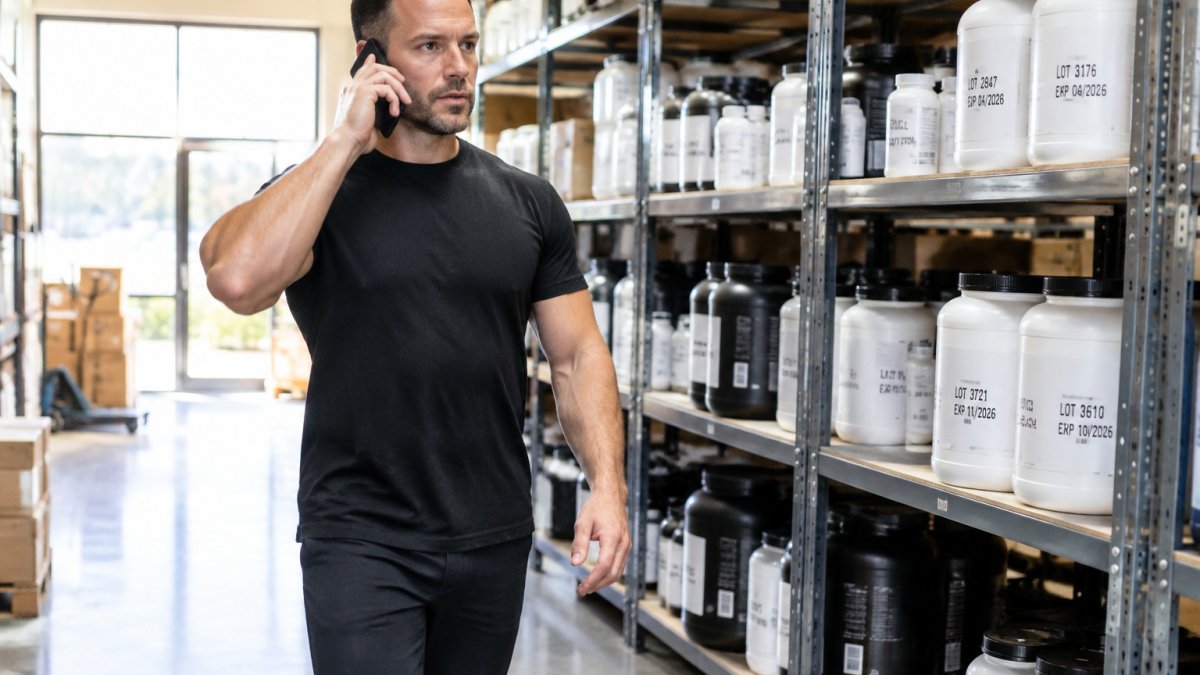
Once you open a container, reseal it tightly and use a dry scoop every time. Moisture introduced by a wet scoop is one of the fastest ways to clump powders and invite spoilage.
Rotate stock so older lots get used first. Write the open date on the container and track expiration dates in a simple spreadsheet. A bulk supply you cannot use before it expires is wasted money.
Watch for signs of spoilage: off smells, unusual color, clumping, or rancid odors in fat-based products. If something seems wrong, do not use it.
Work out how much you actually use per month, then buy enough to cover that period plus a buffer, not the largest tub on the shelf. Our guide to supplement serving size accuracy shows how to confirm the label's serving count matches what arrives.
That is the simple version. The real math is total cost of ownership, and almost nobody does it. Here is how to run it.
Step 1: Calculate true monthly usage. Count scoops or servings you actually consume per day, multiply by 30, and be honest. Most people overestimate usage and end up with expired product. If you train five days a week, do not plan for seven.
2. Build the landed cost per serving. Take the unit price, add freight, add any duties or handling fees, and divide by the number of servings in the container. Then compare that landed cost across order sizes.
3. Factor in spoilage cost. Multiply the probability you will not finish the container before expiration by the cost of the unused portion.
4. Set a reorder point with safety stock. Reorder point equals average daily usage times lead time in days, plus safety stock. If you use 10 servings a day and your supplier's lead time is 21 days, you need 210 servings just to cover lead time.
5. Plan for supply disruption. Keep a backup supplier vetted and ready, even if you never use them. A single-source bulk supply is a single point of failure.
6. Inspect every shipment on arrival. Check the seals, the lot numbers, and the expiration dates against your order and the COA. Inspect for damage, leaks, or broken seals before you store anything. Document problems with photos right away so a claim is easy to file.
Watch out: a shipment that arrives with a different lot number than the COA you were sent is a documentation failure. Quarantine it and get a corrected COA before you put it into inventory.
Run this math once per SKU and you will know exactly which bulk sizes are real savings and which are just bigger boxes with a worse outcome.
Write a one-page checklist and use it every time you order: verified seller, lot-matched COA, label check, serving-size math, storage plan, and reorder date. Run every bulk purchase through that list before you click buy.
Tiger Fitness carries a range of options, including the Ultimate Beginner Stack at $124.97, the Drop It Stack at $99.99, and the Unmatched 2Shred Weight Management Kit at $199.99. Check each label against the checklist above before you commit to a larger order.


| Step | What to Check | Frequency |
|---|---|---|
| Supplier vetting | Real address, working contact, clear return policy | Every new seller |
| Testing | COA matches your exact lot | Every order |
| Label review | Supplement Facts panel, serving size, net quantity | Every new product |
| Storage | Cool, dry, dark, tightly sealed | Ongoing |
| Reorder | About one month of supply remaining | Every cycle |
Bulk supplements are only as trustworthy as the supplier and the testing behind them. Ask for a current Certificate of Analysis for the specific lot you are buying, confirm the product has been independently tested by a recognized third-party lab, and check that the label matches what the testing shows. A supplier that will not share batch documentation, or that cannot tell you where raw ingredients are sourced, is a red flag. Buying in bulk does not change the standard; it raises the stakes, because a bad lot multiplies your losses.
Dietary supplements sold in the United States are regulated by the FDA, so check the official FDA website for the current rules. Labels must list the product name, net quantity, a Supplement Facts panel, ingredient list, manufacturer or distributor name and address, and any required warnings. The FDA does not approve supplements before they reach the market, so verifying compliance falls on the buyer. Check the label against these requirements before you commit to a large order.
Watch for unusually low prices that sound too good to be true, vague or missing lot numbers, no expiration date, and claims that a supplement cures disease or guarantees specific results. Be wary of suppliers who cannot provide a Certificate of Analysis, who refuse to name their manufacturer, or who pressure you into a large order before you have seen documentation. Missing contact information and mismatched labels between the listing and the product on arrival are also warning signs worth acting on immediately.
Store bulk supplements in a cool, dry, dark place, sealed in their original containers or airtight bins. Heat, humidity and light are the main causes of potency loss, and powders clump and degrade when moisture gets in. Keep lots separated, label each container with its lot number and expiration date, and follow a first-expired, first-out rotation so older stock gets used before it loses strength. Check the label for any storage temperature directions and follow them exactly.
Raw powders usually cost less per serving, but they demand more handling: weighing, blending, labeling and documenting each batch. Pre-packaged supplements cost more per serving and leave less room for error, and they arrive with labeling that already meets regulatory requirements. Run the numbers on your actual volume, including your time and the risk of contamination or dosing error, before deciding. For most buyers, the cheapest option per unit is not the cheapest option once handling and risk are counted.
{"one"=>"Select 2 or 3 items to compare", "other"=>"{{ count }} of 3 items selected"}







Leave a comment