







IDENTIFYING HIGH QUALITY SUPPLEMENT MANUFACTURERS
Identifying High Quality Supplement Manufacturers: A No-Nonsense Guide
Last Updated: October 27, 2026
Quick Summary
Identifying high quality supplement manufacturers means auditing their GMP compliance, batch records, and independent testing before you sign anything. Ask for FDA registration, inspection results, batch specific COAs from an accredited lab, and a written quality agreement. A manufacturer that hesitates on documents is a manufacturer you walk away from.
- Score each criterion 0 to 2, weight it, and treat a total below roughly 70% as a pass.
- Every production run needs a batch record tracing the finished bottle back to its raw ingredient lot.
- A COA only counts if it is batch specific, names the lab, and includes heavy metals and microbial panels.
- In-house testing is the manufacturer grading its own homework, so verify the outside lab is accredited.
- No facility audit allowed, ever, is a red flag that should end the conversation.
Table of Contents
- Why Supplement Manufacturer Quality Decides Your Results
- The Supplement Manufacturer Audit Checklist You Need Before You Sign
- Questions to Ask a Supplement Manufacturer Before You Commit
- What a Supplement Certificate of Analysis Actually Tells You
- Why Third-Party Tested Supplements Beat In-House Claims
- Red Flags and Commercial Risk When Vetting Manufacturers
- Choosing Supplements You Can Trust at Tiger Fitness
- Frequently Asked Questions
Why Supplement Manufacturer Quality Decides Your Results
Three in four adults use supplements, according to data cited by Nutritional Outlook's supplement market coverage. That means the powder in your tub came from somebody's factory. The question is whether that factory runs tight or sloppy.
Here's the hard truth most people skip: identifying high quality supplement manufacturers, the actual supplement manufacturers behind the label, is the single biggest variable in whether your stack works. Not the label art. Not the influencer holding the tub. The manufacturer.
A great formula made in a weak facility is a bad product. A boring formula made in a strong facility is a good one. That's the whole game.
And the industry is growing fast. IBISWorld counted 377 vitamin and supplement manufacturing businesses in the US in 2026, up 2.4% from 2025, with average annual growth of 2.5% over five years (IBISWorld vitamin and supplement manufacturing data). More factories means more choices. It also means more bad ones to weed out.
Below is a checklist for evaluating supplement manufacturers.
The Supplement Manufacturer Audit Checklist You Need Before You Sign
A supplement manufacturer audit checklist is a set of documented checks you run before signing a contract, covering facility standards, testing, records, and traceability. Run it before you pay a deposit. Not after.
Most people vet a manufacturer by reading their website. That's not vetting. That's reading marketing copy. Here's what to actually check, and how to score it so the decision isn't a gut call.
Facility, GMP, and Documentation Checks
Good Manufacturing Practices, or GMP, are the baseline rules for how a supplement facility must operate. The FDA sets these in 21 CFR Part 111, and a real manufacturer can prove compliance on paper. Ask for these documents and score each one 0 (missing), 1 (partial), or 2 (complete and current):
- Current GMP registration status and FDA registration number
- Most recent FDA inspection results, including any Form 483 observations and the corrective actions taken
- Written quality assurance and quality control procedures
- Standard operating procedures for each production step
- Allergen and cross-contamination controls
- Equipment cleaning and calibration logs
- Written quality agreement that assigns responsibility for testing, deviations, and recalls
If a manufacturer hesitates on any of these, walk. A facility that runs clean keeps records without being asked twice.
Batch Records and Traceability
Batch level documentation is where most buyers stop asking questions. Don't be most buyers.
Every production run should have a batch record showing what went in, when, and who handled it. You want to trace a finished bottle back to its raw ingredient lot. That's called traceability, and it's non-negotiable. Ask for:
- Batch numbers tied to specific production dates
- Ingredient lot numbers from the supplier
- Manufacturing date and expiration date on every run
- A sample batch record you can review before signing
- A written recall procedure that shows how a lot is pulled and who is notified
No batch records, no deal. Simple as that.
The Manufacturer Scorecard: Weighted Criteria and Evidence
A checklist tells you what to ask. A scorecard tells you whether to sign. Weight the criteria by what actually affects product quality and your launch risk, then demand evidence for each score. A practical weighting looks like this:
| Criterion | Weight | Evidence to Request |
|---|---|---|
| GMP compliance and inspection history | 25% | FDA registration, latest inspection results, corrective actions |
| Independent testing and COAs | 20% | Batch-specific COA from an accredited lab, full panel |
| Batch records and traceability | 15% | Sample batch record, lot-to-lot traceability, recall procedure |
| Ingredient supplier qualification | 15% | Supplier approval records, incoming COAs, audit reports |
| Capacity, lead times, and MOQs | 15% | Written capacity statement, sample schedule, MOQ terms |
| Contract and formula ownership | 10% | Signed quality agreement, IP and formula ownership clause |
Score each criterion 0-2, multiply by the weight, and total it. A manufacturer below roughly 70% of the possible score is a pass. Above that, you have a real operator. The scorecard is only as good as the evidence behind it, so never award a 2 without a document in hand.
Supplier Qualification and Ongoing Oversight
Onboarding is not the finish line. The manufacturers that fail you usually pass the first audit and slip later. Build ongoing oversight into the relationship:
- Approve ingredient suppliers before they ship, and keep their COAs on file
- Review corrective and preventive action (CAPA) reports after any deviation
- Requalify the manufacturer on a set schedule, annually is a common pattern, and after any ownership, facility, or process change
- Track batch failure rates and complaint trends quarter to quarter
A manufacturer that welcomes this level of scrutiny is telling you something. One that resists it is telling you more.
Questions to Ask a Supplement Manufacturer Before You Commit
The right questions to ask a supplement manufacturer expose whether they run a real quality system or just talk about one. Ask them in writing. Verbal answers don't count.
Here's our short list. Use it like a script.
- Who actually makes the product? Some brands broker to a contract manufacturer and never touch the facility. Know who's running the machines.
- Can you send a sample certificate of analysis? A real manufacturer has one ready.
- Which independent lab do you use? If testing happens in-house only, ask why.
- How do you verify ingredient identity? You want a documented method, not a promise.
- What happens when a batch fails testing? Listen for a clear rejection and quarantine process.
- Can you support private label or custom formulation? Match their capability to your actual manufacturing needs.
- Who handles labeling and packaging support? Regulatory compliance on labels is not optional.
Watch out: a manufacturer who answers every question with "yes" and produces no documents is telling you something. Believe the paperwork, not the sales pitch.
What a Supplement Certificate of Analysis Actually Tells You
A supplement certificate of analysis is a document from a testing lab that reports what a specific batch actually contains, including potency, purity, and contamination results. It's the receipt for your product's quality.
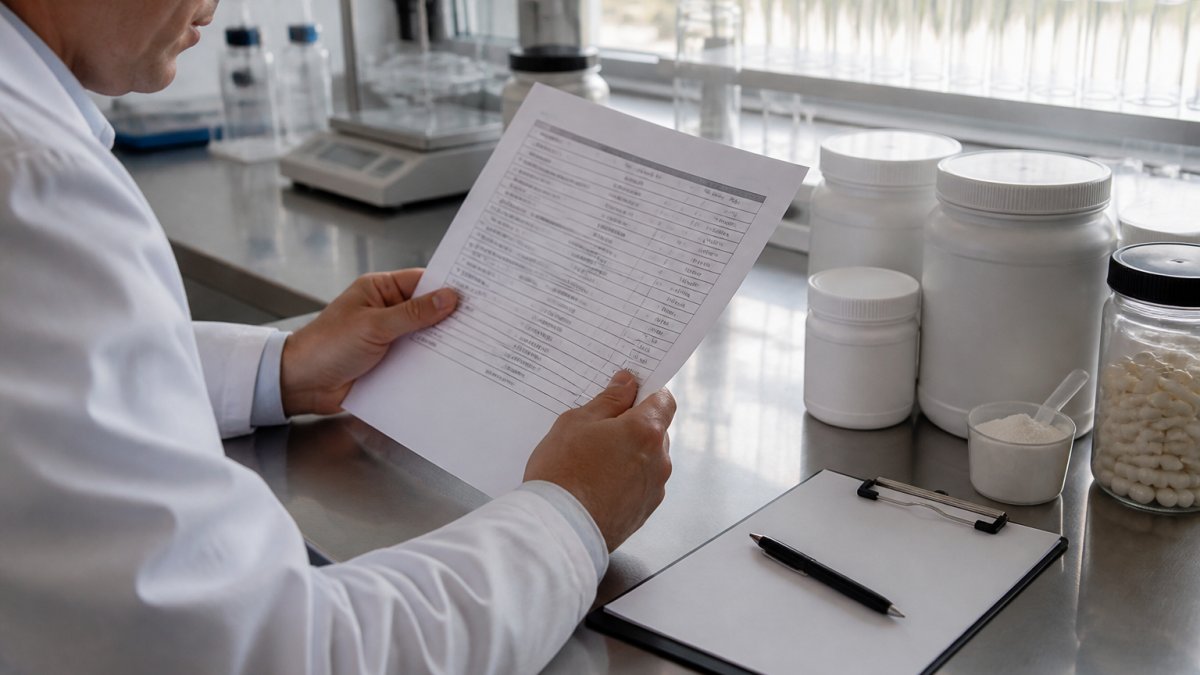
But here's what most guides miss: a COA only matters if it's batch-specific and from an independent lab. A generic COA covering "our product line" tells you nothing about the bottle in your hand.
MTS Creapure® Pure German Creatine Powder →
Purity, Potency, and Contamination Testing
Three things must show up on a real COA. Potency confirms the active ingredient matches the label claim. Purity checks for fillers and excipients you didn't pay for. Contamination testing screens for heavy metals, microbial growth, and prohibited substances.
Look for these panels:
- Heavy metals testing
- Microbial testing
- Potency and ingredient verification
- Residual solvents where relevant
If the COA skips heavy metals or microbials, it's incomplete. Ask for the full panel or find another manufacturer.
Testing Methods and Independent Laboratory Verification
A COA is only as strong as the method behind it. Different tests answer different questions, and a real COA names the method and the lab for each one:
- Identity testing confirms the ingredient is what the label says. Common methods include high-performance liquid chromatography (HPLC) and Fourier-transform infrared spectroscopy (FTIR).
- Potency testing measures how much active ingredient is present against the label claim, usually by HPLC.
- Microbiological testing screens for total aerobic count, yeast and mold, and pathogens such as E. coli and Salmonella.
- Heavy-metal testing screens for lead, arsenic, cadmium, and mercury, typically by inductively coupled plasma mass spectrometry (ICP-MS).
- Residual solvent testing checks for manufacturing solvents, usually by gas chromatography.
A valid COA should contain the product and lot number, the test methods used, the specification and the actual result, the pass/fail status, the testing lab's name and accreditation, and the date. If any of that is missing, the document is decoration.
Verify the lab, too. Ask whether it is accredited and whether the manufacturer uses a third party with no financial stake in the result. In-house testing is the manufacturer grading its own homework. A common pattern is a manufacturer that runs potency in-house but sends heavy metals and microbials out, that can be fine, as long as the outside lab is named and accredited.
Watch Out A COA that lists results but no methods, no lot number, or no lab name is not proof of anything. Request the full document or move on.
What to Do When a Batch Fails
Ask the manufacturer to walk you through a failed batch. You want a documented rejection and quarantine process, a CAPA report, and a clear answer on whether the failed lot ships. If the answer is vague, the quality system is vague. Believe the paperwork, not the sales pitch.
Why Third-Party Tested Supplements Beat In-House Claims
Third-party tested supplements are verified by an independent lab with no financial stake in passing the batch. In-house testing is the manufacturer grading its own homework.
This matters because supplement makers are generally exempt from running costly clinical trials when a product is classified as a dietary supplement, as noted in a 2025 review of supplement regulation. No trial requirement means testing discipline has to come from somewhere. Independent labs are that somewhere.
A common mistake is trusting a certification mark without checking who issued it. Harvard Health warns that many seals of approval are meaningless and recommends vetted independent third-party certification instead (Harvard Health on vetting supplements). The USP verification program, for example, involves actual testing and facility audits (USP Dietary Supplement Verification Program).
You can see Creapure® creatine in our MTS Creapure® Pure German Creatine Powder.

Red Flags and Commercial Risk When Vetting Manufacturers
Commercial risk is the part nobody talks about. A manufacturer can pass every quality check and still wreck your business with missed deadlines, vague contracts, or a sudden price hike.
Watch for these red flags:
- No facility audit allowed, ever
- COAs that aren't batch specific
- Vague answers on ingredient sourcing
- No written quality agreement
- Pricing that changes after you commit
Get your product specifications, delivery terms, and quality responsibilities in a signed contract. Handshake deals are how brands get burned.
Choosing Supplements You Can Trust at Tiger Fitness
Here's where we land. You don't have to audit every factory yourself if you buy from people who already did.
At Tiger Fitness, we carry products built on tested ingredients and transparent labels. Our Mutant Multi High Potency Multivitamin covers your micronutrient base, and Ghost® Size V3 gives you a strength focused formula from a brand that shows its work.
We also give you free tools to dial in your plan, like our fitness calculators.
Frequently Asked Questions
How do you evaluate a supplement manufacturer?
A supplement manufacturer checklist can cover facility standards, testing, records, and traceability. Consider what documentation is available for the product and batch, and review the information before making a decision.
What certifications should a supplement manufacturer have?
The article discusses Good Manufacturing Practices and third-party certification as topics to consider when evaluating a supplement manufacturer. Review the scope and documentation for any certification before drawing conclusions from it.
What are red flags when choosing a supplement manufacturer?
When evaluating a supplement manufacturer, consider the information available about ingredient sourcing, batch documentation, and testing. Review the details before deciding whether they meet your needs.
How can you tell whether a supplement manufacturer follows good manufacturing practices?
Good Manufacturing Practices are a topic to consider when evaluating a supplement manufacturer. Review available documentation and consult the relevant official sources for information about applicable requirements.
The supplement aisle is full of promises. The manufacturers behind those products are not all equal. Do the vetting, ask the hard questions, and demand the paperwork.
Get started with Tiger Fitness and put tested, quality-backed supplements to work on your goals.

Leave a comment