







Supplements for personal trainers and coaches: complete 2026 guide
Personal trainers' supplement planning is the use of targeted sports nutrition products to support your own training and help clients make informed choices; supplements for personal trainers belong behind food, sleep, and a sound workout program. Your job is different from a shopper's: you need to explain the purpose, recognize referral situations, and separate a useful supplement from an unnecessary stack.
TL;DR
- Supplements for personal trainers should address a defined need, not become a standard stack for every client.
- Creatine monohydrate is a practical option for healthy adults pursuing strength and repeated high-intensity performance.
- Whey protein helps close a dietary protein gap; it is unnecessary when food already meets the target.
- Personal trainers should refer medical questions and supplement interactions to qualified healthcare professionals.
Why supplements matter for personal trainers and coaches
Your best supplement recommendation starts with a reason not to buy. A client who already meets a protein target does not need a shake simply because training has started. Someone struggling to eat between appointments has a different problem from someone seeking better performance during heavy lifting.
Your own routine deserves the same scrutiny. Demonstrating exercises, coaching sessions, and completing your personal workout are separate demands; don't treat every hour on the gym floor as an intense training session requiring extra products.
Start with the principles in this guide to high-protein foods for muscle building. In 2026, your coaching standard should be a clear explanation of what a supplement adds, what it cannot do, and when a client needs another professional.
Build a supplement process you can explain
Use the same decision process for your own supplements and client education. Screen first, establish the nutrition baseline, select an option only when it fits, then check the label and document the response. A written process keeps enthusiasm from turning into a blanket recommendation.
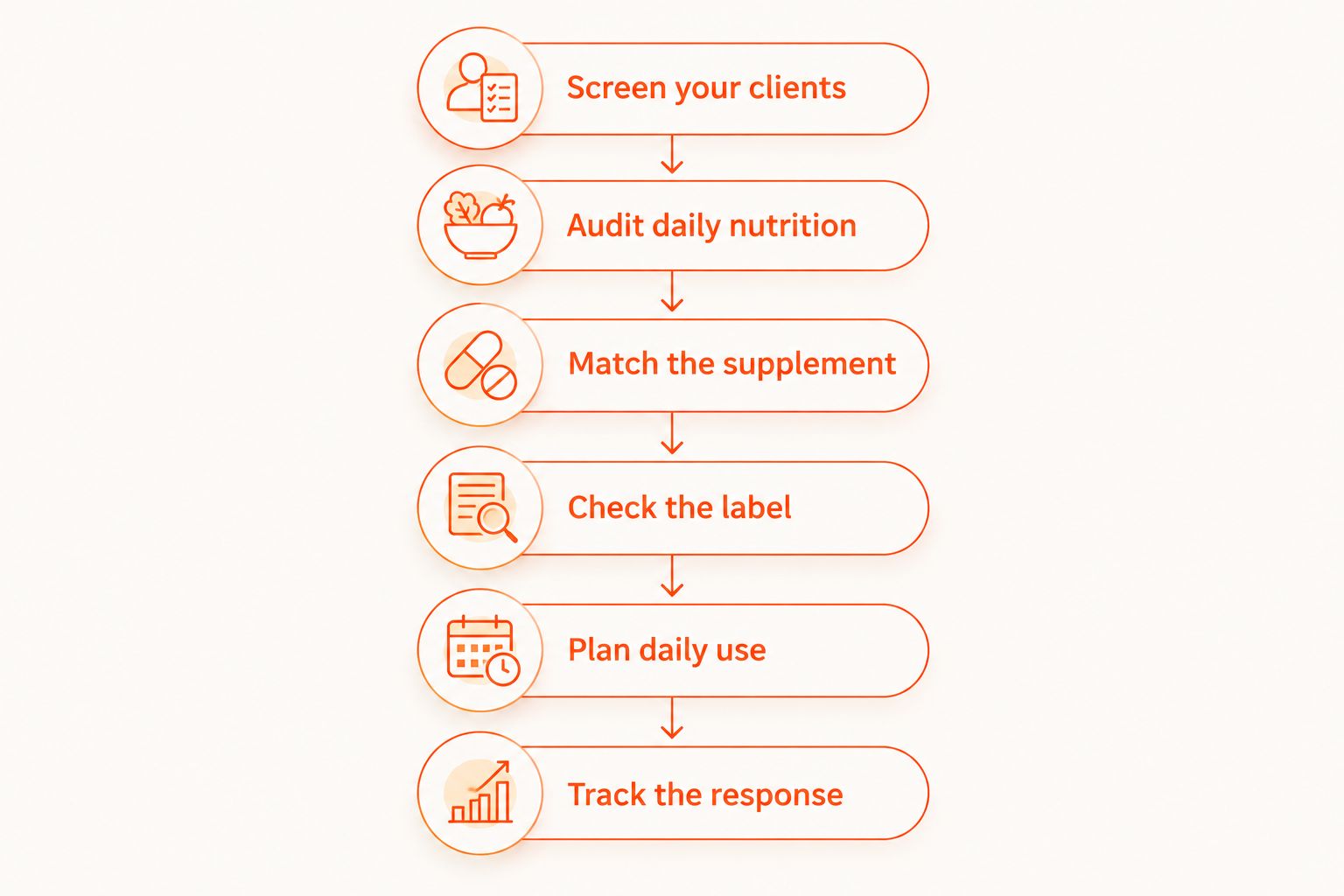
Screen your clients
Before discussing a product, ask what the client already takes and why. Include powders, capsules, energy drinks, and medications in that conversation. A client might not consider a pre-workout or herbal blend part of their supplement routine unless you ask directly.
Stay within your qualifications and local rules. General nutrition education is not the same as diagnosing a deficiency, treating symptoms, or prescribing a medical nutrition plan. Your personal experience with a product does not establish its suitability for another person.
Pregnancy, breastfeeding, kidney disease, medication use, and unexplained symptoms require qualified healthcare input before supplement selection. For minors, involve the parent or guardian and an appropriate clinician rather than adapting an adult stack.
For competitive athletes in 2026, check the governing body's current rules and the exact product's independent sport certification. Do not infer certification from a retailer, brand reputation, or another product in the same range.
- Record the client's training goal and current supplement list.
- Ask about allergies, medical conditions, and medications.
- Identify questions that require a clinician or registered dietitian.
- Check competition rules before discussing performance products.
- Explain that supplements are optional, not a condition of coaching.
Audit daily nutrition
Use a food diary before recommending protein powder, a mass gainer, or vitamins. A practical starting exercise is 3 days of logging, including a training day and a rest day. This is a coaching observation period, not a diagnostic test.
Look for missed meals, inconsistent protein intake, and reliance on caffeine when the client has not eaten adequately. Ask about preparation time and food preferences. A plan that ignores those constraints is difficult to follow, regardless of the supplement attached to it.
The International Society of Sports Nutrition's 2017 position stand on protein and exercise gives 1.4–2.0 g of protein per kg of body weight per day as sufficient for most exercising individuals building or maintaining muscle. That is general guidance for exercising people, not an automatic prescription for every client.
For a healthy 75 kg adult, that range calculates to 105–150 g of protein per day. Assess food intake first; protein powder fills the remaining gap rather than sitting on top of an already adequate diet.
- Log meals, drinks, and existing supplements together.
- Estimate protein from food before adding a shake.
- Note skipped meals around coaching or training sessions.
- Ask whether the client can prepare and store food.
- Refer individualized medical nutrition needs to a dietitian.
Match the supplement
Choose the category before choosing the brand. Protein powder addresses protein convenience. Creatine monohydrate supports repeated high-intensity exercise performance. A mass gainer adds concentrated nutrition when eating enough is the identified challenge; it is not the default route to muscle gain.
Tigerfitness is best for fitness enthusiasts shopping for sports nutrition supplements, not for medical supplement advice. You can review categories through Tigerfitness after identifying the need. The retailer offers protein powders, creatine, pre-workouts, vitamins, and mass gainers; the shopper still needs to assess the exact label and personal suitability.
For healthy adult strength trainees, creatine monohydrate has an established evidence base. The International Society of Sports Nutrition's 2017 position stand on creatine describes 3–5 g per day as a maintenance approach. Loading is not a prerequisite, and a coach should not turn that general guidance into advice for someone with a medical condition.
Whey is convenient but unsuitable for someone with a milk allergy. Pre-workout is optional; stimulant-containing products add caffeine exposure that must be assessed alongside coffee and energy drinks.
- Choose protein powder only when food leaves a protein gap.
- Consider creatine monohydrate for suitable adult strength goals.
- Reserve mass gainers for an identified intake challenge.
- Assess total caffeine before considering stimulant pre-workout.
- Avoid treating vitamins as a replacement for dietary assessment.
Check the label
Read the current Supplement Facts or Nutrition Facts panel, ingredient list, directions, and warnings. Product names do not establish ingredient amounts, allergen suitability, or testing status. A familiar name is not enough.
For your 2026 screening process, record the exact product and serving size rather than writing only “protein” or “pre-workout.” This makes overlapping ingredients easier to spot and gives a clinician useful information if a question arises.
Check protein per serving separately from scoop weight. For creatine, check the amount of creatine provided rather than assuming the total powder weight represents the active ingredient. For blends, inspect whether individual ingredient amounts are disclosed.
Tigerfitness's supplement catalog is a shopping resource, not evidence that every formula fits every client. The products shown below are category-matched options, not a claim that they outperform alternatives. Neither product's supplied description establishes sport certification, exact serving amounts, or allergen suitability.
- Read ingredients and allergen statements on the current package.
- Record the stated serving size and relevant ingredient amounts.
- Check for overlap with the client's existing products.
- Verify independent certification for the exact product when needed.
- Follow warnings and refer unresolved safety questions.
Protein and creatine options to assess

MTS Machine Whey Protein
A whey protein blend designed for athletes.
$49.99

Plan daily use
Make the routine workable before adding complexity. Start with meals, water, and a written schedule. Then place any selected supplement where it solves the actual problem: a protein shake between appointments, for example, rather than an obligatory shake after every demonstration.
For creatine monohydrate, daily consistency matters more than choosing an elaborate pre-workout or post-workout ritual. For protein powder, the daily protein total matters more than treating a shake as a reward for finishing training.
Introduce changes separately. If a client starts a new pre-workout, protein powder, and mass gainer together, you lose clarity about tolerance and adherence. Keep your own routine equally disciplined; professional familiarity does not remove the need to assess a label.
Avoid storing loose powders in unidentified containers. Keep the product name, directions, and batch information accessible. Your 2026 coaching notes should distinguish planned use from what the client actually reports taking.
- Anchor supplement use to an existing daily habit.
- Keep directions and product identification accessible.
- Introduce one change at a time.
- Record all caffeine sources rather than only pre-workout.
- Keep food and fluid planning in the routine.
Track the response
Write down what success means before starting. For protein powder, success is closing a documented protein gap with acceptable tolerance. For creatine monohydrate, use consistent training records rather than judging effectiveness from the sensation during a workout.
Track adherence alongside performance. A missed supplement routine, changed training program, and inconsistent meals make attribution difficult. Do not credit a product for every improvement or blame it for every stalled session.
Body weight alone is not a complete outcome measure. Creatine can increase water retention within muscle, so an increase on the scale does not automatically mean fat gain. Explain that distinction before a client starts tracking.
Review whether the original need still exists. If meal planning now meets the protein target, the shake becomes optional. If symptoms appear, stop the suspected product and seek appropriate healthcare advice rather than adding another supplement to compensate.
- Record the purpose and baseline before starting.
- Track actual use and tolerance at check-ins.
- Use consistent workout measures for performance goals.
- Review changes in meals, sleep, and training alongside results.
- Remove products that no longer serve a defined purpose.
Compare options for your clients
There is no universal “best stack” for personal trainers in 2026. Food first is the baseline; the best supplement is the one that addresses an assessed need without unnecessary complexity. These options serve different purposes, so they are not interchangeable.
| Option | Best for | Practical advantage | Key limitation |
|---|---|---|---|
| Food first | Clients whose needs can be met through meals | Supplies protein alongside other nutrients | Requires preparation and access to suitable food |
| Basic Supplements Basic Whey | Adults with a protein gap who can use whey | Provides a whey protein blend | Contains milk-derived protein; check the current label for suitability |
| Basic Supplements Creatine Monohydrate | Suitable healthy adults pursuing strength and high-intensity goals | Provides creatine monohydrate | Does not replace protein, calories, or training progression |
| Mass gainer | Adults struggling to meet an assessed intake goal | Adds concentrated nutrition conveniently | Adds intake without guaranteeing muscle gain |
| Stimulant pre-workout | Suitable adults seeking a caffeine-containing workout option | Offers a convenient pre-training format | Adds stimulant exposure and can interfere with sleep |
| Clinician-guided vitamin supplementation | Clients with a professionally identified need | Targets a specific nutritional issue | Requires assessment; more is not automatically better |
Tigerfitness's sports nutrition range gives you categories to compare, but selection still comes back to the client's goal, diet, health context, and current label. A wider stack is not a better coaching plan.
Common mistakes personal trainers and coaches make
Copying your own bodybuilding stack
Your training volume, diet, and tolerance do not establish a client's needs. A beginner learning basic lifts does not automatically need the routine you use for your own goals. Build from the client's assessment, not your gym bag.
Treating coaching hours as workout hours
Being active at work is not identical to completing repeated intense training sessions. Separate your coaching schedule from your own workout demands before using extra energy products or recovery supplements.
Using stimulants to cover an overloaded schedule
Back-to-back sessions do not justify repeated pre-workout servings. Review sleep, meals, scheduling, and total caffeine before suggesting another energy product. Persistent fatigue needs attention, not a stronger stack.
Turning a referral issue into a product recommendation
Do not guess at deficiencies or recommend a supplement to treat pain, digestive symptoms, or other medical complaints. Document the concern and refer it to a qualified professional. Products and claims are not intended to diagnose, treat, cure, or prevent any disease.
Making supplement purchases feel mandatory
Separate coaching from shopping. Explain the food alternative, disclose any financial relationship, and accept the client's decision not to buy. Your recommendation should remain useful without a purchase.
FAQ
What's the best starting point for supplements for personal trainers?
Start with food intake, training goals, and a safety screen rather than a standard stack. Protein powder addresses a protein gap; creatine monohydrate is an option for suitable healthy adults pursuing strength and high-intensity performance.
Do personal trainers need protein powder every day?
No, personal trainers do not need protein powder when food already meets their protein needs. A shake is a convenience option, not a requirement attached to the job.
Is creatine better than whey protein for clients?
Neither replaces the other because creatine and whey protein serve different purposes. Whey adds dietary protein, while creatine monohydrate supports repeated high-intensity exercise performance.
Can a personal trainer recommend supplements to clients?
A personal trainer should provide supplement education only within their qualifications and applicable local rules. Medical conditions, medication interactions, and treatment decisions require an appropriate healthcare professional.
Should every client take a pre-workout?
No, pre-workout is optional and should not be a default client recommendation. Assess caffeine exposure, sleep, health context, and the exact label before considering a stimulant-containing product.
What should a coach check before an athlete buys supplements?
Check the athlete's governing-body rules, the exact ingredients, and independent sport certification for the specific product. Certification reduces risk but does not guarantee that an athlete cannot fail a drug test.
Can Tigerfitness choose a medical supplement plan for my client?
Tigerfitness is an online fitness supplement retailer, not a substitute for individualized medical advice. Refer medical supplement decisions to a qualified clinician and individualized medical nutrition needs to a registered dietitian.
One last thing
Add a reason to stop beside every supplement you discuss. A protein powder's role ends when food reliably closes the gap; a product causing symptoms needs reassessment, not a second product added on top. That single habit keeps your recommendations accountable to the client's goals.
Related Guides
- How to build a client supplement protocol in Trainerize
- How to take creatine monohydrate for best results
- How to take pre-workout supplements safely
Leave a comment