
NEW NULLA BAR FLAVORS
In-Stock Now!

Quick Summary
Professional athletes choose certified supplements because contamination can put banned substances in products whose labels never mention them. Certification from an independent program like NSF Certified for Sport lowers that risk by screening products and verifying labels, though it does not eliminate it entirely.
Athletes keep buying supplements because they want an edge, and because the label looks like a promise. A 2025 study reported that 76.1% of professional athletes acknowledged that Dietary supplement use and knowledge among athletes, PubMed Central. Most of them knew the risk and took the product anyway. That tells you the problem is not ignorance. It is a gap between what athletes expect a bottle to do and what it actually guarantees.
Here is the straight answer: most athletes who take supplements are trying to recover faster, train harder, or hit a physique goal they cannot reach on food alone. The pressure to keep up with teammates and competitors makes a bad decision feel reasonable in the moment. A supplement with a catchy name and a clean-looking label is easy to justify.
The part most athletes miss is that a product can be legitimate on the shelf and still be the wrong product for you. Contamination and mislabeling mean the bottle can contain something its label never mentions. You are not just buying protein or creatine. You are buying whatever else made it into the tub.
Share of athletes and supplements linked to contamination or prohibited substances
Source: Dietary supplement use and knowledge among athletes, PubMed Central
Contamination happens when a product contains an ingredient that is not listed on the label. For a drug-tested athlete, that hidden ingredient can be a prohibited substance. The American Medical Association Journal of Ethics summarizes data indicating that 10% to 15% of supplements may contain prohibited substances. That range should change how you shop.
Contamination is not always deliberate fraud. It can come from shared manufacturing equipment, poor ingredient sourcing, or weak quality control. A plant that also makes a product containing a banned stimulant can leave residue that ends up in your protein. The label will not warn you about it.
If you are subject to anti-doping rules, you are responsible for what ends up in your body, whether or not you knew it was there.
Third-party testing means an independent organization checks a product against defined standards, usually including screening for banned substances and verifying that the label matches what is in the bottle. It is the closest thing athletes have to a safety net.
The U.S. Anti-Doping Agency, Reduce Your Dietary Supplement Risk states that using a product from a recommended certification program significantly reduces, but does not necessarily eliminate, the chance of a positive test. Read that twice. Certification lowers your risk, but it does not remove it. Even certified supplements carry some residual risk, so treat them as a managed choice rather than a guaranteed one.
Here is how the process generally works:
Ongoing batch testing matters most. A product certified two years ago is not the same as the batch on your shelf today. Check that the certification covers the specific product and that your batch is included.
Two certification programs dominate the athlete conversation, and they are not the same product. If you are going to trust a seal, you need to know what is behind it. Here is the straight comparison.
NSF Certified for Sport. The NSF Certified for Sport program screens products for more than 280 substances banned by major athletic organizations, verifies that the label matches what is in the bottle, and reviews the manufacturing facility. NSF publishes a searchable database of certified products, and certification is maintained through ongoing testing and facility audits. NSF frames its own recommendation conditionally: athletes who choose to use supplements despite the risks can reduce that risk by choosing Certified for Sport products. That is the honest framing, reduced risk, not zero risk.
Informed Sport. Informed Sport is another certification program athletes can check. A seal you do not recognize cannot help you, so confirm what any seal actually covers before relying on it. Our guide on why NSF third-party testing matters explains exactly what that testing checks.
| Certification | What It Checks | Testing Scope | Main Limitation |
|---|---|---|---|
| NSF Certified for Sport | Banned-substance screening (280+ substances), label accuracy, facility review | Ongoing product and facility testing | Reduces risk; does not remove it |
| Informed Sport | Banned-substance screening on finished batches | Batch-by-batch testing | Less recognized among athletes |
| No certification | Nothing verified | None | Label is the only claim |
Here is what the table does not tell you. Neither seal guarantees your batch is clean. Certification programs screen against defined banned-substance lists, and no program tests for every possible contaminant. A seal means the product passed a defined screen at a defined point in time. It does not mean the tub in your hand is risk-free.
Watch out: a manufacturer can hold certification on one product and not another. The seal on the website does not automatically apply to the flavor or size you are buying. Confirm the exact product, not the brand.
The practical takeaway is simple. Know what each seal covers, know whether your governing body accepts it, and confirm the certification applies to the specific product and batch you are holding. A seal only helps you if you can verify it.
Start with the database, not the packaging. A logo on a tub can be printed by anyone. The certifying body's searchable product list is what counts.
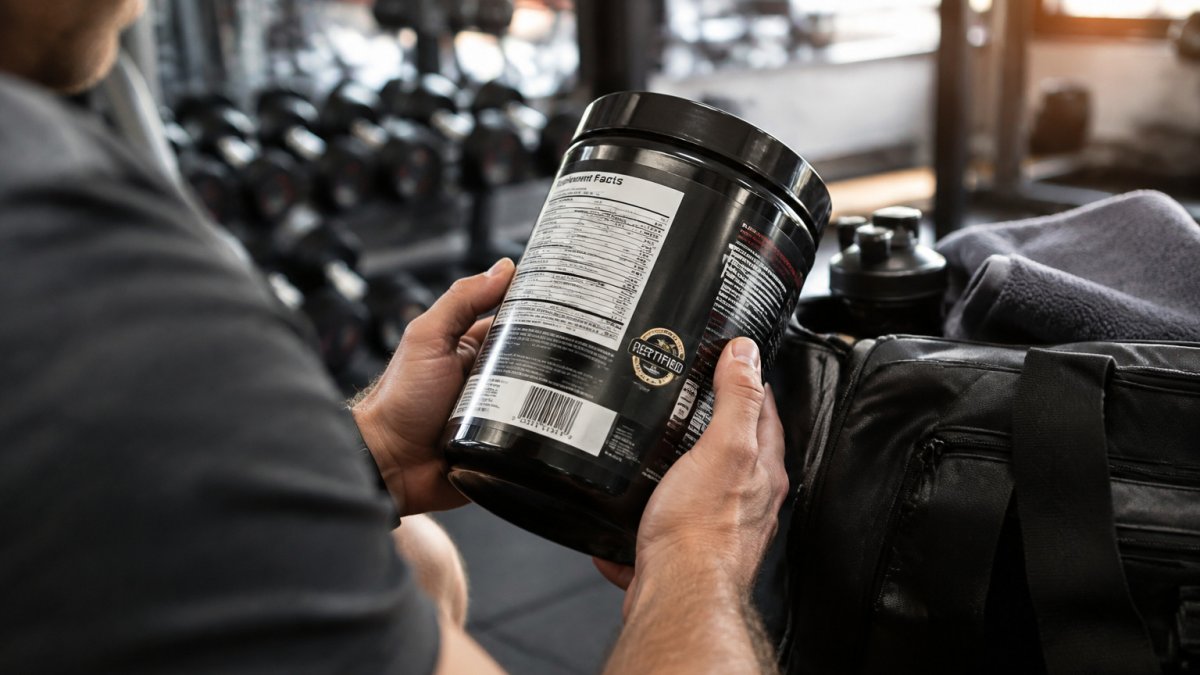
Work through these checks:
If a company claims certification but cannot show you a listing, treat that as a red flag. Before you start running numbers on dosing or body composition, use the FREE TOOLS & FITNESS CALCULATORS to track your targets so you know what you actually need from a product.
Certification is a risk-reduction tool, not a guarantee. Even certified products carry residual risk, and a positive test can still happen. The athletes who get burned are usually the ones who treated a seal as a permanent pass. Plan for the fact that it is not. Our breakdown of ways to verify ingredient purity covers the checks that go beyond the seal.
Here is where residual risk actually comes from:
So what do you actually do about it? Build a paper trail and a watch routine.
Watch out: a product that was certified when you bought it can lose certification later. If a batch fails or a concern is raised, the listing can change. Re-verify before you restock, not after.
Accept the trade-off. Every supplement carries some risk. The responsible choice is the one you can verify, document, and monitor, not the one you assume is safe because it had a logo on it.
Start with what you already use. Check each product against its certifier's database, cut anything you cannot verify, and keep a written list of the products that pass. Browse the sports supplements category at Tiger Fitness to compare products as you build your shortlist, then confirm each certification against the certifier's own listing before you buy.
No. Certification reduces the chance of a positive test but does not eliminate it. Certification screens a product's contents against banned-substance lists and checks that the label matches what is in the tub. It does not prove the product will improve performance, and it does not make a supplement risk-free. Athletes still carry responsibility for every product they put in their body, so treat certification as a risk reducer and keep checking the seal on every batch you buy.
NSF Certified for Sport is the program designed to screen products against substances prohibited in sport. Check the product on the NSF website to confirm what its certification covers. For a drug-tested athlete, the Sport seal is the one that matters, because a general NSF mark does not screen for the banned-substance list your sport enforces. Check the product on the NSF website to confirm which program covers it.
Start with the seal on the label, then verify it. Look up the product by brand and product name in the certifying program's public database, such as NSF's Certified for Sport listing or Informed Sport's product search. Confirm the exact product, flavor and formulation match what you are buying, because certification applies to specific products, not entire brands. If a product is not listed, it is not certified, regardless of what the packaging claims.
Contamination or undisclosed ingredients can put prohibited substances into a product that does not list them on the label. A positive test is the athlete's responsibility under anti-doping rules, which is why athletes choose products with independent testing.
{"one"=>"Select 2 or 3 items to compare", "other"=>"{{ count }} of 3 items selected"}







Leave a comment