





About this workout
This is a two day full body dumbbell plan for the person whose schedule is genuinely full. Not the person who says they are busy and then watches four hours of TV. The person who has two windows a week and that is the honest number. Two sessions, both full body, both built around movements that cover a lot of ground per exercise. It runs eight weeks and it will build muscle if you are new, and hold onto what you have if you are not. It is not the fastest plan I have ever written. It is the one you are most likely to still be running in six months.
Who This Program Is For
- Beginners who can realistically train twice a week and want a plan that treats that as enough, because it is.
- Anyone with a pair of adjustable dumbbells at home and 45 to 60 minutes, twice a week, to give it.
- Lifters coming back after a long layoff who want to rebuild a base without wrecking themselves in week one.
- Experienced lifters in a busy season of life who need to maintain muscle rather than chase new gains right now.
- Men and women both. The program does not change. The loads do.
Who this is NOT for: If you are an intermediate or advanced lifter chasing a new personal best on a barbell lift, two dumbbell days a week will not get you there and I am not going to pretend otherwise. And if you actually have four or five days available, use them, because more quality frequency does build more muscle.
What You'll Need
- A pair of adjustable dumbbells, or a rack with enough range that you can go light on lateral raises and heavy on squats and rows.
- A bench that inclines, or a sturdy step or ottoman you trust with your bodyweight plus load.
- A watch or a phone timer. Rest periods matter here because you are doing a lot in one session.
The Program
Two sessions a week, Full Body A and Full Body B, with at least two days between them. Monday and Thursday works. Saturday and Tuesday works. Pick two slots you can defend and put them on the calendar like a meeting you cannot move. Every muscle gets hit twice a week, which is the whole reason both days are full body instead of an upper and a lower. If you split it, everything gets trained once a week, and once a week is where progress goes to die. Because you only have two sessions, each one runs six or seven exercises and every one of them earns its spot by covering ground. Squats, hinges, presses, rows, carries. There is very little isolation work in here and that is deliberate.
| Day 1 | |||
|---|---|---|---|
| Full Body A | |||
| Exercise | Sets | Reps | Rest |
| Goblet Squat | 4 | 8-10 | 90 sec |
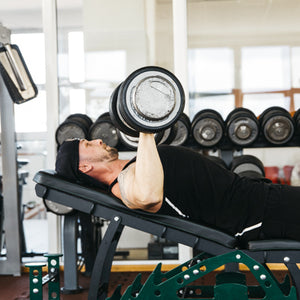
| Dumbbell Bench Press | 4 | 8-10 | 90 sec |
| One Arm Dumbbell Row | 3 | 10-12 per side | 75 sec |
| Dumbbell Romanian Deadlift | 3 | 10-12 at RPE 8 | 90 sec |
| Standing Dumbbell Shoulder Press | 3 | 8-10 | 75 sec |
| Hammer Curls | 2 | 10-12 | 60 sec |
| Plank | 3 | 30-45 sec hold | 45 sec |
| Day 2 | |||
|---|---|---|---|
| Full Body B | |||
| Exercise | Sets | Reps | Rest |
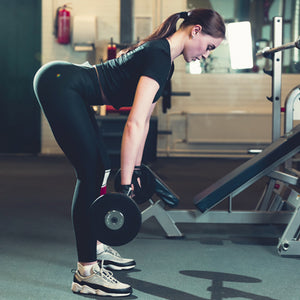
| Dumbbell Deadlift | 4 | 8-10 | 90 sec |
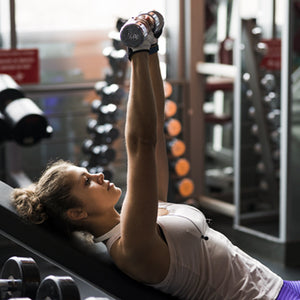
| Incline Dumbbell Bench Press | 4 | 8-10 | 90 sec |
| Dumbbell Reverse Lunge | 3 | 10-12 per leg | 90 sec |
| Bent Over Dumbbell Row | 4 | 10-12 | 75 sec |
| Dumbbell Lateral Raise | 3 | 12-15 at RPE 9 | 60 sec |
| Lying Dumbbell Tricep Extension | 2 | 10-12 | 60 sec |
| Dumbbell Farmers Walk | 3 | 40 yards | 75 sec |
How to Progress
Two days a week means every session counts, so the progression is slower on purpose and you follow it exactly.
Weeks 1 and 2. Learn the movements and find your weights. Stop every set with two or three reps left in the tank. You should finish both sessions thinking you could have done more. That is correct. Write down every weight and every rep you hit, because the whole plan is built on that logbook.
Weeks 3 and 4. Now push. Add weight anywhere you hit the top of the rep range for all your sets last time. If you got 10, 10, 10, 10 on the goblet squat, go up. Take the last set of each big movement to one rep shy of failure. The small stuff, curls and lateral raises and triceps, can go all the way to failure. It is not going to hurt you.
Weeks 5 and 6. Add one set to the two heaviest movements in each session. Day 1 goblet squat and bench go to five sets. Day 2 deadlift and incline press go to five sets. Keep the same reps. This is where the honest limitation of dumbbell training starts to show up on the lower body, because your legs will outgrow what your hands can hold long before your legs are done growing. The fix is not heavier dumbbells you do not own. The fix is slowing the eccentric down to three seconds on the squat and getting deeper in the range.
Weeks 7 and 8. Hold the sets where they are and push the reps. Take every top set to true failure on the last set only. If you have run out of dumbbell on the lower body work, swap the goblet squat load for a slow three second lowering and a one second pause at the bottom, and swap straight reverse lunges for a full pause in the bottom position. Same weight, more tension, more stimulus. At the end of week 8, take a full week easy or just repeat the eight weeks with your new numbers as the starting point.
Warm-Up and Recovery Notes
Five to eight minutes, every session, no skipping it. Two or three minutes of easy cardio to raise your body temperature, then a set of Worlds Greatest Stretch per side, then a Deep Squat Hold for 30 seconds. Then do a light set of the first exercise of the day at maybe half your working weight for 10 reps, and one more at about 75 percent for five. That is it. You do not need 20 minutes of foam rolling. You need to be warm and you need your first working set to not be a surprise.
Recovery is easy on this plan because you are only training twice a week, which is one of the underrated advantages of a two day schedule. Your muscles get five or six days a week to repair and you will almost never show up beat up. Sleep seven to nine hours. On your off days, walk. Aim for 8,000 to 10,000 steps and treat that as part of the program, because two lifting sessions a week is not much movement on its own and general activity is what actually manages your body composition between workouts.
Nutrition and Supplementation
Two days a week in the gym means your diet is doing an even larger share of the work than usual, so pay attention to it. Get somewhere around 0.8 to 1 gram of protein per pound of goal bodyweight every day, all seven days, not just training days. If you want to build muscle, eat slightly above maintenance, maybe 200 to 300 calories over, and expect it to be gradual. If you want to lose fat, sit 300 to 500 calories under maintenance and keep the protein high so the muscle you are building stays. You cannot out-train two sessions a week worth of bad eating, and honestly you cannot out-train six sessions a week of it either.
Food comes first, but hitting a protein target is a lot easier when a protein powder covers one of your meals, and a daily multivitamin is cheap insurance for the gaps in an ordinary diet. That is all you need to start.
FAQ
Can you really build muscle on only two days a week? Yes, if you are a beginner or coming back from time off. The research on training frequency is pretty clear that total weekly volume taken close to failure is what drives growth, and you can fit enough of that into two full body sessions. Will you grow as fast as someone training four days? No. But the person who trains twice a week for a year beats the person who runs a six day split for three weeks and quits, every single time.
What if I get a third day free? Take it. Run Full Body A, Full Body B, then A again the next week, alternating. Do not add a third day of arms and abs. Add another full body session, because more sets on the movements that matter is what actually changes anything.
My dumbbells are not heavy enough for squats and deadlifts. What now? This is the real ceiling of dumbbell training and it hits the lower body first. Go unilateral. A Bulgarian Split Squat with the same dumbbells is dramatically harder than a two leg squat with them. Slow the lowering phase to three seconds. Pause at the bottom. Push the reps to 20 and take the set genuinely close to failure. Any of those will keep the stimulus climbing after the load stops.


Questions and results
Ask a coach
Running this program? Tell us what week you are on and how the progression is going. A coach answers every question here.